Mexico
Puebla
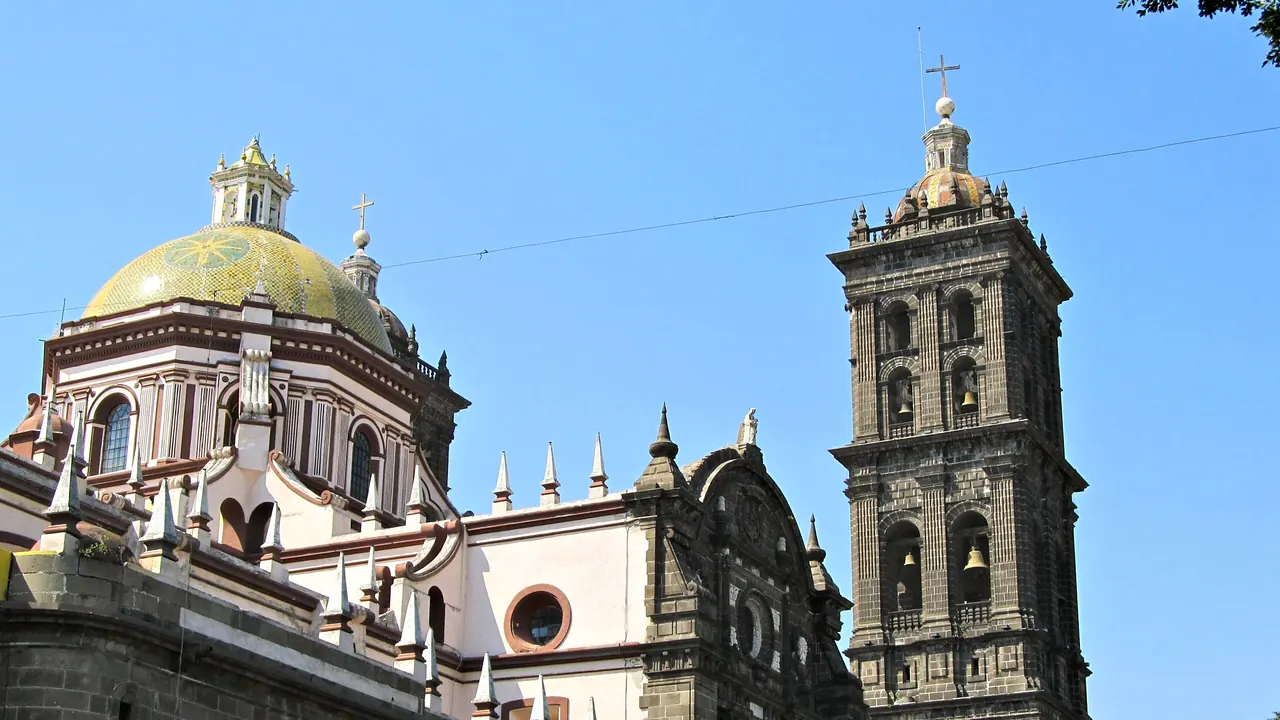
The cathedral dome and bell tower
- Affordable cities82
- Food & drink79
- Day trips76
Photo: Octavio Alonso Maya …, CC BY-SA 3.0, cropped
Match
52
Every category weighted equally
- Beach & sun48
- Culture & arts57
- Food & nightlife54
- Family trip53
- Outdoors56
- Relax & unwind49
- Shopping & style54
- On a budget56
Puebla in twelve categories
Our verdict on each, scored 0 to 100 against the same fixed benchmark cities, so a score means the same thing on every page.
Beaches & swimming. Scores 5 out of 100.
Food & drink. Scores 79 out of 100.
Culture & sights. Scores 73 out of 100.
Nightlife. Scores 42 out of 100.
Nature & outdoors. Scores 58 out of 100.
Day trips. Scores 76 out of 100.
Good for families. Scores 52 out of 100.
Getting around. Scores 45 out of 100.
Shopping & style. Scores 50 out of 100.
Affordability. Scores 82 out of 100.
Live music & performing arts. Scores 36 out of 100.
Wellness & relaxation. Scores 30 out of 100.
Puebla category by category
Beaches & swimming
5Puebla sits on a high plateau more than 2,000m above sea level, and the nearest coast, on the Gulf of Mexico around Veracruz, is several hours away by road. There is no beach life here. Swimming means a hotel pool or one of the public balnearios with spring-fed pools on the edge of the city and in the surrounding valleys.
Food & drink
79Puebla is one of the places Mexican cooking comes from. Mole poblano, dark with chillies, chocolate and spices, started in its convent kitchens, and chiles en nogada, stuffed poblano peppers under walnut sauce and pomegranate seeds, fill menus in late summer when the fruit is in season. Daily eating is just as particular: cemitas, sesame rolls stacked with milanesa, avocado and papalo herb, small fried chalupas in red and green salsa, and tacos árabes brought by Lebanese immigrants.
The Calle de los Dulces is lined with shops selling camotes and convent sweets, and the market halls and fondas around the centre serve cheap set lunches. Mezcal and pulque are easy to find. International food and fine dining are thinner than the local cooking.
Culture & sights
73The historic centre is a UNESCO-listed grid of colonial streets, with house fronts in red brick and blue-and-white Talavera tile and dozens of churches within a few blocks. The cathedral rises over the zócalo with some of the tallest towers in Mexico. In the Church of Santo Domingo, the Capilla del Rosario is covered almost entirely in gilded stucco, one of the high points of Mexican Baroque. The Biblioteca Palafoxiana, from the seventeenth century, is often called the oldest public library in the Americas.
The Museo Amparo has a fine pre-Hispanic and colonial collection, the white Museo Internacional del Barroco stands out in the modern west of the city, and the hilltop forts of Loreto and Guadalupe mark the battle of 5 May 1862. This is a city for two or three slow days.
Nightlife
42Evenings in the centre are mostly mezcal bars, cantinas and rooftop terraces with cathedral views, busiest around the Callejón de los Sapos and the streets off the zócalo. The large student population pushes the real going-out scene towards neighbouring Cholula, where a strip of bars and small clubs near the university fills up on Thursday to Saturday nights. Club life in the city itself centres on the modern Angelópolis district. It is a sociable, unpretentious scene that is fine for a night or two.
Nature & outdoors
58On clear mornings, especially in the dry winter months, Popocatépetl and Iztaccíhuatl fill the western skyline with snow on their summits. La Malinche, a dormant volcano a little over an hour away, is the classic hike, a long climb through pine forest to a summit above 4,400m. The Izta-Popo national park offers high-altitude trails on the flanks of Iztaccíhuatl. The city itself has only modest parks, the rainy season brings afternoon storms from roughly June to September, and nearly every outing needs a car, a tour or an early bus.
Day trips
76Cholula is barely half an hour away. Its Great Pyramid is the largest by volume in the world, a grassy hill with tunnels inside and a yellow church on top, and nearby Tonantzintla and Acatepec have village churches covered in folk-Baroque plasterwork and tilework. Huejotzingo has a sixteenth-century Franciscan convent, part of the UNESCO-listed group of monasteries on the slopes of Popocatépetl.
About an hour away, the small colonial capital of Tlaxcala combines well with the painted Maya-style murals at Cacaxtla. Atlixco is a flower-growing town under the volcano. Mexico City is about two hours by bus, which makes a long but realistic day.
Good for families
52The big draw for children is Africam Safari, a large drive-through wildlife park about half an hour outside the city, where animals roam around the cars. In town there is a giant observation wheel at Angelópolis, the hilltop forts and their open grounds, the tunnels inside Cholula's pyramid, and plenty of sweet shops and street snacks. The flat colonial centre is easy to walk, but narrow pavements, traffic and altitude can tire small children, and most other sights are churches and museums aimed at adults.
Getting around
45The historic centre is a flat, regular grid, and almost every sight lies within twenty minutes on foot of the zócalo. Street numbering is logical once you know it runs out from the centre. Beyond that it gets harder. There is no metro, the bus rapid transit lines cover only a few corridors and local buses are hard for visitors to read, so most people use taxis or ride-hailing apps to reach Angelópolis, Cholula or Africam. Day trips usually mean a long-distance bus, a tour or a hired car.
Shopping & style
50Talavera, the tin-glazed blue-and-white pottery that decorates half the city, is the thing to buy, from long-established workshops where you can watch it being painted to stalls selling plates and tiles. The El Parián craft market sells onyx, textiles and souvenirs. On weekends the Callejón de los Sapos fills with antiques and bric-a-brac stalls, and the Calle de los Dulces is good for boxed sweets. For fashion and international brands, shoppers head to the large malls of Angelópolis rather than the old town.
Affordability
82Puebla is a cheap city to visit, even by Mexican standards. Street food and market lunches cost very little, taxis and ride-hailing across the city are inexpensive, and many museums charge modest entry fees or are free on some days. Comfortable hotels in restored colonial houses near the zócalo cost much less than equivalent rooms in the capital. Only the most polished boutique hotels and smart restaurants approach international prices.
Live music & performing arts
36The Teatro Principal, among the oldest theatres in the Americas, still stages plays and concerts, and the university's large cultural complex hosts touring productions, dance and orchestral evenings. The springtime festivities around the 5 de Mayo anniversary bring concerts and folk dance into the streets. Day to day, live music mostly means trios and mariachis in the restaurants and on the squares, plus a few small bars with bands or son jarocho. Visitors find something to attend, but performance is not a main reason to come.
Wellness & relaxation
30There is no real bathing tradition in the city, but there are a few things to try. Pre-Hispanic temazcal sweat lodges are offered by small spas around Puebla and Cholula, and the sulphurous spring water at the long-running Agua Azul balneario fills public pools. Thermal springs further out in the state take most of a day. Otherwise wellness means hotel spas and the slow rhythm of the old town: shaded courtyards, quiet plazas in the morning and long lunches. Traffic outside the centre spoils some of the calm.
When should you go?
Pick a month to see what it is like. The climate figures are measured averages, not a forecast.
Puebla in July
Daytime high, °C
Rainfall in the month, mm
The whole year
Shaded against this city’s own year: the deepest cell is its best month for that figure and the palest its weakest.
Temperature and rainfall are climate normals, averaged over the years shown. Puebla: 1991-2020 normals, Puebla, Pue. (5.4 km from centre).
Before you go
| Measure | Puebla |
|---|---|
| Official language | Spanish, Nahuatl, Yucatec Maya |
| Currency | Mexican Peso (MXN) |
| Sockets | AB127 V, 60 Hz |
| Driving side | Right |
| Time zone | UTC-6 |
| Emergency number | 911 |
| Elevation | 2,153 m |
| Main airport | Hermanos Serdán International Airport (PBC)20 km from centre14 non-stop destinations |
| Public holidays this year | 9 days |
By the numbers
| Measure | Puebla |
|---|---|
| City population | 1,542,232 |
| People per km² | 2,825 |
| Museums within 10 km | 17 |
| UNESCO World Heritage sites within 50 km | 2 |
Compare Puebla with
Every comparison with a written verdict behind it.
- Acapulco
- Akumal
- Bacalar
- Guadalajara
- Guanajuato
- Huatulco
- Mazatlan
- Merida
- Mexico City
- Nuevo Vallarta
- Oaxaca
- Playa del Carmen
- Puerto Escondido
- Puerto Vallarta
- San Miguel de Allende
- Sayulita
- Tulum
- Valladolid, Mexico
- Zihuatanejo