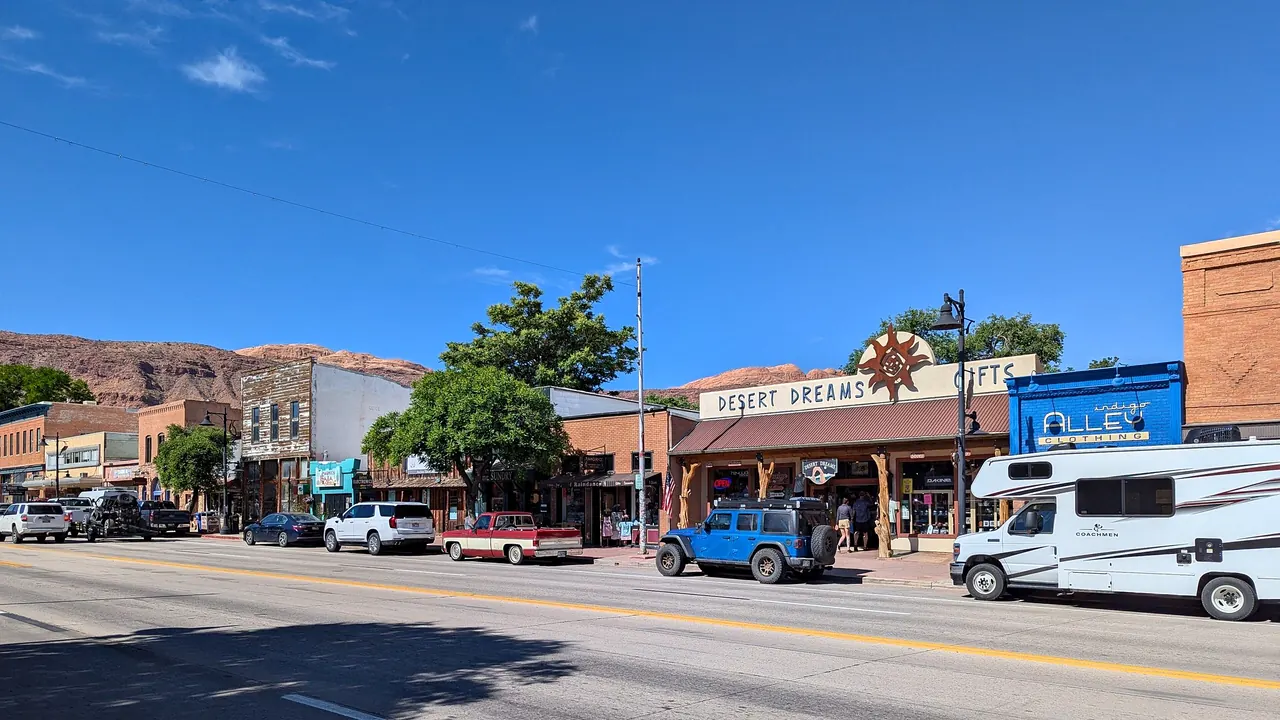
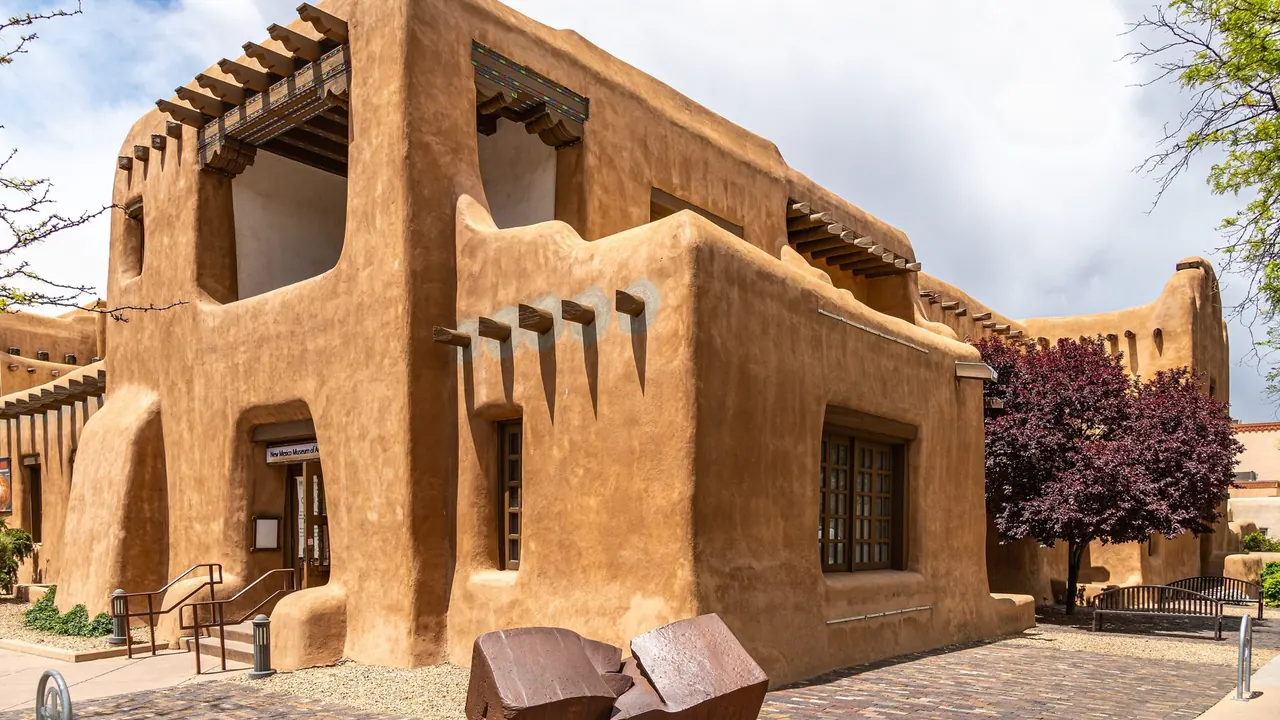
Photos: Moab by G. Edward Johnson, CC BY 4.0, cropped; Santa Fe by dconvertini, CC BY-SA 2.0, cropped.
Moab or Santa Fe?
Our verdict in twelve categories, each scored against the same fixed benchmark cities, and the climate month by month, so you can choose for your trip.
Choose Moab for
- nature and the outdoors
- beaches
- prices
Moab is for travellers who want to spend the whole trip in the landscape. Arches begins at the edge of town, and Canyonlands and Dead Horse Point are close by. The days go on hiking, mountain biking on slickrock, rafting the Colorado and driving jeep trails, and the nights end early under a very dark sky. If you want museums, memorable meals or anything to do after dinner, the town has little to give.
Choose Santa Fe for
- culture and sights
- day trips
- shopping
Santa Fe gives you the high desert with a real town attached. It is an old Spanish colonial capital with adobe streets, museums worth the visit, its own chile cooking, a large gallery quarter, summer opera and plenty of places to soak and unwind. The hiking and skiing in the mountains nearby are very good, if not as extraordinary as the red rock around Moab. In return, pueblos, old villages and cliff dwellings lie within a day's drive.
Scoreboard
Twelve categories on one fixed scale from 0 to 100. The shaded stretch is the gap between the two.
Your match
Pick a travel style or drag the sliders, and both match scores follow your weighting.
Wins on nature and the outdoors and beaches with your weighting.
Wins on culture and sights and day trips with your weighting.
What matters to you?
Category by category
What the scores mean for a trip.
Beaches & swimming
Neither town has anything like a beach, since both sit in high desert far from the sea. The difference is in where you cool off in summer. In Moab that means Mill Creek's shallow pools, Ken's Lake or a careful dip off a sandbar in a fast, cold Colorado River.
From Santa Fe the nearest real swim is Abiquiu Lake, an hour's drive north, or a float on the Rio Grande. In both places the motel or hotel pool is where most of the swimming happens.
Food & drink
Moab feeds hungry hikers and bikers well enough: big plates of burgers, tacos and pizza on Main Street, early coffee and a couple of breweries, with dusty boots welcome everywhere. There is no local cooking to seek out, though, and Utah's alcohol rules make a drink with dinner more of a formality.
Santa Fe is where you eat well. Its New Mexican cooking is a cuisine of its own, with red and green chile, blue corn, posole and carne adovada served in old adobe dining rooms near the Plaza. There is also more fine dining than a town this size usually has, and the Railyard farmers' market is worth a morning. Beyond its own cuisine the choice is narrow.
Culture & sights
Moab's culture is mostly outside town and very old: Ancestral Puebloan and Fremont rock art on the cliffs along Potash Road and Kane Creek, and dinosaur trackways. The town itself has a small museum and a few buildings from the uranium boom, enough for a morning.
Santa Fe is a different kind of place. Around its 17th-century Plaza stand the Palace of the Governors, the cathedral and the Loretto Chapel with its spiral staircase. Museum Hill holds the vast folk art collection and museums of Native American art, and the O'Keeffe Museum is downtown. Everything is modest in scale, but there is easily enough for several days.
Nightlife
Both towns go to bed early, but Santa Fe offers more of an evening. In Moab a night out means a brewpub full of mountain bikers and rafters, and by eleven the main event is the star-filled sky. In Santa Fe a long dinner can lead to a mezcal on a rooftop as the sun sets behind the Jemez Mountains, or a beer at a brewery near the Railyard. Anyone wanting clubs from either town ends up driving to a bigger city.
Nature & outdoors
Both are superb outdoor bases, but Moab's landscape is in another league. Arches, the Island in the Sky in Canyonlands and Dead Horse Point give you red-rock arches and canyon mazes within an hour. The Slickrock Trail and the Whole Enchilada descent make Moab a byword for mountain biking.
Santa Fe's outdoors is greener and higher. Trails climb from the edge of town through piñon foothills to aspen forest in the Sangre de Cristo Mountains and on into the Pecos Wilderness. There is also skiing in winter, which Moab does not offer, plus the Valles Caldera and the red cliffs of Abiquiu further out.
Day trips
From Moab a day out nearly always means more landscape. The towns within reach are small, Bluff and Green River among them, and the best cultural outing is a long drive south to the Edge of the Cedars ruins in Blanding or the stone towers at Hovenweep.
Santa Fe has far more to choose from. The High Road to Taos runs through Chimayo and Truchas to Taos Pueblo, which has been lived in for about a thousand years. Bandelier's cliff dwellings, Los Alamos, the Pecos mission and the old mining villages of the Turquoise Trail all make easy days out, and the Rail Runner train reaches Albuquerque without a car.
Good for families
Both towns work best for school-age children who like being active rather than for toddlers. Moab is the place for kids who love scrambling on rocks: short walks to Sand Dune Arch, dinosaur tracks, calm raft floats and Junior Ranger badges. On the other hand, summer heat and long unfenced drops call for close watching.
Santa Fe leans more towards learning. It has a children's museum, the toys and miniatures in the folk art collection, the ladders at Bandelier and ski lessons in winter. Galleries and long dinners test small children's patience, though, and the altitude of 2,100m can tire them for the first day or two.
Getting around
Both towns have small centres you can walk, and in both a car is close to essential once you leave them. Moab is the stricter case. Apart from a paved bike path to the Arches entrance there is no useful public transport, so without your own vehicle you depend on outfitters' shuttles and tours, and many trailheads are reached by dirt track.
In Santa Fe the Plaza, Canyon Road and the Railyard are within about twenty minutes of each other on foot. Local buses run, though not often, and the Rail Runner train covers the trip to Albuquerque.
Shopping & style
Moab's Main Street is for what you need in the desert: bike and climbing gear, sun hats, rock shops full of geodes and fossils, and a few galleries selling Navajo jewellery.
Santa Fe is a serious art market. Native American artists sell silver, turquoise and pottery directly to buyers under the portal of the Palace of the Governors. Canyon Road and the Railyard are packed with galleries, and in summer the Indian Market, the Spanish Market and the International Folk Art Market bring in collectors from far away. Neither town is a place for fashion shopping.
Affordability
Both are expensive for small towns. Hotels charge resort rates for what they offer, and a hire car adds to the bill in either place. What differs is where you can save. Around Moab, public campgrounds and free dispersed camping make a cheap trip possible, one national park pass covers a week, and winter costs far less. The money goes on guided rafting, jeep and canyoneering trips.
In Santa Fe you can save by staying out along Cerrillos Road and enjoying free gallery browsing. Rates are highest during the summer markets, the opera season and around Christmas.
Live music & performing arts
Moab has one standout: the Moab Music Festival at the end of summer, when chamber concerts are held in remote canyon grottoes reached by boat. For the rest of the year it is a weekend band in a brewpub.
Santa Fe has a real season. The Santa Fe Opera performs in its open-sided theatre on a hill as the sun goes down, known for rarely staged works as well as the classics. Summer also brings a chamber music festival and flamenco, and the historic Lensic theatre and church choirs keep some programme going through the winter.
Wellness & relaxation
In Moab, rest is what you fit in between the hiking and biking, not the reason for the trip. The days start early and run long in the heat. A massage is mainly a way to loosen up after the Slickrock Trail, and there is nowhere to soak. The restful part costs nothing: an evening outside once the rock has cooled, with the town quiet and the stars coming out.
Santa Fe can be a trip built around unwinding. Up the road towards the ski area, outdoor tubs among the pines are run on the model of a Japanese mountain onsen. About an hour north, the mineral pools at Ojo Caliente have drawn bathers since the nineteenth century. In town there are more spas, yoga studios and massage therapists than a place this size usually has, and the slow pace of adobe courtyards and early evenings helps too. The soaking itself means a short trip out of the centre.
When should you go?
Pick your month. The climate figures are measured averages, not a forecast.
Moab in July
Santa Fe in July
Daytime high, °C
Rainfall in the month, mm
Where the figures come from
Moab's temperatures are measured 27 km from the centre, at Moab / Crescent Junction.
Moab's station stands 162 m above the city centre, so the centre is likely a little warmer than the figures say.
Moab has no rain gauge within 25 km of the centre, so its rainfall comes from a gridded climate dataset read at the city rather than from a gauge further away.
Santa Fe's station stands 199 m below the city centre, so the centre is likely a little cooler than the figures say.
Santa Fe has no rain gauge within 25 km of the centre, so its rainfall comes from a gridded climate dataset read at the city rather than from a gauge further away.
Temperature and rainfall are climate normals, averaged over the years shown. Moab: 2006-2020 (rainfall 1991-2020) normals, Moab / Crescent Junction (27 km from centre). Santa Fe: 1991-2020 normals, Santa Fe / Cieneguilla (12.4 km from centre).
Moab has the harsher swings. Its best seasons are spring and autumn. From April to May and again from September to October, highs of roughly 20 to 29°C suit long hikes and rides. July reaches about 35°C, which makes walking in the middle of the day risky, and January highs of 2°C leave the trails cold and empty. Rain is light all through the year.
Santa Fe is a little cooler at the height of summer and milder in winter, so walking the town and the foothills is comfortable from late spring well into autumn. Its catch is the summer rain. July and August are the wettest months, with around 60mm each, so outings are best started early in the day. Moab stays dry through those same months but is too hot for most of them.
Which traveller are you?
On an outdoors trip, Moab is the stronger base. Arches is minutes from town and Canyonlands under an hour away, and the Slickrock Trail, rafting on the Colorado and canyoneering can fill every day. Santa Fe's mountain trails are good, but not on this scale.
For a culture and arts trip, choose Santa Fe. The adobe Plaza, the Palace of the Governors, Museum Hill, the O'Keeffe Museum and the galleries of Canyon Road fill two or three days, and summer adds opera. Moab offers rock art and a small museum.
On a relaxing and wellness trip, Santa Fe again comes out ahead. It has soaking tubs among the pines, the old mineral springs at Ojo Caliente and slow evenings that end early. In Moab the days start before dawn, and rest mostly means watching the dark sky.
Before you go
| Measure | Moab | Santa Fe |
|---|---|---|
| Currency | US Dollar (USD) | US Dollar (USD) |
| Sockets | AB120 V, 60 Hz | AB120 V, 60 Hz |
| Driving side | Right | Right |
| Time zone | UTC-7, UTC-6 in summer | UTC-7, UTC-6 in summer |
| Emergency number | 911 | 911 |
| Elevation | 1,227 m | 2,134 m |
| Main airport | Canyonlands Regional Airport (CNY)27 km from centre2 non-stop destinations | Santa Fe Municipal Airport (SAF)12 km from centre5 non-stop destinations |
| Public holidays this year | 12 days | 13 days |
By the numbers
| Measure | Moab | Santa Fe |
|---|---|---|
| City population | 5,366 | 87,505 |
| People per km² | 501 | 645 |
| Museums within 10 km | 1 | 10 |
| UNESCO World Heritage sites within 50 km | 0 | 0 |
Where else could you go?
Every comparison below shares a destination with this one, so you can follow Moab or Santa Fe somewhere new.