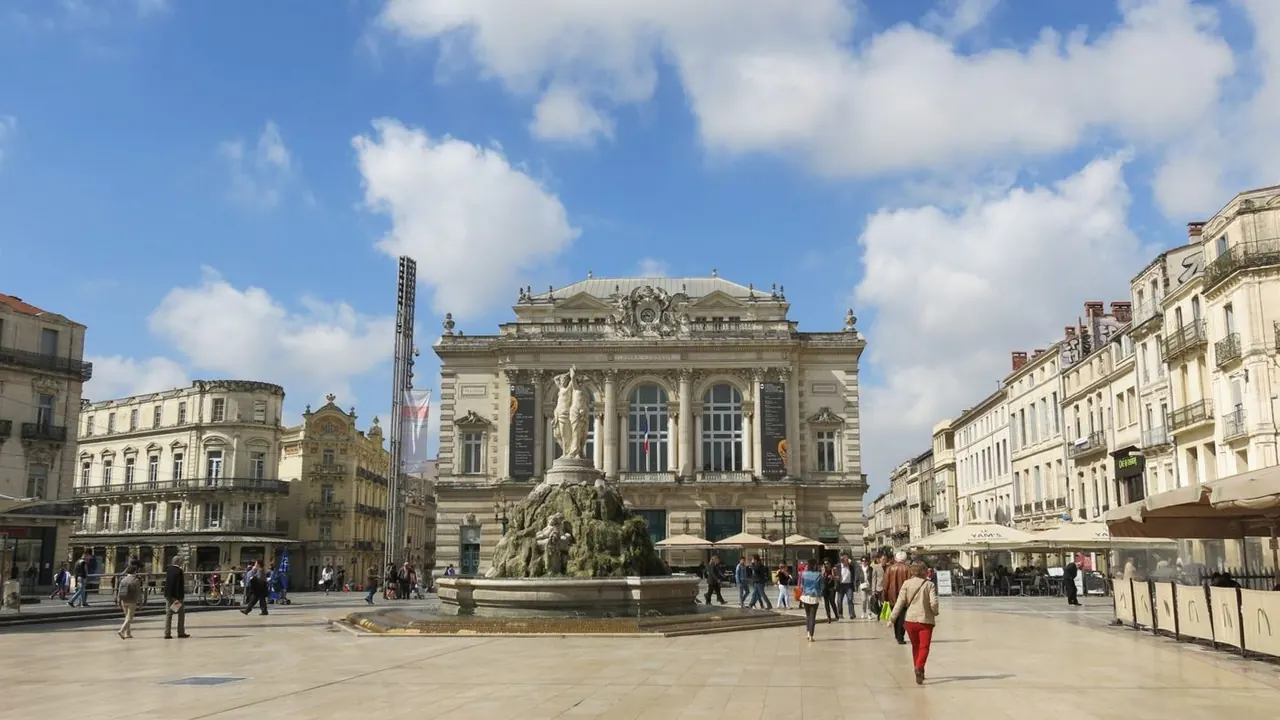
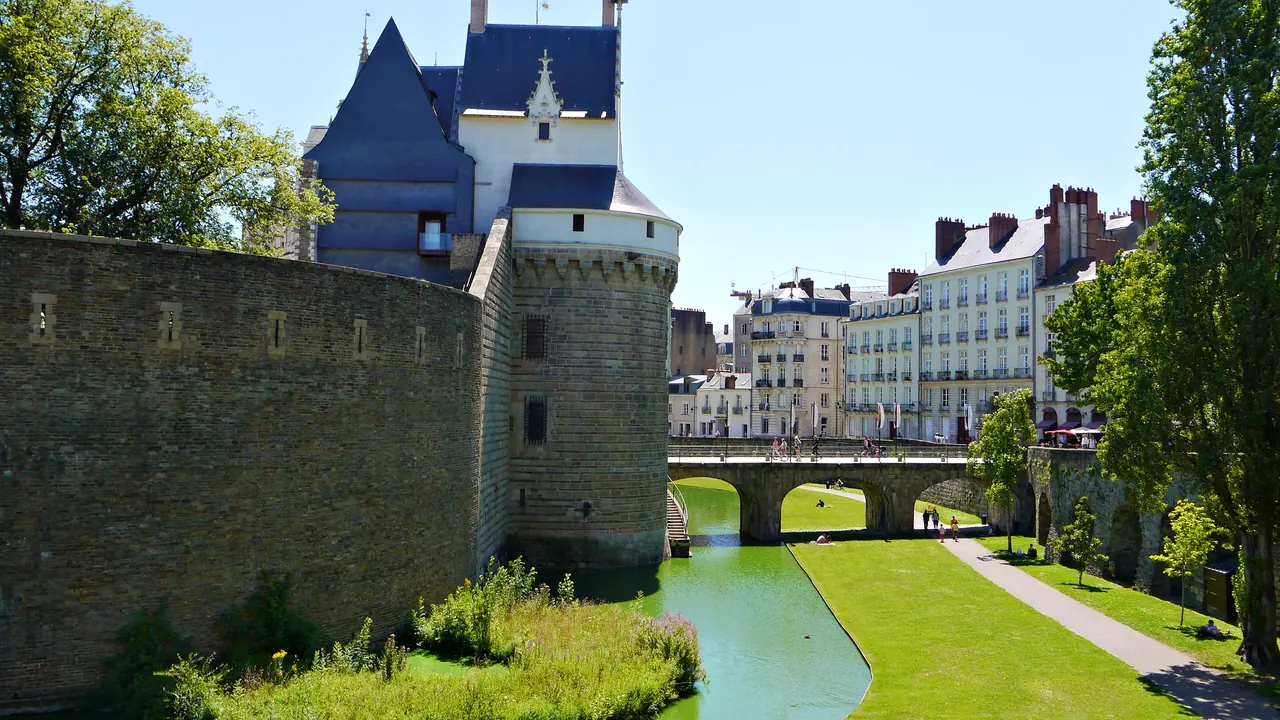
Photos: Montpellier by Peter, CC BY 2.0, cropped; Nantes by Carole44, CC BY-SA 3.0, cropped.
Montpellier or Nantes?
Our verdict in twelve categories, each scored against the same fixed benchmark cities, and the climate month by month, so you can choose for your trip.
Choose Montpellier for
- beaches
- nature and the outdoors
- day trips
Choose Montpellier for a sunny trip that spills well beyond the city. Sandy Mediterranean beaches are a tram and bus ride away, and the hills, gorges and flamingo lagoons are right on its doorstep. Nîmes, Arles and Avignon make some of the best day trips in France. Add a lively student night scene and a strong summer season of dance and music, and it rewards travellers who want something to do every day.
Choose Nantes for
- families
- getting around
- shopping
Nantes suits a gentler stay built around the Loire, its history and days out with children. The ducal château and the walking elephant of the Machines de l'Ile are the highlights, and Guérande, Angers and the Atlantic coast make easy outings. The centre is flat and pleasant on foot, and its milder summers keep midday sightseeing comfortable when the south is baking in the heat.
Scoreboard
Twelve categories on one fixed scale from 0 to 100. The shaded stretch is the gap between the two.
Your match
Pick a travel style or drag the sliders, and both match scores follow your weighting.
Wins on beaches and nature and the outdoors with your weighting.
Wins on families and getting around with your weighting.
What matters to you?
Category by category
What the scores mean for a trip.
Beaches & swimming
Montpellier is much better for swimming. Palavas-les-Flots and Carnon are about 11km away, and from there a long run of fine sand stretches east to the wild dunes of l'Espiguette. The Mediterranean water is shallow and warm enough in late summer for long, easy swims.
From Nantes, the nearest good sand is around 50km away, at La Baule's sheltered bay or the coves of Pornic, about an hour by train. The Atlantic is cooler and the season shorter, so here the coast is an occasional outing rather than a regular part of the trip.
Food & drink
Both cities eat well without being food destinations. The difference is the region on the plate. Montpellier cooks Languedoc food, with Pic Saint-Loup reds, oysters from the Thau lagoon and spicy octopus tielle from Sète, and its markets under the Arceaux aqueduct and at the Halles feel southern and sunny.
Nantes is butter and white wine country. Beurre blanc was born here and comes with pike-perch, alongside buckwheat galettes and crisp Muscadet from vineyards just outside the city. Montpellier has more cheap student places, while Nantes has a slightly more settled bistro scene around Graslin and the Ile de Nantes.
Culture & sights
These two are evenly matched, and each takes two or three days to see, but they offer different things. Montpellier is better for art and architecture: the Musée Fabre's European painting, the car-free lanes and courtyards of the Écusson, the formal Peyrou terrace and Bofill's neoclassical Antigone.
Nantes tells a stronger historical story. The moated château of the Dukes of Brittany holds a city museum that deals openly with the Atlantic slave trade, and the Abolition memorial, the merchant houses of the Ile Feydeau and the Jules Verne museum fill out a past tied to the river and the sea.
Nightlife
Montpellier's evenings are the busier of the two. The terraces around Place Jean-Jaurès and the squares of the Écusson fill on weeknights as well as weekends, and the crowd is young and loud. The drawback is that the clubs are out towards Lattes and the coast, so a late night usually ends with a taxi.
Nantes is calmer overall but more compact after midnight. You can walk from the pubs of the Bouffay to the riverside bars and clubs in the old warehouses of the Ile de Nantes, and the Graslin quarter has quieter wine and cocktail bars.
Nature & outdoors
Montpellier has far more variety close by. To the south there are lagoons full of flamingos, and the Camargue is about an hour away. To the north, the garrigue climbs through vineyards to the ridge of Pic Saint-Loup and on to the Hérault gorges and the Cirque de Navacelles, which gives you proper walks, climbs and canoeing.
Nantes is flat and watery. Its pleasures are slower: a boat or canoe on the Erdre, the Loire à Vélo cycle path, punting in the reed beds of the Brière and cliff walks on the Côte Sauvage. It suits gentle cycling better than hiking.
Day trips
Both are good bases, but Montpellier has a remarkable list of places nearby. Nîmes and its Roman arena are half an hour by train, the Pont du Gard is just beyond, and Arles, Avignon and Carcassonne are all reachable by rail. Sète, Aigues-Mortes and Saint-Guilhem-le-Désert are closer still.
From Nantes the trips are quieter but still rewarding. Guérande sits above its salt marshes, Angers has the Apocalypse Tapestry, and the Loire châteaux around Saumur are within two hours. Vannes on the Gulf of Morbihan is a good train day out.
Good for families
Montpellier's trump card for children is the sea. The beaches near Palavas and Carnon shelve gently into calm, warm water that suits small swimmers. In town, the Lunaret zoo sits in a large wooded park, and the aquarium and planetarium at Odysseum fill an afternoon that is too hot for the stone streets.
Nantes gives children more to do away from the shore and on cooler days. The Jardin des Plantes has playgrounds and oversized, playful benches, older children who know the books will enjoy the Jules Verne museum, and the flat centre is easy with a buggy. The sand at La Baule and Pornic is just as calm, but the water is noticeably cooler.
Getting around
Both are tram cities with walkable centres, and both get around equally well. Nantes has the gentler centre: it is flat, the main districts are within about half an hour's walk, and river shuttles cross the Loire. Montpellier's Écusson sits on a low hill with slopes and uneven paving.
For the coast, Nantes has direct regional trains, while Montpellier's tram-and-bus route to the beach is short but slow in summer. Montpellier's fast trains to Nîmes and Avignon serve its day trips well.
Shopping & style
Nantes has the one shopping place worth visiting for its own sake: the Passage Pommeraye, a 19th-century arcade that climbs over three levels. Independent designers and second-hand shops in the streets around Decré and Bouffay add some character. Montpellier's boutiques, bookshops and delicatessens fill the old stone lanes of the Écusson, with the Polygone mall right beside the Comédie for the big brands.
What you take home shows the difference in region. From Montpellier it is Languedoc wine, olive oil and honey from the covered markets. From Nantes it is salted-butter biscuits, berlingot sweets, Guérande salt and a bottle of Muscadet. Neither city has much in the way of luxury shopping.
Affordability
The two cost about the same, typical of a French regional city. Montpellier's large student population keeps more cheap counters and modestly priced bars open, which helps on a tight budget.
Nantes makes up for that with hotels that are easy to find and a centre you can mostly walk. In both cities, restaurant dinners are the main cost, and coastal rooms get noticeably dearer in high summer.
Live music & performing arts
Montpellier has the deeper programme, especially in summer. Two opera houses, the Comédie and the Opéra Berlioz, share a season with the national orchestra. The Montpellier Danse festival is among Europe's most respected, and the Radio France festival brings many free concerts.
Nantes is livelier in winter. La Folle Journée packs hundreds of short classical concerts into a few days, and the Lieu Unique in the old biscuit factory stages contemporary work. The city's giant street puppetry gives it a taste for spectacle in public spaces.
Wellness & relaxation
Neither city has a bathing culture, but Montpellier has more to offer. Real thermal water is about half an hour away at Balaruc-les-Bains on the Thau lagoon, and long lunches in shaded squares set an unhurried pace.
Nantes relies on the seawater cures of La Baule and Pornic, about an hour away. In town, rest means a slow afternoon in the Jardin des Plantes or along the Erdre.
When should you go?
Pick your month. The climate figures are measured averages, not a forecast.
Montpellier in July
Nantes in July
Daytime high, °C
Rainfall in the month, mm
Temperature and rainfall are climate normals, averaged over the years shown. Montpellier: 1991-2020 normals, Montpellier (7.8 km from centre). Nantes: 1991-2020 normals, Nantes (6.6 km from centre).
Montpellier has a proper Mediterranean summer. June to August is dry and very sunny, with highs around 30°C in July, and the sea warms to about 22°C in August, so these are the beach months. Midsummer afternoons are hot for walking the stone streets, so May, June and early September are the most comfortable for sightseeing. The autumn rain starts in September, at about 88mm, and stays heavy through November. Winters are mild, though much less sunny than the summers.
Nantes is cooler and greener all year. Summer highs reach about 25°C, which is pleasant for walking but cool for the beach, and the Atlantic only warms to around 19°C. It gets far less sunshine than Montpellier in every month. Rain falls all year and is heaviest from October to January, when short, dull days make it the weaker season. Late spring to early autumn is the time to go, and its summer is the easier of the two for long days on foot.
Which traveller are you?
On a beach and sun trip, Montpellier is the clear choice. Long sandy beaches with gently shelving, warmer Mediterranean water are a short ride away, and the summers are much sunnier. From Nantes the Atlantic beaches are a day out by train.
For an outdoors trip, Montpellier wins again. You can climb Pic Saint-Loup, canoe the Hérault gorges near Saint-Guilhem, watch flamingos on the lagoons and kitesurf on the windy coast. Nantes offers flat river cycling and marshland, but no hills at all.
On a family trip with children, Nantes has the edge. The giant mechanical elephant and the sea-creature carousel at the Machines de l'Ile are unlike anything in Montpellier, and the safari park and the Puy du Fou make easy days out.
Before you go
| Measure | Montpellier | Nantes |
|---|---|---|
| Official language | French | French |
| Currency | Euro (EUR) | Euro (EUR) |
| Sockets | CE230 V, 50 Hz | CE230 V, 50 Hz |
| Driving side | Right | Right |
| Time zone | UTC+1, UTC+2 in summer | UTC+1, UTC+2 in summer |
| Emergency number | 112 | 112 |
| Elevation | 7 m | 2 m |
| Main airport | Montpellier-Méditerranée Airport (MPL)8 km from centre41 non-stop destinations | Nantes Atlantique Airport (NTE)8 km from centre97 non-stop destinations |
| Public holidays this year | 11 days | 11 days |
By the numbers
| Measure | Montpellier | Nantes |
|---|---|---|
| City population | 310,240 | 327,734 |
| People per km² | 5,452 | 5,027 |
| Museums within 10 km | 14 | 11 |
| UNESCO World Heritage sites within 50 km | 2 | 0 |
| Swim season, months above 21 °C | 2 months | None |
Where else could you go?
Every comparison below shares a destination with this one, so you can follow Montpellier or Nantes somewhere new.
- Avignonvs Montpellier
- Marseillevs Montpellier
- Toulousevs Montpellier
- Saint-Tropezvs Montpellier
- Lyonvs Montpellier
- Cannesvs Montpellier