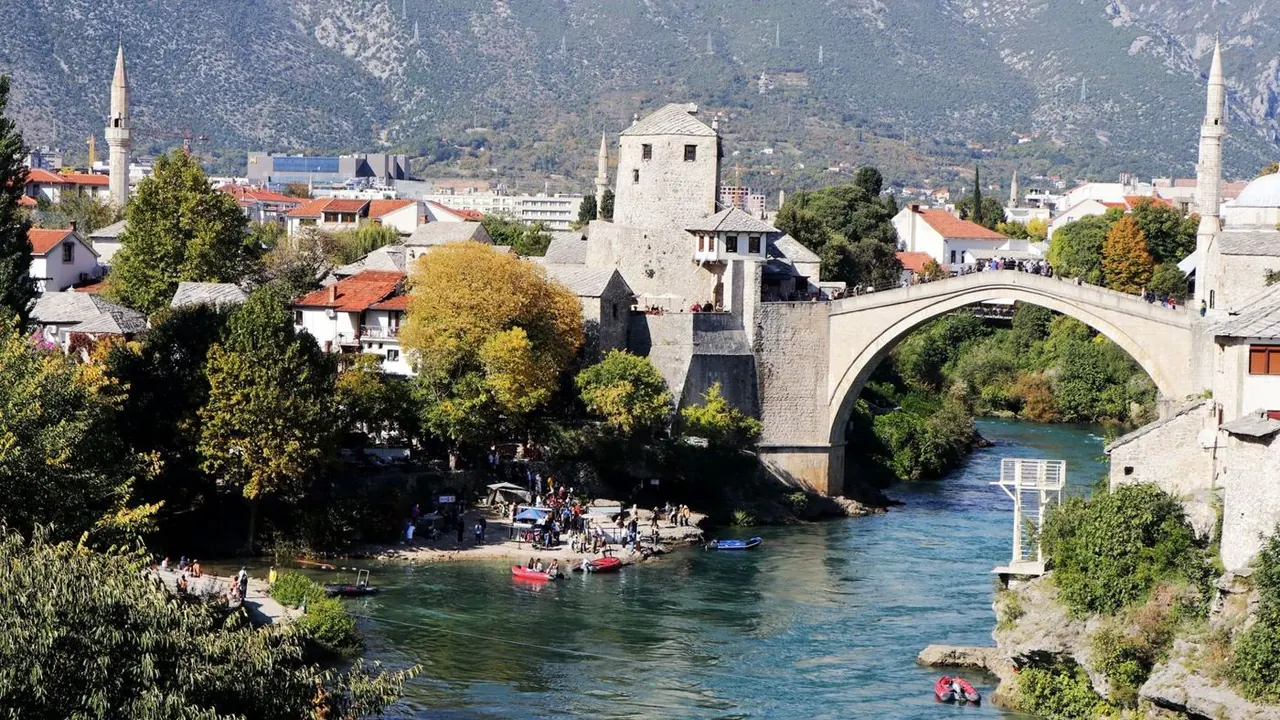
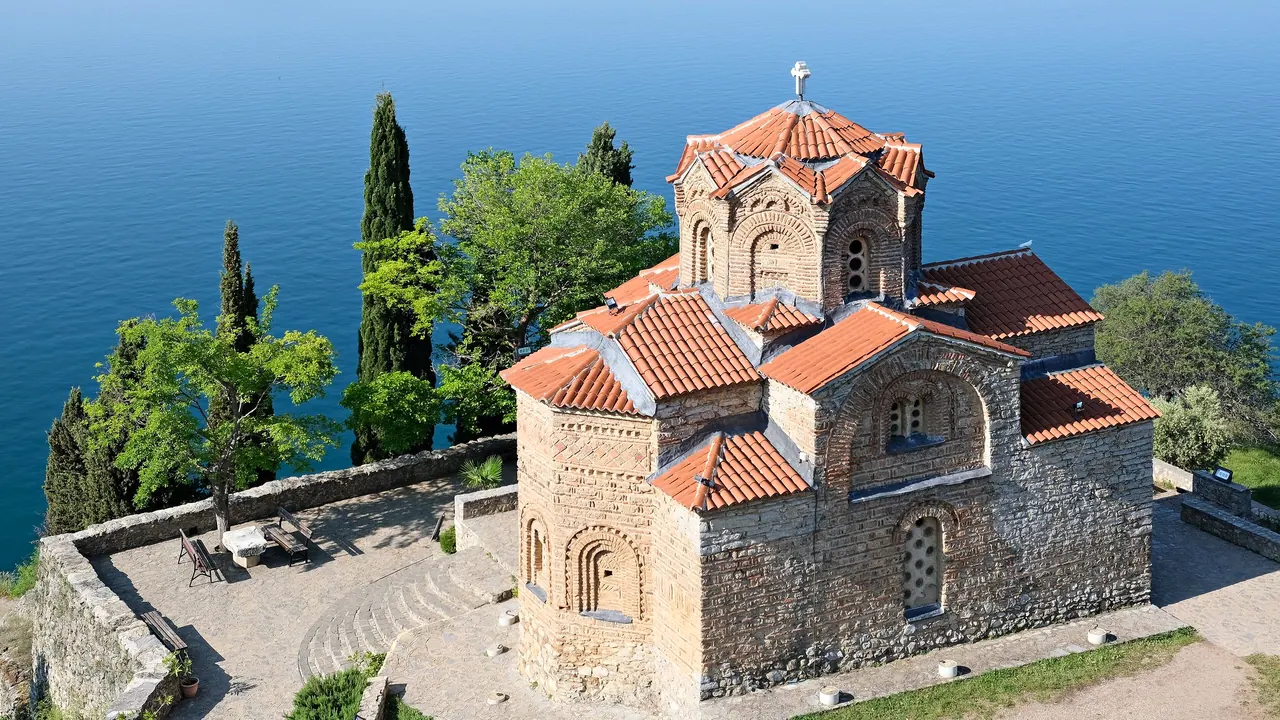
Photos: Mostar by Alan Wang, Pexels License; Ohrid by kallerna, CC BY-SA 4.0, cropped.
Mostar or Ohrid?
Our verdict in twelve categories, each scored against the same fixed benchmark cities, and the climate month by month, so you can choose for your trip.
Choose Mostar for
- day trips
- food and drink
Mostar suits travellers who want a short, history-heavy stop with plenty to explore around it. The Old Bridge, the Ottoman bazaar and the scars along the old front line tell a story that Ohrid cannot, and the Herzegovina valleys around the city hold walled villages, river springs and canyons for rafting. It works best as one or two nights on a wider Balkan route, ideally with a car, and in spring or autumn rather than at the height of summer.
Choose Ohrid for
- beaches
- getting around
- culture and sights
Ohrid is the better choice for a longer, slower stay built around water. Its clear lake gives you summer swimming within walking distance of town, its churches and frescoes make a richer cultural stay than Mostar's single great monument, and families settle in more easily. Summer adds a festival programme and livelier evenings on the promenade, while late spring and early autumn are quiet and restful.
Scoreboard
Twelve categories on one fixed scale from 0 to 100. The shaded stretch is the gap between the two.
Your match
Pick a travel style or drag the sliders, and both match scores follow your weighting.
Wins on day trips and food and drink with your weighting.
Wins on beaches and getting around with your weighting.
What matters to you?
Category by category
What the scores mean for a trip.
Beaches & swimming
Ohrid is the place to swim. In summer the lake becomes the town's living room. There are small coves below Kaneo and the beach at Potpeš within walking distance, and beach bars on longer stretches of shore at Lagadin and Gradište. The water is calm, clear and fresh, though the season only runs from late June to mid-September.
Mostar has nothing comparable. The Neretva is too cold for more than a quick jump from the rocks, so swimming means a trip to the pool beneath the Kravica falls. For salt water you have to drive over an hour to Neum.
Food & drink
The two eat at much the same level, homely and cheap, with little beyond the local kitchen. In Mostar that kitchen leans Ottoman: charcoal-grilled ćevapi in somun, flaky pies, and Bosnian coffee served slowly with rahat lokum. The local Žilavka and Blatina wines are worth asking for.
Ohrid's speciality is lake fish such as belvica, served alongside baked beans in clay pots, sheep's cheese and ajvar, with Tikveš wine. In both towns the best meals are found a few streets away from the main tourist strip.
Culture & sights
Ohrid offers more to see. On one hillside you get the medieval frescoes of St Sophia, the church of St John at Kaneo above the water, Plaošnik with its links to Cyrillic learning, a Hellenistic theatre and Samuel's Fortress, all within a UNESCO listing that includes the lake.
Mostar's sights centre on one famous monument and the story around it. The rebuilt Old Bridge, the bridge divers, the Koski Mehmed Pasha minaret and the Ottoman house museums sit near the war-damaged buildings of the former front line. These make a powerful day, but a narrower one.
Nightlife
Ohrid has the livelier evenings, though only in summer. Then visitors from across the region fill the lakefront café-bars, and beach clubs on the southern shore play music late into the night. Out of season it goes quiet.
Mostar's evenings mostly mean dinner on a terrace looking at the lit bridge. After that you have a few cocktail bars and student clubs at weekends.
Nature & outdoors
Both are set in fine scenery, but the landscapes are very different. Mostar lies in a dry karst basin under Velež and the rugged Prenj range. Its outdoor life follows the river, with rafting in the canyons, the Buna spring at Blagaj and birdlife on the Hutovo Blato wetland. Summer in the valley is too hot for serious walking.
Ohrid's landscape is lake and mountain. Galičica National Park rises between two lakes and offers trails to summits above 2,000m, and paragliders launch from the ridge. On the water there are easy kayaks and a rowing-boat trip through the reeds at the springs by St Naum.
Day trips
The two are close here, but Mostar's outings are packed closer together. Blagaj's dervish house, walled Počitelj, the medieval tombstones at Stolac and Tito's bunker at Konjic all lie within easy reach. Sarajevo is a long day by train through the Neretva gorge.
From Ohrid the classic trip is by boat to St Naum. Beyond it are Struga, the mosaics of Heraclea near Bitola, and an easy crossing into Albania for Pogradec and Korçë. From either town you will need a car or driver for most of these.
Good for families
Ohrid is the easier town with children. Clear, calm water for whole days of swimming, boat rides, ice cream on the promenade and the pile village at the Bay of Bones fill a week without strain.
Mostar is better for an afternoon than for a whole stay. Children enjoy the bridge divers and the minaret climb, and Kravica makes a memorable outing. Against that, the polished stone lanes are hard with a pushchair and the summer heat is tough on small children.
Getting around
You can cover the centre of both on foot, but Ohrid is easier once you go further out. Taxis are plentiful for short hops, and local buses and summer boats run down the shore to the beaches and St Naum, even if they are not always frequent.
In Mostar the old town and the Austro-Hungarian centre make a short stroll on slippery cobbles. Beyond that, city buses serve residents rather than visitors, so Blagaj or Počitelj means a car, taxi or tour. Its one advantage is the train to Sarajevo.
Shopping & style
Neither is a shopping destination, but each has one craft worth seeking out. In Mostar it is hand-hammered copper from the workshops on the Kujundžiluk, among stalls that are otherwise full of imported souvenirs. In Ohrid it is the lake pearl, made by a handful of long-established family workshops, along with filigree silver and carved icons.
Affordability
Both are among the cheapest places to visit in Europe, with low-cost guesthouses, inexpensive meals and local wine at little expense. The difference is where prices rise. In Mostar it is terraces with a view of the bridge and old-town rooms in midsummer. In Ohrid it is lakefront rooms on summer weekends, so late spring and early autumn give the best value.
Live music & performing arts
Ohrid has more to offer, though only in summer. The Ohrid Summer Festival, held every year since the early 1960s, brings opera, classical concerts and theatre to St Sophia and the ancient theatre, and a choral festival adds sacred and folk singing.
Mostar has a national theatre and a youth theatre, but they perform mainly in local languages. Beyond summer open-air concerts, there is little more than a band in a café bar.
Wellness & relaxation
Neither town has a bathing tradition, but Ohrid is the easier place to unwind. There are hotel spas with pools and saunas, and in May, June and September there are quiet lakeside mornings on still water. August is noisier.
Mostar's hammam survives only as a historic building, and spa treatments are limited to a few hotels. Its calm comes in the early mornings and evenings, when the old town empties and you hear only the river.
When should you go?
Pick your month. The climate figures are measured averages, not a forecast.
Mostar in July
Ohrid in July
Daytime high, °C
Rainfall in the month, mm
Where the figures come from
Ohrid has no rain gauge within 25 km of the centre, so its rainfall comes from a gridded climate dataset read at the city rather than from a gauge further away.
Temperature and rainfall are climate normals, averaged over the years shown. Mostar: 1991-2020 normals, Mostar (0.9 km from centre). Ohrid: 1999-2017 (rainfall 1991-2020) normals, Ohrid (0.2 km from centre).
Mostar sits in a hot, sunny valley, and its best window is short. Late May and June are warm and comparatively dry, ideal for the old town and the hills around it. July and August reach about 33°C, too hot for the stone lanes at midday, though fine for a dip at Kravica. The wet season starts in September, when rainfall jumps to around 143mm, and it builds through autumn to its peak in November and December. Spring is mild but rainy too.
Ohrid is cooler and drier all year, with no month as wet as Mostar's autumn. Highs of about 29°C make July and August the time for swimming in the lake while staying bearable on the old town's hills, and June and September are pleasant for walking. Winter is colder than in Mostar, with highs near 6°C in January, so neither town is at its best between November and March.
Which traveller are you?
For a short city break, Mostar makes the sharper two nights. Its whole story sits along one stretch of river, best seen at dusk and early morning when the day-trippers have gone, and it arrives by a fine train ride. Ohrid needs a few unhurried days by the water before it shows its best.
On an outdoors trip, the season decides. In spring and autumn, Mostar is the bolder base, with whitewater in the Neretva canyons and the wild Prenj range close by. In high summer that valley bakes, and Ohrid, cooler and greener, is the better place for ridge walks and time on the water.
On a tight budget, both cities stretch your money a long way, and Ohrid stretches it a little further. You can walk Mostar's old town for nothing, but Blagaj, Počitelj and Kravica usually mean paying for a car or a tour. In Ohrid, cheap taxis, local buses and low church fees cover most of a stay.
Before you go
| Measure | Mostar | Ohrid |
|---|---|---|
| Official language | Croatian, Serbian, Bosnian | Albanian, Macedonian |
| Currency | Convertible Mark (BAM) | Denar (MKD) |
| Sockets | CF230 V, 50 Hz | CF230 V, 50 Hz |
| Driving side | Right | Right |
| Time zone | UTC+1, UTC+2 in summer | UTC+1, UTC+2 in summer |
| Emergency number | 112 | 112 |
| Elevation | 60 m | 695 m |
| Main airport | Sarajevo International Airport (SJJ)68 km from centre38 non-stop destinations | Ohrid St. Paul the Apostle Airport (OHD)9 km from centre14 non-stop destinations |
| Public holidays this year | 8 days | 12 days |
By the numbers
| Measure | Mostar | Ohrid |
|---|---|---|
| City population | 105,448 | 38,818 |
| People per km² | 90 | 100 |
| Museums within 10 km | 3 | 11 |
| UNESCO World Heritage sites within 50 km | 1 | 2 |
Where else could you go?
Every comparison below shares a destination with this one, so you can follow Mostar or Ohrid somewhere new.