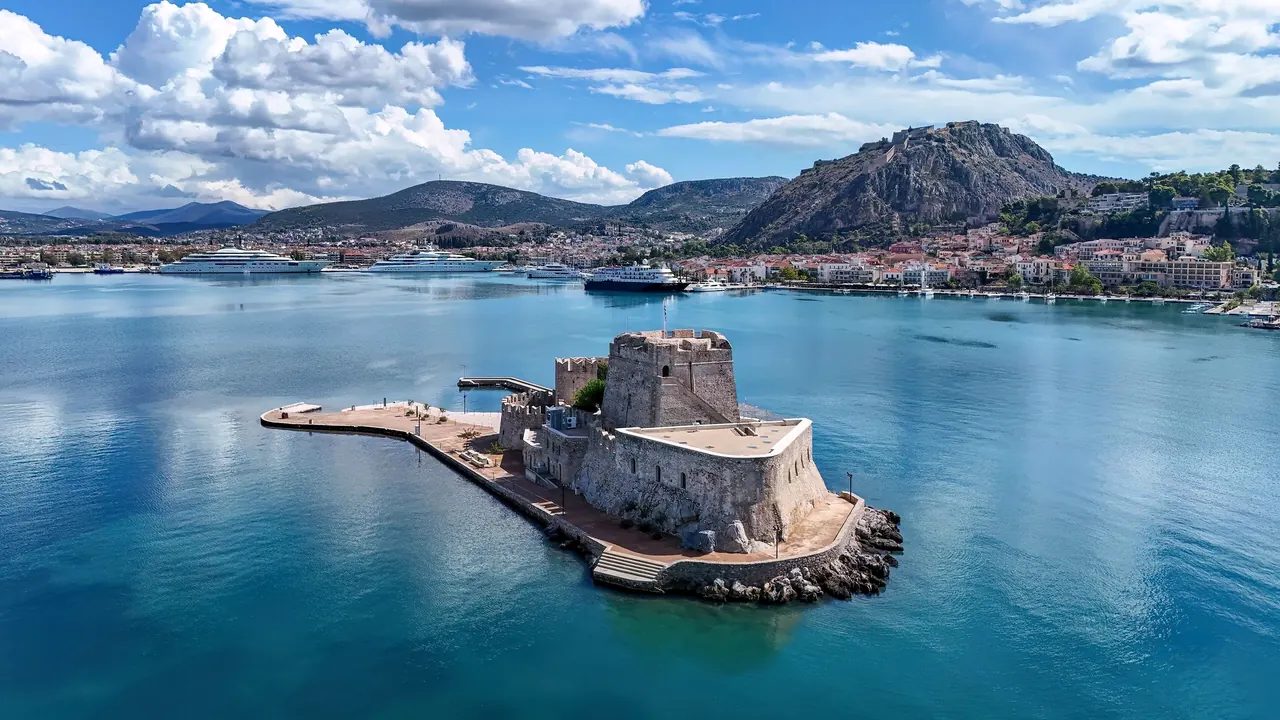
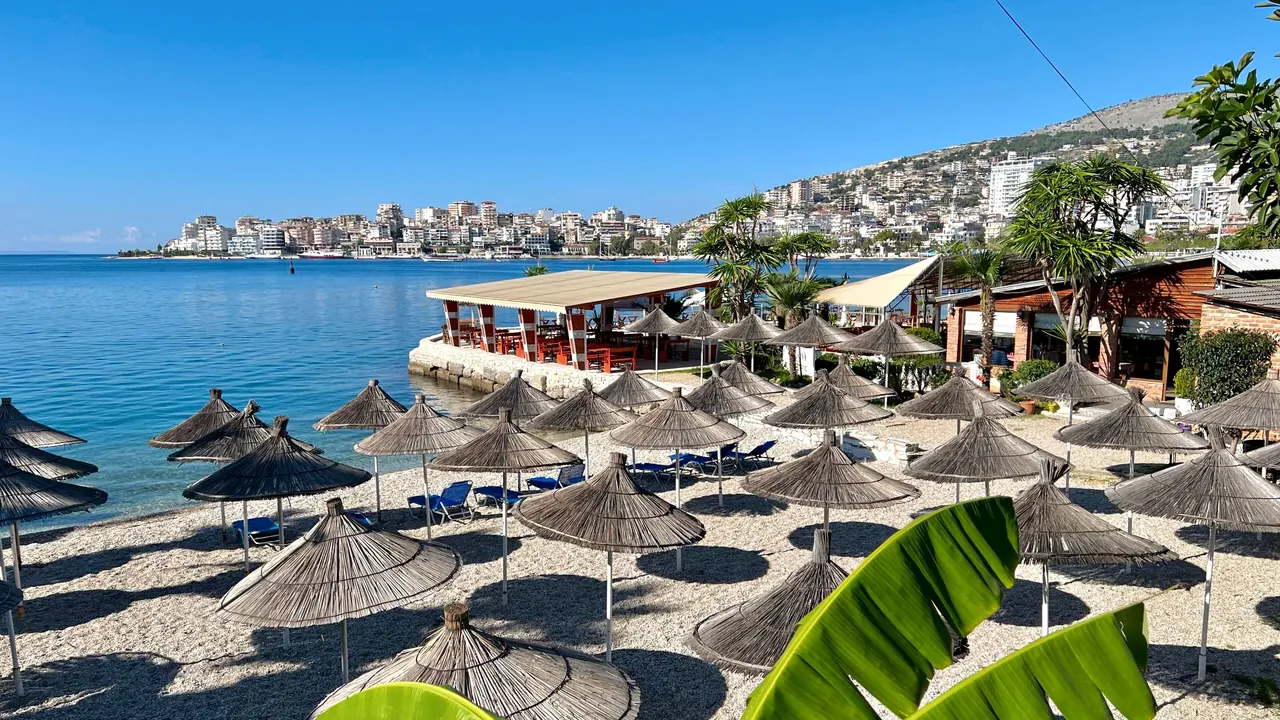
Photos: Nafplio by Giles Laurent, CC BY-SA 4.0, cropped; Saranda by Sharon Hahn Darlin, CC BY 2.0, cropped.
Nafplio or Saranda?
Our verdict in twelve categories, each scored against the same fixed benchmark cities, and the climate month by month, so you can choose for your trip.
Choose Nafplio for
- culture and sights
- live music and the arts
- day trips
Nafplio suits travellers who want history alongside their swimming. The Venetian old town, the Palamidi fortress and the museums of Greece's first capital are all a short walk apart. Mycenae, Tiryns and Epidaurus are close enough for a morning outing, and in summer you can catch an ancient drama at Epidaurus if your dates fit. It is calmer and a little dearer than Saranda, and it is the easier choice for families who want a flat old town with few cars.
Choose Saranda for
- prices
- beaches
- nightlife
Pick Saranda if the sea is the main point. The clear coves at Ksamil and the long Riviera bays beat Nafplio's small beaches, your money goes further, and summer evenings on the promenade run later and louder. Its sights lie outside town, at Butrint, at Gjirokaster and across the strait on Corfu, so it works best as a beach base with a few well-chosen excursions.
Scoreboard
Twelve categories on one fixed scale from 0 to 100. The shaded stretch is the gap between the two.
Your match
Pick a travel style or drag the sliders, and both match scores follow your weighting.
Wins on culture and sights and live music and the arts with your weighting.
Wins on prices and beaches with your weighting.
What matters to you?
Category by category
What the scores mean for a trip.
Beaches & swimming
Saranda is the stronger beach destination. Ksamil's pale coves and offshore islets, twenty minutes south, have clearer and more striking water. When the nearer beaches are packed, the Riviera has long, quiet bays such as Lukova and Borsh.
Nafplio's swimming is pleasant but smaller in scale: pebbly Arvanitia below the cliffs, sandy Karathona in its pine-backed bay and the developed strip at Tolo. The calm, sheltered gulf suits a swim between sightseeing rather than a vacation built around the sea.
Food & drink
Neither town is worth the journey for its food, and both rely on grilled fish and octopus from the water in front of them. Nafplio's cooking is Peloponnesian, with slow-cooked lamb, citrus from the Argolid and agiorgitiko red from Nemea, so it has a real wine culture that Saranda lacks.
Saranda leans towards mussels from the Butrint lagoon, byrek in the morning and southern Albanian home cooking, with raki rather than wine. In both towns the better meals are away from the main waterfront: in Tolo and the villages of the plain near Nafplio, and in the family taverns in Saranda's back streets.
Culture & sights
Nafplio is far ahead on sights. The old town is itself the attraction, a well-preserved mix of Venetian, Ottoman and neoclassical houses below Palamidi. Add the Bourtzi in the harbour, the Mycenaean armour in the old arsenal museum and the church where Kapodistrias was shot.
Saranda is a modern resort town. Its own sights come down to the mosaics of the old synagogue, fragments of city wall, Lekuresi Castle and the Forty Saints ruins, and people visit the last two mostly for the views. For history, you leave town for Butrint or Gjirokaster.
Nightlife
Saranda has the livelier summer nights. After the family stroll on the promenade, cocktail bars play loud music until well after midnight, and beach clubs at Ksamil keep DJs going later still, for a young crowd made up largely of Albanians and Kosovars.
In Nafplio an evening means a long dinner, then drinks by the harbour or off Syntagma Square. These are busy on summer weekends when people come from Athens, but there are no clubs. Out of season, both towns go quiet.
Nature & outdoors
Both have the outdoors on the doorstep, with limestone hills, a calm sea for kayaking and summer heat that pushes walking into spring and autumn. Nafplio's version is gentler and easier to follow: the path around Akronafplia, the coast trail to Karathona, rock climbing on the local limestone and the fir forests of Mainalo inland.
Saranda's is wilder. Butrint's lagoon and reed beds are good for birdwatching, the Blue Eye spring is a startling blue, and the Riviera has cliff roads and sea caves, though its mountain trails are mostly unmarked.
Day trips
Nafplio has the longer list. Tiryns, Mycenae and Epidaurus are all within forty minutes. Ancient Corinth, Nemea, the canal, the islands of Hydra and Spetses and even Mystras can fill a whole week with outings.
Saranda's list is shorter but strong. Butrint, a layered ancient city in lagoon woodland, is half an hour away. Gjirokaster's Ottoman tower houses fill a full day, and the ferry to Corfu takes you to Greece in under an hour.
Good for families
Nafplio is the easier choice with children. The old town is flat and largely free of traffic, the harbour front makes a safe evening stroll, and Karathona and Tolo have shallow water. Older children enjoy the castles and the boat out to the Bourtzi.
Saranda has lovely water for young swimmers at Ksamil and a friendly promenade scene. But steep streets, patchy pavements and summer traffic make it harder work, and the August crowds are intense. Neither town has a zoo or theme park.
Getting around
Both are easy on foot in the centre and awkward beyond it. Nafplio's old town is flat apart from the climb to Palamidi, and regional buses reach Mycenae, Epidaurus and Athens, though not often.
Saranda's promenade links most of what visitors need, but hotels on the slopes mean steep walks, and the buses have no printed timetables. In both, a hire car makes day trips far easier. In Saranda that means narrow, winding roads and a jammed coast road in summer, and in Nafplio a struggle to park near the old town.
Shopping & style
Neither is a shopping destination, but Nafplio has more to browse. Among the souvenir shops in its old-town lanes are a few jewellers, ceramics and textile shops and art galleries, and komboloi and Nemea wine make good things to take home.
Saranda stops at beachwear, souvenirs and everyday goods. The things worth buying are olive oil, honey and raki from the market stalls, and for crafts you need to go to the old bazaar in Gjirokaster.
Affordability
Saranda is clearly the cheaper stay. Meals, buses, taxis and simple rooms cost little for most of the year, although in July and August sunbeds at Ksamil and seafront hotels cost noticeably more.
Nafplio is fair value rather than cheap. Food and site fees are reasonable, but the restored old-town guesthouses aimed at weekenders from Athens make accommodation the big cost. Weekdays, the shoulder seasons or a base in Tolo all help.
Live music & performing arts
Nafplio offers one experience Saranda cannot match. In summer, the Athens and Epidaurus Festival stages ancient drama in the theatre at Epidaurus, and there are concerts at Palaia Epidavros and a classical music festival in the town's historic buildings.
Saranda has almost nothing on the calendar beyond occasional open-air concerts, the odd performance at Butrint and live Albanian music in restaurants. If you want to hear polyphonic singing, look inland around Gjirokaster.
Wellness & relaxation
Neither town has a bathing tradition, and in both a spa means a hotel spa. Nafplio is the calmer retreat, with coffee by the harbour and walks around the headland, and thermal water is within reach at Loutraki and Methana.
Saranda can be restful in May, June and late September. In high summer, though, the music and traffic carry on into the night, which makes it a poor choice for peace and quiet.
When should you go?
Pick your month. The climate figures are measured averages, not a forecast.
Nafplio in July
Saranda in July
Daytime high, °C
Rainfall in the month, mm
Where the figures come from
Nafplio's temperatures are measured 89 km from the centre, at Kalamata Airport.
Nafplio has no rain gauge within 25 km of the centre, so its rainfall comes from a gridded climate dataset read at the destination rather than from a gauge further away.
Saranda's temperatures are measured 30 km from the centre, at Kerkyra Airport.
Saranda has no rain gauge within 25 km of the centre, so its rainfall comes from a gridded climate dataset read at the destination rather than from a gauge further away.
Temperature and rainfall are climate normals, averaged over the years shown. Nafplio: 1991-2020 normals, Kalamata Airport (88.8 km from centre). Saranda: 1991-2020 normals, Kerkyra Airport (29.8 km from centre).
The two towns have almost the same summer. Highs reach 32°C in July and August, which is good for the beach but hard going in the streets or at exposed ruins around midday. In both towns the sea is warm enough for comfortable swimming from June to September, and Nafplio's sheltered gulf stays a touch warmer into October. April, May and late September are the best months for walking and sightseeing in both.
The real difference is rain. Nafplio is the drier of the two all year round. In Saranda, autumn turns wet early, with heavy rain from September and a soaking winter of about 230mm a month in November and December, against roughly 95mm in Nafplio. For a trip after mid-September, Nafplio is the safer choice, and it also gets a little more sunshine through the winter months.
Which traveller are you?
For a culture and arts trip, Nafplio is the clear choice. Its well-preserved old town and fortresses are within easy reach of Mycenae, Tiryns and Epidaurus, where summer evenings bring ancient drama to the theatre. In Saranda, most of the history lies outside town at Butrint.
On a beach and sun trip, Saranda has the better water. The clear coves and islets of Ksamil, and the long Riviera bays further north, outdo Nafplio's small pebble and sand beaches, and the summer evenings on the promenade go on late.
On a tight budget, Saranda makes your money go further. Simple meals, local buses and family-run rooms cost little outside July and August. In Nafplio, the old-town guesthouses make accommodation the main expense, especially at weekends.
Before you go
| Measure | Nafplio | Saranda |
|---|---|---|
| Official language | Greek | Albanian |
| Currency | Euro (EUR) | Lek (ALL) |
| Sockets | CF230 V, 50 Hz | CF220 V, 50 Hz |
| Driving side | Right | Right |
| Time zone | UTC+2, UTC+3 in summer | UTC+1, UTC+2 in summer |
| Emergency number | 112 | 112 |
| Elevation | 6 m | 0 m |
| Main airport | Athens Eleftherios Venizelos International Airport (ATH)109 km from centre176 non-stop destinations | Corfu Ioannis Kapodistrias International Airport (CFU)32 km from centre88 non-stop destinations |
| Public holidays this year | 15 days | 14 days |
By the numbers
| Measure | Nafplio | Saranda |
|---|---|---|
| Population | 14,532 | 22,613 |
| People per km² | 433 | 383 |
| Museums within 10 km | 5 | 0 |
| UNESCO World Heritage sites within 50 km | 2 | 3 |
| Swim season, months above 21 °C | 5 months | 5 months |
Where else could you go?
Every comparison below shares a destination with this one, so you can follow Nafplio or Saranda somewhere new.