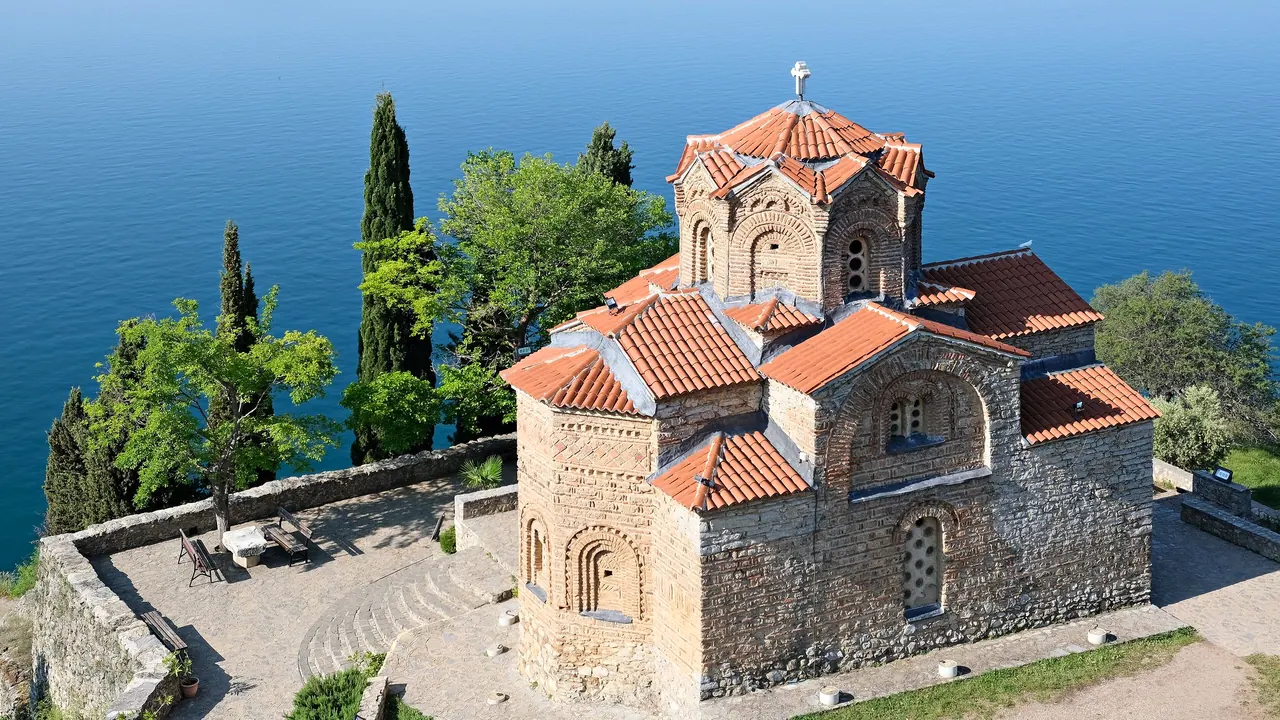
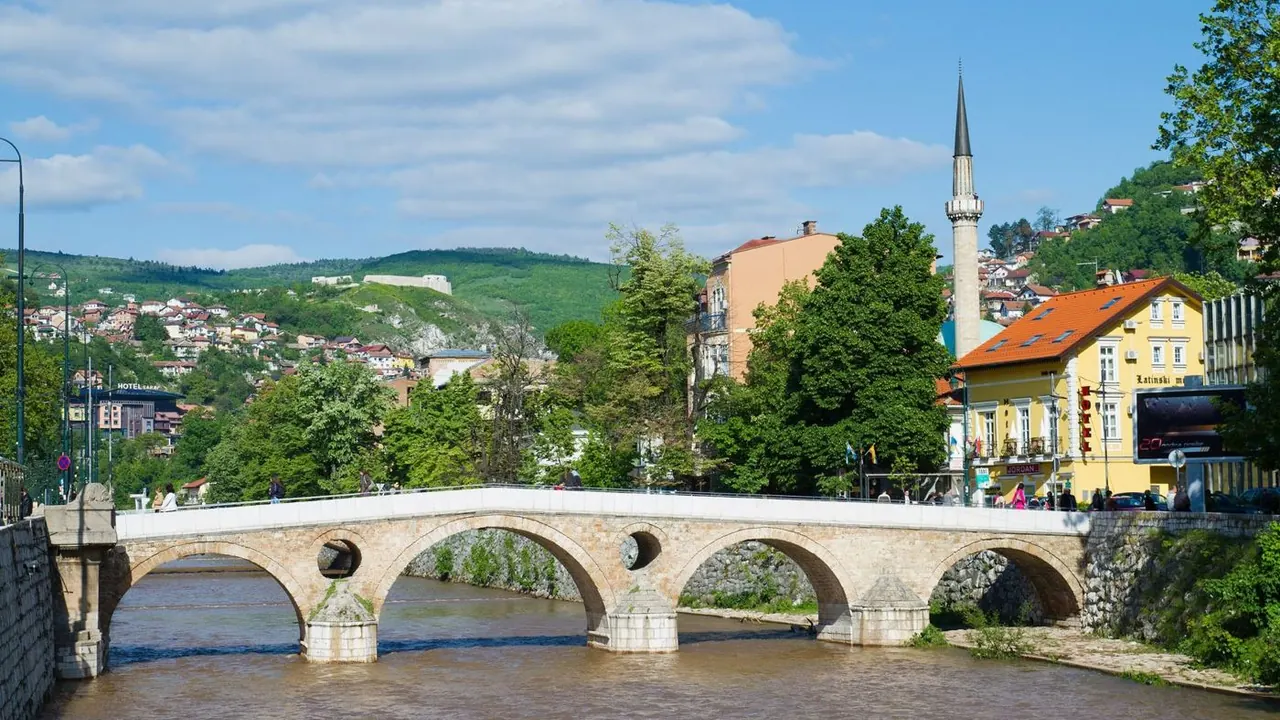
Photos: Ohrid by kallerna, CC BY-SA 4.0, cropped; Sarajevo by Tumi-1983, CC0.
Ohrid or Sarajevo?
Our verdict in twelve categories, each scored against the same fixed benchmark cities, and the climate month by month, so you can choose for your trip.
Choose Ohrid for
- beaches
- families
- culture and sights
Ohrid suits a slow summer trip built around water. You spend the days swimming off jetties and pebble strips in a very clear lake, then walk up through the old town to St Sophia's frescoes and the church at Kaneo on its rock above the shore. It is also the gentler pick with children, because in July and August the lake keeps them busy all day.
Choose Sarajevo for
- food and drink
- live music and the arts
- nightlife
Sarajevo is the better choice if you want a proper city with mountains right beside it. It has more to eat, livelier evenings and a deeper mix of history, from the Ottoman bazaar to the 1914 assassination site and the siege. It also has a second season when the Olympic slopes open in winter. Swimming is the one thing it cannot offer, so anyone who needs water should go to Ohrid.
Scoreboard
Twelve categories on one fixed scale from 0 to 100. The shaded stretch is the gap between the two.
Your match
Pick a travel style or drag the sliders, and both match scores follow your weighting.
Too close to call, 2 points apart
Wins on beaches and families with your weighting.
Wins on food and drink and live music and the arts with your weighting.
What matters to you?
Category by category
What the scores mean for a trip.
Beaches & swimming
This is Ohrid's clearest win. Its lake is one of the clearest in Europe, salt-free and calm, with small coves below Kaneo, the town beach at Potpeš, and longer stretches with loungers at Lagadin and Gradište. The season is short, roughly late June to mid-September, and the beaches are modest in size. Still, a summer stay can be built around swimming.
Sarajevo sits in an inland valley, about three hours from the Adriatic. Swimming there means cold mountain rivers, Jablanica lake or a pool, so anyone who wants beach days should add a stretch on the coast.
Food & drink
Sarajevo eats better. Ćevapi in somun bread with kajmak is a dish worth travelling for, and pita bakeries sell burek by weight. Slow dishes such as begova čorba and lamb cooked under a metal lid, plus the Bosnian coffee ritual with rahat lokum, give meals a real character.
Ohrid offers honest Macedonian home cooking: tavče gravče, ajvar, sheep's cheese and lake fish such as belvica. The same dishes repeat along the waterfront, though, and the better meals are found in family places in the upper old town. Neither city has much international or fine dining.
Culture & sights
Both cities have rich sights, but of different kinds. Ohrid is a single medieval Orthodox setting, listed by UNESCO together with its lake. Its highlights are St Sophia's frescoes, the church at Kaneo, Plaošnik with its links to the Cyrillic tradition, and Samuel's Fortress on top of the hill. All of it is best seen slowly over a day or two.
Sarajevo's strength is the way faiths and centuries meet. Mosques, cathedrals and the Old Synagogue stand a few minutes apart, and the Latin Bridge marks where the First World War began. The siege adds a weight Ohrid does not have, through the Tunnel of Hope and the War Childhood Museum.
Nightlife
Sarajevo has more going on at night and keeps it going all year. Café-bars around Ferhadija fill from the afternoon, and students keep cellar bars and small clubs open past midnight at weekends. It is sociable rather than wild.
Ohrid comes alive only in high summer, when visitors from across the region fill the promenade and beach clubs on the southern shore play late. From autumn to spring, evenings there end over dinner wine.
Nature & outdoors
Sarajevo has the stronger and more varied outdoors. The Trebević cable car starts at the edge of the Old Town. Olympic ridges good for hiking, mountain biking and skiing are under an hour away. There is also the shepherds' village of Lukomir above the Rakitnica canyon, and rafting on the Neretva.
Ohrid's nature is gentler and centred on the lake: kayaks, boat trips and the shore path, with Galičica National Park rising behind. From its ridge you can see both Ohrid and Prespa lakes, and paragliders launch from there. Ohrid is the place for scenery and water, Sarajevo for real mountain days.
Day trips
Sarajevo has more to see within reach. The headline trip is Mostar, about two hours away on a train that runs through the Neretva gorge. Konjic's Cold War bunker, Blagaj's dervish house and Počitelj lie on the same route, and the bridge at Višegrad and Ottoman Travnik make good days in other directions.
From Ohrid, the classic outing is by boat to St Naum at the southern tip of the lake. Bitola and the mosaics at Heraclea Lynkestis are also within reach, and the closeness of Albania makes Korçë an easy cross-border day. In both countries the roads are slow, so a car or driver helps.
Good for families
Ohrid is easier with children, at least in summer. Days revolve around the lake, with boat rides, ice cream on the promenade, and the prehistoric pile village built over the water at the Bay of Bones. A lakeside apartment avoids the steep cobbled old town.
Sarajevo's flat Old Town is good for pushchairs, and the cable car, the carriages to Vrelo Bosne and the small zoo make good outings. Its main sights are about war, though, which is heavy going for children, and winter smog and grill smoke are hard on small lungs.
Getting around
Ohrid's public transport comes down to local buses and summer boats that run too rarely to plan a day around, while Sarajevo has a tram that has followed its valley floor since the late nineteenth century. In Ohrid that matters less than it sounds, because the promenade, the bazaar and the old town are a short walk apart and taxis handle the short hops. The old town's cobbles and stairs are tiring, though, and the shore villages, St Naum and the Galičica road are much easier with a hired car or a driver.
Sarajevo stretches along a narrow valley, so the line from the loop at Baščaršija west to Ilidža makes the city easy to grasp, and the Old Town and the Austro-Hungarian centre are flat enough to walk. Away from that single corridor, the buses and minibuses that climb the steep residential slopes are harder for a visitor to follow. The airport, the Tunnel of Hope and the ski mountains are best reached by taxi or car.
Shopping & style
Sarajevo gives a shopper more to do. On Kazandžiluk, the coppersmiths' street, you can still watch coffee sets and trays being hammered out, and the Bezistan covered market sells kilims, slippers and filigree. Beyond the bazaar there are high-street chains and malls.
Ohrid really has one thing to buy: the Ohrid pearl, a lustre-coated bead made in a few family workshops. Buy it from an established workshop rather than a stall. Apart from carved wood and icons, the rest is souvenirs and summer clothes.
Affordability
Both cities are very cheap for a European trip, and neither will strain a tight budget. The difference is when costs rise. In Ohrid, lakefront rooms cost more in July and August, so late spring and early autumn are the best value. In Sarajevo, the Old Town and the summer film festival push prices up a little, but it stays affordable most of the year.
Live music & performing arts
Sarajevo has a stage life that runs through the year. The National Theatre puts on drama, opera and ballet, and the Philharmonic gives regular concerts. MESS brings international theatre in autumn, a jazz festival takes over in November, and you can hear sevdah in traditional restaurants.
Ohrid's performing arts mostly come down to the Ohrid Summer Festival, held since the early 1960s. Concerts in St Sophia and the ancient theatre are memorable settings, but outside summer there is little to attend.
Wellness & relaxation
Sarajevo has an actual place to bathe. At Ilidža, at the end of the tram line, thermal springs used since Roman times feed a spa with warm pools, and the shaded avenue to Vrelo Bosne is close by. Winter smog takes some of the calm away.
Ohrid has no spa tradition beyond a few hotel pools and saunas. What it offers instead is stillness: quiet mornings by the lake in May, June and September, before the August crowds make it noisier.
When should you go?
Pick your month. The climate figures are measured averages, not a forecast.
Ohrid in July
Sarajevo in July
Daytime high, °C
Rainfall in the month, mm
Where the figures come from
Ohrid has no rain gauge within 25 km of the centre, so its rainfall comes from a gridded climate dataset read at the city rather than from a gauge further away.
Temperature and rainfall are climate normals, averaged over the years shown. Ohrid: 1999-2017 (rainfall 1991-2020) normals, Ohrid (0.2 km from centre). Sarajevo: 1991-2020 (rainfall 1971-2000) normals, Sarajevo-Bejelave (2 km from centre).
The two cities have almost the same temperatures. Both reach about 28°C in July and August and drop to single figures from December to February. The difference is the rain. Ohrid's summer is clearly dry, with only 36mm in each of July and August, and that is also when the lake is warm enough for a proper swim, from late June to mid-September. The wet months there are autumn and early winter, with November and December the wettest at 94mm each. May, June and September are the most comfortable months for walking the old town's steep lanes.
In Sarajevo the wettest month is June, with 95mm, often as summer storms. Even so, high summer is the sunniest time, with about 257 hours of sunshine in July. Late spring and September are best for walking the city and the trails above it. Winter is cold and grey in the valley, but that is when the nearby mountains are good for skiing.
Which traveller are you?
For a beach and sun trip, Ohrid is the only real option of the two. Its lake is clean, calm and warm in high summer, with coves below Kaneo and longer beaches south of town. Sarajevo is hours from any coast.
For a food and nightlife trip, Sarajevo is the better choice. You get ćevapi grills and pita bakeries in Baščaršija, long coffee rituals, then café-bars and cellar bars that stay busy all year. Ohrid's menus repeat along the waterfront, and its evenings go quiet once summer ends.
For skiers, Sarajevo has something Ohrid lacks. Jahorina and Bjelašnica, the 1984 Olympic mountains, are under an hour's drive away and have reliable snow. Ohrid's peaks get snow in winter, but there is no ski resort to travel for.
Before you go
| Measure | Ohrid | Sarajevo |
|---|---|---|
| Official language | Albanian, Macedonian | Croatian, Serbian, Bosnian |
| Currency | Denar (MKD) | Convertible Mark (BAM) |
| Sockets | CF230 V, 50 Hz | CF230 V, 50 Hz |
| Driving side | Right | Right |
| Time zone | UTC+1, UTC+2 in summer | UTC+1, UTC+2 in summer |
| Emergency number | 112 | 112 |
| Elevation | 695 m | 518 m |
| Main airport | Ohrid St. Paul the Apostle Airport (OHD)9 km from centre14 non-stop destinations | Sarajevo International Airport (SJJ)7 km from centre38 non-stop destinations |
| Public holidays this year | 12 days | 8 days |
By the numbers
| Measure | Ohrid | Sarajevo |
|---|---|---|
| City population | 38,818 | 275,524 |
| People per km² | 100 | 1,947 |
| Museums within 10 km | 11 | 26 |
| UNESCO World Heritage sites within 50 km | 2 | 1 |
Where else could you go?
Every comparison below shares a destination with this one, so you can follow Ohrid or Sarajevo somewhere new.