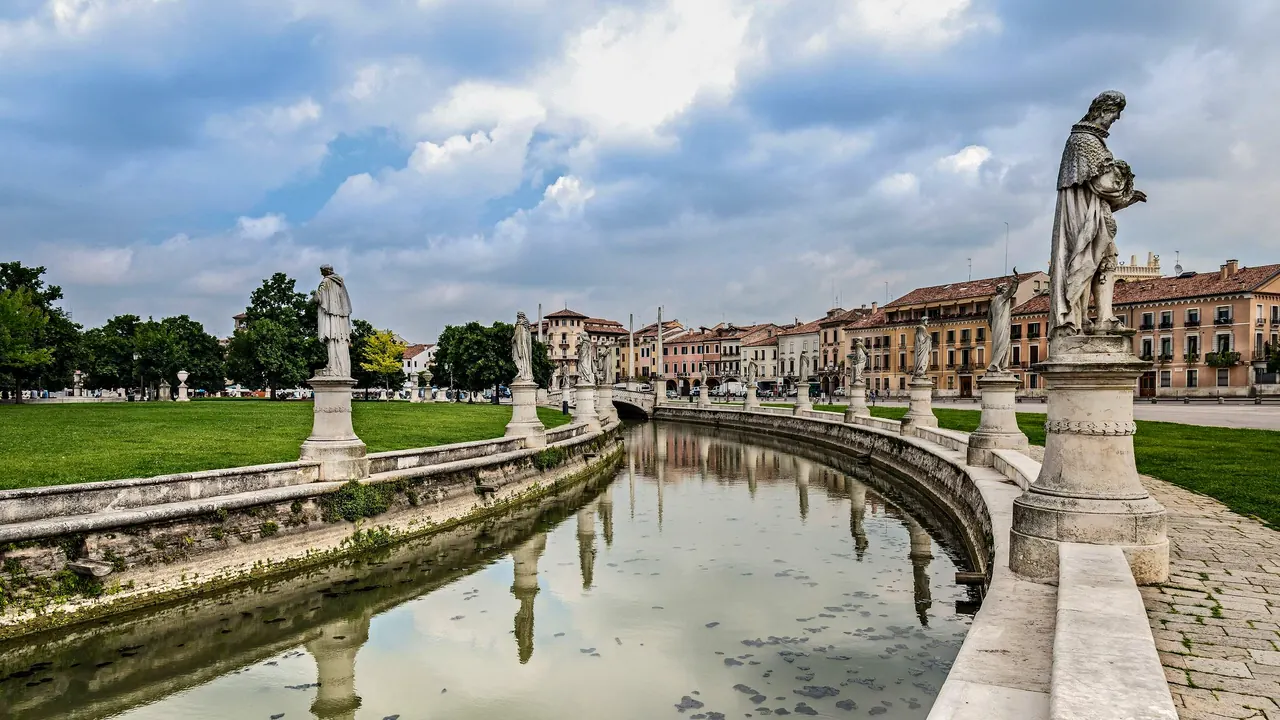
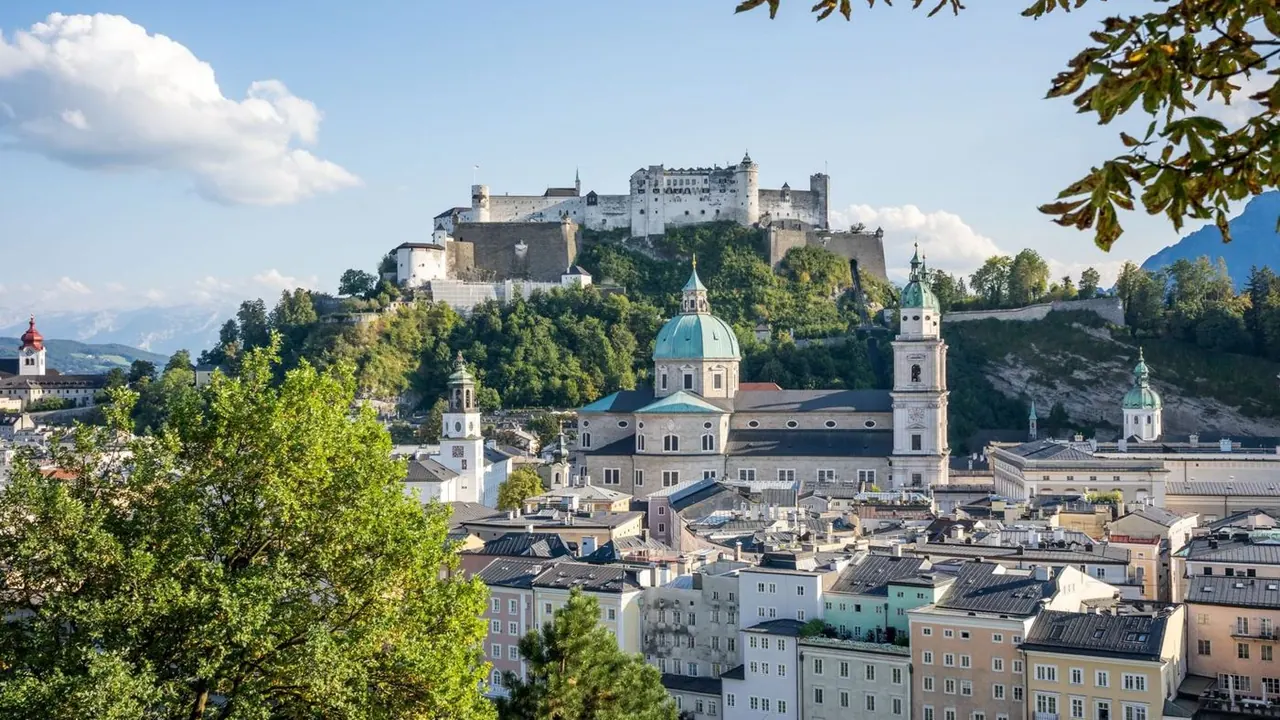
Photos: Padua by Didier Descouens, CC BY-SA 4.0, cropped; Salzburg by Leonhard Niederwimmer, Pexels License.
Padua or Salzburg?
Our verdict in twelve categories, each scored against the same fixed benchmark cities, and the climate month by month, so you can choose for your trip.
Choose Padua for
- prices
- nightlife
- food and drink
Padua suits travellers who want to eat and drink well, stand in front of Giotto, and then spend their days on the Veneto's railways, with Venice, Vicenza, Verona and Bologna all close enough to visit and still sleep in a calmer, cheaper bed. Its evenings in the market squares are more sociable, and the thermal pools of Abano are a short ride from the centre.
Choose Salzburg for
- live music and the arts
- nature and the outdoors
- families
Choose Salzburg if the trip is about mountains, lakes and music. The Alps begin at the edge of town, the Salzkammergut and Berchtesgaden are close by, and the festivals and nightly concerts give it a musical life few cities of its size can match. It is also easier with children, though it costs noticeably more and goes to bed early.
Scoreboard
Twelve categories on one fixed scale from 0 to 100. The shaded stretch is the gap between the two.
Your match
Pick a travel style or drag the sliders, and both match scores follow your weighting.
Too close to call, 1 point apart
Wins on prices and nightlife with your weighting.
Wins on live music and the arts and nature and the outdoors with your weighting.
What matters to you?
Category by category
What the scores mean for a trip.
Beaches & swimming
Neither city is a beach destination, and the swimming on offer is quite different. From Padua you go to the sea: Sottomarina or the Lido of Venice, about an hour away, where the Adriatic is shallow, calm and warm, and the beaches are long, flat rows of umbrellas.
From Salzburg you go to the mountain lakes. Fuschlsee, Wolfgangsee and Mondsee are closer, with clear, cooler water that you get into from lawns and wooden jetties. The scenery is lovely but the season is short.
Food & drink
Padua eats better. Its cooking is Venetian and market-driven: bigoli with duck sauce, baccalà, risotto with spring peas, bought fresh from the stalls and the arcaded shops under the Palazzo della Ragione. Wine from the Euganean Hills and the daily spritz ritual turn eating and drinking into the life of the squares.
Salzburg's strengths are narrower: hearty Austrian dishes, a fine coffee-house tradition and the Augustiner monastery brewery's beer garden. In the old town, many places serve the same menu to tour groups at high prices, so the better cooking is out in the suburbs and on the hills.
Culture & sights
The two are about equally rich, but what you go to see is different. In Padua the treasures are mostly inside: Giotto's Scrovegni Chapel, which needs a timed booking, the other fourteenth-century fresco cycles, Donatello's work at the Basilica of Saint Anthony, and the university's anatomical theatre and botanical garden.
In Salzburg the town itself is the sight. The Baroque old town, the Hohensalzburg fortress on its cliff, Mirabell's gardens and the Mozart houses work as one townscape you take in on foot. Both cities can be seen properly in two or three days.
Nightlife
Padua has more going on after dark, mainly because of its university. During term, crowds stand over spritz glasses across Piazza delle Erbe and Piazza dei Signori until late, and there are wine bars and small pubs in the old ghetto. It does go quiet in high summer and during the university breaks.
A Salzburg evening is more often a concert, dinner and a litre mug in a beer hall, and the old town is quiet by midnight. Clubs are scarce in both cities, and for a big night out from Salzburg people go to Munich.
Nature & outdoors
Salzburg is far ahead. The wooded Mönchsberg and Kapuzinerberg ridges rise right in the centre, a cable car climbs the Untersberg to limestone ridge walks, and the Salzkammergut lakes, Berchtesgaden National Park and the ski areas are all within an hour or so.
Padua sits on a flat plain, so its outdoors is gentler. The Euganean Hills, 15km away, have vineyard trails and roads for cyclists, and the Brenta towpaths make easy bike rides. For proper mountain walking you face a drive of about one and a half hours to the pre-Alps.
Day trips
Padua is the stronger base, mainly because of its trains. Venice is under half an hour away, Vicenza a quarter of an hour, and Verona, Treviso, Bologna and Ferrara are all within about an hour, so you need no car. Closer still are the Brenta villas and the walled towns around the Euganean Hills.
Salzburg's list is shorter but has more variety: Hallstatt and the lake villages, salt mines at Hallein and Berchtesgaden, Werfen's fortress, and Munich across the border. Many of these places are much easier by car, as the buses to the lakes are slow.
Good for families
Salzburg does more for children. The trick fountains at Hellbrunn, the zoo next to them, the hands-on Haus der Natur, the fortress funicular and the marionettes fill several days. Out of town, the salt mines add wooden slides and boat rides on underground lakes.
Padua is flat, safe and easy for pushchairs, and children are welcome in any trattoria, but its sights are mostly frescoes and churches. Families there tend to rely on outings, such as Gardaland and Lake Garda about an hour and a quarter away. Salzburg's cobbles and steep lanes are its main drawback with small children.
Getting around
Both centres are compact, pedestrianised and easy on foot, so the difference is in how you get beyond them. Padua is flat and arcaded, with a tram from the station, and its place on the main rail lines makes a car unnecessary for almost everything.
Salzburg relies on trolleybuses rather than a tram and has steeper lanes in the old town. Trains go to Munich and Vienna, but the lakes are served by slow regional buses, which is why many visitors hire a car.
Shopping & style
Neither is a shopping destination, but they are good for different things. Padua's best buys are edible: cheeses, cured meats and Euganean wine from the markets and delicatessens. It also has university bookshops and a large antiques market in Prato della Valle one Sunday a month.
Salzburg's speciality is Tracht. Workshops make dirndls and loden jackets to measure, Getreidegasse is lined with guild signs, and the Advent market on Domplatz is famous. For serious fashion you would go from Padua to Milan or Venice.
Affordability
Padua is clearly the cheaper stay. Prices are moderate for northern Italy, which is why many people sleep there and visit Venice by day, and a standing spritz or a trattoria lunch costs little.
Salzburg is expensive for a small city. Old-town hotels and restaurants cost a lot all year, and they get scarcer and dearer during the summer festival and the Advent markets. A city card helps, as does staying across the river or in the suburbs. Padua's own price peaks come with trade fairs and graduations.
Live music & performing arts
This is Salzburg's great strength. The summer festival fills the Grosses Festspielhaus and the Felsenreitschule with opera and orchestral concerts by leading performers, Jedermann is played in front of the cathedral, and Mozart Week and the Easter Festival add two more seasons. Between festivals, the Mozarteum, the Landestheater and the Marionette Theatre keep going, and there are chamber concerts nearly every evening.
Padua offers a modest programme: the Teatro Verdi, a chamber orchestra playing in the frescoed Sala dei Giganti, and student venues. For major opera, people go to the Fenice in Venice or the Arena in Verona.
Wellness & relaxation
Padua has the advantage of a real thermal district on its doorstep. Abano and Montegrotto, about 12km away, have hot mineral springs, mud treatments and many spa hotels that take day visitors, so you can have a soak after a morning of frescoes.
Salzburg's own offer is the Paracelsus Bad and its quiet riverside and ridge walks. Bad Reichenhall's brine spa is twenty minutes away, while the Gastein springs need a longer trip. Both cities have a slow, unhurried pace.
When should you go?
Pick your month. The climate figures are measured averages, not a forecast.
Padua in July
Salzburg in July
Daytime high, °C
Rainfall in the month, mm
Where the figures come from
Padua's temperatures are measured 35 km from the centre, at Treviso / Istrana.
Padua has no rain gauge within 25 km of the centre, so its rainfall comes from a gridded climate dataset read at the city rather than from a gauge further away.
Padua's sunshine is measured 36 km from the centre, at Treviso / S. Angelo.
Temperature and rainfall are climate normals, averaged over the years shown. Padua: 1991-2020 normals, Treviso / Istrana (35.4 km from centre). Salzburg: 1991-2020 normals, Salzburg (3.4 km from centre).
Padua is the warmer of the two all year. Summer highs reach around 31°C in July and August, which is sticky for sightseeing but good for the Adriatic, where the sea is warm enough from June to September and peaks near 26°C. July is also the sunniest month by some way. April and May, then September and October, are the comfortable months for walking the arcades, and November is the wettest and greyest month.
Salzburg's summers are milder. Highs of around 25°C are pleasant for walking and hiking, but June to August is also its wettest stretch, with up to 168mm of rain a month, and it gets less sun than Padua. Late May and September often give the best balance. Winters are properly cold, with January highs near 3°C, while Padua's winter is milder but often grey.
Which traveller are you?
For a food and nightlife trip, Padua is the clear choice. Mornings at the Piazza delle Erbe markets, bigoli and Euganean wine at lunch, then the early-evening spritz that fills the squares with students give you more than Salzburg's schnitzel, beer halls and early nights.
On an outdoors trip, Salzburg wins easily. You can walk the Mönchsberg in the morning, take the cable car up the Untersberg, paddle on the Salzkammergut lakes and hike in Berchtesgaden. Around Padua, most of the outdoors is gentle volcanic hills and flat towpaths.
For a trip on a tight budget, Padua makes your money go further. Its hotels are moderately priced for northern Italy, a standing spritz and market food cost little, and short train rides reach Venice and Verona. Salzburg's rooms and old-town restaurants are expensive, especially in festival season.
Before you go
| Measure | Padua | Salzburg |
|---|---|---|
| Official language | Italian | German, Austrian Sign Language |
| Currency | Euro (EUR) | Euro (EUR) |
| Sockets | CFL230 V, 50 Hz | CF230 V, 50 Hz |
| Driving side | Right | Right |
| Time zone | UTC+1, UTC+2 in summer | UTC+1, UTC+2 in summer |
| Emergency number | 112 | 112 |
| Elevation | 12 m | 424 m |
| Main airport | Venice Marco Polo Airport (VCE)39 km from centre103 non-stop destinations | Salzburg Airport (SZG)3 km from centre64 non-stop destinations |
| Public holidays this year | 13 days | 16 days |
By the numbers
| Measure | Padua | Salzburg |
|---|---|---|
| City population | 206,496 | 155,021 |
| People per km² | 2,220 | 2,360 |
| Museums within 10 km | 29 | 38 |
| UNESCO World Heritage sites within 50 km | 5 | 3 |
| Swim season, months above 21 °C | 4 months | - |
Where else could you go?
Every comparison below shares a destination with this one, so you can follow Padua or Salzburg somewhere new.
- Venicevs Padua
- Hallstattvs Salzburg
- Veronavs Padua
- Bolognavs Padua
- Munichvs Salzburg
- Cortina d'Ampezzovs Padua