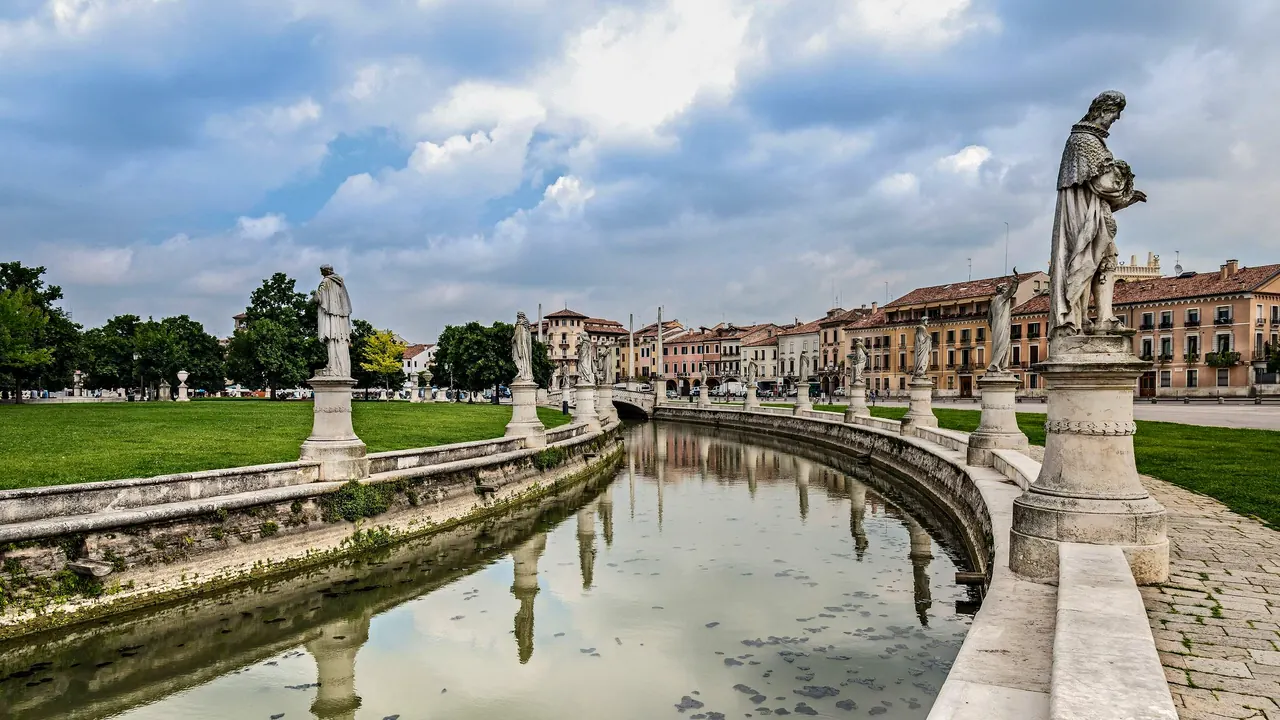
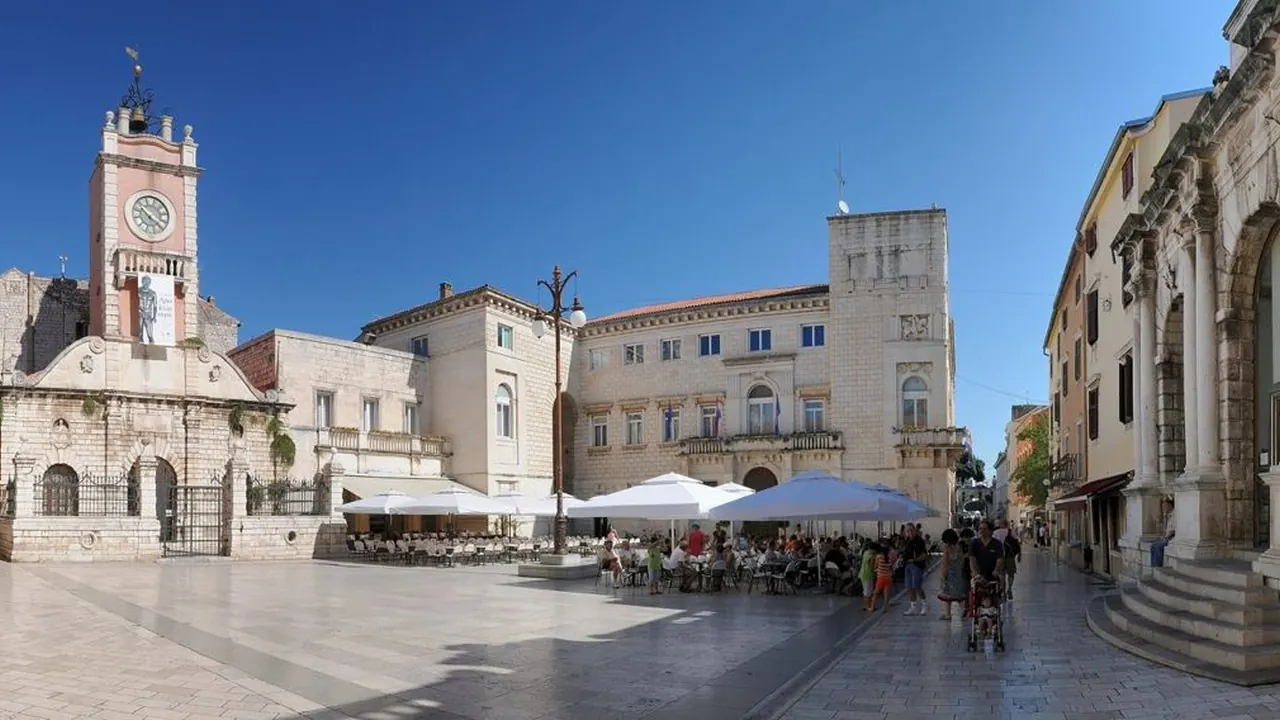
Photos: Padua by Didier Descouens, CC BY-SA 4.0, cropped; Zadar by Böhringer Friedrich, CC BY-SA 2.5, cropped.
Padua or Zadar?
Our verdict in twelve categories, each scored against the same fixed benchmark cities, and the climate month by month, so you can choose for your trip.
Choose Padua for
- wellness
- day trips
- culture and sights
Padua suits a traveller who wants art, food and a base from which to see a lot. Giotto's frescoes and the Basilica of Saint Anthony are in the city itself, the market squares and the evening spritz make daily life enjoyable, and fast trains put Venice, Verona and Bologna within easy reach. Add the thermal spas at the foot of the Euganean Hills, and it works well for a cultured, unhurried vacation in any season except the steamy height of summer.
Choose Zadar for
- beaches
- nature and the outdoors
- families
Zadar is the one for a summer by the sea. You swim off the promenade, take ferries to island coves and go on day trips to Paklenica's gorges, the Kornati and the waterfalls at Krka. The Roman and medieval old town is small enough to see in a couple of days, so the rest of the trip goes on the water and the coast. Families and outdoor types will get more from it than people looking for big cultural sights or good restaurants.
Scoreboard
Twelve categories on one fixed scale from 0 to 100. The shaded stretch is the gap between the two.
Your match
Pick a travel style or drag the sliders, and both match scores follow your weighting.
Wins on wellness and day trips with your weighting.
Wins on beaches and nature and the outdoors with your weighting.
What matters to you?
Category by category
What the scores mean for a trip.
Beaches & swimming
Zadar is the place for swimming. Locals swim straight off the promenade on the edge of the peninsula, and Kolovare and the pine-shaded shore at Borik are within easy reach. Both are pebble and concrete platforms rather than sand. For softer beaches, Nin's sandy shallows are twenty minutes away, and ferries reach quieter coves on Ugljan, Pašman and Dugi Otok.
Padua is inland, and a day at the sea means about an hour each way to Sottomarina or the Lido of Venice. The water there is warm and calm, which is good for paddling children, but the shore is a long row of umbrellas and bathing establishments, with none of the clear water and island scenery you get in Zadar.
Food & drink
Padua eats better and more widely. The morning markets in Piazza delle Erbe and Piazza della Frutta, with delicatessens under the Palazzo della Ragione, supply Venetian home cooking such as bigoli with duck sauce, baccalà and spring risotto. The early-evening spritz in the squares, wines from the Euganean Hills and the grand old Caffè Pedrocchi give the eating day a shape.
Zadar's strength is simpler Dalmatian seafood: grilled fish, black risotto, octopus or lamb cooked under the peka, and Pag cheese to start. Maraschino is a local speciality worth trying. The konobas on the peninsula tend to serve the same menu, though, and you will have fewer choices than in Padua.
Culture & sights
Padua has far more to see. Giotto's frescoes in the Scrovegni Chapel changed the course of European painting. They anchor a UNESCO-listed group of fourteenth-century fresco cycles that continues in the Eremitani church, the Baptistery and the Oratory of Saint George. Beyond these are the Basilica of Saint Anthony with Donatello's bronzes, the world's oldest permanent anatomical theatre at Palazzo Bo and the botanical garden founded in 1545. Chapel visits are short and timed, so book ahead.
Zadar's strength is that its oldest layers are still in plain view. The Roman forum lies open in the centre, beside the round ninth-century St Donatus and the Romanesque cathedral, all inside the Venetian walls. The Museum of Ancient Glass and the Archaeological Museum are fine small collections, and the Sea Organ gives the waterfront a modern landmark. There are fewer sights than in Padua, and nothing that matches the Giotto cycle.
Nightlife
Neither city is for a big night out, but Padua has more going on through more of the year. Students and locals crowd the squares around the Palazzo della Ragione for aperitivo, and in term the wine bars and pubs around the old ghetto and the Bo are busy even on weekday nights. It goes quiet in high summer and the university breaks.
Zadar's evenings work the other way round. They come alive in summer, starting at sunset on the Riva and carrying on in terrace bars on the walls. Anyone who wants clubs travels about an hour to Zrće on Pag, and from October to May going out mostly means a café-bar.
Nature & outdoors
Zadar is much the stronger outdoor base. Behind the coast the Velebit range rises steeply, with Paklenica's limestone gorges for serious hiking and climbing. Out to sea there are sailing and boat trips to the bare Kornati islands and the cliffs of Telašćica. Krka's travertine falls and the Vrana bird reserve are within easy reach, and Plitvice is possible with an early start.
Around Padua the land is flat. The Euganean Hills, about 15km away, offer vineyard trails and quiet roads that road cyclists like, and the Brenta towpaths make easy, level bike rides. For proper mountain walking you need to drive to Monte Grappa or the Asiago plateau.
Day trips
Padua is one of the best bases in Italy for day trips. Venice is under half an hour away by train and Vicenza, with Palladio's palaces and Teatro Olimpico, about a quarter of an hour. Verona, Treviso, Bologna and Ferrara are all easy outings by rail, with no need for a car. Closer still are the Brenta villas, which you reach by road or by boat along the canal, and the walled towns of Este, Monselice and Montagnana around the Euganean Hills. For those, a car makes things simpler.
Zadar's outings are good but more spread out. Šibenik's cathedral and Nin's medieval churches are close, Split and Trogir make long but rewarding days, and ferries reach island villages such as car-free Silba. Most of these trips need a hire car or an organised excursion.
Good for families
Zadar works better for children, mostly because the sea is so close. The tiles of the Greeting to the Sun light up after dark, the wide promenade suits scooters, Nin's shallow sand is ideal for small children, and a ferry to an island feels like an adventure.
Padua is safe and flat and has Prato della Valle for running about, but its main sights are frescoes and churches. Families usually fill the gaps with trips to Gardaland, Lake Garda or the Adriatic, each more than an hour away. Neither city has a zoo or an aquarium of its own.
Getting around
Both centres are flat and easy to walk, but Padua is better connected. A tram runs from the station through the centre to Prato della Valle, arcades keep off the rain and sun, and the station sends fast trains in every direction, so a car is rarely needed.
In Zadar you can cross the pedestrian peninsula on foot in a quarter of an hour, and ferries leave from the edge of the old town. Beyond that the buses are basic, so the national parks and the wider coast are far easier with a hire car. Parking near the old town is tight in summer.
Shopping & style
Padua has more shops, though it is still no shopping destination. Its arcaded streets carry Italian fashion and shoe shops, independent boutiques and university bookshops, and the monthly Sunday antiques market fills Prato della Valle.
Zadar's shopping is mostly jewellers and souvenir shops along marble-paved Kalelarga. What makes it worth a look is the local produce: Maraschino, Pag cheese, figs, olive oil and the fine lace from Pag. In both cities the food markets are the best places to buy something to take home.
Affordability
Overall costs are much the same, but they rise and fall differently. Padua's hotels stay reasonable through most of the year, which is why many people sleep here rather than in Venice. Rooms get dearer around the big trade fairs and graduation season.
In Zadar the season matters more. Private apartments are good value outside July and August but much dearer near the peninsula in high summer, and national park tickets and boat trips add up quickly. June and September are the months to aim for.
Live music & performing arts
Padua has a modest but steady programme all year: prose theatre and some opera at the horseshoe-shaped Teatro Verdi, chamber concerts in the Sala dei Giganti and the Basilica of Saint Anthony, and La Fenice in Venice and Verona's Arena within easy reach for major opera.
Zadar has fewer events, and most of them come in summer. The best is the Musical Evenings in St Donatus, a series of early music concerts in the ninth-century church, alongside concerts in other churches and squares and occasional klapa singing. Outside summer there is little on.
Wellness & relaxation
Padua has a real advantage here. About 12km away, Abano Terme and Montegrotto Terme draw hot mineral water from deep underground and have used the local mud for treatments since Roman times. Their spa hotels take day visitors, so you can have a soak in the afternoon after a morning with Giotto.
Zadar has hotel spas at Borik and the muddy lagoon at Nin, but it has no bathing culture. What it does offer is unhurried days: a long morning in a café, a siesta and the sun going down over the islands.
When should you go?
Pick your month. The climate figures are measured averages, not a forecast.
Padua in July
Zadar in July
Daytime high, °C
Rainfall in the month, mm
Where the figures come from
Padua's temperatures are measured 35 km from the centre, at Treviso / Istrana.
Padua has no rain gauge within 25 km of the centre, so its rainfall comes from a gridded climate dataset read at the city rather than from a gauge further away.
Padua's sunshine is measured 36 km from the centre, at Treviso / S. Angelo.
Zadar has no rain gauge within 25 km of the centre, so its rainfall comes from a gridded climate dataset read at the city rather than from a gauge further away.
Temperature and rainfall are climate normals, averaged over the years shown. Padua: 1991-2020 normals, Treviso / Istrana (35.4 km from centre). Zadar: 1999-2020 (rainfall 1991-2020) normals, Zadar / Zemunik (9.9 km from centre).
The two climates follow almost the same temperature curve, with July and August highs of about 31°C in both, but their rain falls in very different seasons. Zadar's summer is dry, with only 29mm in July, and its sea is warm enough to swim from June to September. Then the autumn rains arrive, and from September to December it is the wetter of the two, peaking at 113mm in November. Its winters are a little milder, though the sea is too cool for most swimmers.
Padua's rain is spread more evenly through the year, with no real dry season. Its summers are hot and humid, which makes long days of sightseeing tiring even though July is its sunniest month. April, May, September and October are the comfortable months for walking the arcades. From November to February the city is cold, often foggy and short of sun. The Adriatic beaches an hour away reach about 25°C in high summer, but in Padua the sea is an outing rather than the reason for coming.
Which traveller are you?
For a beach and sun trip, Zadar is the clear choice. You can swim straight off the stone promenade, the sandy shallows at Nin are close by and ferries go to island coves. From Padua the nearest sand means an hour's journey to a flat strip of umbrellas.
On an outdoors trip, Zadar again comes out ahead. Paklenica's gorges and climbing routes, sailing among the Kornati islands, sea kayaking and the Krka waterfalls are all within reach. Padua offers gentle rides along the Brenta and walks in the Euganean Hills, with the real mountains further off.
For a relaxing and wellness trip, Padua is the better pick. Abano and Montegrotto, one of Europe's largest thermal districts, are just outside the city, so a hot mineral pool or mud treatment fits easily around long lunches. Zadar offers slow sunsets but little in the way of spas.
Before you go
| Measure | Padua | Zadar |
|---|---|---|
| Official language | Italian | Croatian |
| Currency | Euro (EUR) | Euro (EUR) |
| Sockets | CFL230 V, 50 Hz | CF230 V, 50 Hz |
| Driving side | Right | Right |
| Time zone | UTC+1, UTC+2 in summer | UTC+1, UTC+2 in summer |
| Emergency number | 112 | 112 |
| Elevation | 12 m | 5 m |
| Main airport | Venice Marco Polo Airport (VCE)39 km from centre103 non-stop destinations | Zadar Airport (ZAD)10 km from centre66 non-stop destinations |
| Public holidays this year | 13 days | 14 days |
By the numbers
| Measure | Padua | Zadar |
|---|---|---|
| City population | 206,496 | 70,779 |
| People per km² | 2,220 | - |
| Museums within 10 km | 29 | 1 |
| UNESCO World Heritage sites within 50 km | 5 | 2 |
| Swim season, months above 21 °C | 4 months | 4 months |
Where else could you go?
Every comparison below shares a destination with this one, so you can follow Padua or Zadar somewhere new.