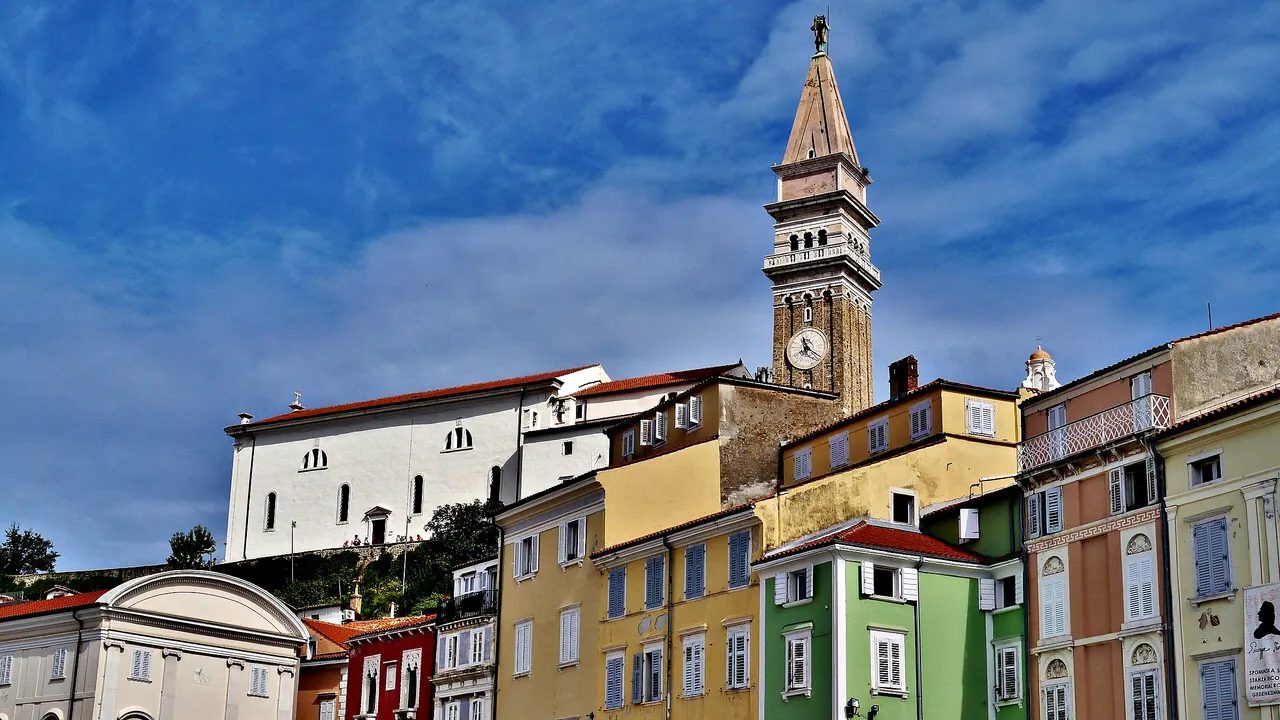
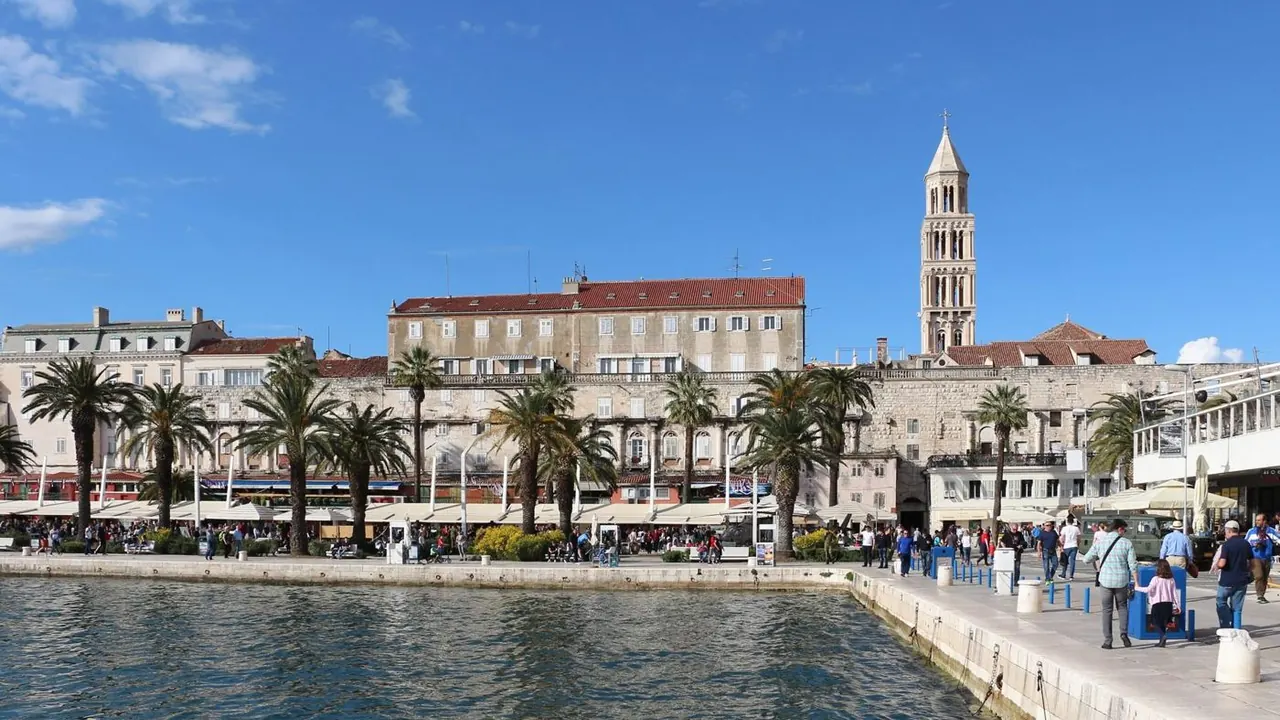
Photos: Piran by Zairon, CC BY-SA 4.0, cropped; Split by Bernard Gagnon, CC BY-SA 4.0, cropped.
Piran or Split?
Our verdict in twelve categories, each scored against the same fixed benchmark cities, and the climate month by month, so you can choose for your trip.
Choose Piran for
- wellness
Piran suits a slow, quiet stay. The car-free Venetian peninsula, swims from the rocks below the walls and the sea-salt spas of Portoroz and the salt pans make it a place to unwind for a few days. Evenings end early, which is the point for couples and anyone who wants calm. With a car it also works as a base for crossing into Trieste and the hill towns of Istria.
Choose Split for
- nightlife
- culture and sights
- nature and the outdoors
Split is the better pick for a fuller, livelier trip. A Roman palace still lived in as a neighbourhood, sandy Bačvice, island ferries leaving from the harbour, real mountains behind the city and bars that run late in summer give it more to fill a week. Choose it if you want sights, activity and a night out, not just a seafront to slow down on.
Scoreboard
Twelve categories on one fixed scale from 0 to 100. The shaded stretch is the gap between the two.
Your match
Pick a travel style or drag the sliders, and both match scores follow your weighting.
Wins on wellness with your weighting.
Wins on nightlife and culture and sights with your weighting.
What matters to you?
Category by category
What the scores mean for a trip.
Beaches & swimming
Piran is for swimming rather than lying on sand. You lower yourself into clear water from concrete platforms and ladders below the walls, or walk to Fiesa, a small pebble cove. For sand you go to the small artificial beach at Portoroz or the quieter shore at Strunjan.
Split has more choice within walking distance. Bačvice is a shallow sandy bay where locals play picigin in knee-deep water, and the pine-shaded coves around Marjan offer deeper, quieter swimming. Ferries to Brač and Hvar add longer beaches, though the city beaches get packed in high summer.
Food & drink
Both towns eat from the sea, but Split cooks a wider Dalmatian repertoire. Next to the grilled fish there is black risotto, slow-braised pašticada and octopus baked under the peka bell, with the fish market and the Pazar showing what is in season. The best meals are in the konobas of Varoš.
In Piran, eating out means simple seafood on the Punta, mussels and scampi buzara with Malvazija or Refosk, and the local salt on the table. It is pleasant, but the harbour menus repeat one another, and for variety you have to drive inland into Istria.
Culture & sights
Split has a monument of world rank. Diocletian's Palace is a Roman emperor's residence that turned into a town, with the cathedral set in his mausoleum, the Peristyle, and vaulted substructures that show the original plan. The Meštrović Gallery on Marjan adds a fine sculpture collection, and two days covers the city well.
Piran's appeal is the townscape itself: Venetian Gothic houses on a narrow peninsula, the oval Tartini Square, and St George's campanile and the old walls above the red roofs. The museums are small, and one unhurried day is enough.
Nightlife
Piran's evenings are a glass of wine at sunset on the Punta or Tartini Square, and the town goes quiet soon after. For anything louder you go to Portoroz, with its casino and a few summer clubs.
Split gives you a real night out in summer. Small bars fill the stone alleys and stairways inside the palace, and the beach bars and clubs at Bačvice run into the early hours. Outside summer both towns are quiet, and in Split a night out comes down to a glass of wine with locals.
Nature & outdoors
Piran's outdoors is gentle and coastal. There are the flysch cliffs and path at Strunjan, wading birds among the lagoons of the Secovlje salt pans, the Parenzana cycle route through vineyards, and the Skocjan caves on the Karst about an hour away.
Split has mountains and open sea. Marjan's pine forest starts at the edge of the old town, Mosor and Biokovo offer serious ridge walks, the Cetina canyon at Omiš is used for rafting and canyoning, and Krka's waterfalls are an hour north. Add kayaking and sailing among the islands and it is the more active base.
Day trips
Both make excellent bases, but the trips are different. From Piran you cross borders: Habsburg Trieste within the hour, Rovinj and the hilltop towns of Motovun and Groznjan in Croatian Istria, Predjama Castle and Ljubljana in Slovenia, and summer boats to Venice. Most of it is easiest with a car.
From Split the outings are by sea and bus. You can take ferries to Hvar, Brač and Vis, or visit UNESCO-listed Trogir and Šibenik, Roman Salona and Klis Fortress close by. In summer you can manage all of it without driving.
Good for families
Neither town has much built for children, and both work in a simple way. Piran is smaller and calmer. The old town has no cars, the seafront is flat and the aquarium suits younger children, but swimming means ledges and ladders, and the lanes up to the church are steep.
Split has more space and more to do. Bačvice is a shallow sandy paddle, Marjan has shade and room to run, and the ferry to an island is usually the highlight. The trade-off is heavy heat and crowds in July and August.
Getting around
Each town has a compact, car-free core you can cross on foot in about fifteen minutes. Piran adds a shuttle and a promenade to Portoroz. Split's palace streets are polished stone and full of steps, which is awkward with a pushchair.
Leaving town is where they part. Piran has no railway and slow buses, so most visitors hire a car to explore. Split has its ferry port, bus station and railway station together on the harbour, which makes the islands and the coast easy to reach without one.
Shopping & style
Neither town is worth visiting for shopping, but Split has a bit more. It has fashion chains on Marmontova, malls on the edge of town, and the Pazar market by the palace for figs, honey and local brandies. Piran keeps to galleries and harbour stalls, and its best buys are salt flower from the Secovlje pans and Istrian olive oil. For anything more you would go to Trieste or Ljubljana.
Affordability
Costs are much the same, and both get expensive in July and August, when old-town rooms are scarce and waterfront fish is priced for the view. In Piran you save by sleeping in Portoroz and eating in simple konobas, and the swimming and walking cost nothing.
In Split, island ferries add up for a family. Bakeries, the green market and buses are cheap, though, and in winter the city becomes modestly priced.
Live music & performing arts
Split has a real stage. The 19th-century Croatian National Theatre runs opera and ballet through the season, the Split Summer Festival puts on opera in the Peristyle, and klapa singers fill the palace vestibule with unaccompanied harmonies.
Piran's music centres on Tartini, with summer concerts in churches, the Minorite cloister and on the square named after him. Its small theatre has only occasional plays and recitals, and outside summer there is little to go to.
Wellness & relaxation
Rest and treatment are where Piran clearly has the edge over Split. Portoroz grew up as a spa resort using seawater, brine and salt-pan mud, the thalasso spa among the Secovlje lagoons lets you lie in salt mud outdoors, and Strunjan has a seawater health resort. The quiet, car-free town adds the slower pace.
Split has no bathing tradition, so you are limited to hotel spas and massage studios. Its calm is the Dalmatian fjaka of long coffees on the Riva, which is hard to find in midsummer, when the old town stays loud late into the night.
When should you go?
Pick your month. The climate figures are measured averages, not a forecast.
Piran in July
Split in July
Daytime high, °C
Rainfall in the month, mm
Temperature and rainfall are climate normals, averaged over the years shown. Piran: 2005-2020 (sunshine 1991-2020, rainfall 1991-2020) normals, Portoroz (1.2 km from centre). Split: 1991-2020 (sunshine 1971-2000, rainfall 1981-2010) normals, Split / Marjan (0.9 km from centre).
Both towns share the Adriatic summer. Swimming is good from June to September, July and August are the hottest months at around 30°C in each, and the sea is warm enough for long swims. The real difference is rain. Split's summers are dry and very sunny, while Piran gets showers right through the summer and turns properly wet from September, with autumn its rainiest season at over 110mm a month. In Split the wet spell comes later, in October and November.
May and late September suit walking the streets in both, before and after the heat. Winter is milder and sunnier in Split, where the sea stays near 14°C. Piran is cooler and greyer, and its sea drops to about 10°C. Split's swimming season also runs a little longer, with the water still pleasant in October.
Which traveller are you?
For a relaxing and wellness trip, Piran is the calmer choice. Seawater pools and salt-mud treatments in Portoroz, an outdoor thalasso spa among the salt pans and quiet car-free lanes give rest a real focus. Split's old town is loud in summer.
On a food and nightlife trip, Split comes out ahead. Dalmatian dishes like peka and pašticada give more range than Piran's repeated harbour menus, and in summer the palace bars and the clubs around Bačvice keep going long after Piran has gone quiet.
For an outdoors trip, Split has far more to offer. There are ridge hikes on Mosor and Biokovo, rafting in the Cetina canyon, Krka's waterfalls and sailing among the islands. Piran's outdoors is gentler: cliff paths, salt-pan birdlife and cycling the Parenzana.
Before you go
| Measure | Piran | Split |
|---|---|---|
| Official language | Slovene | Croatian |
| Currency | Euro (EUR) | Euro (EUR) |
| Sockets | CF230 V, 50 Hz | CF230 V, 50 Hz |
| Driving side | Right | Right |
| Time zone | UTC+1, UTC+2 in summer | UTC+1, UTC+2 in summer |
| Emergency number | 112 | 112 |
| Elevation | 7 m | 0 m |
| Main airport | Trieste Airport (TRS)34 km from centre32 non-stop destinations | Split Saint Jerome Airport (SPU)12 km from centre69 non-stop destinations |
| Public holidays this year | 21 days | 14 days |
By the numbers
| Measure | Piran | Split |
|---|---|---|
| City population | 3,787 | 160,577 |
| People per km² | 85 | - |
| Museums within 10 km | 5 | 11 |
| UNESCO World Heritage sites within 50 km | 4 | 4 |
| Swim season, months above 21 °C | 4 months | 4 months |
Where else could you go?
Every comparison below shares a destination with this one, so you can follow Piran or Split somewhere new.