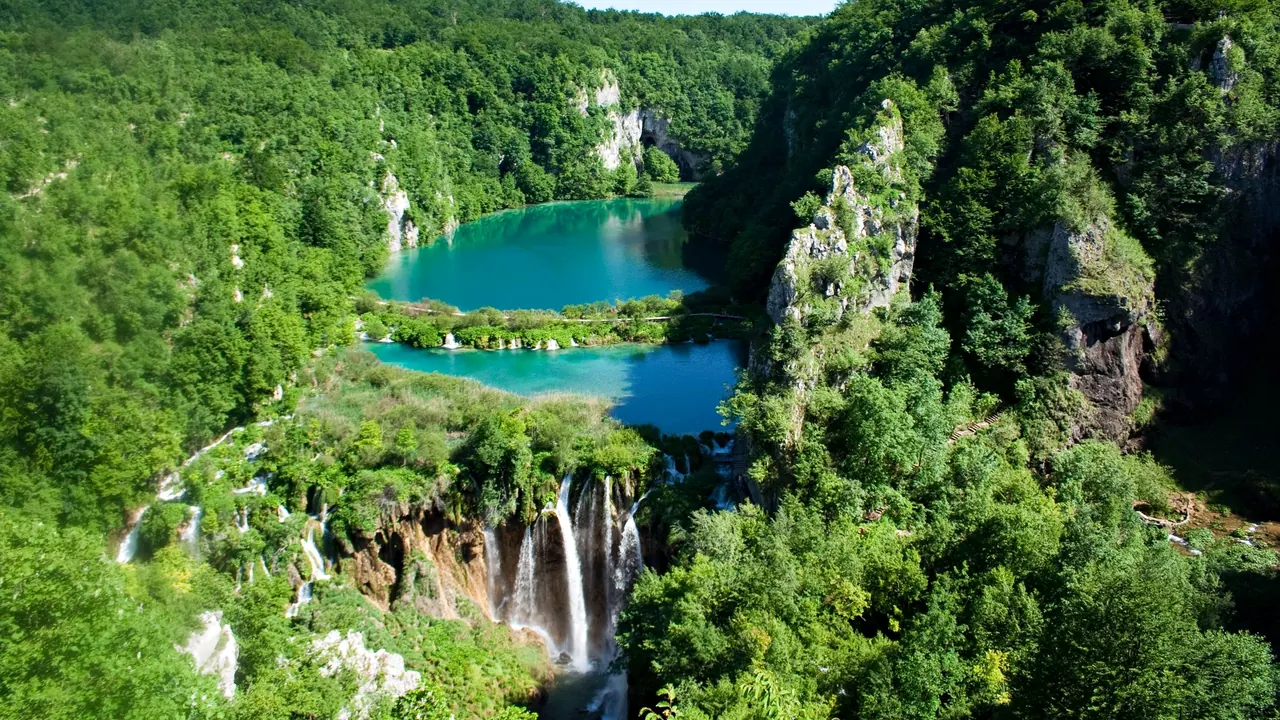
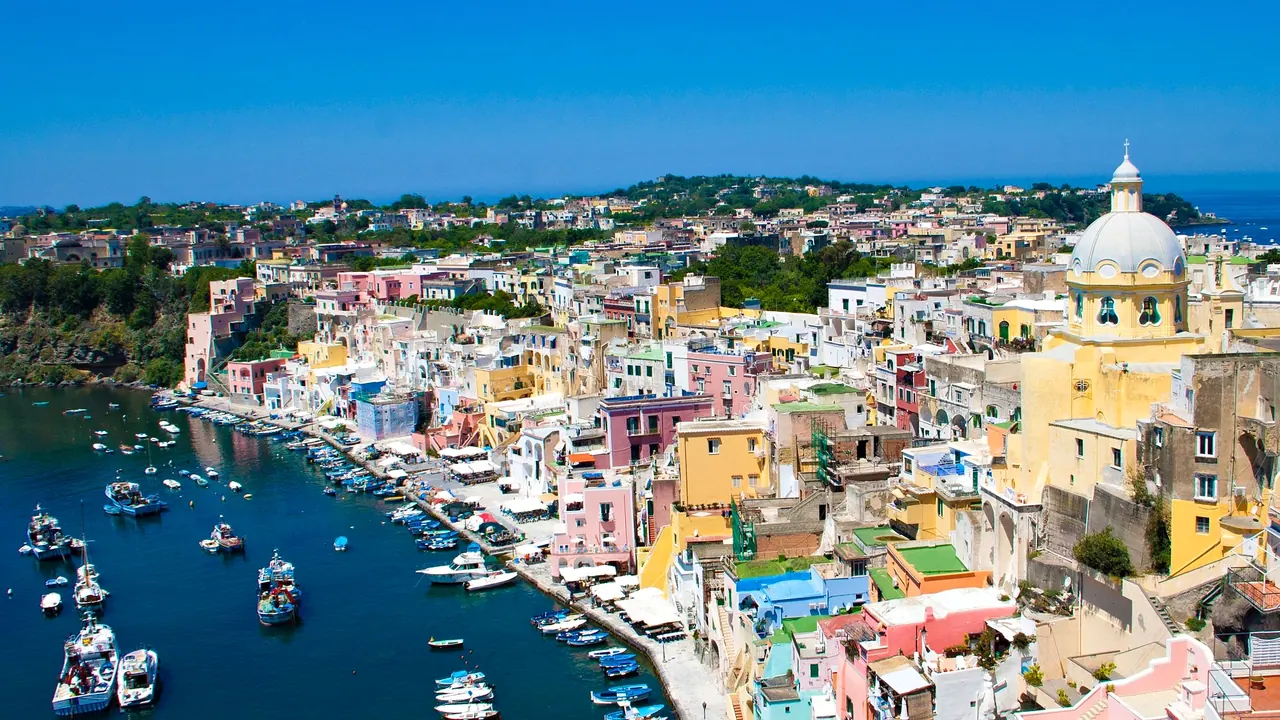
Photos: Plitvice Lakes by Pablo BM from London, England, CC BY 2.0, cropped; Procida by DIANA.GRYGAROVA, CC BY-SA 4.0, cropped.
Plitvice Lakes or Procida?
Our verdict in twelve categories, each scored against the same fixed benchmark cities, and the climate month by month, so you can choose for your trip.
Choose Plitvice Lakes for
- nature and the outdoors
- prices
Plitvice Lakes is the pick for someone who wants to spend their days on foot in the landscape itself. The terraced lakes, travertine falls and beech forest are the reason to come, and the trails, caves and rivers around them fill two or three active days. Expect to give up nearly everything else: no swimming in the park, plain country food, and evenings that end with dinner. It works best as a stop between Zagreb and the coast, or as a short stay in a village guesthouse.
Choose Procida for
- beaches
- day trips
- food and drink
Procida is the better choice for a slow summer island trip built around the sea. Its coves of dark sand, its harbour trattorias and the pastel houses of Corricella make up the stay, and the ferries out to Ischia, Pozzuoli and Naples add all the sightseeing the island itself lacks. Nature here means viewpoints and snorkelling rather than real hiking, and the island makes a fine base for a week of beaches with days out across the gulf.
Scoreboard
Twelve categories on one fixed scale from 0 to 100. The shaded stretch is the gap between the two.
Your match
Pick a travel style or drag the sliders, and both match scores follow your weighting.
Wins on nature and the outdoors and prices with your weighting.
Wins on beaches and day trips with your weighting.
What matters to you?
Category by category
What the scores mean for a trip.
Beaches & swimming
Procida wins this outright. Its beaches are small coves of dark volcanic sand, from family-friendly Chiaiolella facing Vivara to Chiaia, which you reach down a long flight of steps, and a summer day there turns on the sea. They fill early in August, but the water is clear and warm through the season.
At Plitvice, the lakes are off limits for swimming. The best you can do is a cold, clear dip in the Korana river near Slunj on a hot afternoon, and a real sea beach is a long drive away on the Adriatic.
Food & drink
Both serve honest local cooking with a short range. Procida's is the more rewarding: the morning's catch at the harbour trattorias of Corricella and Marina Grande, the island's own lemon salad with mint and chilli, and lingua pastries eaten as the ferries come in.
Plitvice's table is inland and heavy, with lamb and suckling pig from the spit, river trout, cabbage and dishes slow-cooked under the iron bell, finished with local cheese and brandy. One good dinner of it is memorable, but much of it is cooked for passing tour groups and there is little else to try.
Culture & sights
Neither destination is a heritage trip, but Procida gives you more to look at. Terra Murata's walled village, with the Abbey of San Michele and the former prison of Palazzo d'Avalos, plus the stacked pastel houses of Corricella, fill a day or two of slow walking.
Around Plitvice, the World Heritage listing is for nature, not buildings. Rastoke's water mills, the ruined walls of Drežnik and the memorials to the first deaths of the 1990s war are worth seeing, but together they make little more than an afternoon.
Nightlife
Evenings at Plitvice end with dinner at a guesthouse or roadside inn, perhaps with a glass of local brandy. The villages fall silent soon after dark, because everyone is out on the trails at opening time.
Procida gives you a little more to do after dark. In July and August, a long harbour dinner can be followed by drinks at the waterfront bars of Marina Grande or Chiaiolella, which stay busy until around midnight. There are still no clubs, and outside summer the island goes quiet early. A real night out means the ferry to Naples or Ischia and a plan for getting back.
Nature & outdoors
This is Plitvice's great strength. Sixteen lakes step down a forested limestone valley over travertine barriers and waterfalls, with boardwalks running across the cascades and a look that changes from spring floods to autumn gold to frozen winter falls. Beyond the park lie the Barać caves, rafting on the Korana and the Una, and longer hikes on Velebit.
Procida's nature is gentler and smaller in scale: old craters turned into bays, lemon gardens and short cliffs. The headland walks, the guided openings of Vivara and snorkelling off the rocky shore are pleasant for a few days, but they are not a reason to travel on their own.
Day trips
Procida is the far better base for exploring. Ischia is a quarter of an hour away by boat, Pozzuoli's amphitheatre and the sunken villas of Baia are close by, and Naples, with Herculaneum beyond it, makes an easy day. The one limit is the last ferry home.
From Plitvice the outings need a car and longer drives: Rastoke nearby, Bihać and the Una falls across the Bosnian border, Tesla's birthplace at Smiljan, and Zadar or Zagreb at the edge of a day. Most visitors pass through rather than tour from here.
Good for families
The two suit families about equally, in different ways. Plitvice is a single big outing that delights school-age children, with fish in the clear water, the electric boat across Kozjak and the little train, but the wet boardwalks without railings need close watching, and pushchairs struggle.
Procida offers a simple routine of gently shelving beaches and relaxed trattorias, with short distances between them. Its weak points are the narrow lanes without pavements and the steps down to Corricella and Chiaia, and beyond the sea there is little made for children.
Getting around
Procida is the easier of the two without a car. The island is only a few kilometres across, small buses and three-wheeled taxis run from Marina Grande, and frequent boats link it to Naples, Pozzuoli and Ischia. The catch is walking on narrow, walled lanes with traffic and no pavements.
Plitvice is simple inside the park, with signed circuits, boats and trains, and guesthouses in Mukinje or Jezerce within walking distance of an entrance. Beyond the gates, local transport barely exists, so anything further afield means a car on slow, winding rural roads.
Shopping & style
Neither place is somewhere to shop, but Plitvice has the least to offer. Its shopping is the souvenir kiosks at the park entrances and the roadside stalls where farmers sell their own cheese, honey, jams and fruit brandy. Those farm goods are worth buying, and there is no town nearby with shops to browse.
Procida has slightly more, because it has an actual street of shops. Via Roma at Marina Grande has small shops selling hand-painted ceramics, limoncello, linen and beachwear, which you can look round while you wait for a ferry. For real shopping, Naples is a short boat ride away.
Affordability
Plitvice comes out slightly cheaper overall, mainly because village guesthouses and country inns are reasonably priced away from the gates. The high summer entrance fee and the pricey hotels near the park are the costs to plan around, and spring or autumn visits cost much less.
Procida is cheaper than its neighbours in the gulf, but its few rooms fill and rise in price in July and August, and the harbour trattorias charge island prices. Pastries, pizza, buses and a free stretch of beach keep the days themselves inexpensive.
Live music & performing arts
Good Friday is the one date in either place worth planning a trip around, and it belongs to Procida. Around Plitvice, the most a visitor will hear is traditional Lika folk music at a village festival or an inn, and concerts mean the drive to Zagreb or Zadar.
On Procida, the procession of the Misteri carries hand-built tableaux of biblical scenes from Terra Murata down to the sea, with brass bands and hooded confraternities. The rest of the year offers only the odd open-air summer concert in a square. Opera in Naples is possible, but it means a difficult late crossing home.
Wellness & relaxation
Procida is the more restful stay. Long lunches above the harbour and evenings watching the light on Corricella set the pace, and Ischia's hot springs and thermal gardens are a short boat ride away for a day of soaking.
Plitvice has no bathing tradition and only a few hotel saunas. Its calm comes from meadows, fir forest and silent nights in an outlying guesthouse, though the boardwalks themselves are anything but peaceful at midday in summer.
When should you go?
Pick your month. The climate figures are measured averages, not a forecast.
Plitvice Lakes in July
Procida in July
Daytime high, °C
Rainfall in the month, mm
Where the figures come from
Plitvice Lakes has no weather station within reach, so its figures come from a gridded climate model rather than a measured record, and read a broad area rather than one spot.
Procida's temperatures are measured 32 km from the centre, at Grazzanise.
Temperature and rainfall are climate normals, averaged over the years shown. Plitvice Lakes: 2001-2020 normals, NASA POWER reanalysis grid, no weather station within 90 km. Procida: 1991-2020 (rainfall 1971-2000) normals, Grazzanise (32.2 km from centre).
The two run on different calendars. Around the park entrances at Plitvice, summer peaks at about 27°C, which is comfortable for long walks on the boardwalks, though July and August are also when the trails are most crowded. Late spring brings the fullest waterfalls and mild walking weather, and early autumn turns the forest colours before the rain gets heavier from September to November. Winter is properly cold, with highs near 3°C, and the falls freeze under snow, which is beautiful but makes for a short, chilly visit.
Procida is far warmer and drier in summer. Highs reach about 31°C in July and August, hot for walking the lanes at midday, and the sea is warm enough for swimming from June to October, peaking near 26°C. June and early September give long sunny days without the worst of the heat. The rain arrives in October and November, at up to 163mm a month, and winter is mild but grey, a time for quiet walks rather than beaches.
Which traveller are you?
On a beach and sun trip, Procida is the obvious choice. It has warm sea from June to October and small volcanic-sand coves such as Chiaiolella and Pozzo Vecchio. At Plitvice, swimming is banned in the park and the nearest sea is two hours over the mountains.
For an outdoors trip, Plitvice Lakes wins clearly. Boardwalks over the cascades, forest trails to viewpoints, the Barać caves, rafting on the Korana and the Velebit ridges give days of walking. On Procida you will have used up the headlands and Vivara within a few days.
On a culture and arts trip, Procida is the better base. Terra Murata and Corricella are worth a day, and the boats reach the Roman sites at Pozzuoli and Baia, the museums of Naples and Herculaneum. Plitvice has little beyond Rastoke's mills and Drežnik's ruins.
Before you go
| Measure | Plitvice Lakes | Procida |
|---|---|---|
| Official language | Croatian | Italian |
| Currency | Euro (EUR) | Euro (EUR) |
| Sockets | CF230 V, 50 Hz | CFL230 V, 50 Hz |
| Driving side | Right | Right |
| Time zone | UTC+1, UTC+2 in summer | UTC+1, UTC+2 in summer |
| Emergency number | 112 | 112 |
| Main airport | Zagreb Franjo Tuđman International Airport (ZAG)66 non-stop destinations | Naples International Airport (NAP)131 non-stop destinations |
| Public holidays this year | 14 days | 13 days |
By the numbers
| Measure | Plitvice Lakes | Procida |
|---|---|---|
| Population | - | 10,092 |
| People per km² | - | 2,347 |
| Swim season, months above 21 °C | - | 5 months |
Where else could you go?
Every comparison below shares a destination with this one, so you can follow Plitvice Lakes or Procida somewhere new.
- Ischiavs Procida
- Caprivs Procida
- Amalfi Coastvs Procida
- Krkavs Plitvice Lakes
- Bračvs Plitvice Lakes
- Hvarvs Plitvice Lakes