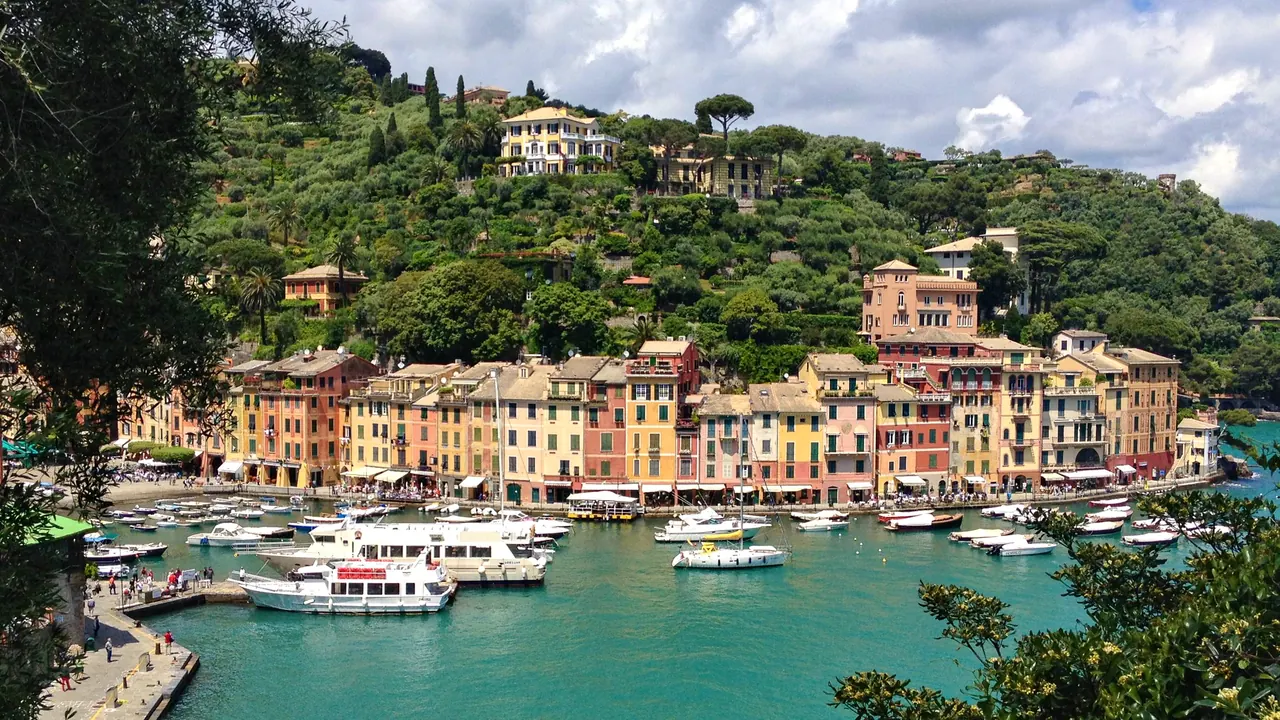
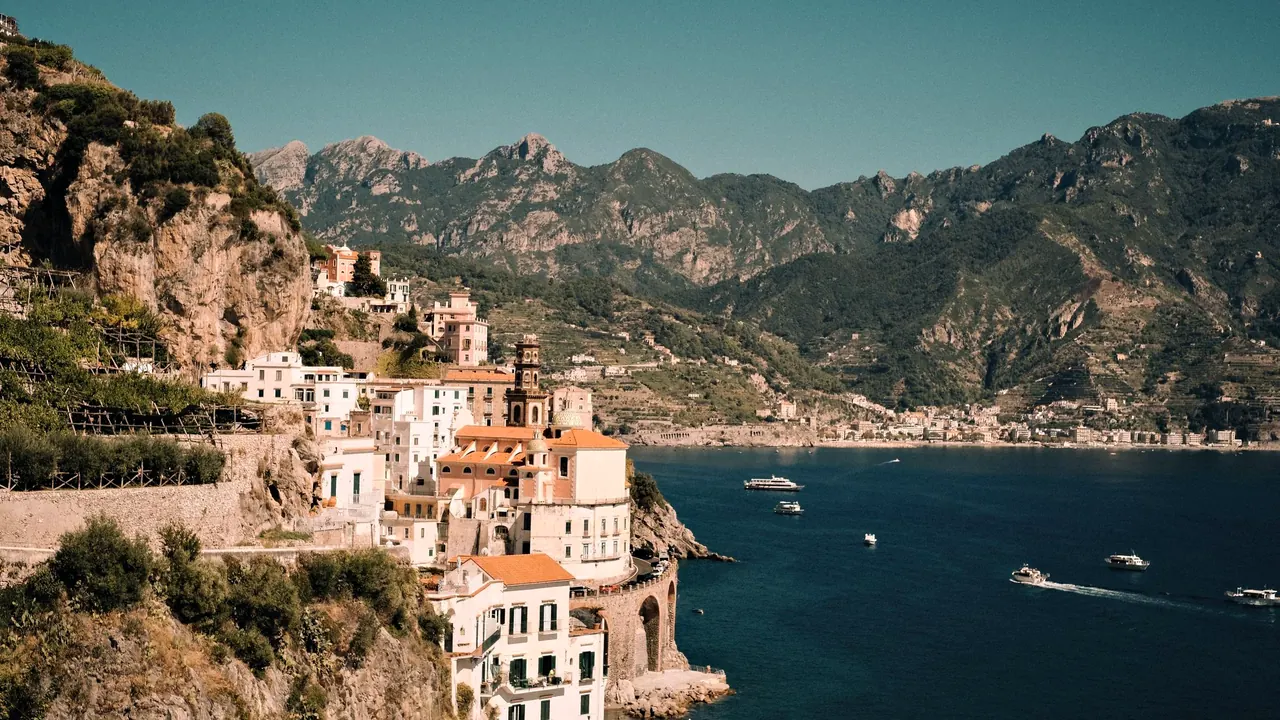
Photos: Portofino by Michal Osmenda, CC BY 2.0, cropped; Amalfi Coast by Alina Chernii, Pexels License.
Portofino or Amalfi Coast?
Our verdict in twelve categories, each scored against the same fixed benchmark cities, and the climate month by month, so you can choose for your trip.
Choose Portofino for
- getting around
Portofino suits a shorter, quieter stay around one small harbour and the protected headland behind it. Everything is a few minutes apart on foot, the trails to San Fruttuoso and the marine reserve are superb, and Genoa and the Cinque Terre are within reach. In return, the evenings are quiet, the food costs a lot for what it is, and there are few sights beyond the village itself.
Choose Amalfi Coast for
- culture and sights
- food and drink
- live music and the arts
The Amalfi Coast is the better pick for a longer stay that mixes swimming, eating and sightseeing. A string of towns gives you Amalfi's cathedral, Ravello's villa gardens and its summer concerts, much better cooking once you leave the waterfronts, and Pompeii, Capri and Paestum within a day. The price is a slow, crowded coast road, a great many steps and very high costs in summer.
Scoreboard
Twelve categories on one fixed scale from 0 to 100. The shaded stretch is the gap between the two.
Your match
Pick a travel style or drag the sliders, and both match scores follow your weighting.
Wins on getting around with your weighting.
Wins on culture and sights and food and drink with your weighting.
What matters to you?
Category by category
What the scores mean for a trip.
Beaches & swimming
Neither destination has long sandy beaches, but the Amalfi Coast has many more places to swim. There are grey-pebble coves at Positano, Amalfi and Atrani and the narrow fjord at Furore, and Maiori and Minori have proper sand with room to spread out. The classic day is a hired boat anchored below the cliffs between Positano and Amalfi.
Portofino has no beach in the village. People swim from the rocks and ladders along the lighthouse path, where the water is very clear, or go to little Paraggi, which is mostly given over to beach clubs. Otherwise, take the boat to the pebbles at San Fruttuoso. It is lovely, but every spot is small and fills quickly.
Food & drink
The Amalfi Coast is clearly the better place to eat. It has scialatielli with clams, fish baked in lemon leaves, colatura from Cetara, Sfusato lemons in everything, and the sfogliatella named after Conca dei Marini. The best meals come from family trattorias in Minori, Maiori and the Agerola hills, not from the waterfronts at Positano and Amalfi.
Portofino's Ligurian cooking has real classics: trofie with pesto, pansoti in walnut sauce and cheese focaccia in the Recco style. In the village, though, you get a few harbour terraces where the setting costs more than the food is worth. Keen eaters head to Camogli or Santa Margherita.
Culture & sights
The Amalfi Coast has far more history to visit. Amalfi's striped cathedral and Cloister of Paradise tell the story of a medieval sea republic, and there is a paper-making museum. Ravello has Villa Rufolo and Villa Cimbrone, and the whole UNESCO-listed coast of pastel towns and lemon terraces is a sight in itself.
Portofino's sights fit into a day: the piazzetta, the church of San Giorgio, Castello Brown and the abbey of San Fruttuoso in its roadless cove. Neither has a major museum, so collections mean Naples from one and Genoa from the other.
Nightlife
Neither is a place for a big night out, but the Amalfi Coast has a bit more going on after dinner. Positano has a few cocktail bars and one or two places open late in summer, and café tables fill Amalfi's cathedral square until around midnight.
In Portofino, the evening is an aperitivo facing the yachts, with people dressed up to be seen, and then dinner. After that the village goes quiet, so for later nights you go to Santa Margherita, Rapallo or Genoa.
Nature & outdoors
Both are superb for the outdoors, but on different scales. The Amalfi Coast has a whole mountain range falling into the sea. You can walk the Path of the Gods above Positano, follow old mule tracks between the villages and climb the shaded gorge of the Valle delle Ferriere. On the water there are kayaks into sea caves, the Grotta dello Smeraldo and snorkelling around Li Galli.
Portofino's outdoors is one protected headland, a regional park on land and a marine reserve at sea. Its trails cross Monte di Portofino to San Fruttuoso and Punta Chiappa, some of them exposed with chains. Divers come for the red coral walls and the bronze Christ of the Abyss.
Day trips
Both make excellent bases for day trips, but the Amalfi Coast reaches more famous places. Pompeii and Herculaneum, Capri by ferry, the Greek temples at Paestum and the archaeological museum in Naples are all within a day. The roads are slow, so boats are often the quickest way out.
From Portofino, the day trips are mainly along the Riviera di Levante: Camogli, Rapallo, Sestri Levante's two bays and the old centre and palaces of Genoa. In summer, ferries also run to the Cinque Terre and Portovenere.
Good for families
Both are poor choices with young children: steep steps, few pushchair-friendly paths and nothing built for children. The difference is where families end up. On the Amalfi Coast, flat Maiori and Minori, with sandier beaches and an easy seafront, are part of the coast itself, and boat trips and the emerald grotto keep children happy.
Portofino offers boats, the walk to the castle and swimming off the rocks. Most families sleep in Santa Margherita or Rapallo and go into Genoa for its aquarium.
Getting around
Getting around is the Amalfi Coast's weak point, because a trip there is spread along many miles of cliff. Positano, Amalfi, Ravello and Maiori all hang off a single road that clogs in summer, so every outing from one town to the next costs time. In season the boats are the better link and turn the journey into part of the view. Out of season you are back on the road, and inside each town nearly everything involves stairs.
Portofino is simpler because there is far less ground to cover. The only awkward stretch is the 5km of narrow road from Santa Margherita, and once you arrive a car is more of a burden than a help. From there, the headland paths and the harbour boats take you on to San Fruttuoso and Camogli without using the road at all.
Shopping & style
The Amalfi Coast has more to browse, and most of it is made locally. Positano has linen and cotton resort clothes and sandal makers who fit a pair while you wait, Amalfi sells handmade paper, and Vietri sul Mare at the eastern end is known for hand-painted majolica.
Portofino's few lanes hold a surprising number of boutiques from big fashion and jewellery houses, plus some Ligurian lace and pesto. You can see it all in under an hour. Markets and a longer browse mean Chiavari, Rapallo or Genoa.
Affordability
Both are among the most expensive places to stay in Italy, but the Amalfi Coast is a little easier to manage. It has cheaper bases on the coast itself, in Maiori, Minori, Atrani and the Agerola hills. Late September and early October bring lower rates while the sea is still warm enough to swim.
Portofino has only a handful of hotels, mostly luxury ones, and the piazzetta charges heavily for the view. The usual way to save is to sleep in Santa Margherita, Rapallo or Camogli and come over for the day.
Live music & performing arts
Here the Amalfi Coast has something Portofino does not. Ravello, long associated with Wagner, puts orchestras on a stage built out over the cliff at Villa Rufolo. A chamber series fills its churches and halls on many summer evenings, and the auditorium below the town adds more.
Portofino has the odd summer concert in the piazzetta or at the castle and little else. For opera or theatre, you spend an evening at Genoa's Teatro Carlo Felice.
Wellness & relaxation
Neither has a bathing tradition, so at both the spas belong to luxury hotels and rest is more a matter of pace. The Amalfi Coast has a slight edge because it has several calm bases away from the crowds: Ravello high above the sea, Atrani, Praiano and Conca dei Marini. Ischia's thermal parks are a long ferry day away.
Portofino's calm comes in the early mornings, the evenings and the months either side of summer, on shaded headland paths with only birdsong and the sea. At midday in high summer, the tour boats fill the harbour.
When should you go?
Pick your month. The climate figures are measured averages, not a forecast.
Portofino in July
Amalfi Coast in July
Daytime high, °C
Rainfall in the month, mm
Where the figures come from
Portofino's temperatures are measured 31 km from the centre, at Genova / Sestri.
Portofino has no rain gauge within 25 km of the centre, so its rainfall comes from a gridded climate dataset read at the destination rather than from a gauge further away.
Amalfi Coast's temperatures are measured 65 km from the centre, at Grazzanise.
Amalfi Coast has no rain gauge within 25 km of the centre, so its rainfall comes from a gridded climate dataset read at the destination rather than from a gauge further away.
Temperature and rainfall are climate normals, averaged over the years shown. Portofino: 1991-2020 normals, Genova / Sestri (31 km from centre). Amalfi Coast: 1991-2020 normals, Grazzanise (64.7 km from centre).
Both coasts are warm enough to swim from June to early October, but the Amalfi Coast runs hotter. Around its main towns, July and August highs reach about 31°C, against 28°C at Portofino, and the sea there is a degree warmer, close to 26°C in August. Amalfi's summers are also very dry and sunny. That heat makes the stairways and mountain paths hard going by midday, so spring and late September are better there for walking and sightseeing.
Autumn is where the two differ most. Portofino turns very wet from September, and October brings around 225mm of rain, so its good season ends quite suddenly. The Amalfi Coast gets wetter more gradually, and its wettest month is November, so it stays pleasant for a beach stay into early October. Winters at both are cool and damp, with highs in the low teens.
Which traveller are you?
For a culture and arts trip, choose the Amalfi Coast. It has the Arab-Norman cathedral at Amalfi, the villas and gardens of Ravello, a Roman villa at Minori and the clifftop summer festival. Pompeii, Herculaneum and Paestum are also within a day's reach.
On a food and nightlife trip, the Amalfi Coast is again the better choice. It has Cetara's colatura, Sfusato lemons and good trattorias in Minori and Agerola, and evenings are livelier in Positano's bars and on Amalfi's cathedral square. Portofino's harbour mostly charges for the view.
For a short city break of two or three days, Portofino is easier. You get a bus from Santa Margherita station, then the whole village, the castle and the lighthouse path are on foot. On the Amalfi Coast, the cliff road and the stairs eat into a short stay.
Before you go
| Measure | Portofino | Amalfi Coast |
|---|---|---|
| Official language | Italian | Italian |
| Currency | Euro (EUR) | Euro (EUR) |
| Sockets | CFL230 V, 50 Hz | CFL230 V, 50 Hz |
| Driving side | Right | Right |
| Time zone | UTC+1, UTC+2 in summer | UTC+1, UTC+2 in summer |
| Emergency number | 112 | 112 |
| Elevation | 20 m | - |
| Main airport | Genoa Cristoforo Colombo Airport (GOA)32 km from centre26 non-stop destinations | Naples International Airport (NAP)131 non-stop destinations |
| Public holidays this year | 13 days | 13 days |
By the numbers
| Measure | Portofino | Amalfi Coast |
|---|---|---|
| Population | 355 | - |
| People per km² | 142 | - |
| Museums within 10 km | 14 | - |
| UNESCO World Heritage sites within 50 km | 2 | - |
| Swim season, months above 21 °C | 4 months | 5 months |
Where else could you go?
Every comparison below shares a destination with this one, so you can follow Portofino or Amalfi Coast somewhere new.
- Genoavs Portofino
- Caprivs Amalfi Coast
- Naplesvs Amalfi Coast
- Cinque Terrevs Portofino
- Procidavs Amalfi Coast
- La Speziavs Portofino