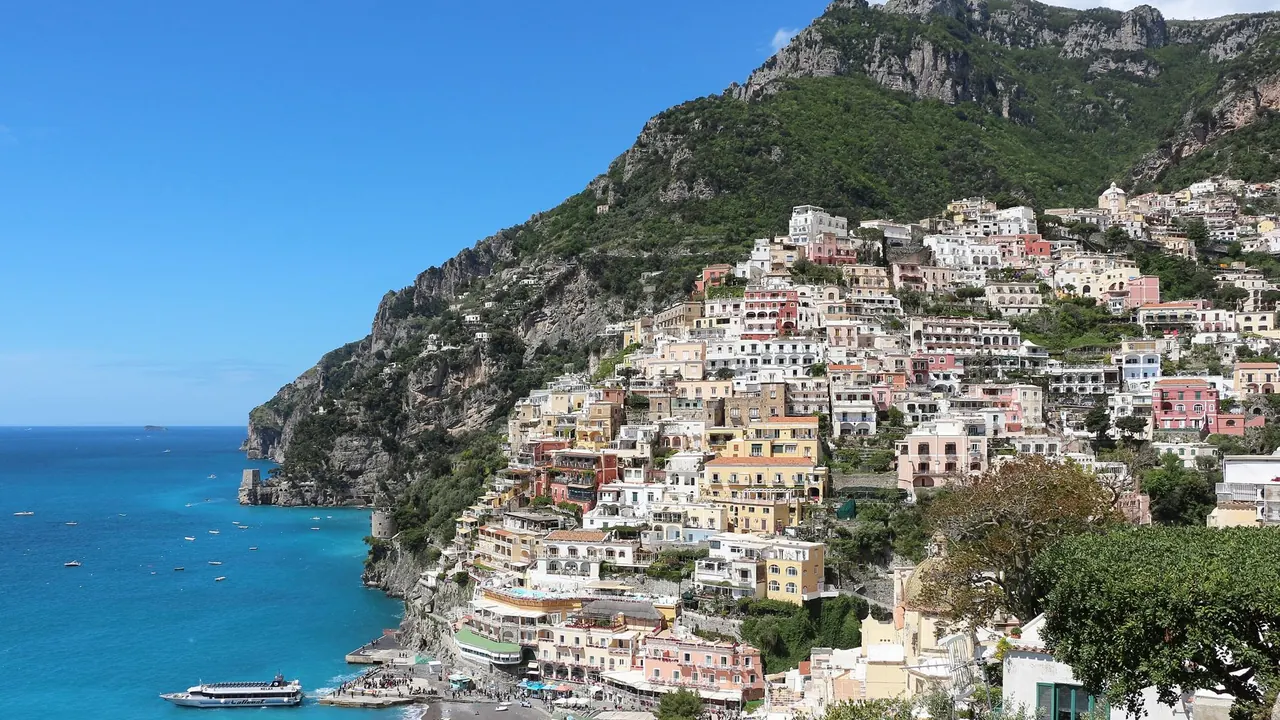
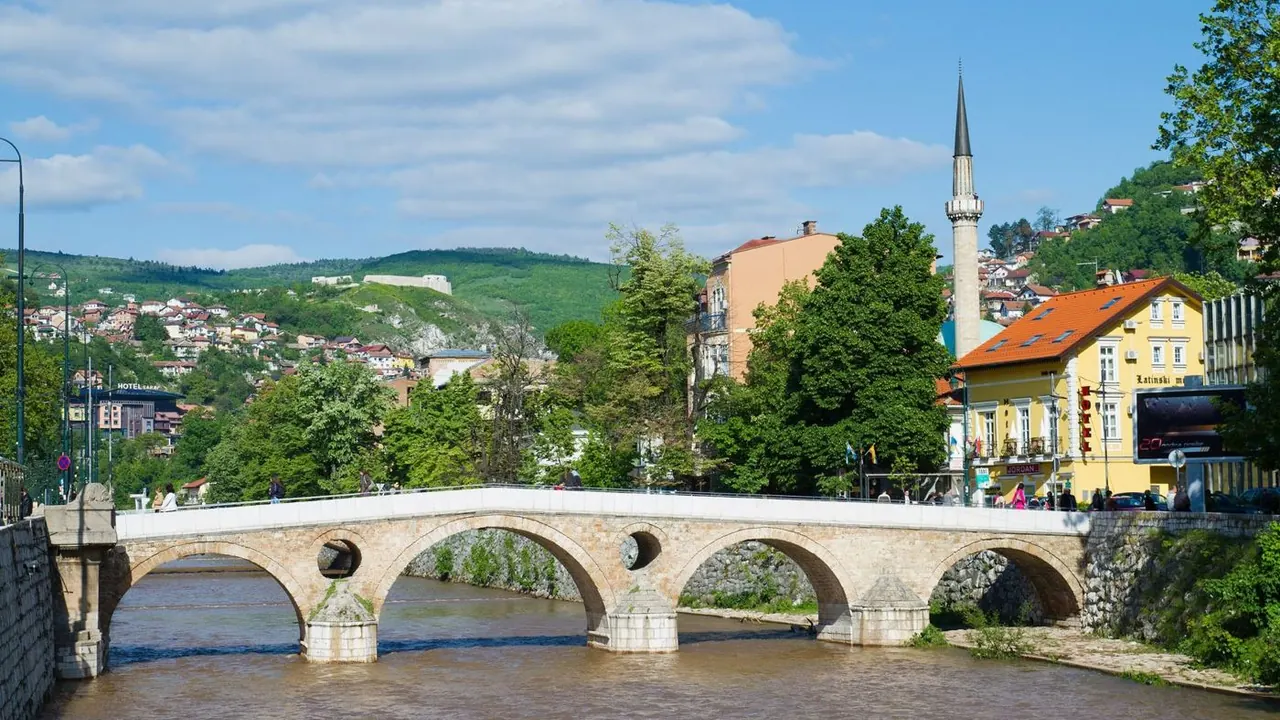
Photos: Positano by Bernard Gagnon, CC BY 4.0, cropped; Sarajevo by Tumi-1983, CC0.
Positano or Sarajevo?
Our verdict in twelve categories, each scored against the same fixed benchmark cities, and the climate month by month, so you can choose for your trip.
Choose Positano for
- beaches
- day trips
- shopping
Positano is for travellers who want the sea and the scenery and are ready to pay for them. You spend the days swimming off coarse beaches below a cliff of pastel houses, walking the Path of the Gods and taking boats to Capri, Amalfi and Ravello. It suits couples on a slow, romantic summer trip far better than anyone after museums, a night out or easy logistics with small children.
Choose Sarajevo for
- prices
- culture and sights
- getting around
Sarajevo rewards curiosity more than sunbathing. In a few flat streets you walk from the Ottoman bazaar to Austro-Hungarian avenues, past mosques, cathedrals and a synagogue, with the history of 1914 and the 1990s siege close by. Ćevapi, Bosnian coffee, café-bars and nearby Olympic mountains cost a fraction of what the Amalfi Coast charges. It is the better choice for a city break, a budget trip or a winter of skiing, though it has no sea at all.
Scoreboard
Twelve categories on one fixed scale from 0 to 100. The shaded stretch is the gap between the two.
Your match
Pick a travel style or drag the sliders, and both match scores follow your weighting.
Wins on beaches and day trips with your weighting.
Wins on prices and culture and sights with your weighting.
What matters to you?
Category by category
What the scores mean for a trip.
Beaches & swimming
Here the gap is total. Positano lives on its beaches: Spiaggia Grande and quieter Fornillo below the town, Arienzo and Laurito down long stairways, and boats running out to coves and Capri. The shore is steep and pebbly, so bring water shoes, but the sea is clear and warm all summer.
Sarajevo has no coast, and the Adriatic is too far away for a day trip. Swimming there means cold mountain rivers, Jablanica lake or a pool, so beach lovers should add a few days on the Croatian or Montenegrin coast.
Food & drink
Sarajevo eats better and far more broadly through the day. Grills in Baščaršija turn out ćevapi in somun bread, pita bakeries sell burek by weight, and older eateries serve slow-cooked lamb and begova čorba, all rounded off with Bosnian coffee and baklava.
Positano's strength is the long seafood lunch on a terrace, with clams, scialatielli and lemon desserts. Menus repeat themselves, though, there is little casual or market food, and much of it closes over winter.
Culture & sights
Sarajevo is far richer for sightseeing. Within a short walk you pass the Gazi Husrev-beg Mosque, the Orthodox and Catholic cathedrals, the Old Synagogue and the Latin Bridge, where the shots of 1914 were fired. The siege years are present at the Tunnel of Hope and the War Childhood Museum.
In Positano the town itself is the sight. The majolica dome of Santa Maria Assunta and the buried Roman villa beneath it fill a morning, and serious museums mean going to Naples.
Nightlife
Neither city is a party destination, but Sarajevo gives you more evenings out. Its café-bars around Ferhadija fill up from the afternoon, and students keep cellar bars and small clubs busy at weekends, with cheap drinks and a sociable crowd all year.
Positano offers aperitivo with a view, a few bars by the beach and one dressy club in a cave, and even that winds down after the summer.
Nature & outdoors
Both are mountain landscapes of real quality, but they are very different kinds. Positano's is vertical and maritime: the Path of the Gods above terraced lemon groves, woods climbing to ridges over 1,000m, and kayaks nosing into grottoes along the cliffs.
Sarajevo's mountains are wooded and open, from the Trebević cable car and its abandoned Olympic bobsleigh track to the grassy ridges of Bjelašnica, the stone village of Lukomir and rafting on the Neretva. It also has proper winter skiing, which the coast cannot offer.
Day trips
Positano has the stronger list of outings, and most of them go by boat. Amalfi, Ravello's gardens, Capri and Sorrento are close by, and Pompeii, Herculaneum and Paestum make full days, although ferries mostly stop in winter.
From Sarajevo, the train along the Neretva gorge to Mostar is the highlight, with Konjic, Blagaj and Počitelj on the same route. Travnik and the Višegrad bridge are good too, but slow roads mean you will usually need a car or a tour.
Good for families
Neither city is easy with small children, but Sarajevo is the gentler of the two. Its flat Old Town takes a pushchair, and the cable car, the carriage rides to Vrelo Bosne and the small zoo give you a few outings, although much of the sightseeing deals with war.
Positano is made of stairs and has nothing aimed at children except the sea. Older swimmers who love boats will enjoy it, while toddlers struggle.
Getting around
Sarajevo is much simpler to move around. Its valley shape means a single tram line links the bazaar with the centre and Ilidža, the core is flat enough to walk, and taxis are cheap for everything beyond.
In Positano every walk involves hundreds of steps. The coast buses crawl in summer, cars are more trouble than they are worth, and the seasonal ferries are the most comfortable way to reach the next town.
Shopping & style
Both offer one distinctive kind of shopping, and in each case it is a narrow one. Positano sells a look, with white linen and printed resort wear in the lanes above the beach and sandals made to measure while you wait.
Sarajevo sells craft. Coppersmiths hammer coffee sets on Kazandžiluk, and the Bezistan offers kilims, slippers and filigree, although you need to sort the real work from the souvenir stock. Away from the bazaar it is mostly malls.
Affordability
This is where the two are furthest apart. Sarajevo is among Europe's cheapest capitals: meals, coffee, trams, museums and central rooms all cost little, and only the Old Town and the summer film festival push prices up.
Positano is at the other extreme. Sea-view rooms, loungers, terrace dinners and boat transfers all cost a lot. Staying in Praiano or Sorrento, or coming in May or October, softens the bill.
Live music & performing arts
Sarajevo has an actual stage life. The National Theatre puts on opera, ballet and drama through the season, the Philharmonic plays regularly, MESS and the jazz festival fill the autumn, and sevdah can be heard in traditional restaurants.
Positano itself offers little beyond occasional church concerts. The real draw is an evening at Ravello's summer festival along the coast.
Wellness & relaxation
Both offer about as much rest, but they get there differently. Positano relies on its upscale hotels: spas and cliffside pools, slow lunches above the sea, and calm in May, June and late September, before and after the crowded, noisy peak.
Sarajevo has the older bathing heritage, with thermal springs at Ilidža used since Roman times and shaded walks at Vrelo Bosne. Lingering over one coffee for an hour is a local habit, though winter smog takes away some of the calm.
When should you go?
Pick your month. The climate figures are measured averages, not a forecast.
Positano in July
Sarajevo in July
Daytime high, °C
Rainfall in the month, mm
Where the figures come from
Positano's temperatures are measured 25 km from the centre, at Capri.
Positano has no rain gauge within 25 km of the centre, so its rainfall comes from a gridded climate dataset read at the city rather than from a gauge further away.
Positano's sunshine is measured 59 km from the centre, at Grazzanise.
Temperature and rainfall are climate normals, averaged over the years shown. Positano: 2005-2025 (sunshine 1991-2020, rainfall 1991-2020) normals, Capri (25.3 km from centre). Sarajevo: 1991-2020 normals, Sarajevo-Bejelave (2 km from centre).
Positano is at its best in summer. June to August are hot, near 30°C at the peak, almost rainless and long on sunshine, and the sea warms to about 26°C by August, staying pleasant for swimming into early October. Rain returns in September, though the days are still warm, and it builds through autumn to a wet November. May and late September suit the cliff walks better than midsummer, when climbing in the midday heat is hard work. Winters are mild but damp and grey.
Sarajevo's inland valley has a much sharper year. Winter highs are only about 4°C in December and January, with little sun, so this is the season for the nearby ski slopes rather than the streets. Rain is spread fairly evenly through the year, with no dry summer like the coast's. Late spring to September is the time for exploring the city and hiking the ridges, with summer warm but rarely punishing.
Which traveller are you?
On a beach and sun trip, Positano is the clear pick. Clear, deep blue water, coves reached by boat and long dry summers beat landlocked Sarajevo, where the nearest proper seaside is a three-hour drive away.
For a culture and arts trip, choose Sarajevo. Its Ottoman bazaar, cathedrals, synagogue, siege memorials and the National Theatre give you days of material. Positano's church and Roman villa take a couple of hours, and its stage life is a summer concert or two.
On a tight budget, Sarajevo is the obvious answer. Meals, trams, taxis, museums and central guesthouses all cost little. Positano ranks among Italy's most expensive places, and sea-view rooms, beach loungers and boat transfers quickly empty a modest wallet.
Before you go
| Measure | Positano | Sarajevo |
|---|---|---|
| Official language | Italian | Croatian, Serbian, Bosnian |
| Currency | Euro (EUR) | Convertible Mark (BAM) |
| Sockets | CFL230 V, 50 Hz | CF230 V, 50 Hz |
| Driving side | Right | Right |
| Time zone | UTC+1, UTC+2 in summer | UTC+1, UTC+2 in summer |
| Emergency number | 112 | 112 |
| Elevation | 142 m | 518 m |
| Main airport | Naples International Airport (NAP)33 km from centre131 non-stop destinations | Sarajevo International Airport (SJJ)7 km from centre38 non-stop destinations |
| Public holidays this year | 13 days | 8 days |
By the numbers
| Measure | Positano | Sarajevo |
|---|---|---|
| City population | 3,729 | 275,524 |
| People per km² | 429 | 1,947 |
| Museums within 10 km | 10 | 25 |
| UNESCO World Heritage sites within 50 km | 5 | 1 |
| Swim season, months above 21 °C | 5 months | - |
Where else could you go?
Every comparison below shares a destination with this one, so you can follow Positano or Sarajevo somewhere new.