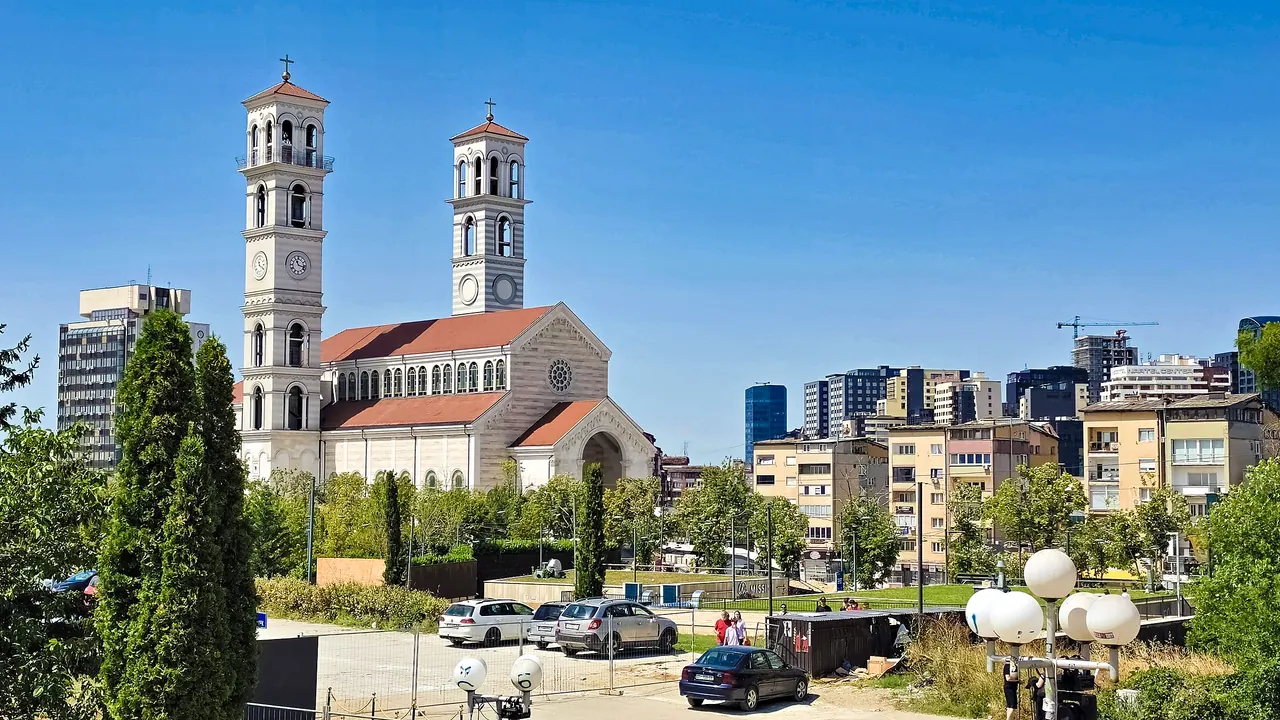
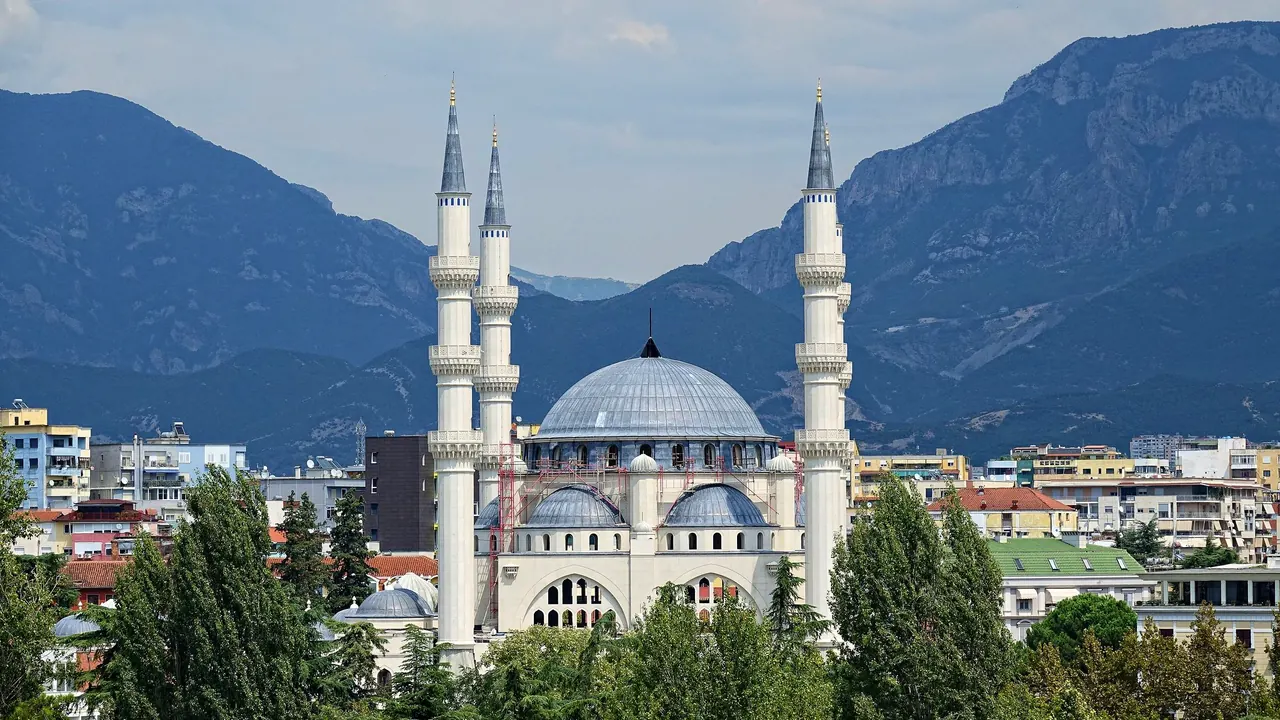
Photos: Pristina by Daciana Cristina Visan, Pexels License; Tirana by Bjørn Christian Tørrissen, CC BY-SA 4.0, cropped.
Pristina or Tirana?
Our verdict in twelve categories, each scored against the same fixed benchmark cities, and the climate month by month, so you can choose for your trip.
Choose Pristina for
- prices
Pristina suits a traveller on a tight budget who is curious about Kosovo's recent story and the medieval Serbian Orthodox monasteries around it. It is the cheaper of the two, its centre takes little time to get to know, and Prizren, Gracanica and Visoki Decani are all short trips away. It works best as one stop on a wider Balkan route, outside the cold winter, rather than as a trip in itself.
Choose Tirana for
- beaches
- nightlife
- food and drink
For most other trips Tirana is the stronger choice. The food is better, with farm restaurants in the hills, and Blloku is a real district for going out. Its Cold War sites stay with you, Mount Dajti rises at the edge of town and a sandy beach is within an hour. Its milder winters also give it a longer season.
Scoreboard
Twelve categories on one fixed scale from 0 to 100. The shaded stretch is the gap between the two.
Your match
Pick a travel style or drag the sliders, and both match scores follow your weighting.
Wins on prices with your weighting.
Wins on beaches and nightlife with your weighting.
What matters to you?
Category by category
What the scores mean for a trip.
Beaches & swimming
Neither city has a shore of its own, but the gap between them is still wide. From Pristina the Adriatic is several hours away across the border in Albania. Summer swimming there means Lake Batlava, a reservoir in wooded hills about forty minutes north-east, or a hotel pool.
Tirana has the sea within an hour: the long sandy beach running from Durrës to Golem, with shallow, warm water that children can manage. It is a crowded strip lined with hotels rather than one of the clear southern coves, but it makes a real beach day possible from the capital.
Food & drink
The two kitchens share a Balkan base of morning burek or byrek and grilled meat, and both cities run on slow coffee. Pristina's strength is the café, above all the macchiato drunk along the pedestrian boulevard. Hearty flija and tavë baked in clay pots round it out, but beyond those the choice narrows quickly.
Tirana's table is broader and fresher, with tavë kosi, fërgesë and produce that tastes of the countryside. The farm restaurants in the hills above town have no real equivalent in Pristina. Blloku and the streets by Pazari i Ri also give more restaurants to choose from, though in both cities high-end dining is thin.
Culture & sights
People visit both capitals for their recent history more than for grand monuments. Pristina's walk takes in the Ottoman remnants around the Imperial Mosque and the bazaar quarter, the Emin Gjiku houses and the latticed National Library. The frescoes at Gracanica, just outside town, are the weightiest stop.
Tirana gives you more to fill your days, mostly through its communist past. Bunk'Art in its Cold War bunker and the House of Leaves are more gripping than anything in Pristina's centre. Skanderbeg Square, with the painted Et'hem Bey Mosque beside it, also gives the city a clearer heart.
Nightlife
Both cities have young crowds and terraces that fill on summer weekends, and neither is wild. In Pristina, evenings carry on from café life: café-bars around the boulevard and in the student area switch to drinks, and there are only a few clubs with DJs.
Tirana has a proper going-out district in Blloku, a grid of cocktail bars, lounge terraces and small clubs. Larger clubs by the Grand Park lake run into the early hours. The mood is dressier and more about being seen, and there is simply more of it.
Nature & outdoors
Pristina's green escape is Germia Park, oak and beech forest with walking and cycling trails at the eastern edge of town. The Mirusha waterfalls, a chain of pools in a limestone canyon, are under an hour's drive. Its real mountains, the Sharr range at Brezovica and the Rugova Gorge leading into the Accursed Mountains, are long days out by car on less developed trails.
Tirana has proper height right at its edge. The cable car up Mount Dajti lifts you to about 1,000m in a quarter of an hour, onto forest trails with views across the plain to the sea. The Bovilla reservoir in its gorge and the hiking around Gamti are within an hour or so, so outdoor days fit easily into a short stay.
Day trips
Both make equally good bases for excursions, and the difference lies in what you go to see. Trips from Pristina are about Ottoman towns and medieval churches: Prizren's old town and fortress, the Patriarchate of Pec and the frescoes of Visoki Decani. Skopje is also in reach across the border. Distances are short and intercity buses cover the routes.
Tirana's excursions span more periods of history. They run from Roman Durrës and ancient Apollonia to Skanderbeg's castle at Kruja and the white houses of Berat. The roads are slower, so most of these take a full day by minibus, tour or hire car.
Good for families
In both cities children are welcome until late in the evening, and in both the pavements are hard going with a pushchair. Pristina has little to offer beyond the pedestrian boulevard and Germia Park with its summer pool. That is enough for a stop on a regional trip, not for a longer stay.
Tirana has more for families to do: the lake and playgrounds of the Grand Park, the cable car up Dajti, a small zoo and the sandy beach at Durrës within an hour. With young children, though, the summer heat needs planning around.
Getting around
Pristina is the easier city to leave, with frequent intercity buses from the main station to Prizren, Peja and Skopje. Inside the city, comfortable walking ends soon after Mother Teresa Boulevard, where cars park on the pavements and streets turn uneven. Most visitors use cheap taxis rather than try to work out the buses.
Tirana's flat centre is better on foot. Pedestrian streets run around Skanderbeg Square, and Blloku, the Pyramid and the market are all a short walk apart. Taxis cover the outlying stops such as Bunk'Art and the Dajti cable car, but day trips mostly mean minibuses, tours or a hire car.
Shopping & style
Neither city is a place to shop, and both sell the same crafts: filigree silver, felt caps and embroidered textiles. Tirana comes out ahead because of Pazari i Ri, a real food market of cheese, olives, honey and raki with souvenir and copperware shops beside it, and because Kruja's bazaar is a day trip away. Pristina's bazaar quarter has only a few stalls, so its best buys are Rahovec wine and silver, and its malls are out on the highway.
Affordability
Both are among Europe's cheapest capitals, and a comfortable stay costs little in either. Pristina is the easier on the wallet: taxis can be used without a second thought and most sights are free or nearly so. Tirana is not far behind. A night out in the smarter restaurants and cocktail bars of Blloku is where costs there start to add up.
Live music & performing arts
There is not much here for a visitor to plan around in either city, and theatre in both is performed in Albanian. Tirana's main draw is one venue, the opera and ballet house on Skanderbeg Square, where seats are easy to get, along with open-air concerts in summer. Pristina's philharmonic and small opera and ballet company play in halls such as the Palace of Youth and Sports, and the city adds a few jazz, classical and film festivals through the year.
Wellness & relaxation
Pristina's thermal springs at Banja e Pejes and Kllokot are old-fashioned health resorts more than an hour away, and the Ottoman hammam in town no longer works as a bath. Tirana's nearest equivalent is Llixha near Elbasan, about an hour out, with simple spa hotels around hot sulphur water. Otherwise a spa treatment in either capital means the wellness area of a larger hotel.
The real difference is in how the days slow down. In Pristina, rest mostly means a long sit over a macchiato, with traffic and building noise close by. Tirana adds the evening xhiro along the boulevards and quieter corners in the Grand Park and on Dajti's forested slopes.
When should you go?
Pick your month. The climate figures are measured averages, not a forecast.
Pristina in July
Tirana in July
Daytime high, °C
Rainfall in the month, mm
Where the figures come from
Pristina has no weather station within reach, so its figures come from a gridded climate model rather than a measured record, and read a broad area rather than one spot.
Temperature and rainfall are climate normals, averaged over the years shown. Pristina: 2001-2020 normals, NASA POWER reanalysis grid, no weather station within 90 km. Tirana: 1961-1990 normals, Tirana (3 km from centre).
Pristina has a continental climate. Winters are properly cold, with January highs of about 2°C, so December to February is a poor time for walking the streets. May, June and September are the most comfortable months, and July and August are warm without being punishing. Rain falls fairly evenly through the year, with no real dry season.
Tirana is warmer all year but much wetter in winter. Even in January the days reach about 12°C, but November to January is the rainy season, with up to 172mm in November and little sunshine. July and August are hot, around 31°C, and very sunny. The sea at Durrës reaches about 25°C, warm enough for swimming from June to September. For walking the city, May and late September to October are the best months.
Which traveller are you?
On a trip on a tight budget, Pristina is the better pick. It is the cheaper of the two capitals, and taxis cost too little to worry about. Most sights are free, and frequent, inexpensive buses run day trips to Prizren and the monasteries.
For a food and nightlife trip, Tirana wins clearly. You can eat village-style lamb and fërgesë in town or eat in farm restaurants in the hills. Blloku keeps its cocktail bars and clubs going past midnight, while Pristina's evenings stay in its café-bars.
On a beach and sun trip, Tirana is the only real option. The sandy shore at Durrës is under an hour away, with warm water and long, sunny summers. From Pristina the nearest sea is several hours' drive away.
Before you go
| Measure | Pristina | Tirana |
|---|---|---|
| Official language | Albanian, Serbian | Albanian |
| Currency | Euro (EUR) | Lek (ALL) |
| Sockets | F230 V, 50 Hz | CF220 V, 50 Hz |
| Driving side | Right | Right |
| Time zone | UTC+1, UTC+2 in summer | UTC+1, UTC+2 in summer |
| Emergency number | 112 | 112 |
| Elevation | 652 m | 110 m |
| Main airport | Priština Adem Jashari International Airport (PRN)15 km from centre42 non-stop destinations | Tirana International Airport Mother Teresa (TIA)13 km from centre121 non-stop destinations |
| Public holidays this year | - | 14 days |
By the numbers
| Measure | Pristina | Tirana |
|---|---|---|
| Population | 227,466 | 389,323 |
| People per km² | 435 | 9,314 |
| Museums within 10 km | 4 | 11 |
| UNESCO World Heritage sites within 50 km | 1 | 0 |
| Swim season, months above 21 °C | - | 5 months |
Where else could you go?
Every comparison below shares a destination with this one, so you can follow Pristina or Tirana somewhere new.