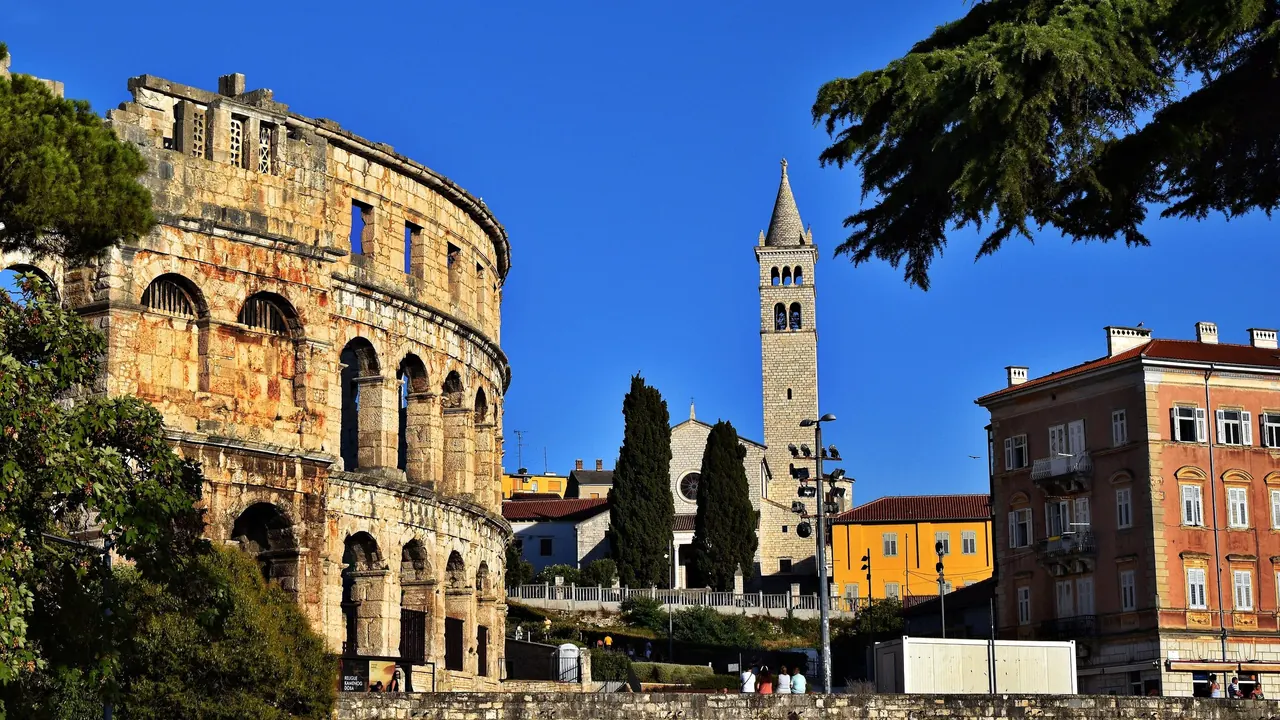
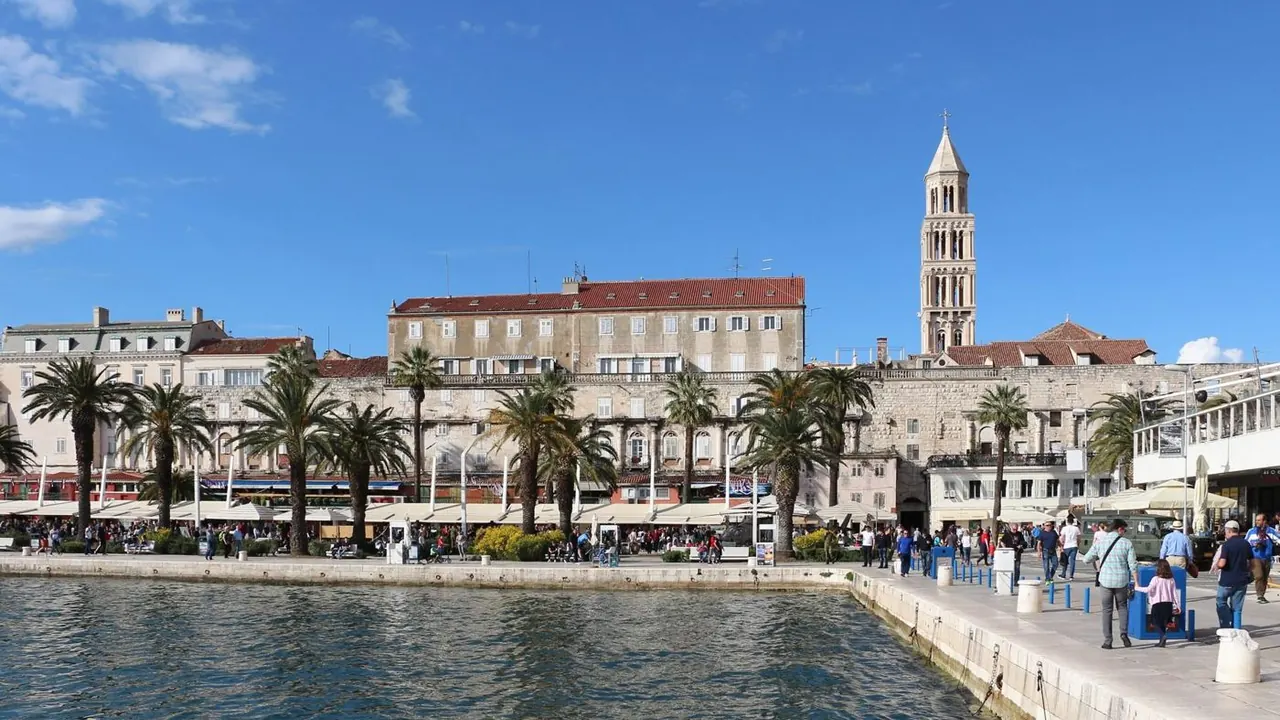
Photos: Pula by Miroslav.vajdic, CC BY-SA 4.0, cropped; Split by Bernard Gagnon, CC BY-SA 4.0, cropped.
Pula or Split?
Our verdict in twelve categories, each scored against the same fixed benchmark cities, and the climate month by month, so you can choose for your trip.
Choose Pula for
- families
- prices
Pula is the better pick for a slower, car-based trip around Istria. You get a Roman Arena still standing whole above the harbour, the wild coves of Cape Kamenjak, and hill towns where truffles and wine are part of the day out. Families with small children also do slightly better here, with sheltered bays near Medulin, an aquarium inside an old fort and theme parks within an hour. Evenings are quiet.
Choose Split for
- getting around
- nightlife
- nature and the outdoors
Split is for travellers who want a livelier base and no need for a car. You can walk from Diocletian's Palace to a swim at Bačvice, catch a ferry to the islands from the same harbour, and spend active days on ridge trails or in the Cetina canyon. Summer nights in the palace alleys carry on much later than anything Pula offers.
Scoreboard
Twelve categories on one fixed scale from 0 to 100. The shaded stretch is the gap between the two.
Your match
Pick a travel style or drag the sliders, and both match scores follow your weighting.
Wins on families and prices with your weighting.
Wins on getting around and nightlife with your weighting.
What matters to you?
Category by category
What the scores mean for a trip.
Beaches & swimming
The swimming is equally good in both, but it feels different. Pula has no beach in town. You swim from rocks, platforms and pebble coves on the peninsulas to the south, and the best water is at Cape Kamenjak, a wild, protected headland about 10km out, where water shoes are a must.
In Split you can walk from the old town to the sea. Bačvice is a shallow, sandy, sociable bay where locals play picigin, and the Marjan coves are quieter. For longer beaches, people take the ferry to Brač or Hvar. Overall, Pula's coast is wilder and Split's is more urban.
Food & drink
In Pula the best meals are often a drive away, while in Split they are a short walk from your room. Pula cooks Istrian food: fuži pasta with truffle or game sauce, scampi buzara and cured pršut, with Malvazija and Teran to drink. In town the choice is modest, and the family taverns in the hinterland villages and small harbours are where the kitchen shows its best.
Split serves Dalmatian classics such as pašticada with gnocchi, black risotto and peka, which you order ahead, with Plavac Mali and Pošip to drink. The good konobas are in Varoš and the streets behind the Riva, and the fish market and Pazar sit at the edge of the palace.
Culture & sights
Each has one great Roman monument, but Split's is something you live inside. Diocletian's Palace is a working neighbourhood of houses, shops and alleys, and its cathedral was once the emperor's mausoleum. The Meštrović Gallery on Marjan adds a fine art museum that Pula cannot match.
Pula's Arena is among the best-preserved amphitheatres anywhere. The Temple of Augustus, the Arch of the Sergii and the Austro-Hungarian forts add history from several eras, but they are separate set pieces rather than a living old town. Both cities can be seen in a day or two.
Nightlife
Split gives a real night out in summer. Small bars fill the stone stairways of the palace, and the crowd moves on to clubs around Bačvice that run into the early hours. Pula's evenings are drinks on terraces by the Forum, beach bars on Verudela and a handful of small clubs, and a glass of wine facing the lit-up Arena is often the high point. Out of season both cities go quiet.
Nature & outdoors
Split has much more varied terrain close at hand. Marjan's pine forest and cliffs begin at the edge of town, Mosor and Kozjak have ridge hikes behind the city, and Biokovo, the Cetina canyon at Omiš and the waterfalls of Krka are each about an hour away. The islands make sailing easy.
Pula's southern Istria is low and stony, with no mountains. Kamenjak is good for walking, cycling, kayaking and spotting dinosaur footprints, Premantura bay suits windsurfing, and naval-era wrecks attract divers. Quiet inland roads suit cyclists, but the nearest real hills, on Učka, are about an hour and a half away.
Day trips
Both are excellent bases for day trips, but you get around in different ways. From Pula, Istria is explored by car: Venetian Rovinj, the Byzantine mosaics of Poreč, the hilltop towns of Motovun and Hum, and the Brijuni islands just offshore. Piran and Trieste are within two hours' drive.
From Split, buses and ferries do most of the work. Trogir and Šibenik have UNESCO-listed cores, Salona and Klis are on the city's edge, and Hvar, Brač and Vis are reached by sea. Pula leans towards hill towns and food, and Split towards islands.
Good for families
Pula has a little more for children. There is an aquarium inside an Austro-Hungarian fort, the Arena has underground passages to explore, and the sheltered bays at Medulin and Premantura suit small swimmers. A dinosaur park and a water park are within an hour, though you will need a car for most of it.
Split's appeal is simpler: paddling at Bačvice, shade and space on Marjan, and the thrill of a ferry ride. With no aquarium or theme park, and packed streets in July and August, it has less to fill a week with young children.
Getting around
Split is much easier without a car. The palace, the markets, Varoš and Bačvice are all a short walk apart, and the ferry port, bus station and railway station sit together on the harbour, so leaving town is simple. The catch is the palace's stepped stone streets, which are hard with a pushchair.
Pula's old centre is flat and easy on foot, and buses reach Verudela. Beyond that, regional buses are infrequent and the railway is of little use, so Kamenjak and the hill towns really need a car or scooter.
Shopping & style
Neither city is a shopping destination, and in both the best things to take home are edible. Pula's specialities are Istrian truffle products, pršut and olive oil from producers in the countryside. Split adds a little more browsing, with galleries, jewellers and ties inside the palace, plus the Pazar market for figs, honey and local brandies.
Affordability
Costs are similar, with Pula perhaps a touch easier on the budget. In both, July and August bring room rates close to Western European levels and tourist pricing beside the main sights. The extras differ: in Pula, car hire and boat trips add up, while in Split it is fish sold by weight on the waterfront and island ferries for a family. Spring and late September are far kinder in each.
Live music & performing arts
Pula's great night out is a summer concert or film screening inside the Roman Arena, with the stone arches lit above the crowd. For the rest of the year there is drama in Croatian at the Istrian National Theatre and little else.
Split has a 19th-century opera house, the Croatian National Theatre, where opera and ballet run through the season and need no Croatian. In summer the Split Summer Festival moves performances into the Peristyle, and klapa harmony singing echoes in the domed vestibule of the palace.
Wellness & relaxation
Neither city has a spa tradition, but Split makes slowing down easier. Dalmatian fjaka, the unhurried idleness of long coffees on the Riva, sets the pace outside high summer. The pine woods on Marjan and the quieter islands are close at hand when the old town gets loud.
In Pula, wellness mostly means resort hotel spas on Verudela and in Medulin. The rest of the calm comes from coastal walks and quiet days in the Istrian countryside.
When should you go?
Pick your month. The climate figures are measured averages, not a forecast.
Pula in July
Split in July
Daytime high, °C
Rainfall in the month, mm
Where the figures come from
Pula's temperatures are measured 87 km from the centre, at Trieste.
Pula has no rain gauge within 25 km of the centre, so its rainfall comes from a gridded climate dataset read at the city rather than from a gauge further away.
Temperature and rainfall are climate normals, averaged over the years shown. Pula: 1991-2020 normals, Trieste (87 km from centre). Split: 1991-2020 (sunshine 1971-2000, rainfall 1981-2010) normals, Split / Marjan (0.9 km from centre).
The two follow the same rhythm. The sea is warm enough for swimming from June to September and reaches about 24°C in high summer in both, with Split's water staying slightly warmer into October. Split is the hotter and sunnier of the two. July and August reach around 31°C there, against 29°C in Pula, and Split's summer months are very dry, while Pula sees a little more rain right through the season.
Autumn brings the rain to both, starting in September in Pula and in October in Split, and November is the wettest month in each at about 100mm. For walking the streets or the hills, May and late September are the sweet spots, because midsummer afternoons are hard going, especially in Split. In winter Split is the milder and brighter of the two, though neither is a beach destination then.
Which traveller are you?
On a family trip with young children, Pula suits a slower beach week with a hire car, built around calm swimming and short outings to places made for children. Split works better for families with older children who enjoy walking, ferries and city streets.
For an outdoors trip, Split wins clearly. Marjan's trails start at the edge of the old town, Mosor and Biokovo offer real mountain hiking, Omiš has rafting and canyoning, and sailing among Brač, Hvar and Vis begins at the harbour.
On a food and nightlife trip, Split is the better choice. The cooking in both cities is equally good in its own regional style, but Split's summer evenings move from the Riva into packed palace bars and on to clubs at Bačvice, while Pula's evenings stay quiet.
Before you go
| Measure | Pula | Split |
|---|---|---|
| Official language | Croatian | Croatian |
| Currency | Euro (EUR) | Euro (EUR) |
| Sockets | CF230 V, 50 Hz | CF230 V, 50 Hz |
| Driving side | Right | Right |
| Time zone | UTC+1, UTC+2 in summer | UTC+1, UTC+2 in summer |
| Emergency number | 112 | 112 |
| Elevation | 5 m | 0 m |
| Main airport | Pula Airport (PUY)7 km from centre34 non-stop destinations | Split Saint Jerome Airport (SPU)12 km from centre69 non-stop destinations |
| Public holidays this year | 14 days | 14 days |
By the numbers
| Measure | Pula | Split |
|---|---|---|
| City population | 52,220 | 160,577 |
| People per km² | 971 | - |
| Museums within 10 km | 4 | 11 |
| UNESCO World Heritage sites within 50 km | 1 | 4 |
| Swim season, months above 21 °C | 4 months | 4 months |
Where else could you go?
Every comparison below shares a destination with this one, so you can follow Pula or Split somewhere new.