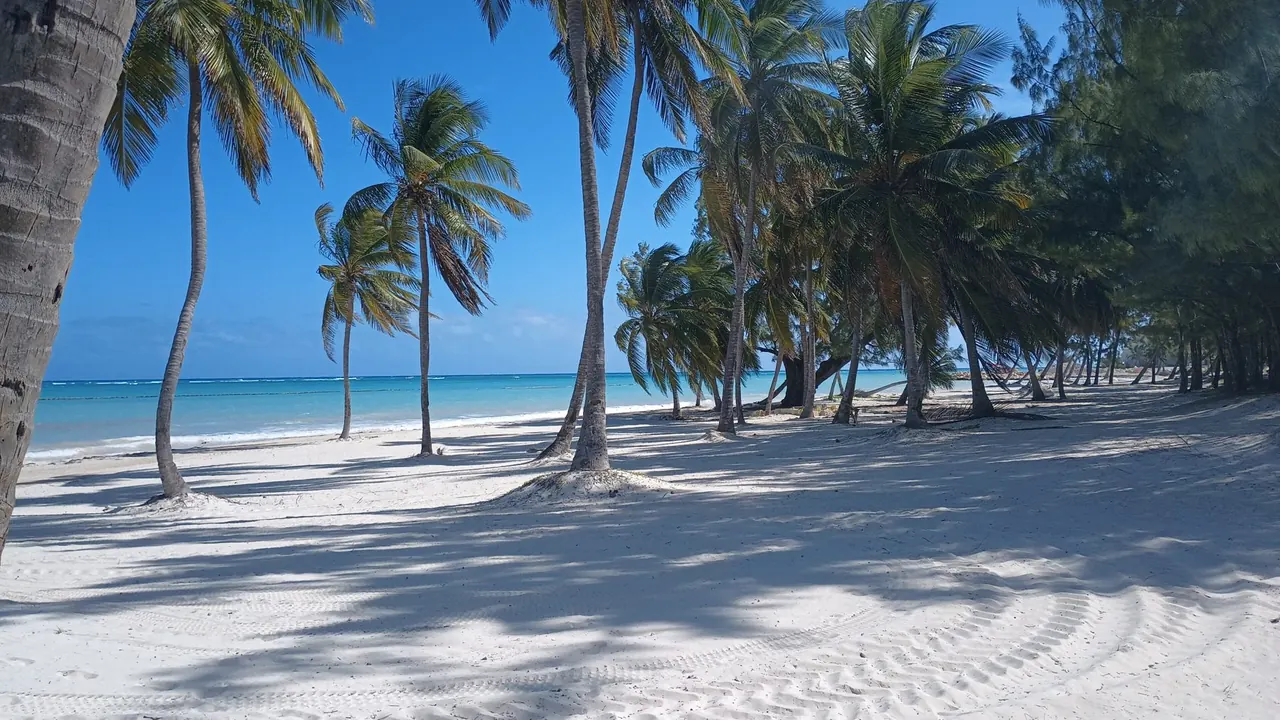
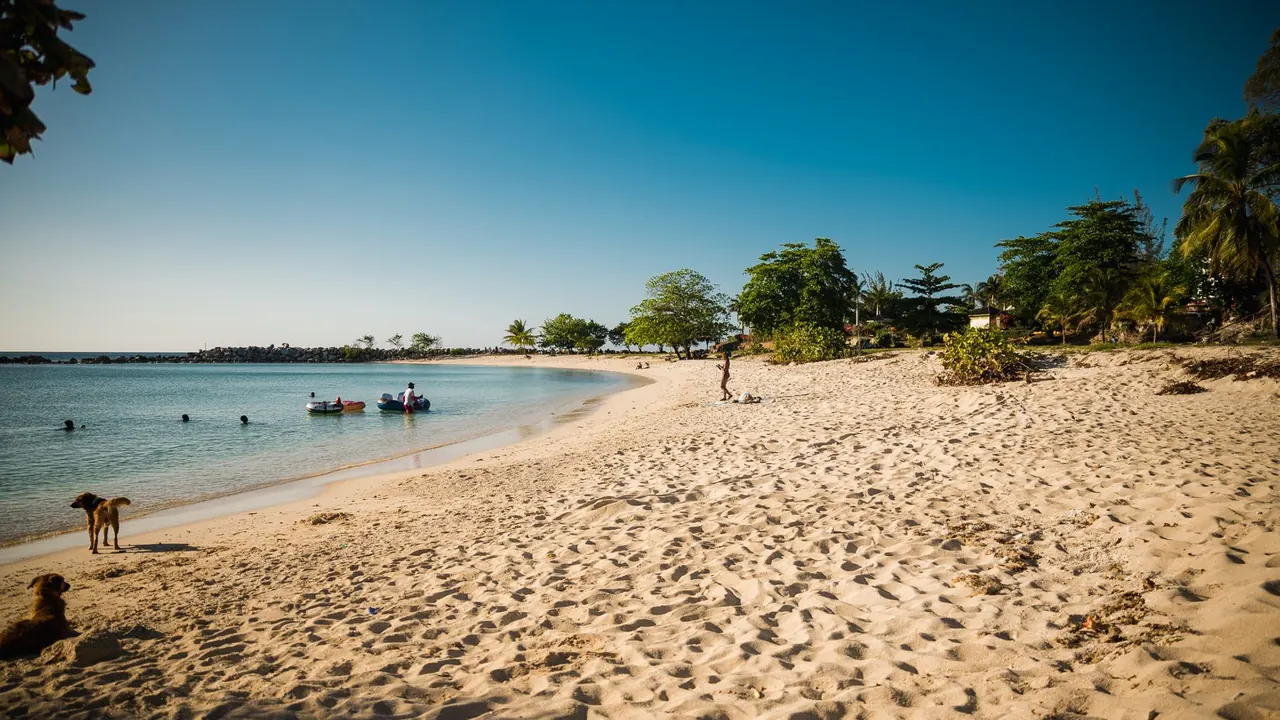
Photos: Punta Cana by Mary Mark Ockerbloom, CC0; Montego Bay by Dre Dawkcide, Pexels License.
Punta Cana or Montego Bay?
Our verdict in twelve categories, each scored against the same fixed benchmark cities, and the climate month by month, so you can choose for your trip.
Choose Punta Cana for
- families
- beaches
- wellness
If the beach itself is the whole plan, Punta Cana is the better pick. Its long coast of pale sand from Juanillo to Macao is broader and more varied than anything around Montego Bay, more of its resorts are built around children, and the flat, self-contained coast makes for an easy week with little reason to leave. Anyone after history or a memorable local meal will have to travel for it.
Choose Montego Bay for
- food and drink
- culture and sights
- live music and the arts
Montego Bay suits travellers who want the Caribbean with some Jamaican character outside the resort gates. Jerk pits, patty bakeries and fish shacks give it a real local kitchen. The green hills behind the coast offer river rafting, zip lines and the karst of Cockpit Country, and Rose Hall, Falmouth's Georgian streets and the reggae of Sumfest give a curious visitor reasons to go out.
Scoreboard
Twelve categories on one fixed scale from 0 to 100. The shaded stretch is the gap between the two.
Your match
Pick a travel style or drag the sliders, and both match scores follow your weighting.
Wins on families and beaches with your weighting.
Wins on food and drink and culture and sights with your weighting.
What matters to you?
Category by category
What the scores mean for a trip.
Beaches & swimming
Both have calm, reef-sheltered water that stays warm all year, but Punta Cana has far more sand. Its beaches run almost unbroken along the coast and change character as you go: long and sociable at Bávaro, quieter at Juanillo, open and wild with surf at Macao, with Saona Island a catamaran ride away.
Montego Bay's beaches are short curves by comparison: Doctor's Cave on the Hip Strip, Cornwall and Dead End in town, and resort sand at Rose Hall and Ironshore. For a long open beach you need Negril, a long drive west. Punta Cana's one drawback is the sargassum seaweed that some summers bring ashore.
Food & drink
Montego Bay eats better, mainly because local cooking is closer at hand and part of the visit. Jerk smoked over pimento wood at roadside pits, patties from bakeries, curry goat and escovitch fish are easy to find, and Blue Mountain coffee is everywhere.
In Punta Cana the resort buffet and themed à la carte rooms dominate, and Dominican dishes such as la bandera, sancocho and mangú are found in the workers' comedores you have to seek out. Its treat is grilled lobster at the beachfront places in Bávaro and the Cap Cana marina. Neither has much fine dining.
Culture & sights
Neither is a place for museums, but Montego Bay at least has a past you can visit. Rose Hall and Greenwood are restored plantation great houses, Sam Sharpe Square keeps the memory of the 1831 rebellion and the old Cage lock-up, and Falmouth's Georgian streets are close by.
Punta Cana was built as a resort coast from the 1970s and has essentially nothing of its own beyond small craft and cigar displays. History there means a long day out to Santo Domingo.
Nightlife
Evenings are on a similar scale, and in both many guests never leave the resort bar and the nightly show. The difference is in sound and setting. Montego Bay's nights out are the open-air bars of the Hip Strip and, more memorably, local street dances and waterfront parties with sound systems playing dancehall and reggae, best attended with someone who knows them.
Bávaro in Punta Cana does big produced nights instead: party-show clubs with acrobats and confetti, a club inside a limestone cave and colmados playing bachata and reggaeton late. It suits a group wanting one or two big nights rather than a local scene.
Nature & outdoors
Montego Bay has the more varied outdoors because it has hills. Bamboo rafting on the Martha Brae, zip lines and horse rides across old estates, hummingbirds feeding from your hand at Rocklands and guided walks into Cockpit Country's caves add a great deal to the reefs of the marine park.
Punta Cana is flat, so its outdoors is mostly at sea: reef diving, the starfish pool off Saona, kitesurfing at Cabeza de Toro and deep-sea fishing for marlin. On land there are the lagoon trails of Indigenous Eyes and the Hoyo Azul sinkhole at Cap Cana, but little more.
Day trips
Montego Bay has more worthwhile outings within reasonable range, and in different directions. Falmouth's Georgian town is about forty minutes away, Negril's cliffs and sunsets lie to the west, and inland are Bob Marley's birthplace at Nine Mile and the Appleton rum estate. The roads are slow, so most people book a tour or a driver.
Punta Cana's nearer outings are Higüey's basilica, the Mediterranean-style stone village of Altos de Chavón and the fishing village of Bayahibe. Its best excursion, Santo Domingo's Zona Colonial, means a very long day with hours on the road each way.
Good for families
Punta Cana is the easier choice with children. More of its resorts are designed around them, with kids' clubs, splash parks and family suites, and adventure parks, dolphin encounters and Saona boat trips make good days out, though each needs a tour or a taxi.
Montego Bay works well inside a family resort too, with calm, shallow water and outings such as glass-bottom boats and Rocklands. Beyond the hotel, though, the chaotic traffic, missing pavements and persistent vendors keep most families close to base.
Getting around
Both are hard work without a driver, in different ways. Montego Bay's airport sits right beside the Hip Strip, which you can walk, but the resorts lie kilometres out along the coast, the route taxis are hard for a visitor to work out and driving is on the left.
Punta Cana has no centre at all, only gated resorts strung along the coast with long driveways. Its compensation is the beach itself, where you can walk for miles between hotels, and the guaguas on the main road towards Higüey are usable if you are willing to try.
Shopping & style
Neither is a reason to travel for shopping, and both rely on craft stalls where haggling is expected. What differs is what you bring home. From Montego Bay it is mostly edible: Blue Mountain coffee, jerk seasoning and rum, with duty-free jewellery and cigars near the cruise port.
Punta Cana offers larimar, the pale blue stone found only on this island, along with amber, cigars, vanilla and faceless dolls. Its open-air malls in Bávaro and Cap Cana add resort fashion and a few upscale labels.
Affordability
Montego Bay asks a little more of the wallet. Its resorts are priced for a North American market, and tourist taxis, excursions and Hip Strip menus all charge visitor rates, so the savings come from roadside jerk, patties, fish shacks and small guesthouses away from the coast.
Punta Cana is a little kinder, because its all-inclusives run from modest to lavish and are often good value when booked with flights. The money there also goes outside the package, on fixed taxi fares, boat trips and beachfront menus, but guaguas, comedores and the small apartment hotels of Los Corales give a real budget route.
Live music & performing arts
Montego Bay has the stronger claim, and it rests on reggae. Reggae Sumfest each summer is a festival known well beyond Jamaica, and dancehall and reggae run through the local nights, even if the rest of the year is mostly cover bands in Hip Strip bars.
Punta Cana offers glossy acrobatic and tribute spectacles in Bávaro and resort theatre shows. The merengue and bachata bands at beach bars are the genuine part. Neither has theatre or classical music.
Wellness & relaxation
In both, wellness means a resort spa and slow beach days, with no bathing tradition of their own. Punta Cana's spas tend to go a step further, with hydrotherapy circuits, steam rooms and treatments using local cacao, coffee and coconut, and the self-contained coast has little to pull you away.
Montego Bay offers open-air spa pavilions by the sea, massages on the sand and many adults-only resorts. The town beyond the gates is noisy, though, so how calm your stay feels depends even more on the hotel you pick.
When should you go?
Pick your month. The climate figures are measured averages, not a forecast.
Punta Cana in July
Montego Bay in July
Daytime high, °C
Rainfall in the month, mm
Temperature and rainfall are climate normals, averaged over the years shown. Punta Cana: 1993-2020 (rainfall 1991-2020) normals, Punta Cana (0.9 km from centre). Montego Bay: 1991-2020 normals, Montego Bay / Sangster (3.7 km from centre).
Both are warm enough to swim in every month. The sea stays around 27°C even in winter and nears 30°C off Montego Bay by September. Montego Bay runs hotter in summer, reaching 34°C in July and August, which makes walking around town at midday hard work. Punta Cana stays a couple of degrees cooler through the same months.
The rain follows a similar pattern in both. February and March are the driest months, showers pick up in May and the wettest stretch runs from September to November. Montego Bay's autumn is the wetter of the two, with about 158mm in October against Punta Cana's 127mm. Montego Bay also gets a sharp burst of rain in May, and its sunniest spell runs from March to July.
Which traveller are you?
On a beach and sun trip, Punta Cana is the stronger choice. Its sand runs for kilometres along the eastern tip, so you can choose a quiet stretch at Juanillo, a sociable one at Bávaro or surf at Macao, while Montego Bay's town beaches are small.
For a culture and arts trip, Montego Bay is the clear pick, though neither is a heritage destination. Rose Hall, Sam Sharpe Square and nearby Falmouth give it real history, and Reggae Sumfest outclasses anything on Punta Cana's resort stages.
On a family trip with children, Punta Cana makes life easier. More of its resorts are designed around kids, the beaches at Bávaro and Juanillo shelve gently for small swimmers, and Saona boat trips and adventure parks fill the days out.
Before you go
| Measure | Punta Cana | Montego Bay |
|---|---|---|
| Official language | Spanish | English, Jamaican Patois |
| Currency | Dominican Peso (DOP) | Jamaican Dollar (JMD) |
| Sockets | AB110 V, 60 Hz | AB116 V, 50 Hz |
| Driving side | Right | Left |
| Time zone | UTC-4 | UTC-5 |
| Emergency number | 911 | Police 110/112/119/911, ambulance 110, fire 110 |
| Elevation | 28 m | 19 m |
| Main airport | Punta Cana International Airport (PUJ)1 km from centre93 non-stop destinations | Sangster International Airport (MBJ)4 km from centre49 non-stop destinations |
| Public holidays this year | 13 days | 10 days |
By the numbers
| Measure | Punta Cana | Montego Bay |
|---|---|---|
| City population | 138,919 | 123,994 |
| People per km² | 292 | - |
| Museums within 10 km | 0 | 0 |
| UNESCO World Heritage sites within 50 km | 0 | 0 |
| Swim season, months above 21 °C | 12 months | 12 months |
Where else could you go?
Every comparison below shares a destination with this one, so you can follow Punta Cana or Montego Bay somewhere new.
- Negrilvs Montego Bay
- La Romanavs Punta Cana
- Ocho Riosvs Montego Bay
- Kingstonvs Montego Bay
- Santo Domingovs Punta Cana
- San Juanvs Punta Cana