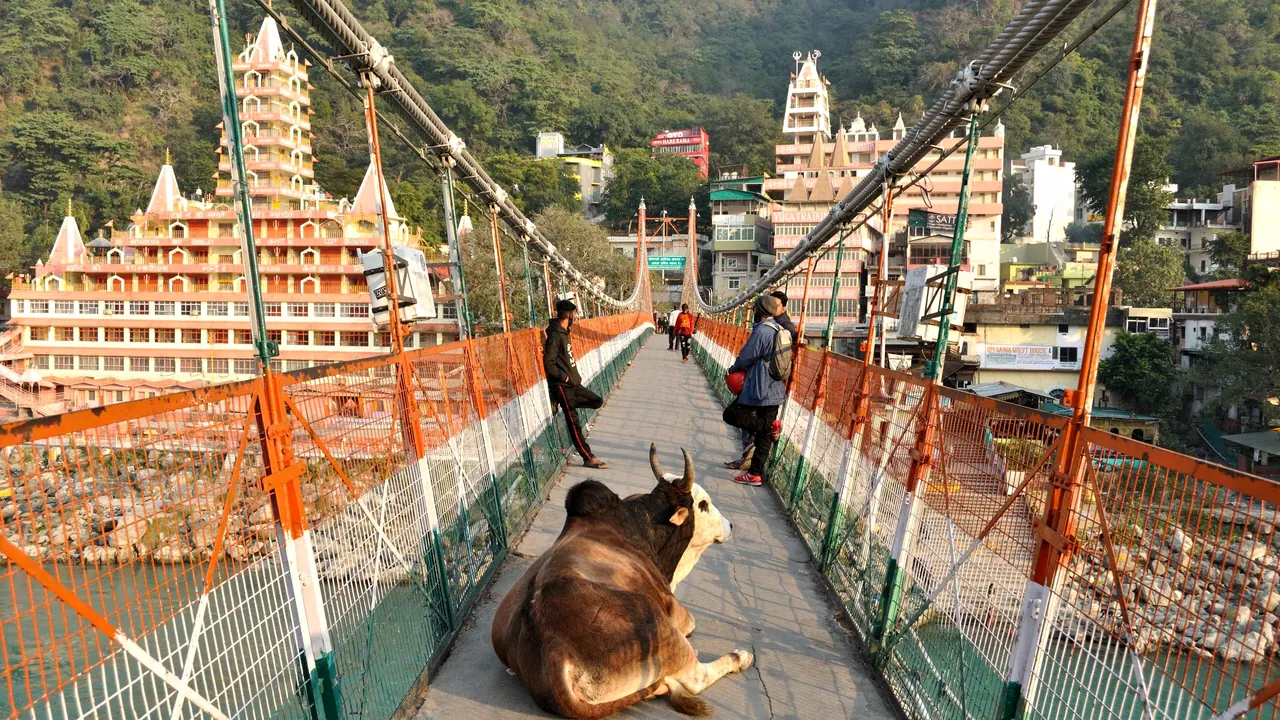
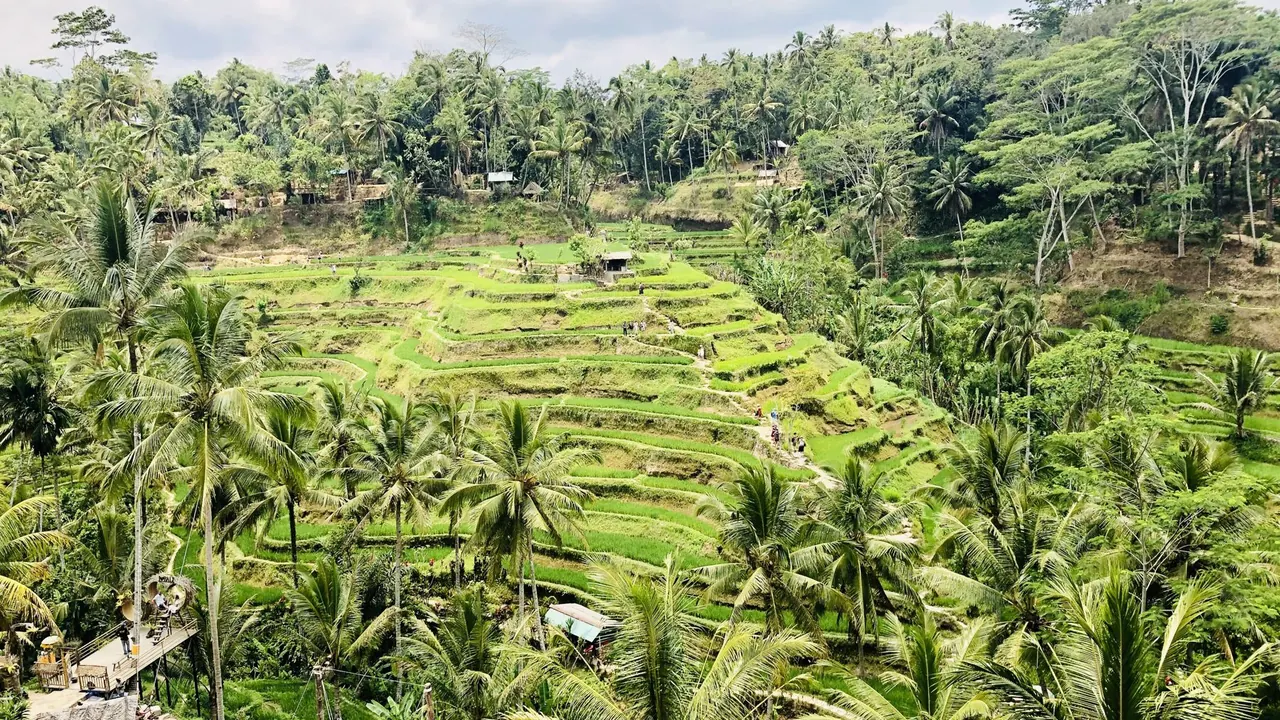
Photos: Rishikesh by Dey.sandip, CC BY-SA 4.0, cropped; Ubud by Pinterpandai, CC BY-SA 3.0, cropped.
Rishikesh or Ubud?
Our verdict in twelve categories, each scored against the same fixed benchmark cities, and the climate month by month, so you can choose for your trip.
Choose Rishikesh for
- getting around
- prices
Rishikesh suits the traveller who wants to practise rather than browse. It is a holy town on the Ganges, alcohol-free and vegetarian, where days run from dawn yoga to the evening aarti and long ashram courses are the norm. Add serious rafting, tiger country in Rajaji and some of the lowest costs anywhere, and it fits a long, simple, focused stay on a small budget.
Choose Ubud for
- live music and the arts
- beaches
- food and drink
Choose Ubud for a rounder trip with more comfort. The wellness is just as central but comes with spas and villas over the rice fields. On top of that you get Balinese cooking worth seeking out, dance with gamelan every night, painting museums and a whole island of temples within a day's drive. It is the easier pick for couples, families and anyone who wants evenings that offer more than an early night.
Scoreboard
Twelve categories on one fixed scale from 0 to 100. The shaded stretch is the gap between the two.
Your match
Pick a travel style or drag the sliders, and both match scores follow your weighting.
Wins on getting around and prices with your weighting.
Wins on live music and the arts and beaches with your weighting.
What matters to you?
Category by category
What the scores mean for a trip.
Beaches & swimming
Neither town has a beach of its own, but Ubud is much closer to proper swimming. In Rishikesh the water is the Ganges: pale sand banks to sit on, a cold, fast current and a dip at the ghats holding the chains. Its "beaches" are for looking at, not for swimming.
From Ubud, the calm reef-sheltered water at Sanur is about an hour's drive away and warm all year. Back in town, a villa pool over the paddies covers the daily swim.
Food & drink
Ubud is the better place to eat. Babi guling at lunchtime counters, duck slow-cooked in spice paste and nasi campur in family warungs give it a real local cuisine, and a few ambitious restaurants build on Balinese produce.
Rishikesh eats well in a narrower way. Everything is vegetarian, with no meat or alcohol sold. Thalis at dhabas and chai by the bridges are excellent, but the Tapovan café menus soon start to look alike.
Culture & sights
Ubud has more to see. The royal palace and the lotus pond at Pura Taman Saraswati sit at its centre, the Neka, ARMA and Puri Lukisan museums trace a century of Balinese painting, and the Elephant Cave lies on the edge of town. Daily offerings and temple processions make the culture part of ordinary life.
Rishikesh's appeal is ritual rather than buildings. It has the fire-lit aarti at Triveni Ghat, the painted ashrams of Swarg Ashram, the tiered Tera Manzil and the overgrown Beatles ashram. With no museums of note, it is moving but soon covered.
Nightlife
Both towns sleep early, but Ubud at least has an evening. Garden bars serve drinks, and a few music bars put on bands before the town goes quiet. Rishikesh sells no alcohol at all, so nights mean a terrace dinner and a chant session, and anyone wanting a drink has to leave town. For a proper night out from Ubud, Seminyak and Canggu are a long drive away.
Nature & outdoors
The two are equally strong outdoors, in very different landscapes. Rishikesh is a river-and-mountain place. Powerful rapids run from the Shivpuri camps, forested Shivalik ridges rise on both banks, jeep safaris in Rajaji may turn up elephants or a tiger, and winter dawns at Kunjapuri look out to snow peaks.
Ubud is tropical and farmed. You walk the rice terraces along Campuhan Ridge or at Tegallalang, swim under jungle waterfalls and climb Mount Batur in the dark for a crater-lake sunrise.
Day trips
Ubud makes the better base. Within reach are the holy spring of Tirta Empul, the cliff-cut tombs of Gunung Kawi, Besakih on the slopes of Agung, the Jatiluwih terraces and sea temples on the coast. The only limit is how far a hired driver can get on slow roads.
From Rishikesh the shortlist is shorter. Haridwar's huge aarti is under an hour away and Dehradun about an hour, while Mussoorie and Devprayag make long days on mountain roads. Beyond those, the interesting places are several days off.
Good for families
Ubud handles children better. Pool villas make hot afternoons easy, the dance shows and a nearby safari park hold their attention, and Balinese hosts make a fuss of them. Narrow pavements and grabbing monkeys still make it better with older children than with toddlers.
Rishikesh has the monkeys too, plus a cold, fast river, steep lanes full of motorbikes and nothing designed for young visitors. Teenagers old enough for rafting and ziplines will enjoy it. Small children mostly will not.
Getting around
Rishikesh is the easier place to get about. Its quarters line up along the river and are linked by footbridges, riverside paths and ferries, with cheap shared vikrams on the main road. You need a taxi only for waterfalls and rafting put-ins.
Ubud has no public transport worth relying on. Its sights are spread across steep river valleys, so most days are planned around a hired driver, ride-hailing or a scooter. Stay central if you want to walk to dinner.
Shopping & style
In Rishikesh almost everything on sale serves the spiritual stay. The lanes by Ram Jhula and Lakshman Jhula sell cotton yoga clothes, rudraksha malas, brass singing bowls, incense and shelves of philosophy books. Some of it is good, but the same stock repeats from stall to stall, and there is little else to buy.
Ubud has far more to buy because its crafts are made in the villages around it. Mas carves wood, Celuk works silver and gold, Batuan paints its crowded canvases, and furniture workshops line the road to Tegallalang. Back in town, the Art Market and the linen and jewellery boutiques on Jalan Hanoman fill an afternoon, though neither town is a place for fashion.
Affordability
Rishikesh is the cheaper of two cheap places. Ashram rooms, thalis and vikram rides cost almost nothing, and rafting and teacher trainings are the main costs.
Ubud can be just as frugal in a homestay eating at warungs. But its luxury jungle resorts, visitor-priced cafés and heavily taxed wine make it easy to overspend. Relying on a driver every day adds to the cost too.
Live music & performing arts
Ubud has the stronger stage. Every night, Legong, Barong or Kecak is performed to live gamelan in the palace courtyard or at the lotus-pond temple, danced by village troupes with long traditions. If you come across a temple festival, you will see the same dances in their original setting.
Music in Rishikesh is devotional and informal: drums and singing at the aarti, kirtan in ashrams and the odd sitar recital. There is nothing you would buy a ticket for.
Wellness & relaxation
Both towns exist largely for this, and Ubud gives the fuller wellness trip. Yoga in open pavilions comes alongside spas of every level, from street massage rooms to riverside sanctuaries above the Ayung. Flower baths, traditional healers and villas facing silent paddies complete it.
Rishikesh is the more austere and study-minded choice. It has ashrams with residential courses, long teacher trainings, Ayurvedic detox and a daily rhythm without alcohol. The noise of the bridges is the price, and the calm is found in the ashram gardens.
When should you go?
Pick your month. The climate figures are measured averages, not a forecast.
Rishikesh in July
Ubud in July
Daytime high, °C
Rainfall in the month, mm
Where the figures come from
Rishikesh has no weather station within reach, so its figures come from a gridded climate model rather than a measured record, and read a broad area rather than the city itself.
Ubud's temperatures are measured 29 km from the centre, at Denpasar / Ngurah-Rai.
Ubud's station stands 209 m below the city centre, so the centre is likely a little cooler than the figures say.
Ubud has no rain gauge within 25 km of the centre, so its rainfall comes from a gridded climate dataset read at the city rather than from a gauge further away.
Temperature and rainfall are climate normals, averaged over the years shown. Rishikesh: 2001-2020 normals, NASA POWER reanalysis grid, no weather station within 90 km. Ubud: 1991-2020 normals, Denpasar / Ngurah-Rai (29 km from centre).
Rishikesh has sharp seasons. October and November are its best months: dry, clear and warm enough to walk the ghats in comfort. February and March are nearly as good. December and January are cool, with daytime highs around 19°C, but these are also the months of crisp sunrises over the snow peaks. From April the heat builds to about 39°C in May, which makes walking the streets hard work. The monsoon follows, with around 381mm of rain in July, a swollen river and no rafting.
Ubud stays at about 31°C all year, so it is temperature that hardly changes and rainfall that decides the season. December to March is the wet stretch, at close to 297mm in January, with the greenest terraces and the muddiest trails. The middle of the year is drier, and August brings only about 36mm and the most sunshine. Because the sea off the south coast stays warm all year, a beach day works in any month. Put simply, Ubud's best months are Rishikesh's worst, so the two rarely compete for the same dates.
Which traveller are you?
On a trip on a tight budget, Rishikesh goes further. Ashram rooms, thalis and shared vikrams cost next to nothing, and the aarti and many classes are free. Ubud is cheap too, but drivers, resorts and imported drinks quickly push the bill up.
On a family trip with children, Ubud is far easier. Villas with private pools, gentler rafting, nightly dance shows and a warm welcome for children all help. Rishikesh, with its fast cold river and lack of anything aimed at children, really works only for teenagers.
For a culture and arts trip, Ubud gives more to see. It has the royal palace, museums of Balinese painting, Goa Gajah, temples across the island and live gamelan every evening. Rishikesh offers moving riverside ritual and the Beatles ashram, but very little else.
Before you go
| Measure | Rishikesh | Ubud |
|---|---|---|
| Official language | Hindi, English | Indonesian |
| Currency | Indian Rupee (INR) | Rupiah (IDR) |
| Sockets | CM230 V, 50 Hz | CF50 Hz |
| Driving side | Left | Left |
| Time zone | UTC+5:30 | UTC+8 |
| Emergency number | 108 or 112 | 112 |
| Elevation | 372 m | 210 m |
| Main airport | Dehradun Jolly Grant Airport (DED)14 km from centre13 non-stop destinations | Denpasar I Gusti Ngurah Rai International Airport (DPS)29 km from centre63 non-stop destinations |
By the numbers
| Measure | Rishikesh | Ubud |
|---|---|---|
| City population | 70,499 | - |
| People per km² | 133 | - |
| Museums within 10 km | 0 | 14 |
| UNESCO World Heritage sites within 50 km | 0 | 1 |
| Swim season, months above 21 °C | - | 12 months |
Where else could you go?
Every comparison below shares a destination with this one, so you can follow Rishikesh or Ubud somewhere new.
- Delhivs Rishikesh
- Agravs Rishikesh
- Amritsarvs Rishikesh
- Jaipurvs Rishikesh
- Yogyakartavs Ubud
- Pokharavs Rishikesh