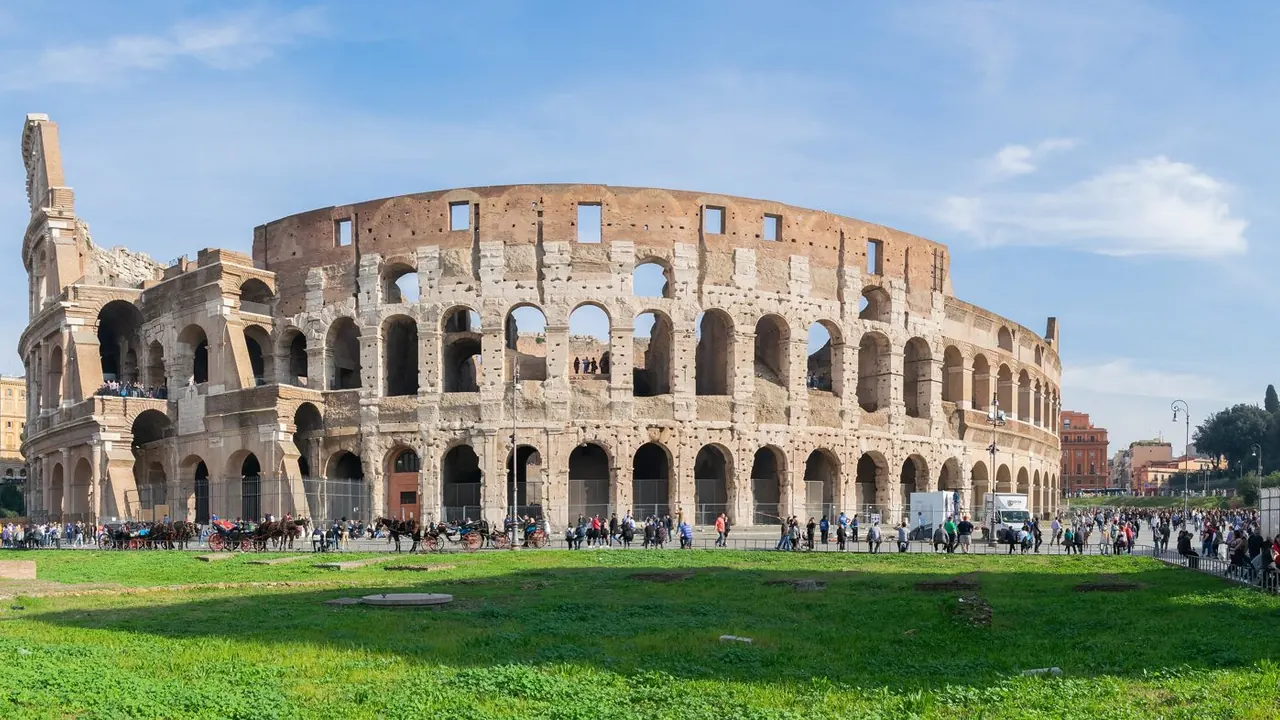
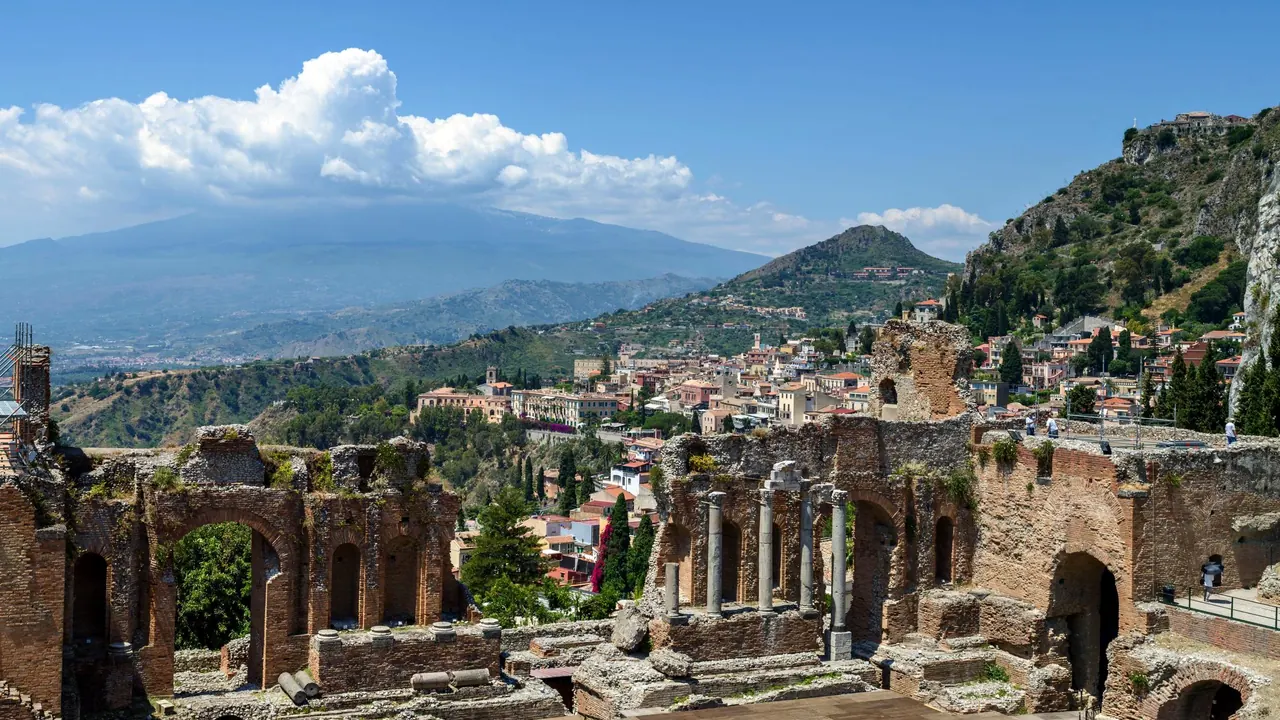
Photos: Rome by Tournasol7, CC BY-SA 4.0, cropped; Taormina by Reinhard Bruckner, Pexels License.
Rome or Taormina?
Our verdict in twelve categories, each scored against the same fixed benchmark cities, and the climate month by month, so you can choose for your trip.
Choose Rome for
- culture and sights
- live music and the arts
- shopping
Rome is the choice for a trip built around seeing things. The ancient city, the Vatican collections and the Baroque churches are in a class of their own. Around them you get a serious Roman kitchen, evenings out in Trastevere and Monti, music at the Opera and the Auditorium, and fast trains to Florence and Naples. It suits a first visit to Italy, or anyone happy to walk all day and still leave things unseen.
Choose Taormina for
- beaches
- nature and the outdoors
- wellness
Taormina is better for a slower Sicilian stay, with the sea below the town and a volcano on the skyline. You can see its sights in a day, but it has clear water at Isola Bella, Etna for walks among craters and lava fields, and Syracuse and Catania along the coast. Couples who want views, swimming and quiet evenings will enjoy it more than a capital, as long as they can accept resort prices and a town built on steps.
Scoreboard
Twelve categories on one fixed scale from 0 to 100. The shaded stretch is the gap between the two.
Your match
Pick a travel style or drag the sliders, and both match scores follow your weighting.
Wins on culture and sights and live music and the arts with your weighting.
Wins on beaches and nature and the outdoors with your weighting.
What matters to you?
Category by category
What the scores mean for a trip.
Beaches & swimming
From Taormina a cable car takes you down to the sea, and the water at Mazzarò and Isola Bella is clear enough for snorkelling. The catch is size: the coves are narrow pebble strips crowded with loungers in summer, and for sand you go to Giardini Naxos or Letojanni.
Rome's coast at Ostia and Fregene has dark volcanic sand and is reached by train, but it is where Romans go at weekends and the water is rarely clear. In Taormina a swim fits into an ordinary day, while from Rome it costs you a day of sightseeing.
Food & drink
Rome eats better and with more depth. It has the four Roman pastas, Jewish-style artichokes in the Ghetto, the offal tradition and covered market of Testaccio, and pizza al taglio everywhere, with whole neighbourhoods such as Trastevere and Monti to eat your way through. What it lacks is good local wine.
Taormina has the more interesting wine, with Etna reds and whites on every list. It also has Sicilian pleasures such as granita and brioche for breakfast, swordfish and cannoli. But it is a small town with many tourist menus along Corso Umberto, and a few days are enough to try the best of it.
Culture & sights
This is the widest gap between the two. Rome piles ancient ruins, early Christian mosaics, Renaissance palaces and Bernini's Baroque on top of one another, and adds the Vatican Museums, the Borghese Gallery and Palazzo Massimo. A week still leaves things unseen.
Taormina has one great monument, the Greek theatre with Etna framed behind its stage, and a pleasant medieval Corso with the Duomo and Palazzo Corvaja. You can see it in a day of slow walking. There is no major museum, so if you want more history you go to Syracuse.
Nightlife
Neither city is a clubbing destination, but Rome gives you far more to do after dinner. There are crowded wine bars in Trastevere, cocktail bars in Monti, cheap student drinking in San Lorenzo and an arty crowd in Pigneto, with some clubs in Testaccio and Ostiense.
Evenings in Taormina are an aperitivo in Piazza IX Aprile, a stroll along the Corso and a drink on a terrace over the sea, mostly among couples and older visitors. Apart from August and the beach clubs of high summer, the town goes quiet soon after dinner.
Nature & outdoors
Taormina sits under an active volcano, and that makes the difference. Etna's lava fields, craters, vineyards and ski slopes are about an hour away, and the basalt Alcantara gorges are closer still. The marine reserve at Isola Bella adds snorkelling, kayaking and diving.
Rome's outdoors is gentler and more historical: the villa parks, a bike ride along the Appian Way past tombs and aqueducts, and the crater lakes of Albano and Nemi. The Apennines offer hiking, but they are a longer trip from Rome than Etna is from Taormina.
Day trips
Both are good bases, but Rome reaches further and has more on its doorstep. Ostia Antica, the villas at Tivoli, the Etruscan tombs at Tarquinia, Orvieto and Civita di Bagnoregio are all within easy range, and fast trains put Florence and Naples about ninety minutes away.
From Taormina the trips run along Sicily's east coast: Catania with its black lava stone, Ortigia and the Greek theatre at Syracuse, baroque Noto, and hill villages such as Savoca. The journeys by coach or car are longer, but they show how varied the island is.
Good for families
Rome has more ready-made fun for children: the Bioparco zoo and rowing boats in Villa Borghese, a children's museum, and gladiators and catacombs to catch the imagination of older ones. Queues for the big sights, cobbles and summer heat still make long sightseeing days tiring, so an unhurried plan works best.
Taormina suits school-age children who can snorkel at Isola Bella and enjoy a trip up Etna. With toddlers it is harder work, because the town is all steps and the nearby coves are crowded pebble. That is why many families stay down in Giardini Naxos, with its sand and flatter streets.
Getting around
Both centres are best seen on foot, and neither has public transport to boast about. In Rome the walking distances are longer, the metro skirts the historic core and buses get stuck in traffic, so a day of sightseeing means a long way on cobbles.
Taormina's centre is tiny by comparison, but it is built on a slope, so every outing involves stairs. The cable car to Mazzarò and the coastal trains cover the basics, while Etna and the inland villages realistically need a tour or a hired car.
Shopping & style
Rome is a real shopping city. The fashion houses line the streets around the Spanish Steps, the chains are on Via del Corso, Monti has independent designers and vintage, Via dei Coronari has antiques, and Porta Portese holds a huge flea market on Sundays.
Taormina's shopping is one street, Corso Umberto, selling mostly coral, cameos, linen and Sicilian ceramics to visitors. It is good for pistachio cream, Etna wine and a painted moor's-head vase, but for serious fashion you go to Catania.
Affordability
Rome is the cheaper of the two, though neither is a bargain, and the gap is widest on rooms. Rome's centre is costly and cramped, but a large city has whole districts beyond it where Romans live and visitors can sleep for less. Taormina is too small for that, and its sea-view hotels set prices for the whole town, so a cheaper bed means staying down on the coast and taking the bus up the hill each evening. The seasons work differently too: Rome's rooms are hardest to find in spring and autumn, which is exactly when Taormina's become easier to afford.
Eating follows the same pattern. Rome's standing espresso, pizza al taglio and plain trattoria lunches stay fair in any neighbourhood away from the big sights, while in Taormina only granita, bakery snacks and the buses stay cheap. Sightseeing is where Rome costs more, because the Vatican, the Colosseum and the Borghese add up over a week. In Taormina the Greek theatre is the one big entry fee, and the Duomo, the Corso and the Villa Comunale gardens cost nothing.
Live music & performing arts
Rome has a classical scene that runs through the year. There is opera and ballet at the Teatro dell'Opera, the Santa Cecilia orchestra at the Auditorium Parco della Musica, sacred concerts in churches and a long-running jazz club scene. In summer the opera moves outdoors to the Baths of Caracalla.
Taormina has one extraordinary stage, and only in summer. Concerts, opera and pop shows in the Greek theatre with Etna behind are memorable, but outside summer there is little beyond chamber music and piano bars.
Wellness & relaxation
Neither has a bathing culture of its own, so the difference is in the setting. Rome has hotel spas and day spas in a loud, crowded centre. For real thermal water you go out to Bagni di Tivoli or the hot springs around Viterbo, and in town the quiet places are the villa gardens and the Aventine.
Taormina's hotel spas have terrace pools above the sea and treatments using volcanic mud and citrus, and the slow pace of the town is restful in itself. That calm holds in May, June and late September, but in August the Corso fills with cruise and day-trip crowds.
When should you go?
Pick your month. The climate figures are measured averages, not a forecast.
Rome in July
Taormina in July
Daytime high, °C
Rainfall in the month, mm
Where the figures come from
Rome's sunshine is measured 31 km from the centre, at Vigna Di Valle.
Taormina's temperatures are measured 45 km from the centre, at Messina.
Taormina has no rain gauge within 25 km of the centre, so its rainfall comes from a gridded climate dataset read at the city rather than from a gauge further away.
Temperature and rainfall are climate normals, averaged over the years shown. Rome: 1991-2020 normals, Roma / Ciampino (15.1 km from centre). Taormina: 1991-2020 normals, Messina (45.1 km from centre).
In both places July and August reach about 31°C in the afternoon. That is too hot for long walks through Rome's centre or a hike on Etna, so spring and early autumn are the seasons for being on foot in either. Rome's summers are dry and very sunny, but the rain starts in October and November is its wettest month, at about 114mm, so late spring is the safer choice for a city trip there.
Taormina is the warmer of the two at both ends of the year. Its summer is almost rainless, and the sea reaches about 26°C in August and stays swimmable through October, so the beach season lasts longer than at Ostia. Winter highs are near 15°C, against Rome's 12°C. The Sicilian coast is just as wet from October to January, though, so its off-season is better for walks and views than for swimming.
Which traveller are you?
For a culture and arts trip, Rome wins by a distance. You can plan a different museum for every morning, duck into churches between sights to find paintings above the altars, and end the evening at a concert. In Taormina the sightseeing is done by the second day.
On a beach and sun trip, Taormina is the better pick. In Rome the sea is an occasional escape. In Taormina you book a room with a sea view, set off early to claim a spot by the water, pack a snorkel mask and spend the hottest hours swimming.
For an outdoors trip, Taormina is the stronger base. In Rome, green space means an afternoon cycle or a picnic between museums. From Taormina an active traveller can fill whole days with a guided volcano hike, a morning in a sea kayak and the steep climb up to Castelmola.
Before you go
| Measure | Rome | Taormina |
|---|---|---|
| Official language | Italian | Italian |
| Currency | Euro (EUR) | Euro (EUR) |
| Sockets | CFL230 V, 50 Hz | CFL230 V, 50 Hz |
| Driving side | Right | Right |
| Time zone | UTC+1, UTC+2 in summer | UTC+1, UTC+2 in summer |
| Emergency number | 112 | 112 |
| Elevation | 21 m | 204 m |
| Main airport | Rome–Fiumicino Leonardo da Vinci International Airport (FCO)23 km from centre242 non-stop destinations | Catania-Fontanarossa Airport (CTA)47 km from centre96 non-stop destinations |
| Public holidays this year | 13 days | 13 days |
By the numbers
| Measure | Rome | Taormina |
|---|---|---|
| City population | 2,748,109 | 10,471 |
| People per km² | 2,135 | 799 |
| Museums within 10 km | 178 | 5 |
| UNESCO World Heritage sites within 50 km | 8 | 2 |
| Swim season, months above 21 °C | 5 months | 5 months |
Where else could you go?
Every comparison below shares a destination with this one, so you can follow Rome or Taormina somewhere new.
- Cataniavs Taormina
- Syracuse, Sicilyvs Taormina
- Palermovs Taormina
- Sienavs Rome
- Naplesvs Rome
- Sorrentovs Rome