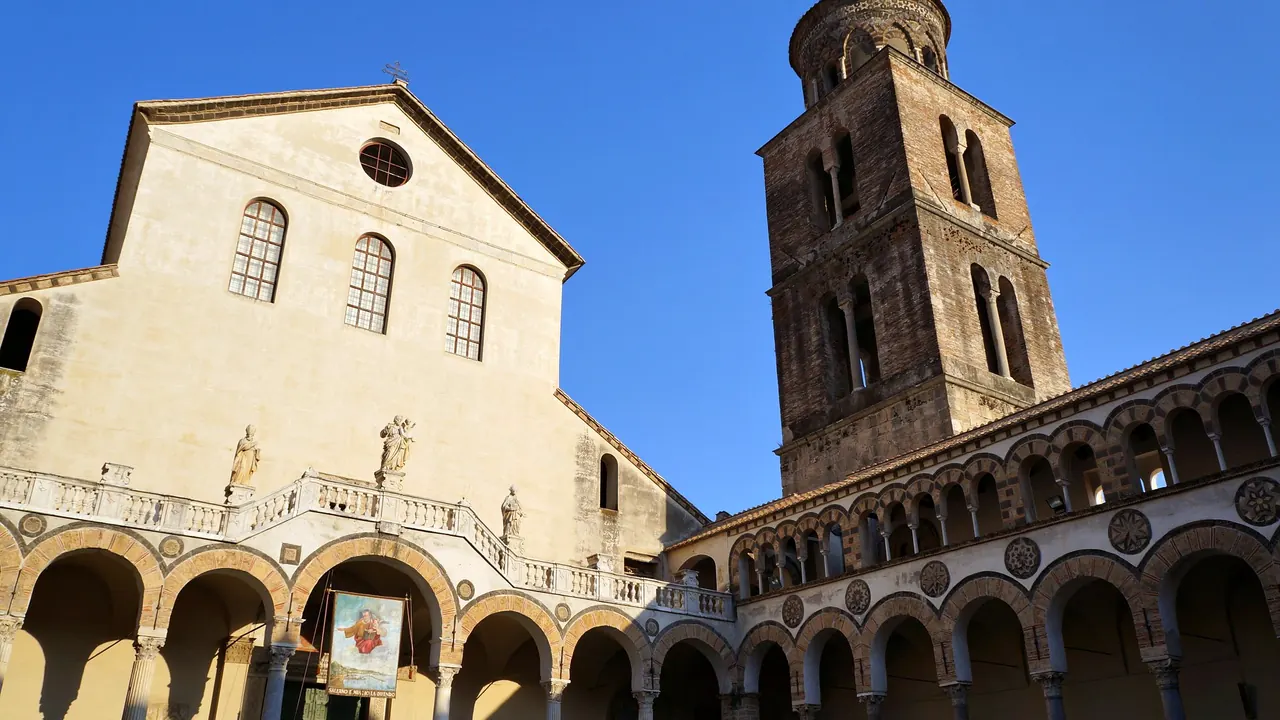
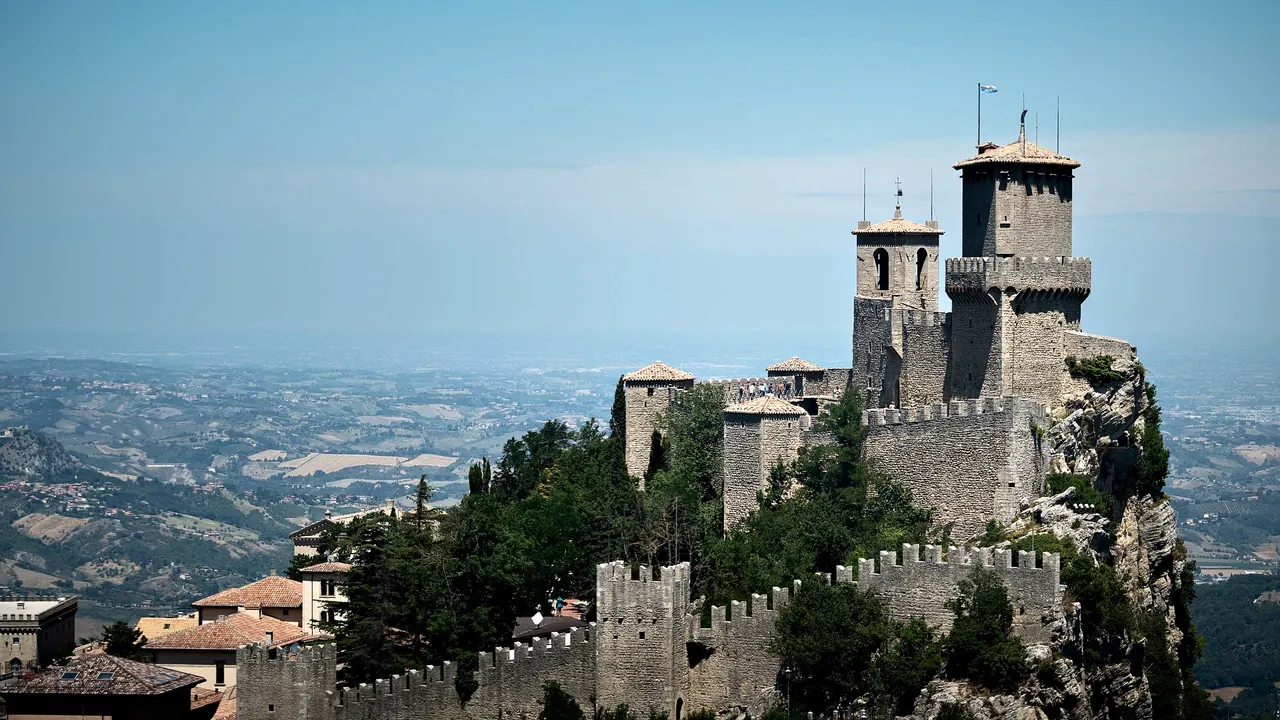
Photos: Salerno by Leandro Neumann Ciuffo, CC BY 2.0, cropped; San Marino by Tibor Szabo, Pexels License.
Salerno or San Marino?
Our verdict in twelve categories, each scored against the same fixed benchmark cities, and the climate month by month, so you can choose for your trip.
Choose Salerno for
- nature and the outdoors
- nightlife
- food and drink
Salerno suits a longer stay on Italy's southern coast. It gives you a real working city with good everyday food, lively evenings in the old town and a seafront for strolling. From there, trains and ferries reach Pompeii, Paestum and the Amalfi Coast without a car. Choose it if you want swimming, coastal hiking and famous sites, all from one affordable base.
Choose San Marino for
San Marino does not lead in any category we score.
San Marino is the choice for a short, singular stop. It is a walled medieval republic on a mountain ridge, with three towers, cliffside paths and very quiet evenings once the day visitors leave. It works best for travellers with a car who want to explore San Leo, Urbino and the Romagna hill towns, and who don't need a beach, a night out or a serious food scene on their doorstep.
Scoreboard
Twelve categories on one fixed scale from 0 to 100. The shaded stretch is the gap between the two.
Your match
Pick a travel style or drag the sliders, and both match scores follow your weighting.
Wins on nature and the outdoors and nightlife with your weighting.
Has no clear advantage with the weighting you have chosen.
What matters to you?
Category by category
What the scores mean for a trip.
Beaches & swimming
Salerno is the beach city of the two because the sea is right in town. Its own grey-sand beaches are fine for a quick swim, and the clear coves of the Amalfi Coast and the wide sandy shore towards Paestum, backed by pine woods, are a short trip away.
From San Marino, the beach is a day out: about half an hour down to Rimini or Riccione, where you'll find neat rows of umbrellas, beach clubs and shallow water. You can't step out of your hotel for a morning swim.
Food & drink
Food is a real reason to choose Salerno. It has wood-fired pizza, pasta with clams, buffalo mozzarella eaten fresh on the day it is made, and sfogliatelle from old-town pastry shops, all at local prices.
San Marino's cooking comes from the Romagna hills: piadina, passatelli in broth, tagliatelle, grilled meat and Tre Monti wafer cake. The cooking is honest, but many summit terraces sell the view more than the food. The better meals are down in Borgo Maggiore or across the border.
Culture & sights
The two are broadly level, but the heritage differs in kind and in the time it asks of you. Salerno's is spread through a lived-in old town of stepped lanes and palazzi. The Norman cathedral keeps the relics of Saint Matthew in its crypt, the Giardino della Minerva recalls Europe's earliest medical school and the Arechi Castle looks down on the gulf. Together with the small museums, they fill one or two unhurried days.
San Marino is a single sight: a fortified ridge with three towers above sheer drops, and the Palazzo Pubblico telling the story of one of the world's oldest surviving republics. It feels more theatrical than Salerno, but it is compact enough that most visitors see it well in half a day.
Nightlife
Salerno has a sociable if modest night out. Young locals fill the squares around Largo Campo and Via dei Mercanti with drinks until late, and the seafront passeggiata carries on into the evening. There are no big clubs, though, and serious nights out mean Naples.
San Marino has almost nothing after dark beyond dinner and a glass of wine above the lights of the coast. For anything livelier, you have to drive down to the Riviera.
Nature & outdoors
Salerno has some of Europe's most dramatic scenery close by. Limestone cliffs drop into the sea, lemon terraces climb the slopes and old mule tracks cross the Lattari mountains, including the Path of the Gods. To the south lie the Cilento's wooded hills and the headlands of Palinuro, and kayaking and sailing fill the summer.
San Marino's landscape is gentler. Monte Titano gives wide views to the Adriatic and the Apennines, with woodland paths and quiet cycling roads in the Montefeltro, but it is suited to a morning walk rather than a whole outdoor trip.
Day trips
Both make good bases, but Salerno is exceptional. The Greek temples of Paestum and the ruins of Pompeii are each about half an hour away by train, ferries cross to Amalfi and Positano, and Naples, Herculaneum and Caserta are easy days out without a car.
San Marino has a fine list of its own: the fortress of San Leo, Renaissance Urbino, the mosaics of Ravenna and the castle at Gradara. Most of these really need a car, because the only regular public link is the bus down to Rimini.
Good for families
Salerno is slightly the easier of the two with children. It has a long, flat, car-free promenade with playgrounds, shallow sandy beaches to the south and the Luci d'Artista Christmas lights in winter, though the old town's steps and the winding Amalfi roads are hard going.
Children love San Marino's towers, battlements and cable car, but the summit has little else for them. The theme parks, waterparks and beaches are down near Rimini, which suits families with a car.
Getting around
Salerno is the simpler place to get about. The station, Corso Vittorio Emanuele, the seafront and the old town lie along one walkable strip. Regional trains run to Naples, Pompeii and Paestum, and in summer ferries are the easy way along the coast.
San Marino's core is small and car-free but almost all steps and slopes, with a cable car down to Borgo Maggiore. Beyond the bus to Rimini, public transport is thin, so a car makes the most difference here.
Shopping & style
Salerno offers the better browsing. Corso Vittorio Emanuele is a long pedestrian street of Italian clothing shops, and the most characterful buys come from nearby: hand-painted Vietri majolica, lemon products and colatura.
San Marino's shops are mostly souvenirs, decorative crossbows and the republic's own stamps and coins, which collectors seek out. Lower taxes bring Italian visitors for perfume, watches and spirits, and there is an outlet centre in the valley.
Affordability
Salerno is somewhat kinder on the budget. It is an ordinary southern city with local-priced trattorias, cheap trains and rooms that cost far less than on the cliffside coast. Summer ferries, beach sunbeds and archaeological site entry fees soon add up, though.
San Marino sits in the middle. Its sights are inexpensive and fuel and spirits are cheaper than in Italy, but the summit hotels and view terraces charge extra. Staying in the lower villages helps.
Live music & performing arts
Salerno has a proper stage in the Teatro Verdi, a gilded opera house modelled on the San Carlo in Naples. It runs a season of opera, concerts and ballet, and the Ravello Festival's clifftop concerts are within reach in summer.
San Marino has only a small theatre and occasional local concerts. Its highlight is the Medieval Days festival, with costumed musicians, flag-throwers and crossbow contests. For opera, people look to Pesaro or Bologna.
Wellness & relaxation
Neither is a spa destination, and in both, wellness means hotel spas. Salerno has a slight edge, with open-air sulphur pools at Contursi Terme about an hour inland and a palm-lined promenade made for slow sunset walks, though its main roads carry port traffic and noise.
San Marino's calm comes in the evening, when the day visitors have gone and the walls look out over a quiet plain. Daytime around the towers in summer is anything but restful.
When should you go?
Pick your month. The climate figures are measured averages, not a forecast.
Salerno in July
San Marino in July
Daytime high, °C
Rainfall in the month, mm
Where the figures come from
Salerno's temperatures are measured 71 km from the centre, at Grazzanise.
Salerno has no rain gauge within 25 km of the centre, so its rainfall comes from a gridded climate dataset read at the city rather than from a gauge further away.
San Marino's temperatures are measured 52 km from the centre, at Frontone.
San Marino has no rain gauge within 25 km of the centre, so its rainfall comes from a gridded climate dataset read at the city rather than from a gauge further away.
Temperature and rainfall are climate normals, averaged over the years shown. Salerno: 1991-2020 normals, Grazzanise (71.3 km from centre). San Marino: 1991-2020 normals, Frontone (51.5 km from centre).
Salerno has the longer and sunnier warm season. Beach weather runs from June to September, with highs of about 31°C in July and August and the sea at its warmest in late summer. Those months are hot for climbing the old town's steps or touring Pompeii, so May and late September to October are better for walking. Rain comes back in autumn and peaks in November at about 154mm. Winters are mild, wet and fairly grey.
San Marino has a cooler climate, high on its ridge. Winter days reach only about 7°C. Rain is spread more evenly through the year and is heaviest in autumn. June to early September is warm enough for a trip down to the Adriatic beaches. April, May and September are the most comfortable months for the walls and the paths between the towers. In winter, Salerno is clearly the milder of the two.
Which traveller are you?
On a food and nightlife trip, Salerno is the clear pick. It has buffalo mozzarella, fried seafood and colatura from Cetara, and the lanes around Largo Campo fill with people drinking outside late at night. San Marino's summit turns quiet once the coaches leave.
For an outdoors trip, choose Salerno. The Path of the Gods, the Valle delle Ferriere, boat trips along the Amalfi cliffs and the Cilento's gorges and headlands are all within reach. San Marino offers pleasant short walks around Monte Titano, but no long trails or water sports.
For a short city break, San Marino makes a distinctive choice. One ridge holds the towers, the Palazzo Pubblico and the cliffside path, so half a day covers the sights. Evenings on the walls are calm. Salerno pays off more as a base for several days.
Before you go
| Measure | Salerno | San Marino |
|---|---|---|
| Official language | Italian | Italian |
| Currency | Euro (EUR) | Euro (EUR) |
| Sockets | CFL230 V, 50 Hz | CFL230 V, 50 Hz |
| Driving side | Right | Right |
| Time zone | UTC+1, UTC+2 in summer | UTC+1, UTC+2 in summer |
| Emergency number | 112 | 112 |
| Elevation | 4 m | 675 m |
| Main airport | Naples International Airport (NAP)46 km from centre131 non-stop destinations | Bologna Guglielmo Marconi Airport (BLQ)114 km from centre98 non-stop destinations |
| Public holidays this year | 13 days | 18 days |
By the numbers
| Measure | Salerno | San Marino |
|---|---|---|
| City population | 127,186 | 4,040 |
| People per km² | 2,123 | 569 |
| Museums within 10 km | 9 | 19 |
| UNESCO World Heritage sites within 50 km | 5 | 2 |
| Swim season, months above 21 °C | 5 months | 4 months |
Where else could you go?
Every comparison below shares a destination with this one, so you can follow Salerno or San Marino somewhere new.
- Amalfivs Salerno
- Positanovs Salerno
- Sorrentovs Salerno
- Naplesvs Salerno
- Assisivs San Marino
- Florencevs San Marino