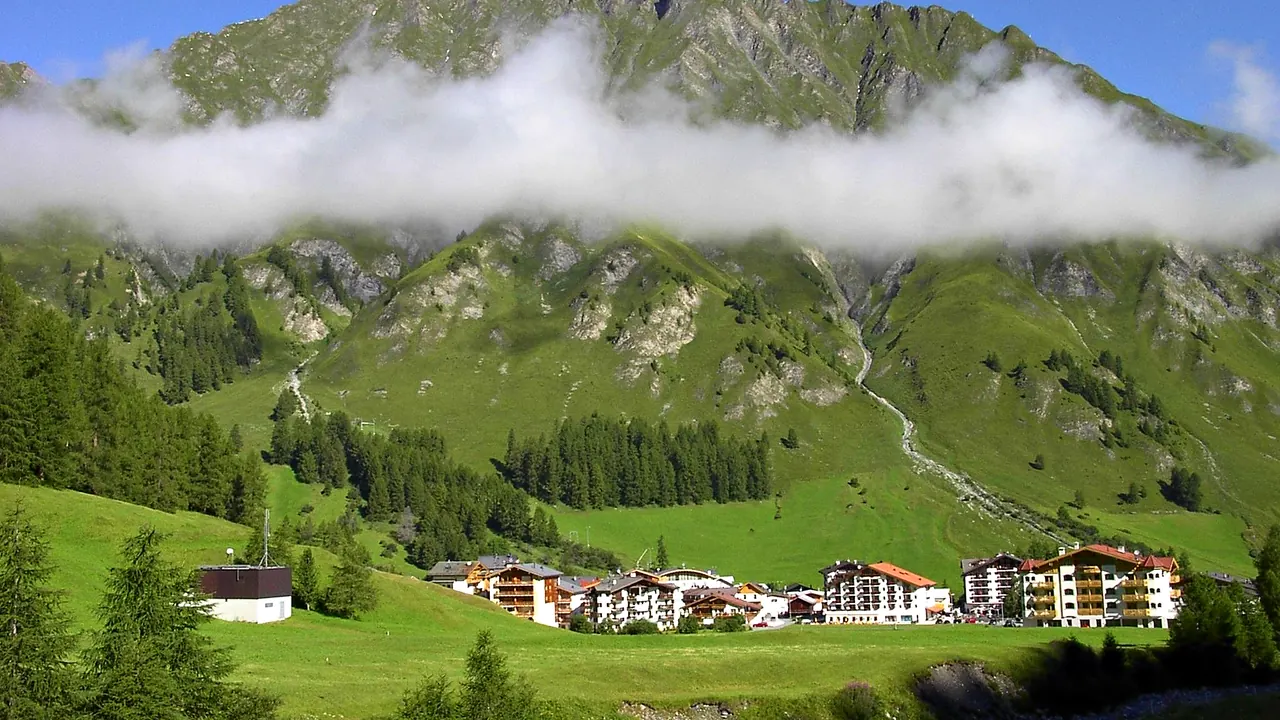
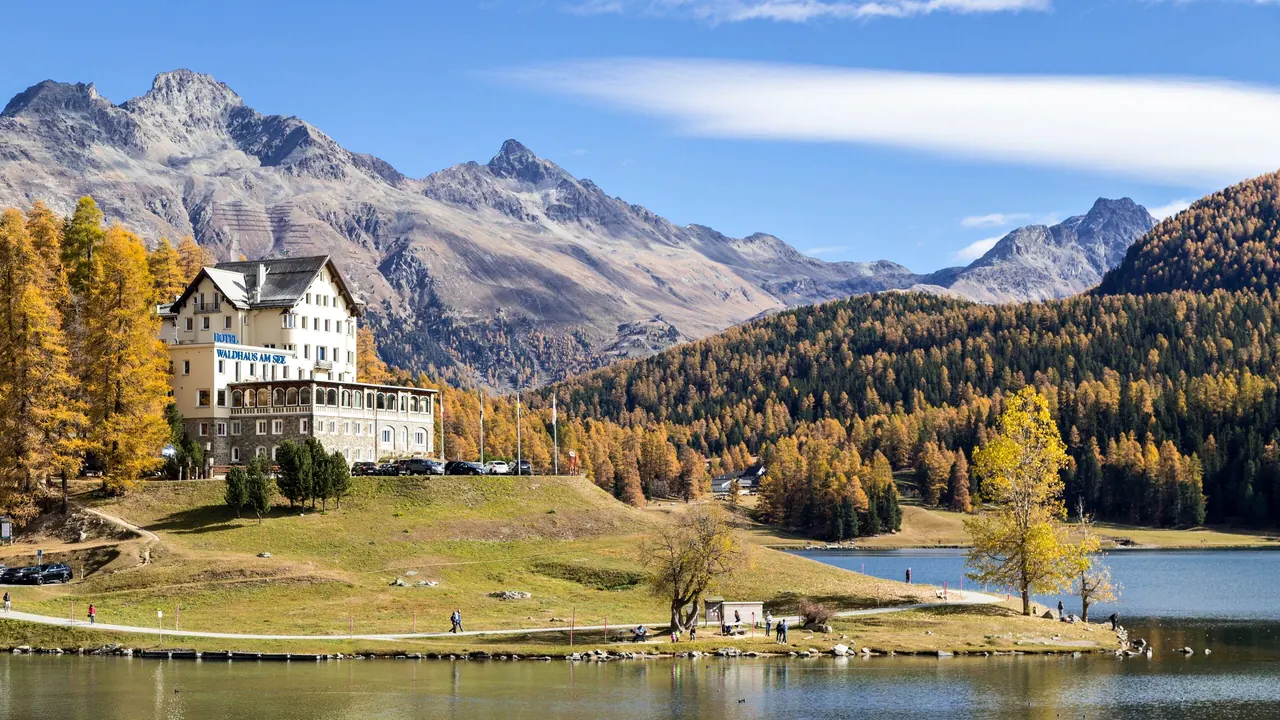
Photos: Samnaun by Rene Nueesch, CC BY 3.0, cropped; St. Moritz by JoachimKohler-HB, CC BY-SA 4.0, cropped.
Samnaun or St. Moritz?
Our verdict in twelve categories, each scored against the same fixed benchmark cities, and the climate month by month, so you can choose for your trip.
Choose Samnaun for
- prices
Samnaun suits skiers who want a big cross-border ski area at somewhat gentler Swiss prices, a quiet valley in the evenings and a car boot full of duty-free shopping on the way home. It works best as a ski or hiking week with half board, where the mountains are the whole point and you are happy to drive for anything else.
Choose St. Moritz for
- getting around
- food and drink
- live music and the arts
For a more rounded Alpine stay, St. Moritz is the stronger choice. The Upper Engadine gives more varied skiing and summer walking, the lakes and glacier views are grander, serious restaurants and grand hotel spas fill the evenings, and the railway means you never need a car. The catch is cost: it is among the priciest places in the Alps, and its glamour is aimed at adults with money to spend.
Scoreboard
Twelve categories on one fixed scale from 0 to 100. The shaded stretch is the gap between the two.
Your match
Pick a travel style or drag the sliders, and both match scores follow your weighting.
Wins on prices with your weighting.
Wins on getting around and food and drink with your weighting.
What matters to you?
Category by category
What the scores mean for a trip.
Beaches & swimming
Neither is a place to swim, and the difference is small. In Samnaun the cold streams and tarns allow a brave splash at most, so the village leisure pool or your hotel pool is the option. St. Moritz has a little more to offer outdoors: Lej da Staz, a forest lake with a lawn, warms enough for a few weeks of midsummer swims, and Lake Silvaplana draws windsurfers in wetsuits.
Food & drink
Both serve hearty Graubünden cooking such as capuns, but St. Moritz eats on another level. Its grand hotels and mountain restaurants hold an unusual number of ambitious kitchens, terrace lunches at Corviglia or Muottas Muragl are part of the day, and the old confectioners sell proper Engadine nut tart.
Samnaun is mostly half board in hotel dining rooms and rösti in the ski huts, with Tyrolean dishes drifting over the border. Its real food and drink interest is in the duty-free shops, where the range of spirits and wines is remarkable for a mountain village.
Culture & sights
St. Moritz has the edge, though an afternoon covers it. The Segantini Museum and its great triptych, the Engadin Museum's painted interiors and the leaning tower give you a few hours, and the Olympic history and the Cresta Run add a story.
In Samnaun, sightseeing amounts to modest chapels, a few old timber farmhouses and the curious history of being left outside the Swiss customs area in 1892.
Nightlife
Neither is a party town, but St. Moritz has more going on in high winter: grand hotel bars, terrace après-ski and a couple of exclusive late clubs, all glamorous and expensive rather than wild. Samnaun winds down after an early après-ski, with a hotel bar or small club on peak weekends. The famous party resort over the ski area's ridge is out of reach once the lifts close.
Nature & outdoors
Both are superb mountain bases, and the difference is in scale and variety. Samnaun plugs straight into a huge cross-border ski area shared with Austria's Paznaun valley, with high runs above the treeline, the double-decker cable car from Ravaisch and quiet border trails in summer.
St. Moritz offers more kinds of mountain day: three separate ski mountains, top-class cross-country trails on the valley floor, frozen lakes for polo and racing, glacier walks to Morteratsch and kitesurfing on Lake Silvaplana. The open, lake-filled Upper Engadine is also the more striking landscape.
Day trips
The day trips are similar in kind, small villages rather than cities, but you reach them differently. From Samnaun you need a car to get to Guarda, Scuol, Tarasp Castle, and over the Reschen Pass to walled Glurns and Marienberg abbey.
St. Moritz is built around the railway: the UNESCO-listed Bernina line runs down to Tirano in Italy, and Sils Maria, Soglio and Chiavenna are an easy bus ride. Both can reach the convent at Müstair.
Good for families
Both are safe, simple choices for a family ski week, and they differ more in mood than in substance. Samnaun is quiet and hotel-based, with half board and a leisure pool with slides for bad days, though the long winding road in can be hard on carsick children.
St. Moritz gives children a bit more to do outdoors, with sledging runs, skating on natural ice and lakeside walks, and the train makes arrival easier. Its luxury, adult atmosphere is the trade-off.
Getting around
St. Moritz is much easier without a car. The Rhaetian Railway arrives at the lakeside, and trains and buses link the lifts and villages from Maloja to Zuoz, though the climb from Bad up to Dorf takes escalators or a lift.
Samnaun is easy once you are there, with one road, local buses and walkable hamlets. Reaching it is the problem: there is no railway, and the postbus from Scuol takes more than an hour, so most people drive.
Shopping & style
The two are evenly matched but sell to different shoppers. Samnaun's main street is duty-free, so you go there for bargains on watches, perfume, spirits, chocolate, ski clothing and even fuel, all international brands.
St. Moritz sells luxury at full price, with fashion houses, jewellers and furriers along Via Serlas, plus a little Engadine woodwork and linen. Neither has markets or independent design shops.
Affordability
Both are expensive, but Samnaun is easier on the wallet. Its hotels and meals follow Swiss resort prices without the premium of the fashionable names, half board helps, and duty-free fuel and drink trim the total.
St. Moritz is priced for a wealthy winter crowd, from lift passes down to a coffee. Lifts and transport included with many rooms help a little, and staying in a simpler village down the valley is the usual way to save.
Live music & performing arts
St. Moritz is the one with something to book. A long-running summer jazz festival, the Engadin Festival's chamber concerts in churches and a winter classical series give it a few weeks of real quality, even if most of the year means a hotel pianist. Samnaun has nothing comparable beyond brass bands, après-ski performers and the big open-air concerts that open and close the ski season.
Wellness & relaxation
St. Moritz began as a spa, and it shows: the medical bath in Bad still uses its iron-rich spring and peat, and the grand hotel spas with indoor-outdoor pools facing the peaks are among the Alps' most lavish. Samnaun offers hotel saunas and the public pool's sauna area, which are fine after a ski day but not a reason to come.
Both rely on Scuol's thermal baths for a proper soak, but the trip is shorter from Samnaun. Samnaun is also quieter in high winter, when St. Moritz turns social.
When should you go?
Pick your month. The climate figures are measured averages, not a forecast.
Samnaun in July
St. Moritz in July
Daytime high, °C
Rainfall in the month, mm
Where the figures come from
Samnaun has no rain gauge within 25 km of the centre, so its rainfall comes from a gridded climate dataset read at the destination rather than from a gauge further away.
St. Moritz has no rain gauge within 25 km of the centre, so its rainfall comes from a gridded climate dataset read at the destination rather than from a gauge further away.
Temperature and rainfall are climate normals, averaged over the years shown. Samnaun: 1991-2020 normals, Passo Resia / Resia Pass (16.3 km from centre). St. Moritz: 2015-2025 (rainfall 1991-2020) normals, Samedan (5.5 km from centre).
The two valleys sit at almost the same height and follow the same rhythm. Winter is properly cold in both, with daytime highs hovering around freezing from December to February, which is ideal for skiing and too cold for lingering outdoors. St. Moritz is a degree or two colder in midwinter but noticeably drier, with only about 42mm of rain or snow in February against wetter months in Samnaun, so its clear, crisp days are a real strength from January to March.
Summer is short and mild, peaking around 21°C in July, good for hiking and cycling rather than swimming. It is also the wettest stretch in both, with Samnaun taking about 118mm in July, so expect afternoon showers. June to September is the walking season, and late September is often the most settled. October and November are cool, damp and quiet in both before the snow returns.
Which traveller are you?
On a trip on a tight budget, Samnaun is the less painful choice. Room rates sit below the fashionable resorts, half board keeps meals predictable, and fuel, spirits and perfume are cheaper. St. Moritz offers no cheap way in at any season.
For a food and nightlife trip, St. Moritz clearly wins. Its grand hotels hold a cluster of serious kitchens, long terrace lunches on Corviglia, and high-season hotel bars and clubs. Samnaun's evenings mean hotel half board and an early après-ski drink.
On a culture and arts trip, neither is a real destination, but St. Moritz gives you something. There is the Segantini Museum, the Olympic resort history, a summer jazz festival and the Engadin Festival's concerts. Samnaun has little beyond chapels and season-end slope concerts.
Before you go
| Measure | Samnaun | St. Moritz |
|---|---|---|
| Official language | French, German, Italian, Romansh | French, German, Italian, Romansh |
| Currency | Swiss Franc (CHF) | Swiss Franc (CHF) |
| Sockets | CJ230 V, 50 Hz | CJ230 V, 50 Hz |
| Driving side | Right | Right |
| Time zone | UTC+1, UTC+2 in summer | UTC+1, UTC+2 in summer |
| Emergency number | 112 | 112 |
| Elevation | 1,846 m | 1,822 m |
| Main airport | Innsbruck Airport (INN)82 km from centre40 non-stop destinations | Zürich Airport (ZRH)145 km from centre226 non-stop destinations |
| Public holidays this year | 9 days | 9 days |
By the numbers
| Measure | Samnaun | St. Moritz |
|---|---|---|
| Population | 773 | 5,027 |
| People per km² | 14 | 175 |
| Museums within 10 km | 1 | 7 |
| UNESCO World Heritage sites within 50 km | 1 | 2 |
Where else could you go?
Every comparison below shares a destination with this one, so you can follow Samnaun or St. Moritz somewhere new.
- Lenzerheidevs St. Moritz
- Arosavs St. Moritz
- Davosvs St. Moritz
- Klostersvs Samnaun
- Klostersvs St. Moritz
- Davosvs Samnaun