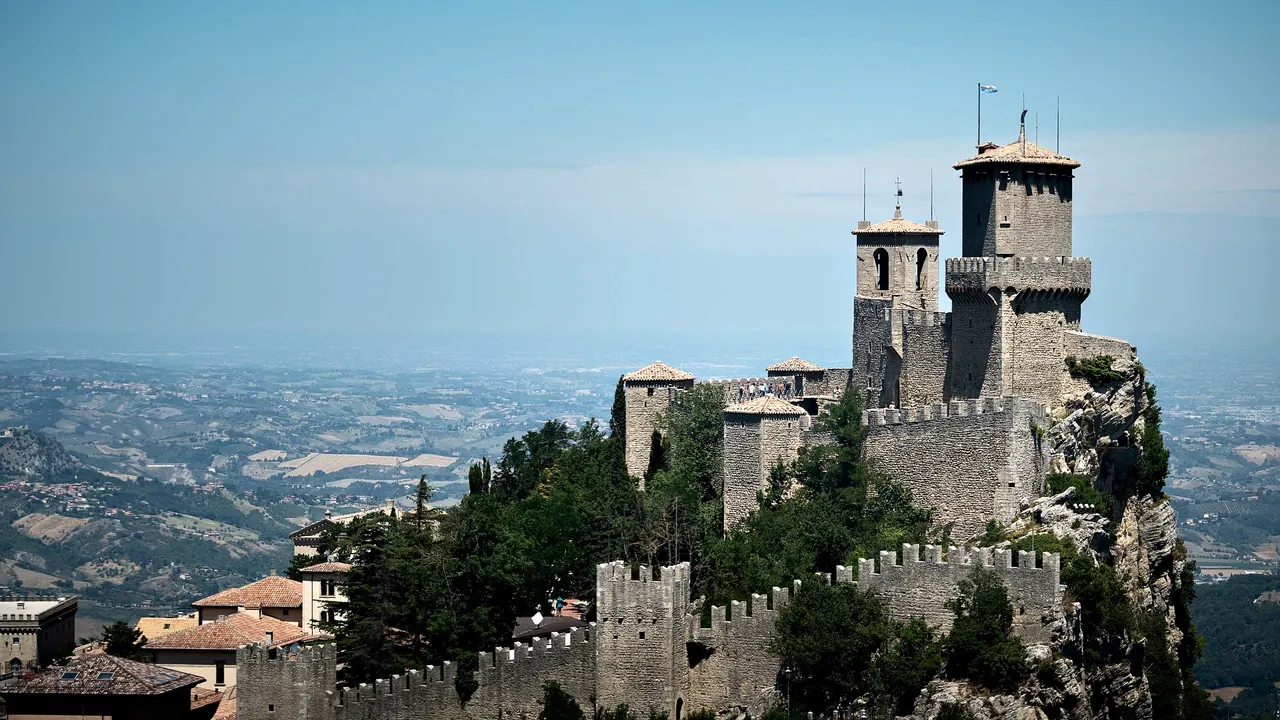
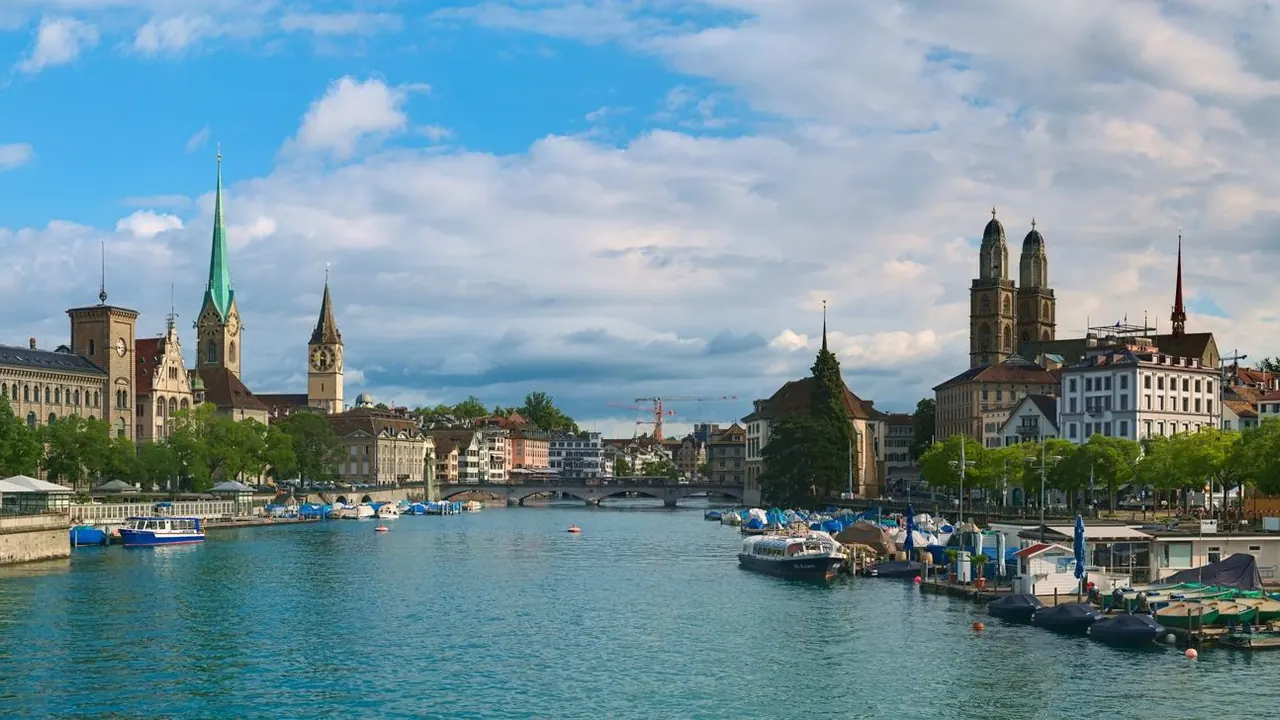
Photos: San Marino by Tibor Szabo, Pexels License; Zurich by Daniel Kraft, CC BY-SA 3.0, cropped.
San Marino or Zurich?
Our verdict in twelve categories, each scored against the same fixed benchmark cities, and the climate month by month, so you can choose for your trip.
Choose San Marino for
- prices
San Marino suits a traveller who wants a walled hilltop republic and a cheaper base, ideally with a car. Half a day on Monte Titano's towers, then the sandy Romagna shore, Urbino, San Leo and Ravenna below, makes for a good touring stay. The bills stay at provincial Italian levels rather than Swiss ones. Expect quiet evenings, because there is little to do on the summit after dark.
Choose Zurich for
- live music and the arts
- nightlife
- getting around
For nearly every other kind of trip, Zurich is the better choice. Opera, clubs, strong art museums and lake swimming are all in the city, the Alps are close, and trains reach Lucerne, Bern and the Rhine Falls without a car. The catch is cost: it is one of the most expensive places in Europe to spend even a few days.
Scoreboard
Twelve categories on one fixed scale from 0 to 100. The shaded stretch is the gap between the two.
Your match
Pick a travel style or drag the sliders, and both match scores follow your weighting.
Wins on prices with your weighting.
Wins on live music and the arts and nightlife with your weighting.
What matters to you?
Category by category
What the scores mean for a trip.
Beaches & swimming
Neither city is on the sea, and they offer about the same amount of swimming in very different forms. From San Marino you go down about half an hour to the sandy Romagna shore at Rimini and Riccione, with rows of numbered umbrellas, beach clubs and shallow, warm water.
Zurich swims in the middle of town. It has wooden bathing houses and lawned lidos on the clean lake, plus the Limmat river baths at Letten, where you float downstream with the current. You lie on grass and decks rather than sand, but there is no drive to get there.
Food & drink
San Marino serves the honest cooking of the Romagna hills: piadina, passatelli in broth and hand-rolled strozzapreti, with the republic's own Sangiovese. On the summit, though, the terraces trade on the view, and the better meals are down in Borgo Maggiore or over the border.
Zurich gives you more to eat, at a steep price. There is veal Geschnetzeltes with rösti, winter fondue in the Altstadt guild houses, the old Paradeplatz tea rooms and the casual international places around Langstrasse, though markets and street food are thin.
Culture & sights
In San Marino the sight is the town itself. You get the three towers on the crest of Monte Titano, the cliffside path between Guaita and Cesta, and the Palazzo Pubblico as the seat of an ancient republic. It is memorable, but you can see it in half a day.
Zurich has enough to fill a longer stay. The Kunsthaus runs from Monet to Giacometti, and there are also the Swiss National Museum and the Rietberg. Add the Grossmünster, where the Swiss Reformation began, and Chagall's windows in the Fraumünster, and two or three days pass easily.
Nightlife
Once the coaches leave, San Marino's summit goes quiet, and a glass of wine above the lights of the coast is the whole night out. Clubbing means driving down to Rimini and Riccione.
Zurich has a serious club scene built on electronic music. Venues in Kreis 4 and 5 and Zurich West stay open until morning at weekends, and the Street Parade takes over the lake shore every August. In summer, nights move outdoors to the bars in the lake bathing houses, though rounds are dear and weeknights are calm.
Nature & outdoors
Monte Titano gives San Marino cliffs, woodland paths down to Borgo Maggiore and views across the plain to the sea, with gentle Montefeltro farmland beyond. It is fine for a morning, but there are no long trails.
Zurich has the lake, and the Uetliberg and the Albis ridge right at the edge of town. The Alps are about an hour away, with summer hiking on Rigi and Pilatus and winter skiing at Flumserberg. For anyone planning whole days outdoors, Zurich is far ahead.
Day trips
Day trips are San Marino's strongest suit. San Leo, Urbino, Ravenna's mosaics, Gradara and the Riviera all lie within about an hour or so. Apart from the bus to Rimini, though, most of them need a car.
Zurich still does better because of the train. Lucerne, Bern, Basel, St Gallen, and the Rhine Falls with Stein am Rhein are all easy days out by rail, and Rapperswil is a trip by lake boat. A visitor without a car sees far more of the country.
Good for families
Children enjoy San Marino's battlements and the cable car up from Borgo Maggiore. However, steep steps make pushchairs hard work and the summit has little built for children. The miniature park, waterparks and shallow beaches are on the coast below, so a car helps.
Zurich is easier in every way. It is safe, its transport copes with buggies, the zoo has a Madagascar rainforest hall, the lake lidos have shallow areas, and the Technorama is a short train ride away. Its quiet evenings suit families with younger children best.
Getting around
You can walk across San Marino's old town in under half an hour, but nearly every street climbs or drops. Beyond the cable car and the bus up from Rimini, public transport is thin, and the surrounding hill towns realistically need a car.
Getting around Zurich is close to effortless. Trams, S-Bahn trains, funiculars and even the lake boats share one ticket, and the airport is a short train ride from the main station. A car is more nuisance than help.
Shopping & style
San Marino's shops lean on souvenirs, collectors' stamps and coins, and perfume, watches and spirits made cheaper by lower taxes. There is also an outlet centre on the valley floor.
Zurich has Bahnhofstrasse, one of the world's great luxury streets, plus watch dealers in the side streets, Niederdorf boutiques and design shops in the Zurich West viaduct arches. The range is narrow beyond luxury and design, but it goes much deeper than anything on Monte Titano.
Affordability
The two are furthest apart on the biggest items in a trip, the room and the evening meal. A plain hotel and a dinner of strozzapreti and Sangiovese in a valley trattoria near San Marino cost a small fraction of their Zurich equivalents, and a round of drinks, which is often the biggest surprise in Zurich, stays unremarkable. Where San Marino does cost extra is on the summit, where you pay for the view as much as for the plate. Lower taxes on fuel and spirits help to balance that out.
Zurich also charges heavily for things that cost little on Monte Titano, such as museum entry and getting around. The combined transport and museum card takes the edge off, and the lake lidos and drinking fountains are free. Even with careful spending, though, Zurich comes nowhere near San Marino's prices.
Live music & performing arts
San Marino has a small theatre, occasional concerts by local ensembles and the costumed Medieval Days in summer. For opera, people head to Bologna or Pesaro.
Zurich has a full season at the Opernhaus, the Tonhalle Orchestra and the Schauspielhaus, whose plays are mostly in German. There is also jazz and indie at the Rote Fabrik and the open-air Theater Spektakel by the lake. For evenings at a performance, it is the clear choice.
Wellness & relaxation
In San Marino the calm comes in the evening, walking the walls once the day crowds have gone. Beyond a few hotel spas, a thermal bath means a separate trip to the coast or the Apennine valleys.
Zurich builds relaxation into the city. There are thermal pools in the stone vaults of the old Hürlimann brewery, and in winter the wooden lake baths become saunas, with cold dips between sessions. The hot springs of Baden are about twenty minutes away by train.
When should you go?
Pick your month. The climate figures are measured averages, not a forecast.
San Marino in July
Zurich in July
Daytime high, °C
Rainfall in the month, mm
Where the figures come from
San Marino's temperatures are measured 52 km from the centre, at Frontone.
San Marino has no rain gauge within 25 km of the centre, so its rainfall comes from a gridded climate dataset read at the city rather than from a gauge further away.
Temperature and rainfall are climate normals, averaged over the years shown. San Marino: 1991-2020 normals, Frontone (51.5 km from centre). Zurich: 1991-2020 normals, Zurich Town / Ville. (2.2 km from centre).
San Marino has the hotter summer. July highs reach about 30°C on the mountain, and the Adriatic below is warm enough for swimming from July into early September, at around 25°C. Late May and June, and September again, are the best times to walk the walls and towers without the midsummer heat. Autumn is the wet season, with rain building to about 105mm in November, and winters are cold and raw on the ridge.
Zurich's summer is milder, with highs around 24°C. That is ideal for walking and for the lake lidos from June to early September, though May to August is also its wettest stretch, at about 128mm in June, so pack for showers. July and August are the sunniest months. Late autumn and winter are cold and grey, with fog over the lake and very little sun, so museums and saunas suit those months better than sightseeing on foot.
Which traveller are you?
On a trip on a tight budget, San Marino is the realistic choice. Hotels and trattorias in the lower villages are priced like provincial Italy, the sights cost little, and the Riviera beaches are a bus ride away. In Zurich even simple rooms and casual lunches cost far more.
For a culture and arts trip, Zurich wins clearly. The Kunsthaus, the Swiss National Museum, a respected opera house, the Tonhalle and the Schauspielhaus give both days and evenings real depth. San Marino's towers and Palazzo Pubblico fill half a day, and its stages are mostly quiet.
On an outdoors trip, Zurich is the far stronger base. The Uetliberg ridge and the lakeside paths start in the city, and Rigi, Pilatus and the Glarus valleys are about an hour away by train. San Marino offers pleasant but short walks around Monte Titano and the Montefeltro lanes.
Before you go
| Measure | San Marino | Zurich |
|---|---|---|
| Official language | Italian | French, German, Italian, Romansh |
| Currency | Euro (EUR) | Swiss Franc (CHF) |
| Sockets | CFL230 V, 50 Hz | CJ230 V, 50 Hz |
| Driving side | Right | Right |
| Time zone | UTC+1, UTC+2 in summer | UTC+1, UTC+2 in summer |
| Emergency number | 112 | 112 |
| Elevation | 675 m | 408 m |
| Main airport | Bologna Guglielmo Marconi Airport (BLQ)114 km from centre98 non-stop destinations | Zürich Airport (ZRH)9 km from centre226 non-stop destinations |
| Public holidays this year | 18 days | 10 days |
By the numbers
| Measure | San Marino | Zurich |
|---|---|---|
| City population | 4,040 | 440,935 |
| People per km² | 569 | 5,016 |
| Museums within 10 km | 19 | 63 |
| UNESCO World Heritage sites within 50 km | 2 | 1 |
| Swim season, months above 21 °C | 4 months | - |
Where else could you go?
Every comparison below shares a destination with this one, so you can follow San Marino or Zurich somewhere new.