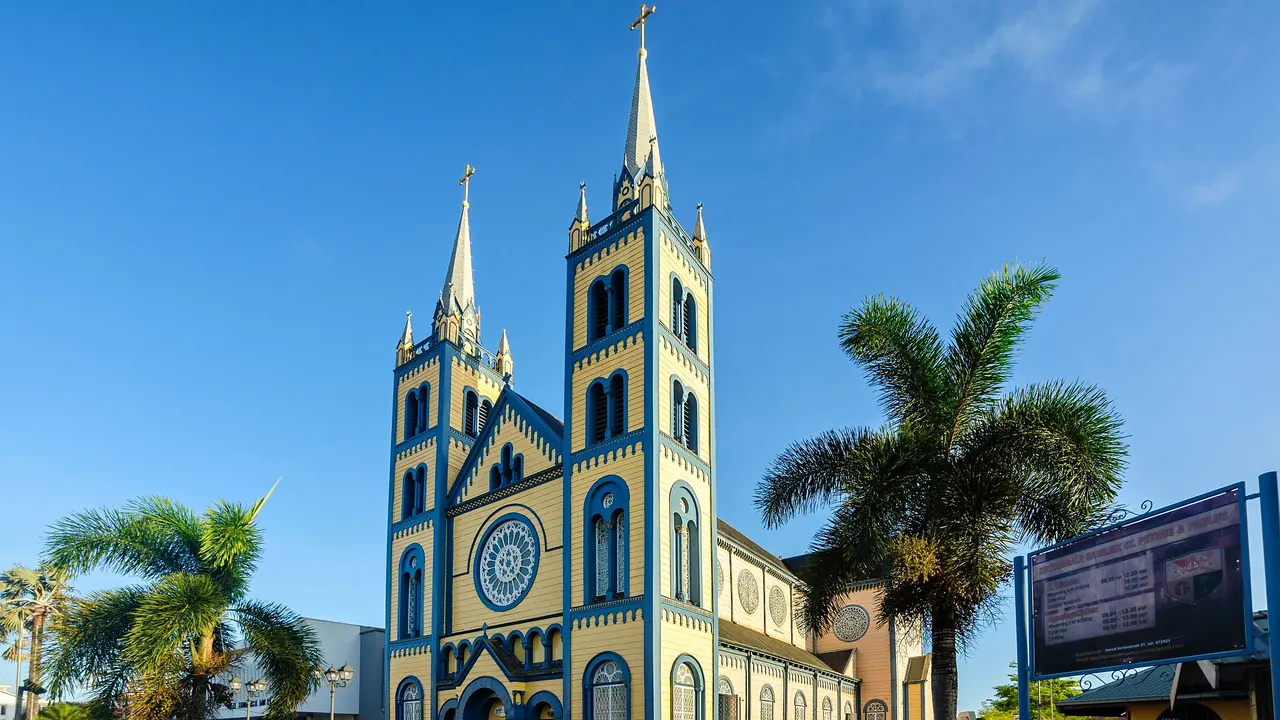
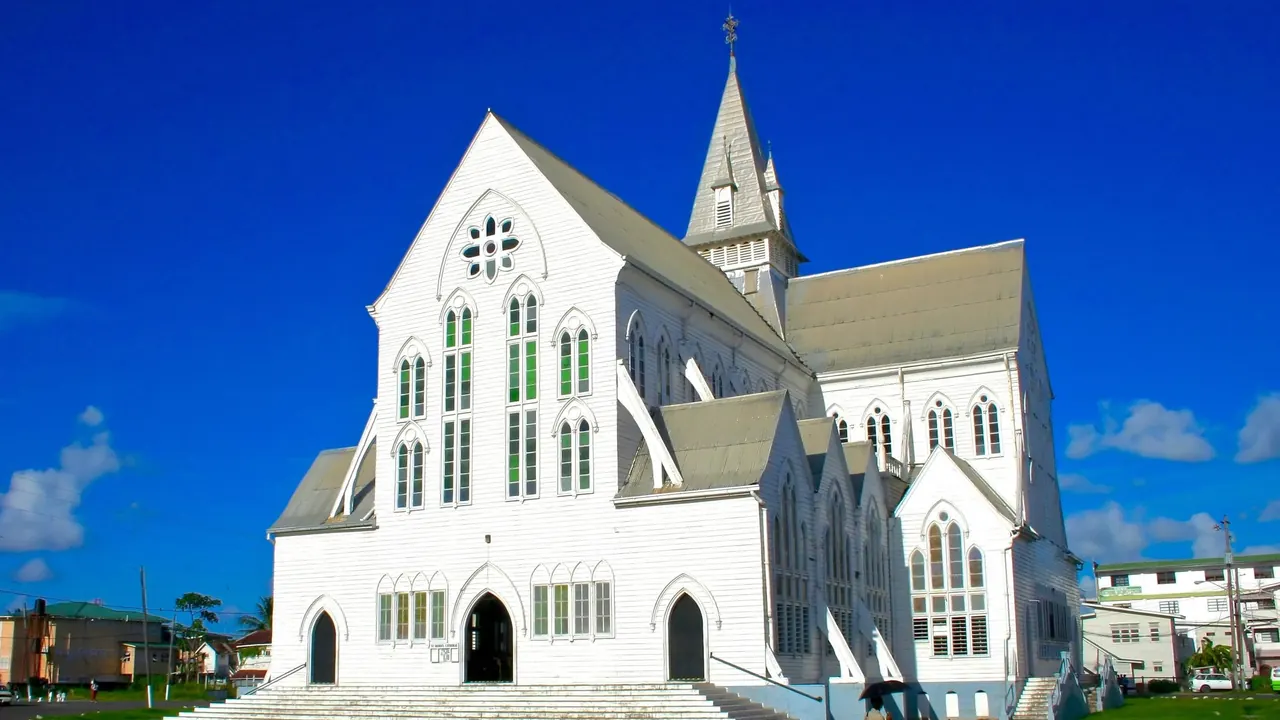
Photos: Suriname by ApintiGamelan, CC BY-SA 4.0, cropped; Guyana by Ian Mackenzie, CC BY 2.0, cropped.
Suriname or Guyana?
Our verdict in twelve categories, each scored against the same fixed benchmark cities, and the climate month by month, so you can choose for your trip.
Choose Suriname for
- day trips
- prices
- culture and sights
Suriname suits a traveller who wants a tropical country with a capital worth staying in. Paramaribo's wooden old town, its Javanese, Hindustani and Creole cooking and the plantations of Commewijne across the river fill several good days before you go anywhere near the forest. The capital and the coast are cheap. The rainforest is still within reach, from Brownsberg to the Voltzberg, if you want a taste of the interior without making it the whole trip.
Choose Guyana for
- nature and the outdoors
Choose Guyana if the wilderness is the whole point. Kaieteur, Iwokrama and the Rupununi savannahs give you bigger landscapes and a better chance of seeing rare animals, and the trip is built around remote community lodges rather than a city. A day or two covers Georgetown, travel inland is slow and costly, and families with young children will find it hard going. For wildlife, though, it is the more rewarding of the two.
Scoreboard
Twelve categories on one fixed scale from 0 to 100. The shaded stretch is the gap between the two.
Your match
Pick a travel style or drag the sliders, and both match scores follow your weighting.
Wins on day trips and prices with your weighting.
Wins on nature and the outdoors with your weighting.
What matters to you?
Category by category
What the scores mean for a trip.
Beaches & swimming
Neither country is the place for a beach trip. Both coasts are mudflat and mangrove with a brown, silty sea, and their sandy stretches, Galibi in Suriname and Shell Beach in Guyana, belong to nesting turtles. In both, swimming means fresh water, and what differs is the setting.
In Suriname the best dips come with a lodge stay, beside the rapids and sandbanks of the Upper Suriname River, with the creeks along the Zanderij road and Brokopondo Reservoir closer to the capital. Guyana's versions are weekend outings: the black-water creeks off the Soesdyke-Linden highway, the Essequibo river banks near Bartica and Lake Mainstay.
Where in Suriname: Upper Suriname River, Creeks south of Paramaribo, Brokopondo Reservoir
Where in Guyana: Essequibo River near Bartica, Lake Mainstay, Soesdyke-Linden creeks
Food & drink
Suriname is the better country to eat in. Javanese, Hindustani, Creole and Chinese cooking all have a place in Paramaribo, so in a few days you can go from saoto soup at a warung to roti, pom and moksi meti. The weekend stalls at Blauwgrond and Lelydorp add even more choice.
Guyana's cooking has equally mixed roots, with pepperpot, cook-up rice and metemgee, and aged Demerara rum gives it a drink with real pedigree. But most of the range is in Georgetown's Stabroek and Bourda markets and a few sit-down restaurants, with Berbice the place for Indo-Guyanese curry and dhal puri. In both countries, the choice shrinks to set lodge meals once you leave the coast.
Where in Suriname: Paramaribo, Blauwgrond, Lelydorp
Where in Guyana: Georgetown, Berbice
Culture & sights
Suriname has the stronger set of sights, thanks to Paramaribo's UNESCO-listed inner city. Its grid of white timber houses holds Fort Zeelandia, the Presidential Palace and the great wooden cathedral within a few streets, with the synagogue and mosque side by side. Outside the capital, the Jodensavanne ruins and the Commewijne plantation houses add a second layer.
Georgetown has a similar wooden colonial look, with St George's Cathedral, City Hall and the Stabroek clock tower, and its two small museums are good on Amerindian history. But many of its buildings are weathered. Beyond the capital there is only the Dutch brick fort on Fort Island, the fragment of Kyk-Over-Al and the quieter centre of New Amsterdam.
Where in Suriname: Paramaribo historic inner city, Commewijne, Jodensavanne
Where in Guyana: Georgetown, Essequibo River, New Amsterdam
Nightlife
In both countries, nights out happen only in the capital, and at the lodges the evening ends with a drink and the sound of the forest. Paramaribo has a little more going on, with a strip of open-air bars and lounges south of the centre, casinos and late dance parties playing kaseko and Dutch club music.
Georgetown's nights centre on rum shops with sound systems and a few clubs that fill on Fridays and Saturdays, playing soca, dancehall and chutney. The scene peaks around Mashramani, and visitors usually take taxis between places rather than walk.
Where in Suriname: Paramaribo
Where in Guyana: Georgetown
Nature & outdoors
Both countries are mostly rainforest, but Guyana has the bigger and more varied wilderness. Kaieteur's single drop of about 226m, the giant otters and canopy walkway at Iwokrama and the open Rupununi savannahs, with anteaters, harpy eagles and the chance of a jaguar, add up to landscapes and wildlife Suriname does not match.
Suriname's forest is easier to get into. Brownsberg is a few hours' drive from Paramaribo, and the Voltzberg dome in the Central Suriname Nature Reserve rises above the canopy. On the coast there are dolphins where the Commewijne meets the Suriname River and scarlet ibis at Bigi Pan. Both countries have a turtle beach, Galibi and Shell Beach, where nesting runs from around March to August.
Where in Suriname: Central Suriname Nature Reserve, Upper Suriname River, Brownsberg Nature Park, Galibi
Where in Guyana: Kaieteur National Park, Iwokrama, Rupununi, Shell Beach
Day trips
Paramaribo is the better base for days out. Across the river, Commewijne fills a day of cycling or boating between plantations such as Peperpot and Frederiksdorp, ending at Fort Nieuw Amsterdam. Jodensavanne makes a second outing, and you can stop at Lelydorp and the Javanese villages on the road south.
From Georgetown the choice is thinner: the boat from Parika up the Essequibo to Fort Island, the river town of Bartica, or the drive east to New Amsterdam. Its best-known day out, the flight to Kaieteur Falls, is about scenery rather than places.
Where in Suriname: Commewijne, Jodensavanne, Lelydorp
Where in Guyana: Fort Island, Bartica, New Amsterdam
Good for families
Neither country is built for children, and both suit adventurous families with older children rather than toddlers. Suriname is the easier of the two. Paramaribo has a small zoo and some resort pools, and the dolphin boat trips near the capital and the night walks to watch turtles at Galibi are the highlights.
In Guyana, most of what appeals to children is far away, at Rupununi ranch lodges with otters, caiman and horse rides across the savannah. Getting there means small planes or long, bumpy drives, and medical care outside the capital is basic. In Georgetown, feeding the manatees in the Botanical Gardens is the one real treat.
Where in Suriname: Paramaribo, Galibi, Upper Suriname River
Where in Guyana: Rupununi, Georgetown
Getting around
Both countries run on minibuses, taxis, boats and light aircraft, and in both most visitors leave the interior travel to a package or a lodge. Suriname is a little easier. Paramaribo's historic centre is walkable, and paved roads reach Brownsberg and Atjoni, where the river journeys begin.
Guyana's coastal road is good, but the single road south to Lethem and the Rupununi is long and rough and can turn to deep mud in the rainy season. That is why the small domestic planes landing on grass strips do most of the work of reaching Kaieteur and the lodges.
Where in Suriname: Paramaribo
Where in Guyana: Georgetown, Rupununi
Shopping & style
Shopping is a minor part of a trip to either country, and the difference is in what you take home. In Suriname that means Maroon woodwork, carved and painted trays, stools and paddles, sold near the Paramaribo waterfront and in villages along the Upper Suriname River, plus Javanese batik and local gold.
In Guyana, look for Amerindian woven baskets, hammocks and carved balata figures, and a bottle of aged Demerara rum. For browsing, Paramaribo's two-storey Central Market rewards a slow wander, while Georgetown's Stabroek Market is crowded and you need to watch your bag.
Where in Suriname: Paramaribo, Upper Suriname River
Where in Guyana: Georgetown, Rupununi
Affordability
Suriname is the cheaper country to visit. Around Paramaribo, warung meals, roti shops, minibuses and taxis cost little, guesthouses and mid-range hotels are fairly priced, and a bicycle day in Commewijne is among the cheapest outings in the country.
Guyana's street food, minibuses and rum are inexpensive too, but Georgetown's better hotels are priced for business travellers. In both countries most of the money goes on the interior, on lodge packages and light aircraft. In Guyana the slow overland road to the Rupununi is the main way to spend less.
Where in Suriname: Paramaribo, Commewijne
Where in Guyana: Georgetown, Rupununi
Live music & performing arts
Neither country has much formal stage life. Paramaribo has a small cultural centre and Georgetown has the National Cultural Centre, and both run irregular programmes, so what you hear depends on when you come.
In Suriname, the times to come are New Year and Keti Koti, the emancipation festival in July, when kaseko fills the streets, and Maroon villages may put on drumming and dance for visitors. Guyana's big occasion is Mashramani in February, with costume bands and steel pan, while Phagwah and Diwali bring music to the Indo-Guyanese communities.
Where in Suriname: Paramaribo, Upper Suriname River
Where in Guyana: Georgetown
Wellness & relaxation
Suriname is the better of the two for a few restful days, though here that means a quiet lodge rather than a spa. Its riverside lodges sit beside the rapids of the Upper Suriname River, where you spend the days in a hammock with no phone signal. Paramaribo also has a few hotel spas and massage rooms for an afternoon off.
In Guyana, the restful option is a stay at a savannah or riverside lodge in the Rupununi or the Iwokrama forest, with early nights and forest sounds. But the journey there is tiring, and Georgetown itself is hot and noisy, not a place to slow down. Don't come to either country for treatments, thermal waters or a retreat.
Where in Suriname: Upper Suriname River, Paramaribo
Where in Guyana: Rupununi, Iwokrama Forest
When should you go?
Pick your month, and for a country the place in it. The climate figures are measured averages, not a forecast.
Where in Guyana
Paramaribo (Suriname) in July
Georgetown (Guyana) in July
Daytime high, °C
Rainfall in the month, mm
Where the figures come from
Paramaribo (Suriname)'s temperatures are measured 45 km from the centre, at Zanderij.
Paramaribo (Suriname) has no rain gauge within 25 km of the centre, so its rainfall comes from a gridded climate dataset read at the destination rather than from a gauge further away.
Temperature and rainfall are climate normals, averaged over the years shown. Paramaribo (Suriname): 1991-2020 (sunshine 1981-2010) normals, Zanderij (44.7 km from centre). Georgetown (Guyana): 1961-1990 (sunshine 1991-2020, rainfall 1991-2020) normals, Georgetown (0.7 km from centre).
Both countries are hot and humid all year, so when to go depends on the rain, not the heat. Paramaribo is driest and sunniest from August to October, and September and October are the driest months of all. That is also when daytime highs reach 34°C, which makes long walks through the old town slow going. The heaviest rain falls in May and June, and December and January are wet as well.
Georgetown has two wet seasons, May to July and November to January, with more than 300mm in both May and June. Its drier spells come in February and March and again in September and October. Kaieteur, inland, is a little cooler and has only one wet season, from May to August, when daytime highs drop to about 26°C. From September to March it stays fairly dry, and March is the driest month at about 54mm, a good time for the flight to the falls. The sea is warm off both coasts all year, but it is brown with silt, so it shouldn't decide when you go.
Which traveller are you?
On an outdoors trip, Guyana is the stronger choice. Kaieteur Falls, the Iwokrama canopy walkway and the open Rupununi savannahs, with giant otters, anteaters and a chance of jaguar, are wilder and more varied than Suriname's forest, though the light-aircraft journeys take more planning.
For a food and nightlife trip, Suriname comes out ahead. Paramaribo's Javanese warungs, roti shops and weekend stalls at Blauwgrond give you a wider choice than Georgetown, and its open-air bars, casinos and late kaseko dance parties make a slightly fuller night out.
On a trip on a tight budget, Suriname is the better bet. Paramaribo's cheap food, minibuses and fairly priced guesthouses, plus a bicycle day in Commewijne and an outing to Jodensavanne, fill a stay without the costly flights and lodge packages that Guyana's main sights need.
More comparisons
Each shares a side with Suriname or Guyana.
Where else could you go?
Set Suriname or Guyana against any other country.