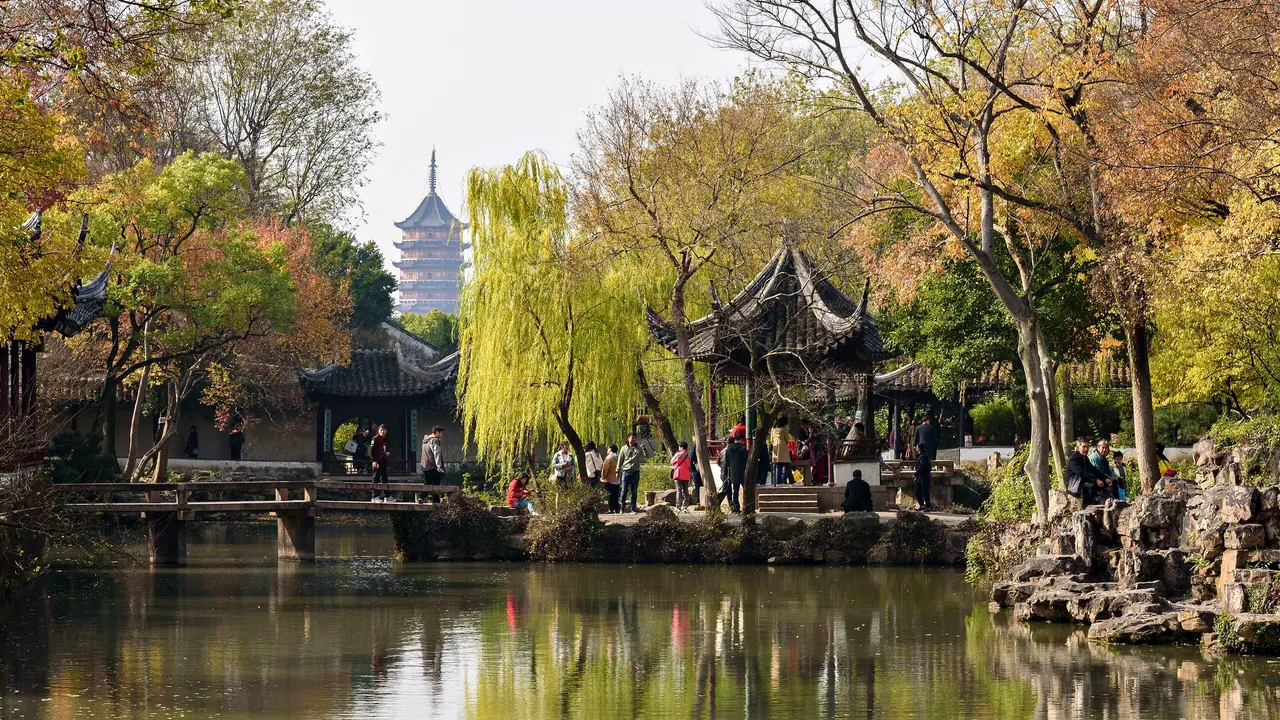
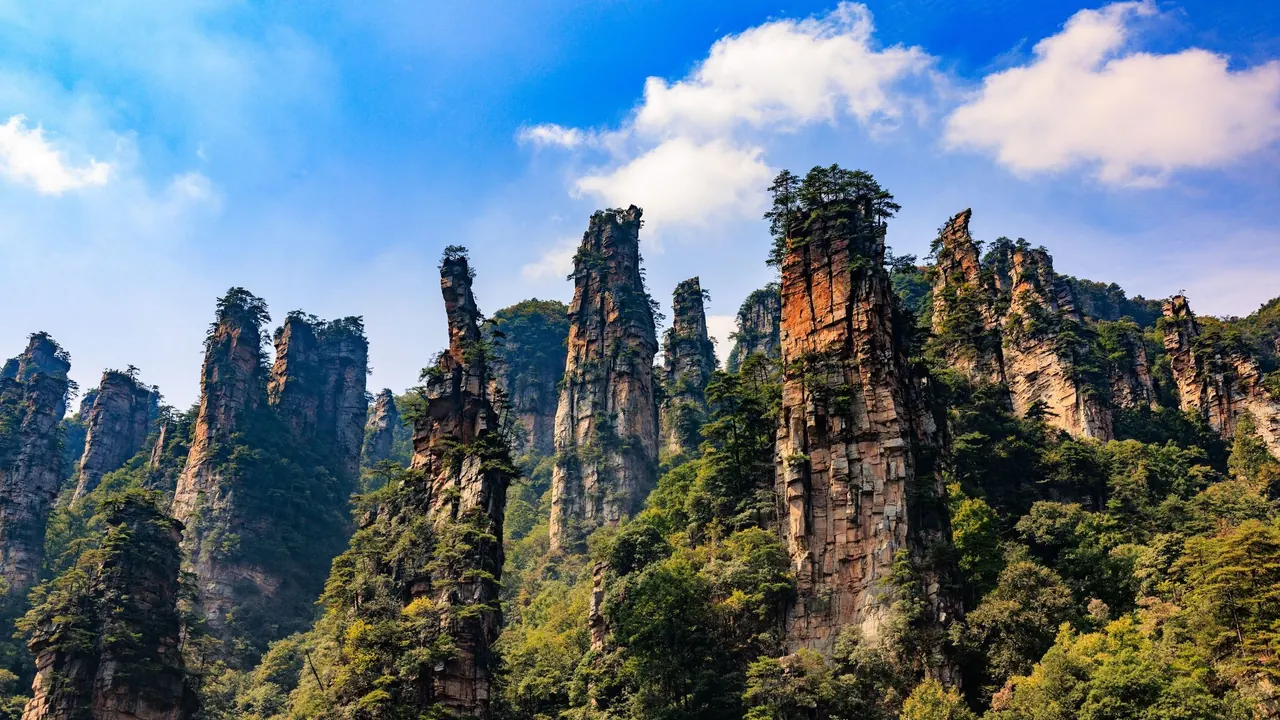
Photos: Suzhou by King of Hearts, CC BY-SA 4.0, cropped; Zhangjiajie by David Tran, Pexels License.
Suzhou or Zhangjiajie?
Our verdict in twelve categories, each scored against the same fixed benchmark cities, and the climate month by month, so you can choose for your trip.
Choose Suzhou for
- culture and sights
- day trips
- shopping
Suzhou suits travellers who want a cultivated, unhurried city. It has UNESCO-listed classical gardens inside the old moat, canal streets such as Pingjiang Road, Kunqu opera sung in garden pavilions and a refined Jiangsu kitchen. It is also an easy base, with Shanghai, Nanjing and Hangzhou close by fast train and water towns like Tongli nearby. That makes it a good choice for a first trip to China or for linking several cities.
Choose Zhangjiajie for
- nature and the outdoors
- prices
Zhangjiajie is for travellers who come for the landscape and will give up comfort and city life to see it. The sandstone pillars of Wulingyuan and the cliff paths of Tianmen Mountain are some of the most striking scenery in China, and cable cars, lifts and glass walkways take you up to them. Expect early starts, crowds on the stone steps, fiery Hunan food and quiet evenings. The town itself has little to offer beyond the mountains.
Scoreboard
Twelve categories on one fixed scale from 0 to 100. The shaded stretch is the gap between the two.
Your match
Pick a travel style or drag the sliders, and both match scores follow your weighting.
Wins on culture and sights and day trips with your weighting.
Wins on nature and the outdoors and prices with your weighting.
What matters to you?
Category by category
What the scores mean for a trip.
Beaches & swimming
Neither city has anything for swimmers. Suzhou's lakes and canals are for looking at, and its nearest coast is the muddy Yangtze estuary. In Zhangjiajie, the lakes among the peaks are only for boat trips.
The one difference is how you might get wet. In the mountains, summer rafting through the gorges is a real day on the water, while in Suzhou a hotel pool is the only option.
Food & drink
Suzhou eats better, and more gently. Its Jiangsu cooking is sweet, delicate and based on fish and shrimp from the lakes, from squirrel-shaped mandarin fish to the breakfast noodle bowl and the autumn hairy crab. Teahouses and pastry shops add to it, and there are more polished restaurants around Jinji Lake.
Zhangjiajie's western Hunan food is a different thing entirely: hot, sour and smoky, built around the three-pot stew, cured bacon and chilli pickles. It is rewarding in the city's food streets, but meals near the park gates are often generic tour-group food, and there is little cooking from outside China.
Culture & sights
This is where the two cities differ most. Suzhou's walled classical gardens, including the Humble Administrator's Garden and the Master of the Nets, are a world-class reason to visit on their own. Tiger Hill, the Panmen water gate, the canal streets and two fine museums add to them.
Zhangjiajie has a quiet Ming temple, a Tujia folk park and a few rebuilt streets, which together take half a day. Its heritage lies out of town, in places such as Fenghuang and Laosicheng, rather than in the city itself.
Nightlife
Neither city is a place for a big night out, but Suzhou gives an evening more shape. You can take a lantern-lit stroll along Pingjiang Road, try the small bars on Shiquan Street or go to the rooftop lounges and few clubs around Jinji Lake, and Shanghai is half an hour away by train for anything bigger.
Zhangjiajie keeps early hours because its visitors get up at dawn for the parks. A beer by the river or an hour of karaoke is about the limit, and Wulingyuan goes quiet after dinner.
Nature & outdoors
Zhangjiajie is in another league. Wulingyuan's thousands of mist-wrapped sandstone pillars, the cliff walkways and natural arch on Tianmen Mountain, the Yellow Dragon cave and mountain rafting make it one of China's great landscapes, even if the paths are paved and crowded at peak times.
Suzhou's outdoors is gentle delta country. You can cycle the lakeside roads and tea terraces on the Lake Tai peninsulas, make short climbs on Lingyan Hill or take an evening loop round Jinji Lake. It is pleasant, but there are no mountains nearby.
Day trips
Suzhou is much the better base for day trips. Fast trains reach Shanghai in about half an hour and Nanjing, Hangzhou and Yangzhou within two hours. The canal water towns of Tongli, Luzhi and Zhouzhuang are close enough for an afternoon.
From Zhangjiajie the choice is narrower. Fenghuang's riverside old town, the cliff-top village of Furong and the overgrown Tujia capital at Laosicheng are all worth the trip. Beyond those three, most of what is within reach is more mountain scenery.
Good for families
Suzhou is the easier choice with children, though neither city is ideal. Children may get bored in the gardens, but canal boat rides, the lakeside parks around Jinji Lake and the water and amusement parks west of the old town give them something of their own.
Zhangjiajie can thrill older children with its cable cars, glass walkways, the lift up the cliff face and the macaques. Long queues, steep steps and summer storms are hard on small children and pushchairs, though, and almost nothing is designed for families.
Getting around
Distances are what separate these two. In Suzhou, the old town inside the moat is small enough to cover on foot or by shared bike along the canal lanes, and a clean metro with English signs runs out to the railway stations and Jinji Lake. Only outer sights such as Tiger Hill and the Lake Tai shore need a taxi, and paying through Chinese mobile apps makes it all smoother.
Zhangjiajie takes more planning. The main forest park at Wulingyuan is about 30km from the city, and the Grand Canyon and other sights are scattered further out. Inside the park, the shuttle routes are confusing and the signs are mostly in Chinese. Many visitors split their nights between Wulingyuan and the city, or hire a driver for the outlying sights.
Shopping & style
Suzhou gives you a real reason to shop: silk and fine double-sided embroidery, best seen in the workshops of Zhenhu village. Its canal streets sell tea and fans, and there are modern malls by Jinji Lake. Zhangjiajie sells souvenirs, mountain produce and smoked bacon near the park gates, and the Tujia xilankapu brocade and Miao silverwork are the only things worth looking out for.
Affordability
By Western standards both cities are cheap for hotels, meals and getting around. The difference is where the money goes. In Suzhou, a prosperous city, the extras are garden entry fees and special crab or fish dinners.
In Zhangjiajie, daily life costs a little less, but the separate tickets for the forest park, the Tianmen cable car, the glass bridges and the lifts soon become the largest part of the budget. In both cities, Golden Week pushes hotel rates up.
Live music & performing arts
Suzhou has living traditions of its own. It is the birthplace of Kunqu opera, performed in theatres and on summer evenings in garden pavilions, and of Pingtan storytelling, heard in teahouses. Concerts and touring shows play at the arts centre by Jinji Lake.
Zhangjiajie's stage belongs to big folklore spectacles: Tujia and Miao song and costume in large theatres, and an open-air show set against the Tianmen cliffs. They are polished, but they are made for tourists, with no local music or theatre scene behind them.
Wellness & relaxation
In Suzhou, rest is part of everyday life rather than something you have to travel to find. There are massage parlours on almost every street, and it is easy to fall into the slow habits of a garden and teahouse town. The exception is the gardens at weekends and in the national festival weeks, when the narrow paths fill and the calm disappears.
Zhangjiajie offers recovery rather than relaxation. After a day on the stone steps a foot massage is a real pleasure, and the hot-spring resorts in the countryside beyond town offer the kind of soak Suzhou cannot, as it has no thermal bathing tradition. Otherwise, quiet is limited to early mornings in the park's lower valleys, before the tour groups arrive.
When should you go?
Pick your month. The climate figures are measured averages, not a forecast.
Suzhou in July
Zhangjiajie in July
Daytime high, °C
Rainfall in the month, mm
Where the figures come from
Suzhou's temperatures are measured 79 km from the centre, at Shanghai / Hongqiao.
Suzhou has no rain gauge within 25 km of the centre, so its rainfall comes from a gridded climate dataset read at the city rather than from a gauge further away.
Suzhou's sunshine is measured 81 km from the centre, at Shanghai.
Zhangjiajie has no weather station within reach, so its figures come from a gridded climate model rather than a measured record, and read a broad area rather than the city itself.
Temperature and rainfall are climate normals, averaged over the years shown. Suzhou: 1991-2020 normals, Shanghai / Hongqiao (78.8 km from centre). Zhangjiajie: 2001-2020 normals, NASA POWER reanalysis grid, no weather station within 90 km.
Both cities are at their best in spring and autumn, and both are hard going in high summer, but for different reasons. In Suzhou, July and August reach 33°C with sticky humidity, which makes a day of gardens and canal walks tiring, and June and August are its wettest months. October stands out. It is mild, dry at about 25mm, and among the sunnier months of the year, so it is ideal for walking the old town. Winters are cool and grey but not especially wet.
Zhangjiajie gets far more rain, and it comes earlier. The wet season builds from April to a peak of 229mm in June, bringing mist, slippery steps and hidden peaks just as the days warm up. Summer there is slightly less hot than in Suzhou. September to November is the most reliable time for clear views. From December the highs drop towards 7°C, the high paths can turn icy, and the peaks sometimes carry snow.
Which traveller are you?
On a culture and arts trip, Suzhou is the clear choice. Its UNESCO gardens, the Tiger Hill pagoda, I. M. Pei's museum and Kunqu opera fill several days. Zhangjiajie's town sights take half a day, and its evening shows are tourist spectacles.
For an outdoors trip, Zhangjiajie wins easily. Wulingyuan's sandstone pillars, the Tianmen Mountain cliff paths, the Grand Canyon and river rafting are on another scale from Suzhou's flat delta, where cycling round Lake Tai and climbing low hills is about the most on offer.
On a relaxing and wellness trip, Suzhou fits better. Quiet early mornings in a garden, afternoons in a teahouse over Biluochun tea and lakeside spa hotels make for a slow pace. Zhangjiajie means dawn starts, queues and thousands of stone steps, with a foot massage at the end of the day.
Before you go
| Measure | Suzhou | Zhangjiajie |
|---|---|---|
| Official language | Putonghua | Putonghua |
| Currency | Yuan Renminbi (CNY) | Yuan Renminbi (CNY) |
| Sockets | ACI220 V, 50 Hz | ACI220 V, 50 Hz |
| Driving side | Right | Right |
| Time zone | UTC+8 | UTC+8 |
| Emergency number | Police 110, ambulance 120, fire 119 | Police 110, ambulance 120, fire 119 |
| Elevation | 5 m | 170 m |
| Main airport | Shanghai Hongqiao International Airport (SHA)69 km from centre82 non-stop destinations | Zhangjiajie Hehua International Airport (DYG)5 km from centre31 non-stop destinations |
| Public holidays this year | 6 days | 6 days |
By the numbers
| Measure | Suzhou | Zhangjiajie |
|---|---|---|
| City population | 12,748,262 | 1,517,027 |
| People per km² | 1,473 | 159 |
| Museums within 10 km | 9 | 0 |
| UNESCO World Heritage sites within 50 km | 1 | 1 |
Where else could you go?
Every comparison below shares a destination with this one, so you can follow Suzhou or Zhangjiajie somewhere new.
- Shanghaivs Suzhou
- Hangzhouvs Suzhou
- Chongqingvs Zhangjiajie
- Guilinvs Zhangjiajie
- Yangshuovs Zhangjiajie
- Xi'anvs Zhangjiajie