Taiwan
Kaohsiung
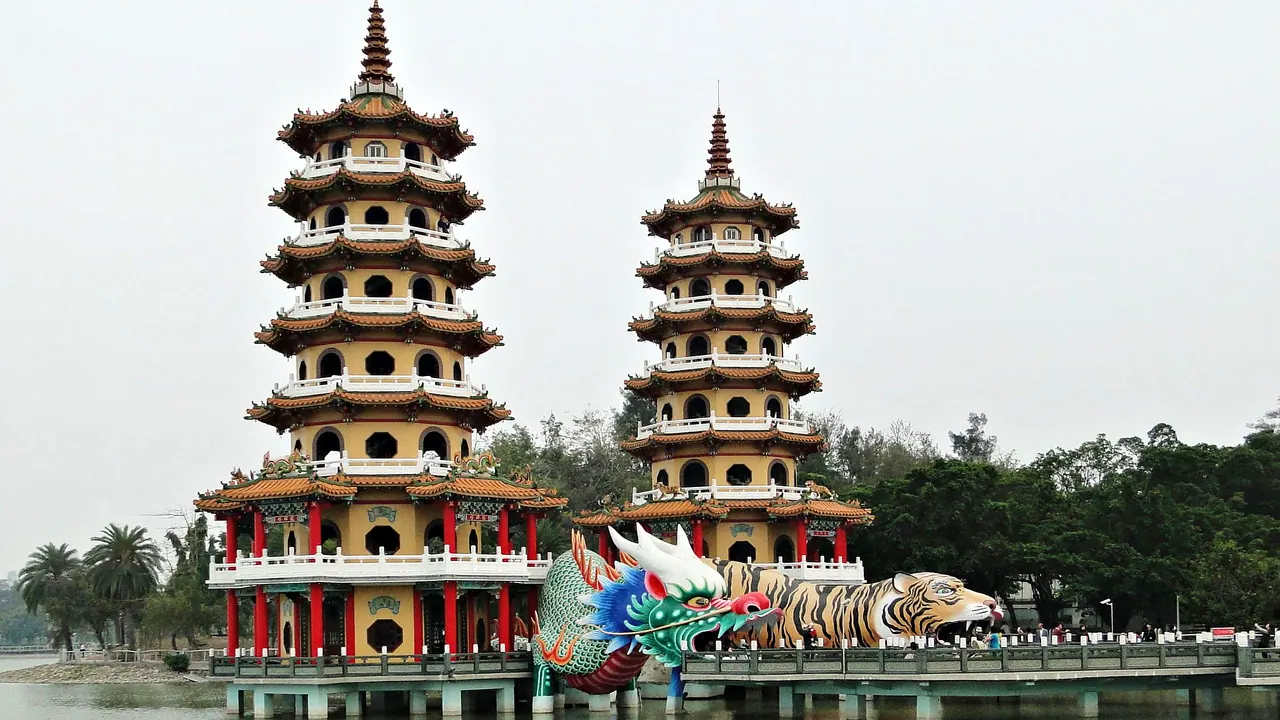
The Dragon and Tiger Pagodas on Lotus Pond
- Food & drink72
- Affordable cities72
- Day trips68
Photo: Bernard Gagnon, CC BY-SA 3.0, cropped
Match
56
Every category weighted equally
- Beach & sun55
- Culture & arts58
- Food & nightlife56
- Family trip59
- Outdoors59
- Relax & unwind55
- Shopping & style56
- On a budget58
Kaohsiung in twelve categories
Our verdict on each, scored 0 to 100 against the same fixed benchmark cities, so a score means the same thing on every page.
Beaches & swimming. Scores 40 out of 100.
Food & drink. Scores 72 out of 100.
Culture & sights. Scores 54 out of 100.
Nightlife. Scores 40 out of 100.
Nature & outdoors. Scores 60 out of 100.
Day trips. Scores 68 out of 100.
Good for families. Scores 62 out of 100.
Getting around. Scores 63 out of 100.
Shopping & style. Scores 50 out of 100.
Affordability. Scores 72 out of 100.
Live music & performing arts. Scores 52 out of 100.
Wellness & relaxation. Scores 40 out of 100.
Kaohsiung category by category
Beaches & swimming
40Kaohsiung faces the Taiwan Strait, and the sea is warm, around 29°C in summer. Even so, beaches play a small part in a visit. Cijin island, a short ferry ride across the harbour, has a long stretch of dark sand that people use more for sunset walks, kites and seafood than for swimming. Sizihwan, beside the university below Shoushan, has a small sheltered bay with a swimming area that only opens in season. Strong currents, typhoon swells and lifeguard rules limit where and when you can swim.
The best water within reach is on Xiaoliuqiu, a coral island reached by road and ferry from Donggang. Its small coves are good for snorkelling with sea turtles. The white-sand beaches of Kenting lie at the southern tip of the island, a long drive away and better treated as a separate stay.
Food & drink
72Kaohsiung eats the southern Taiwanese way, which leans sweeter and more seafood-heavy than the north. The best of it is cheap and informal. Morning stalls serve milkfish congee, rice rolls and soy milk with fried dough. Food courts in the traditional markets serve braised pork rice and fish-ball soup. On Cijin, rows of seafood restaurants let you choose your catch from ice and have it cooked to order.
In the evening, people go to the night markets. Liuhe is the famous one but is aimed at visitors. Ruifeng, near the Arena, is where locals queue for oyster omelettes, grilled squid and bubble tea. Shaved ice with mango in summer is a local ritual. There are good Japanese and modern Taiwanese restaurants, but high-end dining is limited.
Culture & sights
54Kaohsiung grew up as an industrial port, and its sights reflect that. Lotus Pond in Zuoying is the best-known place, with a ring of temples, among them the zigzag-bridged Dragon and Tiger Pagodas, and fragments of a Qing-era city wall nearby. Above the harbour mouth stands the red-brick former British Consulate at Takao, and across the water on Cijin there is an old lighthouse and coastal fort.
The Pier-2 Art Center fills old harbour warehouses with galleries and outdoor installations. The Kaohsiung Museum of Fine Arts sits in a lakeside park, and the Dome of Light glass ceiling makes Formosa Boulevard metro station a sight in its own right. Two or three days covers it. Most visitors combine the city with older towns nearby.
Nightlife
40Evenings in Kaohsiung usually start with food rather than drinks. The most local way to drink is at a stir-fry hall, where groups share plates of seafood and crates of Taiwan Beer until well past midnight. Craft beer bars and cocktail rooms sit around Pier-2 and the old Yancheng harbour streets, and a few relaxed terraces line the Love River. A small cluster of clubs in Sinsing and Lingya fills up on Friday and Saturday nights.
Many places stay open late, but there are not many of them, and the crowd is mostly local. There is no nightlife district that keeps going all week, few international DJs, and little street life after the night markets close. It suits a relaxed evening of beer, seafood and a riverside drink. Visitors who want a big night of clubbing will find little here.
Nature & outdoors
60Shoushan is a forested limestone hill that rises right beside the harbour. Its trails are full of Formosan macaques, and from the top you look over the container port and the strait. Along the shoreline below, the Chaishan cliffs and the harbour-mouth promenades make good walks at sunset. Inside the city, cycle paths follow the Love River and circle the Lotus Pond and Chengcing Lake.
Within an hour or two are the grey mudstone badlands of Tianliao's Moon World, the mud volcanoes of Yanchao, and the gorges, waterfalls and purple crow butterfly valleys of Maolin. Xiaoliuqiu offers snorkelling and diving on its coral reefs. Summer heat, humidity and typhoons push hiking into early mornings, and October to April is the comfortable season.
Day trips
68The best day trip is Tainan, Taiwan's oldest city, about half an hour away by high-speed rail or a little over an hour by ordinary train. It has Dutch-era forts, hundreds of temples, the Confucius Temple and a deep food tradition. Fo Guang Shan, a vast Buddhist monastery complex with a giant seated Buddha, is under an hour inland. The Hakka town of Meinong, known for oil-paper umbrellas and flat noodles, makes a gentle rural outing.
Xiaoliuqiu is a small coral island with temples and fishing villages, reached through the port of Donggang. Chiayi, the gateway to the Alishan tea country, is a short high-speed train ride north. Hengchun's walled old town and the Kenting peninsula are around two hours south.
Good for families
62Kaohsiung is safe and easygoing, and Taiwanese culture is warm towards children. The National Science and Technology Museum is large and hands-on, and Shoushan Zoo is a modest outing on the hill above the harbour. A big theme park and outlet complex in Dashu fills a day. Children usually enjoy the short ferry to Cijin, riding the light rail around the harbour, and the harbourside mall with a Ferris wheel on its roof.
The difficulties are practical. Summers are hot and humid, pavements are often blocked by parked scooters, and traffic at junctions needs watching. Plan outdoor time for mornings and evenings, and spend midday inside the museums and malls.
Getting around
63Getting around is simple once you know the layout. Two metro lines, red and orange, cross at Formosa Boulevard. A circular light rail loops past the harbour, Pier-2 and the arts centre, and one stored-value card covers these plus buses and the Cijin ferry. Signage is in English, and the trains are clean and calm.
The network is thin for a city this spread out, though, and many places are a long walk or a bus ride from the nearest station. Arcades and pavements are often taken over by parked scooters, and summer heat makes long walks tiring. Taxis and the public bike-share fill the gaps, and there is no need for a car unless you head deep into the countryside.
Shopping & style
50Shopping in Kaohsiung mostly happens in malls and department stores. Japanese-style stores with basement food halls cluster around Sanduo and the Arena, and an enormous harbourside mall draws families at weekends. Xinjuegang, a grid of small streets near Central Park, is full of youth fashion, sneakers and accessories. Night markets sell cheap clothes, gadgets and phone cases.
Pier-2 has a handful of design and illustration shops. The souvenirs worth carrying home are Taiwanese tea, pineapple cakes and dried mullet roe. Luxury brands appear only as counters inside the department stores, not as flagships on a shopping street. The independent boutique scene is small, and there is no market or craft speciality worth crossing the city for.
Affordability
72Kaohsiung is easy on the wallet. Market breakfasts, night-market snacks and simple noodle or rice shops cost very little. Metro, light rail and bike-share fares are low, and most temples, parks and the harbourside art district are free to visit. Comfortable business hotels are fairly priced, except around long weekends and festival periods. Costs rise mainly with imported drinks, Japanese and Western restaurants, and the larger international hotels by the harbour.
Live music & performing arts
52Kaohsiung's arts life centres on Weiwuying, the National Kaohsiung Center for the Arts. This huge wave-roofed building in a former military park holds an opera house, a concert hall, a playhouse and an outdoor theatre. It hosts touring orchestras and dance companies, Taiwanese theatre and the city's own symphony orchestra.
The Kaohsiung Music Center on the harbour and the Arena host pop and rock concerts, mostly Mandarin-language acts. Glove puppetry and Taiwanese opera still appear at temple festivals. The scene is solid, but much of it is local-language theatre or touring productions, and there is little regular jazz or small-venue live music.
Wellness & relaxation
40The city has no thermal baths of its own. Its wellness offer is mostly the Taiwanese habit of massage: foot reflexology and body massage shops on ordinary streets, cheap and often very skilled, plus spas in the larger hotels. The pace is more relaxed than in the capital, and a slow evening by the Love River or on the Chengcing Lake paths can be restful. Hot springs, at Baolai in the hills to the north-east and further south in Pingtung, need a long drive and are best done as an overnight stay.
When should you go?
Pick a month to see what it is like. The climate figures are measured averages, not a forecast.
Kaohsiung in July
Daytime high, °C
Rainfall in the month, mm
The whole year
Shaded against this city’s own year: the deepest cell is its best month for that figure and the palest its weakest.
Where the figures come from
Kaohsiung has no rain gauge within 25 km of the centre, so its rainfall comes from a gridded climate dataset read at the city rather than from a gauge further away.
Temperature and rainfall are climate normals, averaged over the years shown. Kaohsiung: 1991-2020 normals, Kaohsiung International Airport (6.4 km from centre).
Before you go
| Measure | Kaohsiung |
|---|---|
| Official language | Taiwanese Sign Language, Amis, Taiwanese Hokkien, Rukai, Bunun, Kanakanavu, Standard Taiwanese Mandarin, Paiwan, Yami, Atayal, Saaroa, Kavalan, Tsou, Seediq, Puyuma, Saisiyat, Sakizaya, Taiwanese Hakka, Truku, Matsu dialect, Kinmen dialect, Wuqiu dialect |
| Currency | New Taiwan Dollar (TWD) |
| Sockets | AB110 V, 60 Hz |
| Driving side | Right |
| Time zone | UTC+8 |
| Emergency number | 110 or 112 or 119 |
| Elevation | 9 m |
| Main airport | Kaohsiung International Airport (KHH)7 km from centre35 non-stop destinations |
By the numbers
| Measure | Kaohsiung |
|---|---|
| City population | 2,713,032 |
| People per km² | 919 |
| Museums within 10 km | 20 |
| UNESCO World Heritage sites within 50 km | 0 |
| Swim season, months above 21 °C | 12 months |
Compare Kaohsiung with
Every comparison with a written verdict behind it.