Zimbabwe
Victoria Falls
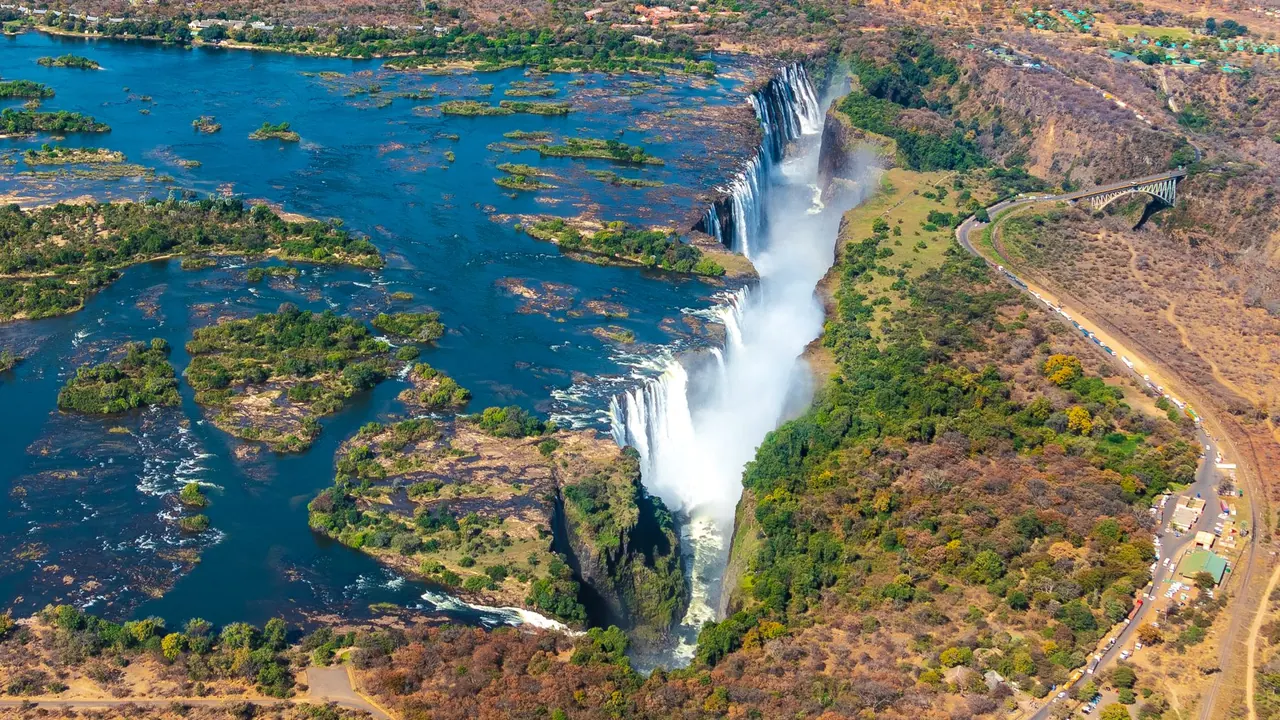
Victoria Falls and its gorge from a helicopter
- Nature & outdoors94
- Getting around45
- Families38
Photo: Murray Foubister, CC BY-SA 2.0, cropped
Match
29
Every category weighted equally
- Beach & sun29
- Culture & arts25
- Food & nightlife22
- Family trip34
- Outdoors38
- Relax & unwind32
- Shopping & style25
- On a budget29
Victoria Falls in twelve categories
Our verdict on each, scored 0 to 100 against the same fixed benchmark cities, so a score means the same thing on every page.
Beaches & swimming. Scores 7 out of 100.
Food & drink. Scores 24 out of 100.
Culture & sights. Scores 12 out of 100.
Nightlife. Scores 8 out of 100.
Nature & outdoors. Scores 94 out of 100.
Day trips. Scores 22 out of 100.
Good for families. Scores 38 out of 100.
Getting around. Scores 45 out of 100.
Shopping & style. Scores 18 out of 100.
Affordability. Scores 32 out of 100.
Live music & performing arts. Scores 10 out of 100.
Wellness & relaxation. Scores 34 out of 100.
Victoria Falls category by category
Beaches & swimming
7Victoria Falls is deep in landlocked southern Africa, with no beach anywhere within reach. The Zambezi is not a river for casual swimming: crocodiles and hippos live above the falls and the currents are powerful. Most swimming happens in lodge and hotel pools, which make a welcome break in the hot months.
The one exception is famous. At low water, roughly from late in the dry season until the rains return, guided groups from the Zambian side swim in Devil's Pool and Angel's Pool, natural rock basins right on the edge of the drop. It is a short, supervised thrill rather than a beach day.
Food & drink
24Eating here mostly happens in lodges, hotels and a short list of town restaurants built around visitors. Game meat is the local speciality: kudu, warthog and crocodile grilled over open fires, often at large outdoor dinners with drumming. Sadza, the stiff maize porridge served with stews and greens, is the Zimbabwean staple. Fried mopane worms come out as a dare for the adventurous.
The historic Victoria Falls Hotel, with its terrace looking across to the bridge and the gorge, is a classic stop for afternoon tea or a sundowner. Sunset cruises on the upper Zambezi come with drinks and snacks. Beyond that the range is narrow: there is no street-food culture, no markets worth eating at and nothing like a café scene.
Culture & sights
12The town grew up around the railway and has little built heritage. The best is the Victoria Falls Bridge, completed in 1905 as part of Cecil Rhodes's Cape to Cairo railway. It spans the gorge between Zimbabwe and Zambia and can be walked across, with a small display about its construction. The Edwardian Victoria Falls Hotel, set in old gardens, carries the same colonial history.
Elsewhere there is a large baobab known as the Big Tree, a few modest displays on local Tonga and Ndebele culture, and statues of David Livingstone at the falls. Visitors who want museums cross to Livingstone in Zambia. The town itself is a base for the landscape, not a sightseeing destination.
Nightlife
8Evenings here start early and end early. The ritual is the sundowner: a drink on a river cruise boat or on a lodge deck as the sun drops over the Zambezi. After dinner there are hotel bars, a couple of local pubs and the bar at the backpacker lodges, which sometimes stays lively with rafting crews and overland travellers.
There are no clubs to speak of. Elephants and buffalo wander through town after dark, so people take a taxi rather than walk between bars at night. Most visitors are in bed early anyway, before a dawn game drive or a day on the rapids.
Nature & outdoors
94Mosi-oa-Tunya, the Smoke that Thunders, is the reason the town exists. The Zambezi falls about 100m into a sheer basalt gorge along a front of more than 1.7km. In peak flow, after the rains, the spray rises hundreds of metres and soaks the rainforest path along the opposite rim. In the low-water months of the late dry season the rock face shows through and the views are clearer. At full moon a lunar rainbow sometimes forms in the spray.
The gorges below are where visitors go for adventure: rafting the Batoka Gorge rapids, the bungee jump and swing from the bridge, and helicopter or microlight flights over the falls. Upstream, Zambezi National Park begins on the edge of town, with elephant, buffalo and lion, and canoe trips past hippos. Chobe National Park in Botswana, with some of Africa's largest elephant herds, is about an hour and a half by road. Hwange is a longer safari trip. It is hot, and wettest from November to March.
Day trips
22Most excursions from here are wildlife trips, not visits to other places. The main town worth visiting is Livingstone, about 10km away across the bridge in Zambia. It is an old colonial capital with a wide main street of early twentieth-century buildings and the Livingstone Museum, which holds explorers' letters and good ethnographic collections. Nearby Mukuni village offers a look at Leya chieftaincy traditions.
Kasane, the gateway to Chobe in Botswana, is a small riverside town that people pass through on their way to the park. Beyond these there are no historic towns, wine regions or heritage sites within two hours, and the distances in this part of Africa are long.
Good for families
38Older children often love it here. Game drives, river cruises past hippos, the walk through the spray and the sight of elephants crossing the road make for memorable days. Lodges with pools give a base for the hot afternoons, and the town is small enough to stay simple.
The limits are real, though. Victoria Falls is in a malaria area, so families need to plan prophylaxis carefully, and this matters most for young children. Rafting, bungee, gorge swings and Devil's Pool all have minimum ages. Some safari lodges do not accept younger children on game drives. Medical facilities are basic, and nothing in the town is built for small children. It suits families with children of about eight and up much better than toddlers.
Getting around
45The town centre is small, and the entrance to the falls, the bridge and the main hotels are within walking distance of each other. Most activity operators collect guests from their lodge and drop them back, so a car is rarely needed. Crossing to the Zambian side is easy on foot or by taxi over the bridge, with border formalities at each end.
There is no public transport worth the name, though, and many lodges sit several kilometres out along the river or in private concessions, which means taxis and shuttles. Elephants and buffalo move through town, especially at dusk, so walking after dark is unwise. Longer trips to Chobe or Hwange need a tour or a driver.
Shopping & style
18Shopping here means crafts. The large curio market near the town centre sells Shona-style stone sculpture, wooden carvings of animals, baskets, fabrics and beadwork. Bargaining is expected, and traders outside the falls and along the main road will offer carvings and old Zimbabwean banknotes as you pass. A small cluster of gallery-style shops sells better-made crafts and jewellery at fixed prices.
The stone pieces on sale are mostly smaller, repeated designs made for travellers, and finding a serious sculpture by a known artist takes luck and patience. There is no fashion, design or department-store shopping, and beyond crafts the town offers only basic supplies.
Affordability
32It is an expensive place to visit, especially by African standards. Prices are set for international visitors, and the costs that make up a stay are all high: entry to the falls, river cruises, rafting, flights over the gorge and game drives. Lodges and hotels on the river or in private reserves charge safari rates. Much of the food is imported, and restaurant prices reflect that.
It can be done more cheaply in the town's backpacker lodges and guesthouses, by eating simply and by choosing one or two activities rather than many. Seeing the falls from both sides means paying two park entrance fees. For most travellers, the activities are what make the bill large.
Live music & performing arts
10Live performance here is almost all staged for visitors. Traditional dance troupes and drummers appear at the big game-meat dinners and at lodges, and marimba bands sometimes play at hotels in the evening. Some of it is lively and well done, but it is entertainment set around a meal. There is no theatre, concert hall or regular live-music venue, and visitors interested in Zimbabwean music will find nothing beyond these shows.
Wellness & relaxation
34There is no bathing tradition here, and wellness means the spas in the larger hotels and riverside lodges. Some offer treatment rooms on decks above the Zambezi or open to the bush, using local oils such as marula. The better lodges upstream, inside private concessions, are very peaceful. The rhythm there is early game drives, long hot afternoons by the pool and sunset on the water.
The town, though, is built around adrenaline. Rafting, bungee jumps and helicopter flights fill most visitors' days, and the road near the falls is busy with traders and tour vehicles. Travellers who want rest should stay out along the river rather than in the centre.
When should you go?
Pick a month to see what it is like. The climate figures are measured averages, not a forecast.
Victoria Falls in July
Daytime high, °C
Rainfall in the month, mm
The whole year
Shaded against this city’s own year: the deepest cell is its best month for that figure and the palest its weakest.
Temperature and rainfall are climate normals, averaged over the years shown. Victoria Falls: 1991-2020 normals, Livingstone (13.1 km from centre).
Before you go
| Measure | Victoria Falls |
|---|---|
| Official language | English, Xhosa, Ndau, Venda, Chewa, Khoisan, Kalanga, Shona, Tonga, Tswana, Tsonga, Sesotho, Northern Ndebele, Nambya, Zimbabwe Sign Language, Barwe |
| Currency | Zimbabwe Gold (ZWG) |
| Sockets | G220 V, 50 Hz |
| Driving side | Left |
| Time zone | UTC+2 |
| Emergency number | 999 |
| Elevation | 961 m |
| Main airport | Victoria Falls International Airport (VFA)18 km from centre12 non-stop destinations |
| Public holidays this year | 13 days |
By the numbers
| Measure | Victoria Falls |
|---|---|
| City population | 33,060 |
| Museums within 10 km | 2 |
| UNESCO World Heritage sites within 50 km | 0 |
Compare Victoria Falls with
Every comparison with a written verdict behind it.