
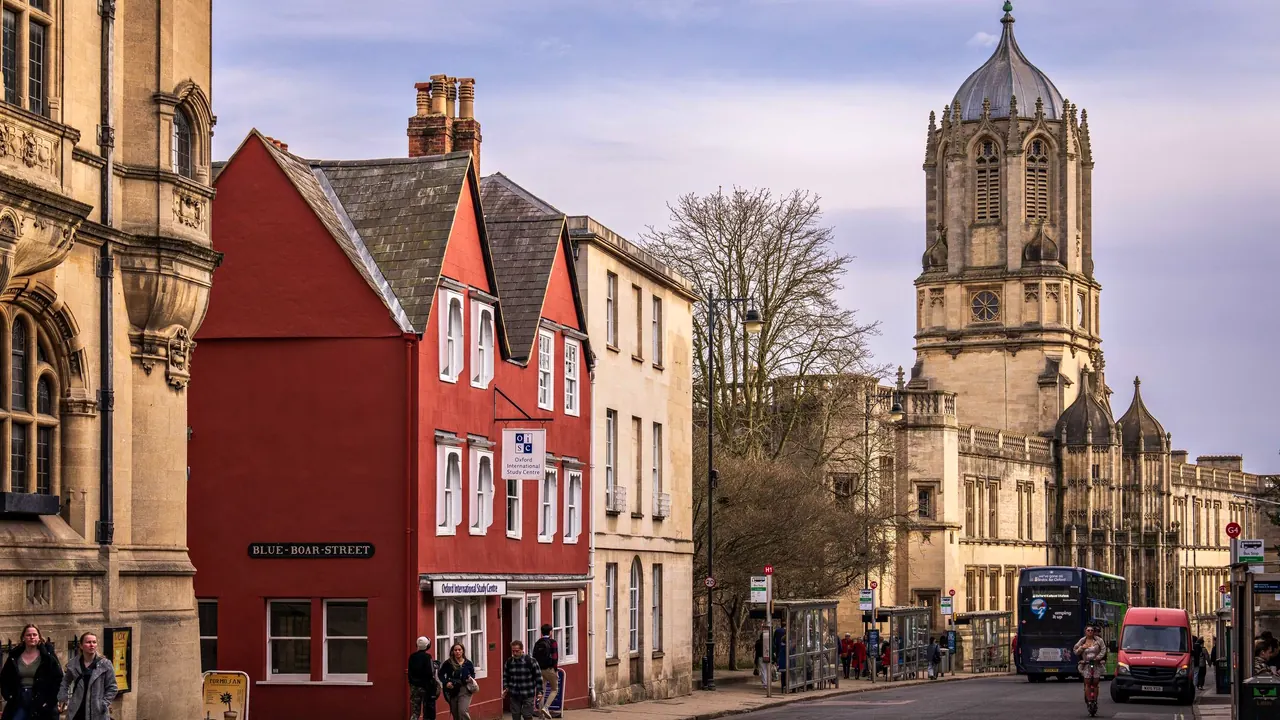
Photos: Aberdeen by Holger Uwe Schmitt, CC BY-SA 4.0, cropped; Oxford by Mark Stebnicki, Pexels License.
Aberdeen or Oxford?
Our verdict in twelve categories, each scored against the same fixed benchmark cities, and the climate month by month, so you can choose for your trip.
Choose Aberdeen for
- nature and the outdoors
- prices
- beaches
Aberdeen is the pick for people who want to spend their days outside. Royal Deeside, the Cairngorms and the castle-dotted country inland are all close, the sea cliffs and dolphins are on the city's doorstep, and hotel rooms are easier to find at sensible rates. It suits a walker, a castle lover or a whisky pilgrim who will hire a car and treat the granite city as a comfortable base rather than the main event.
Choose Oxford for
- culture and sights
- day trips
- shopping
Oxford wins the trip built around the city itself. The colleges, libraries and museums fill a centre small enough to cross on foot, Evensong in the college chapels gives the evenings something Aberdeen cannot match, and Blenheim, the Cotswolds and London are all easy day trips. Come here for history, architecture and gentle English countryside, and be ready to pay more for a bed.
Scoreboard
Twelve categories on one fixed scale from 0 to 100. The shaded stretch is the gap between the two.
Your match
Pick a travel style or drag the sliders, and both match scores follow your weighting.
Wins on nature and the outdoors and prices with your weighting.
Wins on culture and sights and day trips with your weighting.
What matters to you?
Category by category
What the scores mean for a trip.
Beaches & swimming
Aberdeen at least has a real beach: a long run of sand and dunes starting at the edge of the centre, with emptier strands at Balmedie and towards Newburgh. The cold North Sea and the wind make it a place for a bracing walk rather than sunbathing or swimming.
Oxford has no sea at all, and the coast is well over an hour away. Its swimming is in the Thames at Port Meadow, the Cherwell or the open-air pool at Hinksey, which is pleasant on a warm afternoon but is a riverbank, not a beach.
Food & drink
Both cities feed you well without being reasons to travel, but in different ways. Aberdeen's strengths are its ingredients: North Sea fish and shellfish, Aberdeen Angus beef, the salty buttery roll for breakfast, serious fish and chips down the coast at Stonehaven and Speyside whisky on every bar shelf.
Oxford's eating revolves around old pubs and riverside Sunday roasts, with the historic Covered Market for lunch. For variety, head to Cowley Road's cheap Middle Eastern, South Asian and Caribbean cooking or to the bistros of Jericho.
Culture & sights
Oxford is the richer place for sightseeing. Honey-coloured colleges, chapels and libraries that are still in daily use crowd its few central streets, from Christ Church and the Radcliffe Camera to the cloisters of Magdalen and Merton. The Ashmolean, the Pitt Rivers and the Natural History Museum give it museums of national standing.
Aberdeen's appeal is quieter and more uniform. The silver-grey granite of Marischal College and Union Street gleams after rain, and Old Aberdeen, with King's College and St Machar's Cathedral, is a real pleasure, along with the art gallery, the Maritime Museum and the cottages of Footdee. It is a good couple of days rather than a destination in itself.
Nightlife
Evenings in the two cities are much alike: they centre on the pub, are busiest in term time and go quiet outside it. Aberdeen gathers its bars and its few student clubs around Belmont Street, and its traditional pubs lean towards long whisky lists and real ale.
Oxford's nights out are more spread out and more tied to the seasons. Summer evenings belong to the Thames-side pubs, Cowley Road has the late bars and small clubs, and Jericho suits a calm glass of wine. The centre is usually quiet by midnight, and the long summer vacation empties it further.
Nature & outdoors
Aberdeen has the bigger landscapes by a distance. Within an hour or so up the Dee you reach the Cairngorms National Park, with high plateau walks, Lochnagar, the forests around Braemar and skiing at Glenshee and the Lecht. Closer in are the cliffs towards Stonehaven, the seals of the Ythan estuary and dolphins seen from Torry Battery.
Oxford's outdoors is gentle and close at hand: Port Meadow, Christ Church Meadow, punting on the Cherwell and flat towpath rides. Further out, the Cotswolds, the Chilterns and the Ridgeway offer long, mild walks rather than mountains.
Day trips
Oxford is the stronger base. Blenheim Palace is twenty minutes away, the Cotswold villages are within an hour, London is an hour by train, and Stratford, Warwick, Windsor and Bath are all manageable in a day, many of them by rail or with a tour.
Aberdeen's outings have their own character: Dunnottar on its sea stack, the tower houses of the Castle Trail, Balmoral and Deeside, Speyside's distilleries and the cliff-hugging villages of Pennan and Crovie. They are spread further apart, though, and most of them really need a car.
Good for families
Oxford is slightly easier with children, mainly because of its free museums. Dinosaur skeletons at the Natural History Museum, the curiosities of the Pitt Rivers, punting and the Harry Potter connections at Christ Church make for a good couple of days, with the wildlife park and Blenheim's maze a short trip out.
Aberdeen offers the Science Centre, the beach funfair, Duthie Park's glasshouses and the excitement of spotting dolphins at the harbour mouth. The colder, windier weather means you will rely on the indoor options more often.
Getting around
Oxford is the simpler city to move around. Its small, flat centre takes about twenty minutes to cross, several streets are closed to through traffic, the station is close by and bicycles are everywhere. A car only gets in the way, which suits a visitor who arrives by train.
Aberdeen's centre is also walkable, with the station in the middle and the beach and Old Aberdeen reachable on foot. Its best sights lie out in Deeside and the castle country, though, where buses and trains reach only part of it, so a car becomes close to essential.
Shopping & style
Oxford gives shoppers more to discover. Alongside the chains there are the Covered Market's traders, the independents of Little Clarendon Street and Jericho, antique map dealers and Blackwell's vast bookshop, with the designer outlet at Bicester a short drive away.
In Aberdeen, two indoor centres and Union Street cover everyday needs, and Rosemount and Belmont Street add a few independents. The knitwear, tartan and whisky worth taking home are often better bought in the Deeside villages and at the distilleries.
Affordability
Aberdeen is the cheaper stay, mostly because of its beds. Hotels built for business travellers often cut their rates at weekends and in summer, although meals and drinks cost what they do anywhere in Britain, and hiring a car adds to the bill.
Oxford's limited central hotel stock and a steady calendar of graduations and conferences keep rooms expensive. Once you have a bed, the free museums, walkable streets and Cowley Road cafés help, but college entry fees and library tours add up.
Live music & performing arts
Oxford has the more memorable live programme because of its choirs. Evensong at Christ Church, Magdalen and New College is open to visitors on most term evenings, and the Sheldonian and the historic Holywell Music Room host concerts. Touring theatre and summer student productions in college gardens fill out the season.
Aberdeen's stage life is a solid regional mix. His Majesty's Theatre takes touring drama and visits from the national opera and ballet, the Music Hall hosts the Scottish orchestras, and pub sessions bring traditional music.
Wellness & relaxation
Neither city has a spa tradition, but Oxford is better for slowing down. The Botanic Garden, the walled college gardens, Magdalen's deer park and an idle afternoon on a punt give it a calm that suits an unhurried break.
Aberdeen's relaxation means a hotel spa or a country-house hotel with treatments out in Deeside. Its real restorative value lies in the empty hills and coast nearby rather than anything in the city itself.
When should you go?
Pick your month. The climate figures are measured averages, not a forecast.
Aberdeen in July
Oxford in July
Daytime high, °C
Rainfall in the month, mm
Where the figures come from
Oxford's temperatures are measured 37 km from the centre, at Fairford Royal Air Force Base.
Oxford has no rain gauge within 25 km of the centre, so its rainfall comes from a gridded climate dataset read at the city rather than from a gauge further away.
Oxford's sunshine is measured 57 km from the centre, at Lyneham.
Temperature and rainfall are climate normals, averaged over the years shown. Aberdeen: 1991-2020 normals, Aberdeen / Dyce (9 km from centre). Oxford: 1961-1990 (sunshine 1991-2020, rainfall 1991-2020) normals, Fairford Royal Air Force Base (37 km from centre).
Neither city ever gets too hot for walking the streets, and neither is warm enough for a beach day at any time of year. Winters are much alike in both, short, grey and cold, with Aberdeen if anything a touch milder in January and February. From spring to autumn, though, Aberdeen is the cooler of the two. Its summer peaks at about 18°C in July and August, the North Sea only reaches around 13°C, and May is usually its sunniest month. It is also the wetter city all year, and the rain picks up sharply in October, which brings about 101mm.
Oxford has the warmer, brighter summer. Highs reach about 22°C in July, and the long sunny days from May to August suit punting, riverside pubs and walks along the Thames. Its rain is lighter in every month and rises only gently in late autumn. For either city, late spring to early autumn is the best time to go.
Which traveller are you?
On an outdoors trip, Aberdeen is much the better choice. The Cairngorms, Lochnagar and the Deeside pine forests are about an hour away, and the coast has cliff paths, seabird colonies and seals. Oxford's meadows and Cotswold footpaths suit gentler walking.
For a culture and arts trip, Oxford is the clear choice. Aberdeen has handsome granite streets, Old Aberdeen and a good Scottish art collection. Oxford adds medieval colleges still in use, the Bodleian, the Ashmolean's antiquities and old masters, and Evensong sung by choirs known worldwide.
On a tight budget, Aberdeen goes further. Its art gallery and Maritime Museum are free, and so are beach walks, the cliffs at Stonehaven, which you can reach by train, and watching dolphins from Torry Battery. Oxford often works out cheaper as a day out from London.
Before you go
| Measure | Aberdeen | Oxford |
|---|---|---|
| Official language | English | English |
| Currency | Pound Sterling (GBP) | Pound Sterling (GBP) |
| Sockets | G230 V, 50 Hz | G230 V, 50 Hz |
| Driving side | Left | Left |
| Time zone | UTC, UTC+1 in summer | UTC, UTC+1 in summer |
| Emergency number | 112 or 999 | 112 or 999 |
| Elevation | 29 m | 73 m |
| Main airport | Aberdeen International Airport (ABZ)8 km from centre29 non-stop destinations | London Heathrow Airport (LHR)63 km from centre224 non-stop destinations |
| Public holidays this year | 10 days | 8 days |
By the numbers
| Measure | Aberdeen | Oxford |
|---|---|---|
| City population | 200,680 | 147,500 |
| People per km² | 3,083 | 3,235 |
| Museums within 10 km | 10 | 11 |
| UNESCO World Heritage sites within 50 km | 0 | 1 |
| Swim season, months above 21 °C | None | - |
Where else could you go?
Every comparison below shares a destination with this one, so you can follow Aberdeen or Oxford somewhere new.
- Londonvs Oxford
- Bathvs Oxford
- Bristolvs Oxford
- St Andrewsvs Aberdeen
- Cambridgevs Oxford
- Brightonvs Oxford