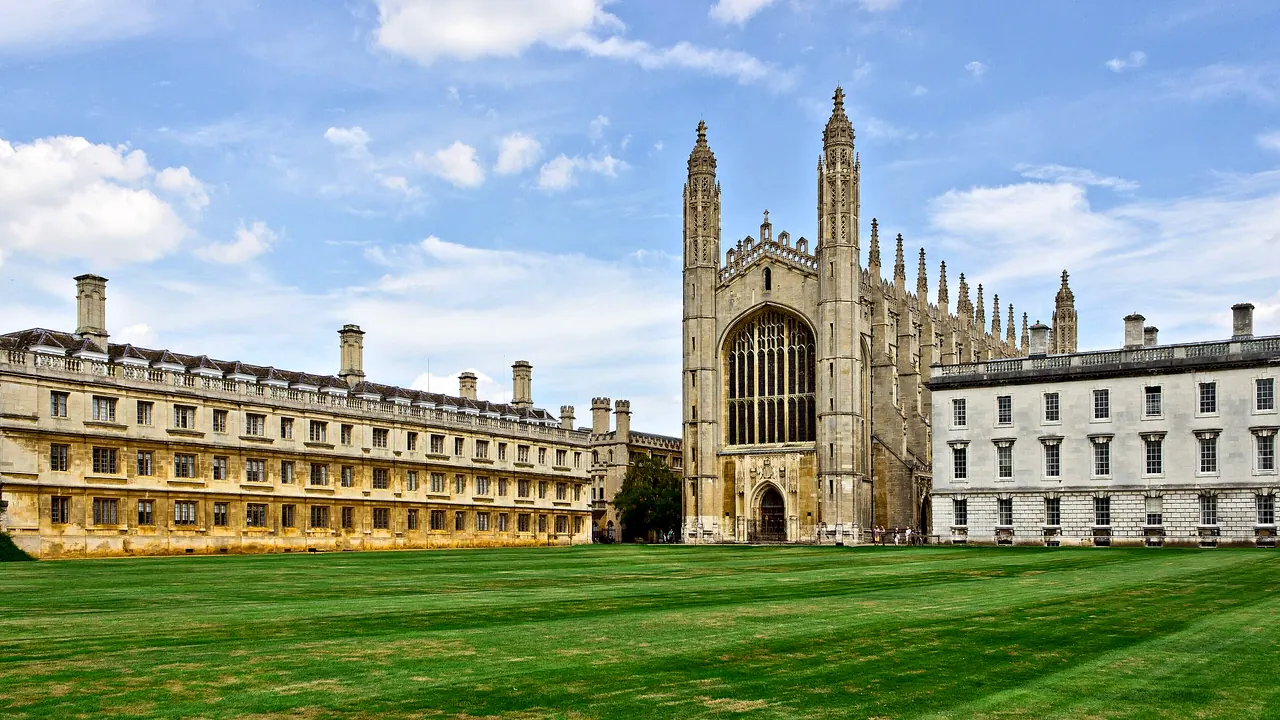
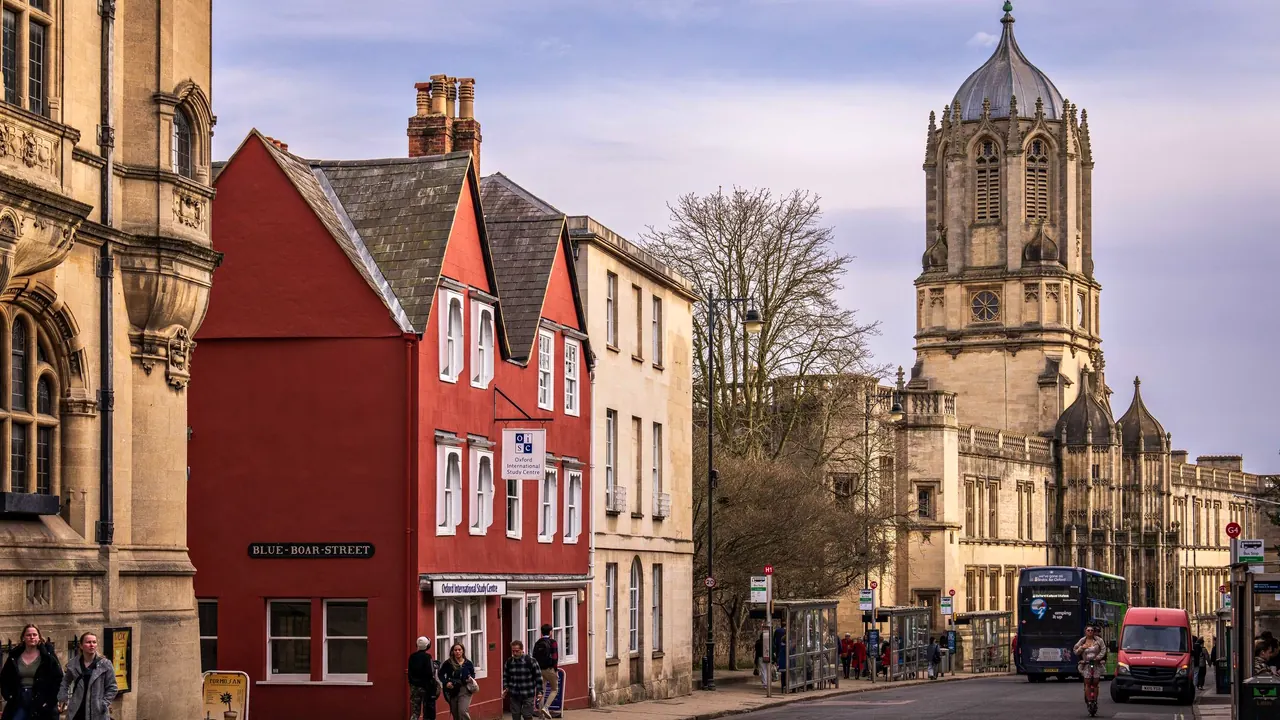
Photos: Cambridge by Dmitry Tonkonog, CC BY-SA 3.0, cropped; Oxford by Mark Stebnicki, Pexels License.
Cambridge or Oxford?
Our verdict in twelve categories, each scored against the same fixed benchmark cities, and the climate month by month, so you can choose for your trip.
Choose Cambridge for
- wellness
- families
Cambridge suits a traveller whose trip is about the buildings themselves and a slow pace around them. King's College Chapel, the Backs seen from a punt and the Fitzwilliam reward unhurried days. Its day trips run east to Ely's fenland cathedral and the timber-framed Suffolk wool towns, mostly by train. Families get Duxford's airfield of historic aircraft, and anyone after rest gets the lido and the meadow walk to Grantchester. It also lies a little nearer London for a day in the capital.
Choose Oxford for
- nature and the outdoors
- shopping
- day trips
Oxford is the better pick for anyone who wants the city as a base for a wider trip. Blenheim, the Cotswold villages, Stratford and Bath all lie within reach, and real walking country starts close by on Port Meadow and carries on to the Cotswold hills and the Ridgeway. It also gives more to shoppers, from Blackwell's and the Covered Market to the designer outlet near Bicester. The station is a short walk from the colleges.
Scoreboard
Twelve categories on one fixed scale from 0 to 100. The shaded stretch is the gap between the two.
Your match
Pick a travel style or drag the sliders, and both match scores follow your weighting.
Wins on wellness and families with your weighting.
Wins on nature and the outdoors and shopping with your weighting.
What matters to you?
Category by category
What the scores mean for a trip.
Beaches & swimming
Both cities are inland, and neither works for a beach vacation. The swimming in both is fresh water, so the difference is only in how you take your dip.
Cambridge has the long 1920s pool at Jesus Green and the river swimmers' stretch of the Cam at Grantchester Meadows. Its nearest coast is Norfolk sand or Suffolk shingle on a cool North Sea. Oxford swimmers use the Thames off Port Meadow, the Cherwell and the big open-air pool at Hinksey, with the south coast a similar long drive away.
Food & drink
You eat about equally well in both, and in both the best of it is an old pub with a Sunday roast near the river. The difference is in the markets and the side streets. Cambridge has an open-air market on Market Hill every day, with street food among the produce stalls, plus riverside tea rooms and Mill Road's Asian and Mediterranean cooking.
Oxford's centrepiece is the Covered Market, which has been trading since the eighteenth century and has butchers, cheese counters and lunch stalls under one roof. Cowley Road brings cheap Middle Eastern, South Asian and Caribbean food, and Jericho has neighbourhood bistros.
Culture & sights
These are very close rivals, each with eight centuries of colleges and museums far beyond what their size suggests. Cambridge's sights spread along the river. The Backs give the views, and King's College Chapel, with its fan vaulting, is the single greatest building in either city. The Fitzwilliam and Kettle's Yard lead its museums.
Oxford's honey-coloured stone forms a tighter cluster: the Radcliffe Camera, the Bodleian with its Divinity School, the Sheldonian and Christ Church are all a few minutes apart. Its museums are more varied. There is the Ashmolean's antiquities and old masters, the crowded ethnography cases of the Pitt Rivers, and the Natural History Museum under its Gothic glass roof.
Nightlife
Evenings are much alike, built around historic pubs and riverside gardens in summer. Both quieten noticeably when the students leave. In Cambridge, the livelier bars gather on Regent Street and Mill Road, and the few clubs are aimed squarely at students. For a big night, people take the train to London.
Oxford's busier side is Cowley Road, with late bars and a couple of small clubs, while Jericho offers relaxed cocktail and wine bars for a quieter drink.
Nature & outdoors
Oxford has much more to offer outdoors. Port Meadow, Christ Church Meadow and the University Parks open up within walking distance. Within an hour you reach the Cotswold hills, the Chiltern beech woods and the ancient Ridgeway, real country for a long day's walk.
Cambridge's surroundings are flat fen under wide skies. Its pleasures are gentle: punting, the towpath to Grantchester, birds and wild ponies at Wicken Fen, and a short woodland stroll at Wandlebury. It is good for level cycle rides but has no hills to climb.
Day trips
Oxford's day trips have the bigger names, but Cambridge's are easier to do without a car. From Cambridge, the train takes you to London in under an hour and to Ely's cathedral above the fens in about fifteen minutes. Norwich, Peterborough and Newmarket are on the rails too.
Oxford's list is the stronger one. Blenheim Palace is twenty minutes away, and the Cotswold villages are within an hour. Stratford, Warwick Castle, Windsor and Bath all fit into a day. Many of the Cotswold outings are much easier with a car or a tour, which is the price of that wider choice.
Good for families
Duxford gives Cambridge the one big family outing that Oxford has nothing to match close by. It is the Imperial War Museum's huge airfield of historic aircraft, just south of town. In the city, the free Museum of Zoology has its whale skeleton over the entrance and the Sedgwick has dinosaurs, and Wimpole's working farm makes an easy half-day out.
Otherwise Oxford is just as easy with children, and its appeal is different. Older children who know Harry Potter will recognise the hall and staircase at Christ Church. Younger ones tend to love the dinosaur skeletons at the Natural History Museum and the crowded cases of masks and boats in the Pitt Rivers next door. Its wildlife park and Blenheim's maze need a trip out.
Getting around
Both centres are compact, largely closed to through traffic and best seen on foot or by bike, and in both a car is a burden. Oxford is slightly easier to arrive in, because its station is a short walk from the colleges and buses run often to Headington, Cowley and Summertown.
In Cambridge, the station is about twenty-five minutes' walk from the centre. Hiring a bicycle matters more there, since cycling is the local way to reach Grantchester and the outer colleges.
Shopping & style
Oxford offers more for shoppers. Blackwell's on Broad Street, the small traders of the Covered Market, antique map and print sellers, and Jericho's independents give it character. The designer outlet near Bicester, twenty minutes away, attracts serious bargain hunters.
Cambridge's shopping is smaller and fits around sightseeing. The draws are the market on Market Hill, with local makers on Sundays, the independent and second-hand bookshops around Trinity Street and King's Parade, and the vintage shops of Mill Road.
Affordability
Neither is a cheap place to spend a few nights. In both, the bed is the biggest cost, because central rooms are scarce and university ceremonies and summer visitors keep them in demand. The difference is in what you pay to eat. Meals and drinks in Cambridge are priced like the rest of the wealthy south-east, so your savings come from what is free: the Fitzwilliam and most of the university museums, evensong in the chapels, and a centre you can cross without a bus fare. Out of term, a college room can be the cheapest way to sleep near the sights.
Oxford is easier on the daily budget once you have a bed. A pub lunch or an evening meal along Cowley Road is gentler on the wallet, and the big museums cost nothing here either. The harder part is the room. Central rooms are so few that plenty of visitors sleep on the outskirts or come just for the day. On a longer stay, college entry charges and paid tours of the Bodleian are where the money goes.
Live music & performing arts
In both cities the great experience is choral evensong, sung by choirs with world reputations in candlelit chapels during term. Cambridge's choirs are those of King's, St John's and Trinity. Beyond the chapels, it leans towards student theatre and comedy in the Footlights tradition, plus the long-running Folk Festival each summer.
Oxford hears Christ Church, Magdalen and New College. Its extra strength is concert music: orchestral and choral evenings at the Sheldonian, and chamber music and jazz at the historic Holywell Music Room. Touring musicals come to the New Theatre.
Wellness & relaxation
Neither has a spa tradition, but Cambridge is a little better for a restful break. It has day spas as well as hotel ones, an outdoor lido for a swim, and the walk across the meadows to tea in a Grantchester orchard.
Oxford has fewer spas, and its calm is mostly in green spaces: the Botanic Garden, Britain's oldest, the deer park at Magdalen and Addison's Walk. These are best early in the morning, before the tour groups arrive.
When should you go?
Pick your month. The climate figures are measured averages, not a forecast.
Cambridge in July
Oxford in July
Daytime high, °C
Rainfall in the month, mm
Where the figures come from
Cambridge's temperatures are measured 59 km from the centre, at Wattisham.
Cambridge has no rain gauge within 25 km of the centre, so its rainfall comes from a gridded climate dataset read at the city rather than from a gauge further away.
Oxford's temperatures are measured 37 km from the centre, at Fairford Royal Air Force Base.
Oxford has no rain gauge within 25 km of the centre, so its rainfall comes from a gridded climate dataset read at the city rather than from a gauge further away.
Oxford's sunshine is measured 57 km from the centre, at Lyneham.
Temperature and rainfall are climate normals, averaged over the years shown. Cambridge: 1991-2020 normals, Wattisham (58.5 km from centre). Oxford: 1961-1990 (sunshine 1991-2020, rainfall 1991-2020) normals, Fairford Royal Air Force Base (37 km from centre).
The two share the same mild English year, and neither is ever too hot for walking the streets. Summer is the best time for both. July reaches about 22°C in each, and the long evenings suit punting and riverside pubs. Cambridge runs a degree or two warmer in spring and winter, and it is drier all year. Oxford's wettest stretch comes in October and November, at nearly 70mm a month, while Cambridge stays nearer 60mm. Oxford gets more sunshine in high summer, with over 200 hours in July.
Winter is cold and grey in both, with daytime highs of 5°C to 7°C and short, dull days. It still works for museums and candlelit evensong, but not for the meadows and gardens. Late spring and September are the best balance of mild weather and dry days for walking, and for Oxford's countryside in particular.
Which traveller are you?
On an outdoors trip, Oxford is the better choice. Cambridge's level fen country suits easy cycling and birdwatching, but nothing more strenuous. From Oxford you can spend some days on the colleges and others walking real hill country without changing base.
On a shopping trip, Cambridge is good for browsing between sights, especially if you love books, makers' stalls or vintage clothes. Oxford gives shopping more weight, with more independent character in the centre and a designer outlet close enough to fill a whole day.
For a relaxing and wellness trip, Cambridge is slightly gentler. Treatments are easier to book, and its quiet includes an open-air swim and a slow walk out of town to tea. In Oxford, rest mostly means sitting in a garden early, before the crowds arrive.
Before you go
| Measure | Cambridge | Oxford |
|---|---|---|
| Official language | English | English |
| Currency | Pound Sterling (GBP) | Pound Sterling (GBP) |
| Sockets | G230 V, 50 Hz | G230 V, 50 Hz |
| Driving side | Left | Left |
| Time zone | UTC, UTC+1 in summer | UTC, UTC+1 in summer |
| Emergency number | 112 or 999 | 112 or 999 |
| Elevation | 6 m | 73 m |
| Main airport | London Stansted Airport (STN)37 km from centre197 non-stop destinations | London Heathrow Airport (LHR)63 km from centre224 non-stop destinations |
| Public holidays this year | 8 days | 8 days |
By the numbers
| Measure | Cambridge | Oxford |
|---|---|---|
| City population | 123,867 | 147,500 |
| People per km² | 3,043 | 3,235 |
| Museums within 10 km | 17 | 11 |
| UNESCO World Heritage sites within 50 km | 0 | 1 |
Where else could you go?
Every comparison below shares a destination with this one, so you can follow Cambridge or Oxford somewhere new.