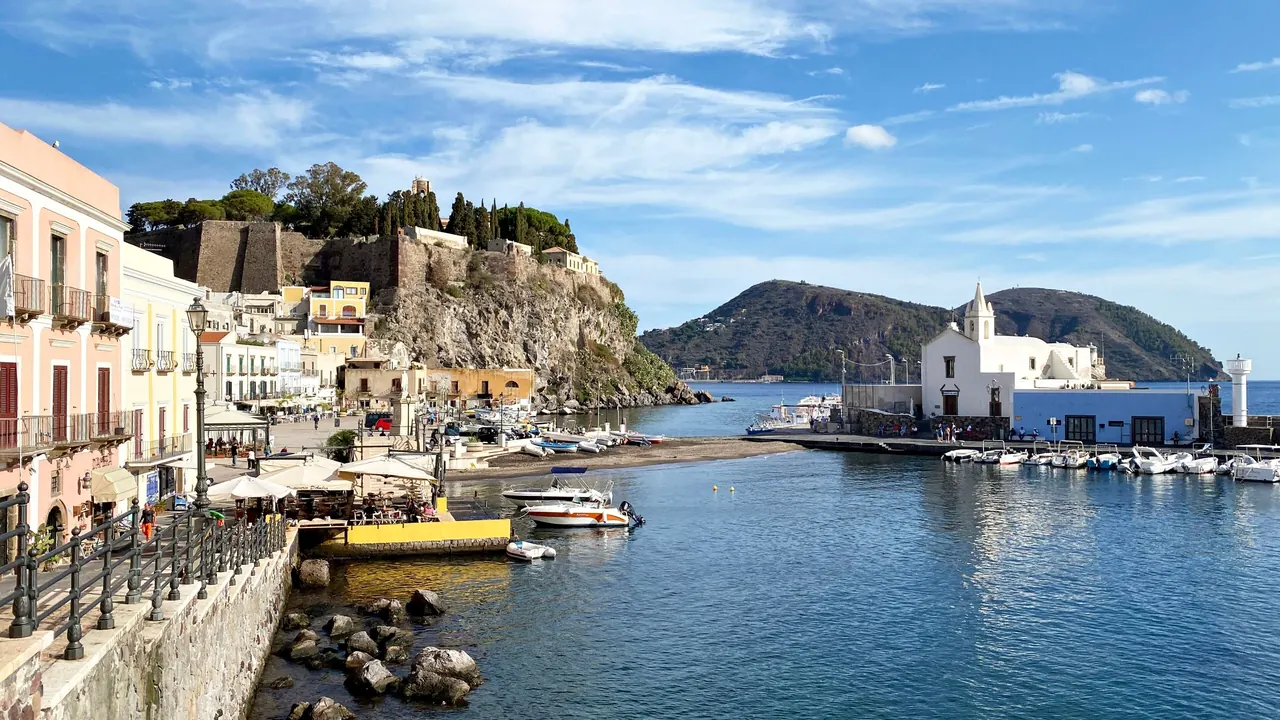
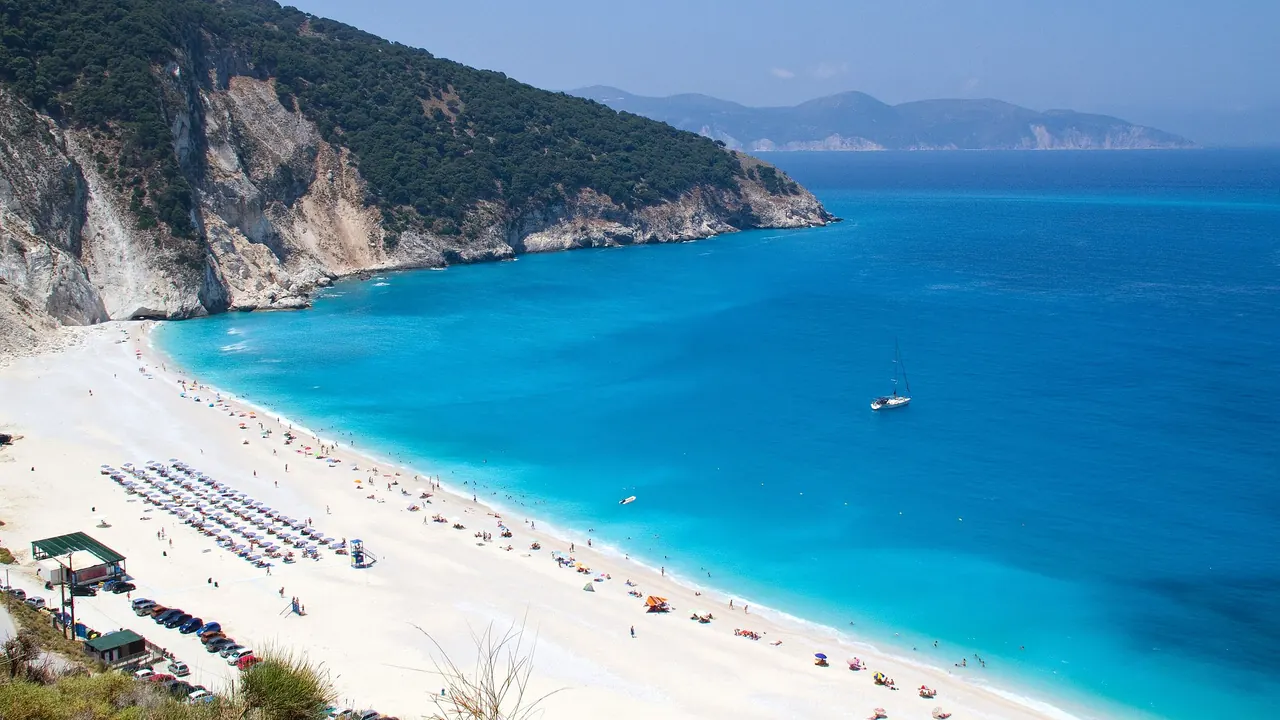
Photos: Aeolian Islands by Bernard Gagnon, CC BY 4.0, cropped; Kefalonia by Tony Hisgett from Birmingham, UK, CC BY 2.0, cropped.
Aeolian Islands or Kefalonia?
Our verdict in twelve categories, each scored against the same fixed benchmark cities, and the climate month by month, so you can choose for your trip.
Choose Aeolian Islands for
- nightlife
- nature and the outdoors
- wellness
Choose the Aeolian Islands if you want the landscape itself to be the event: Stromboli throwing up lava after dark, the steaming crater rim on Vulcano, and long days swimming from a boat in deep coves under volcanic cliffs. Hydrofoils link seven small islands that each feel different, so you move around without a car, and Lipari's citadel and museum give you more history than Kefalonia has. In return the trip costs more, and the shore is rock and dark pebble rather than soft beach.
Choose Kefalonia for
- prices
- beaches
- families
Kefalonia is the better choice for a classic beach vacation. Myrtos, Petani and the sandy south give you a wider and easier choice of shore, and the gently shelving beaches at Skala and Lourdas suit families with small children. Rooms in the south are fairer on the budget too. What you give up is the drama of an active volcano, and you will need a rented car, long winding drives and a willingness to let evenings end quietly by the harbour.
Scoreboard
Twelve categories on one fixed scale from 0 to 100. The shaded stretch is the gap between the two.
Your match
Pick a travel style or drag the sliders, and both match scores follow your weighting.
Wins on nightlife and nature and the outdoors with your weighting.
Wins on prices and beaches with your weighting.
What matters to you?
Category by category
What the scores mean for a trip.
Beaches & swimming
The water is very clear on both, but Kefalonia has the better beaches to lie on. Myrtos's white pebble crescent, Petani on the Paliki peninsula, the reddish sand at Xi and the long sandy stretches at Skala and Lourdas give you a real choice of shore, if you are willing to drive between coasts.
In the Aeolians the swimming is superb but the shore is harder. You get black sand on Vulcano, pebbles at Canneto on Lipari and rock ledges almost everywhere else, with little shade. The best water is reached by boat, in deep coves under the cliffs, so a day of hired-boat cove-hopping replaces the beach day that Kefalonia offers.
Food & drink
The two eat about equally well, but they eat differently. The Aeolians cook Sicilian island food: pane cunzato for lunch, granita with brioche for breakfast, and Salina's capers and sweet Malvasia wine, with the most serious tables on Salina and polished, expensive ones on Panarea.
Kefalonia's tavernas by the harbours and in the hill villages serve meat pie, aliada with salt cod and thyme honey, and you can taste crisp white Robola at the Omala valley wineries. Both scenes are narrow. In the Aeolians many kitchens close outside summer, and on Kefalonia the menus tend to repeat from village to village.
Culture & sights
The Aeolians have more to see, almost all of it on Lipari. The walled citadel above the harbour holds the cathedral, excavated layers of settlement and a museum of Mediterranean prehistory whose obsidian tools, Greek pottery and theatrical masks are worth a long visit on their own.
On Kefalonia the 1953 earthquake left most towns rebuilt plainly. What survives is scattered: Fiskardo's Venetian-era harbour, the fortress at Assos, the Agios Georgios castle and the tholos tomb at Tzanata. They make pleasant stops on a drive rather than a reason to come.
Nightlife
Neither is a party destination, but the Aeolians have one real exception. In July and August Panarea fills with yachts, sunset aperitivo and dancing on terraces late into the night, and Lipari's marina bars stay busy into the small hours.
Kefalonia's evenings are gentler. Argostoli's square and the Lithostroto fill up late in summer, Lassi has a strip of cocktail bars, and the harbour bars at Skala and Fiskardo keep people after dinner, but clubs are few and small. On the quieter Aeolian islands and across most of Kefalonia, the evening ends with dinner.
Nature & outdoors
Both islands are wild and beautiful, but the Aeolians have something Kefalonia cannot match: a volcanic landscape that is still active. Stromboli erupts every few minutes, best watched at night from its flanks or from a boat below the Sciara del Fuoco. You can walk up to the steaming rim on Vulcano, and Salina's wooded peaks and the mule tracks of Filicudi and Alicudi add quieter walks.
Kefalonia's appeal is greener and more settled. You get the fir forest and semi-wild horses of Mount Ainos National Park, white cliffs along the west coast, the blue cave lake at Melissani and loggerhead turtles in the bay. It is lovely walking and kayaking country, but nothing on it is erupting.
Day trips
Day trips are about equal on both, and in both cases they mostly mean going to sea. From Lipari, hydrofoils reach Vulcano in minutes and Salina, Panarea and Stromboli in about an hour, and on the mainland side there are Milazzo's castle and the Greek theatre at Tindari.
From Kefalonia the best outing is Ithaca, a short ferry ride from Sami, and in summer boats also run to Zakynthos and Lefkada. Fiskardo, Assos and Paliki make good drives within the island. The Aeolians give you more variety between neighbouring islands, while Kefalonia's trips lean on the island itself and one fine neighbour.
Good for families
Kefalonia is the easier place for families, as long as you pick the south. Skala, Lourdas and Xi have sand that shelves gently, and the Melissani boat ride and the turtles in the harbour keep children busy. The long, hot drives are the main drawback.
The Aeolians reward older children who love boats, snorkelling and the sight of Stromboli erupting at night. For toddlers they are hard going, with rocky entries, black sand too hot at midday, steep lanes, pushchair-unfriendly islands and hydrofoil crossings that can be rough. Vulcano and Lipari are the most manageable bases.
Getting around
The Aeolians are somewhat easier to get around without a car. Hydrofoils and ferries link the islands often in summer, scooters cover Lipari and Salina, and Stromboli and Panarea have no cars at all. The catch is the weather: rough seas cancel crossings, so build slack into your plans.
On Kefalonia a hire car is close to essential. The beaches, caves and villages sit on different coasts, linked by winding ridge and cliff roads, Argostoli to Fiskardo takes about an hour and a half, and buses run too rarely to rely on. Parking at Myrtos, Assos and Fiskardo is tight in high season.
Shopping & style
Shopping is thin on both, and the best things to take home are edible. From the Aeolians that means Salina's capers and Malvasia, plus pumice and obsidian souvenirs on Lipari's main street. From Kefalonia it means Robola, thyme honey and red mandoles from Argostoli's Lithostroto. Each also has one small cluster of boutiques, resort wear on Panarea and craft stalls around Fiskardo's harbour.
Affordability
Kefalonia is clearly the cheaper of the two. Taverna meals are reasonable and the apartments around Skala, Lourdas and Lassi are fair value, though you have to add car hire. Fiskardo and Assos cost more.
The Aeolians are an expensive corner of southern Italy in summer. Rooms are scarce, food is shipped in, and hydrofoils, boat hire and guided volcano walks add up. Panarea is in a price bracket of its own, and Lipari or Vulcano is the sensible base on a moderate budget. On both, June and September are easier on the wallet than July and August.
Live music & performing arts
Neither has a real stage, but Kefalonia has a little more music of its own. Kantades serenades with guitar and mandolin, and Argostoli's long philharmonic band tradition, can be heard at village festivals and summer concerts in the squares. In the Aeolians it comes down to the odd concert in a church or piazza and band music at religious processions.
Wellness & relaxation
The Aeolians have an actual bathing tradition. There is Vulcano's sulphurous mud pool by the harbour, which closes at times when gas levels rise, warm patches of sea where volcanic vents bubble up, and thermal pools in a few hotels. Salina, Filicudi and Alicudi add a pace with almost no traffic at all.
Kefalonia has no spa heritage, only the hotel spas around Lassi, Skala and Fiskardo. Its calm comes from long village lunches and the quieter Paliki peninsula and north-east coast, which is restful but lacks the Aeolians' volcanic waters.
When should you go?
Pick your month. The climate figures are measured averages, not a forecast.
Aeolian Islands in July
Kefalonia in July
Daytime high, °C
Rainfall in the month, mm
Where the figures come from
Aeolian Islands's temperatures are measured 60 km from the centre, at Messina.
Aeolian Islands has no rain gauge within 25 km of the centre, so its rainfall comes from a gridded climate dataset read at the destination rather than from a gauge further away.
Kefalonia's temperatures are measured 59 km from the centre, at Zakinthos / Agrilia.
Kefalonia has no rain gauge within 25 km of the centre, so its rainfall comes from a gridded climate dataset read at the destination rather than from a gauge further away.
Temperature and rainfall are climate normals, averaged over the years shown. Aeolian Islands: 1991-2020 normals, Messina (59.7 km from centre). Kefalonia: 1991-2020 normals, Zakinthos / Agrilia (58.6 km from centre).
The Aeolian Islands and Kefalonia have much the same summer pattern. From June to August both are hot, sunny and almost dry, and the sea stays warm enough for long swims from June into October. In the Aeolians, where most visitors stay, August highs reach about 31°C. Kefalonia is a little hotter and sunnier at the peak, at around 33°C. On both islands that heat makes midday walking hard, so the walks on Stromboli or Mount Ainos are better in May or October. Spring is mild on both, good for walking but too cool for most people to swim.
September is when the rain comes back. Showers get heavier on both islands even though the sea is still warm, with about 77mm in the Aeolians. From there the Aeolian winter gets steadily wetter, reaching about 104mm in December. Kefalonia's late autumn is much wetter still, close to 159mm in November, so a visit there after October runs a greater risk of grey, rainy days than the same weeks in the Aeolians.
Which traveller are you?
On an outdoors trip, the Aeolian Islands are the stronger choice. Night walks to watch Stromboli erupt, the climb to Vulcano's crater, the woods on Salina and kayaking past sea stacks make for a wilder landscape than Kefalonia's fir forest and caves.
On a family trip with young children, Kefalonia works better. The sandy, gently shelving beaches at Skala, Lourdas and Xi, the boat ride through Melissani and the turtles in Argostoli harbour beat the Aeolians' rocky entries, hot black sand and steep lanes.
On a trip on a tight budget, Kefalonia stretches the money further. Apartments around Skala, Lassi and the southern villages cost less, and so do taverna meals, while in the Aeolians the rooms, boat hire and hydrofoil fares add up, and Panarea is costly by any standard.
Before you go
| Measure | Aeolian Islands | Kefalonia |
|---|---|---|
| Official language | Italian | Greek |
| Currency | Euro (EUR) | Euro (EUR) |
| Sockets | CFL230 V, 50 Hz | CF230 V, 50 Hz |
| Driving side | Right | Right |
| Time zone | UTC+1, UTC+2 in summer | UTC+2, UTC+3 in summer |
| Emergency number | 112 | 112 |
| Main airport | Catania-Fontanarossa Airport (CTA)96 non-stop destinations | Kefalonia International Airport "Anna Pollatou" (EFL)41 non-stop destinations |
| Public holidays this year | 13 days | 15 days |
By the numbers
| Measure | Aeolian Islands | Kefalonia |
|---|---|---|
| Population | 15,419 | 36,064 |
| People per km² | 134 | 49 |
| Swim season, months above 21 °C | 5 months | 5 months |
Where else could you go?
Every comparison below shares a destination with this one, so you can follow Aeolian Islands or Kefalonia somewhere new.
- Zakynthosvs Kefalonia
- Lefkadavs Kefalonia
- Paxosvs Kefalonia
- Sicilyvs Aeolian Islands
- Corfuvs Kefalonia
- Peloponnesevs Kefalonia