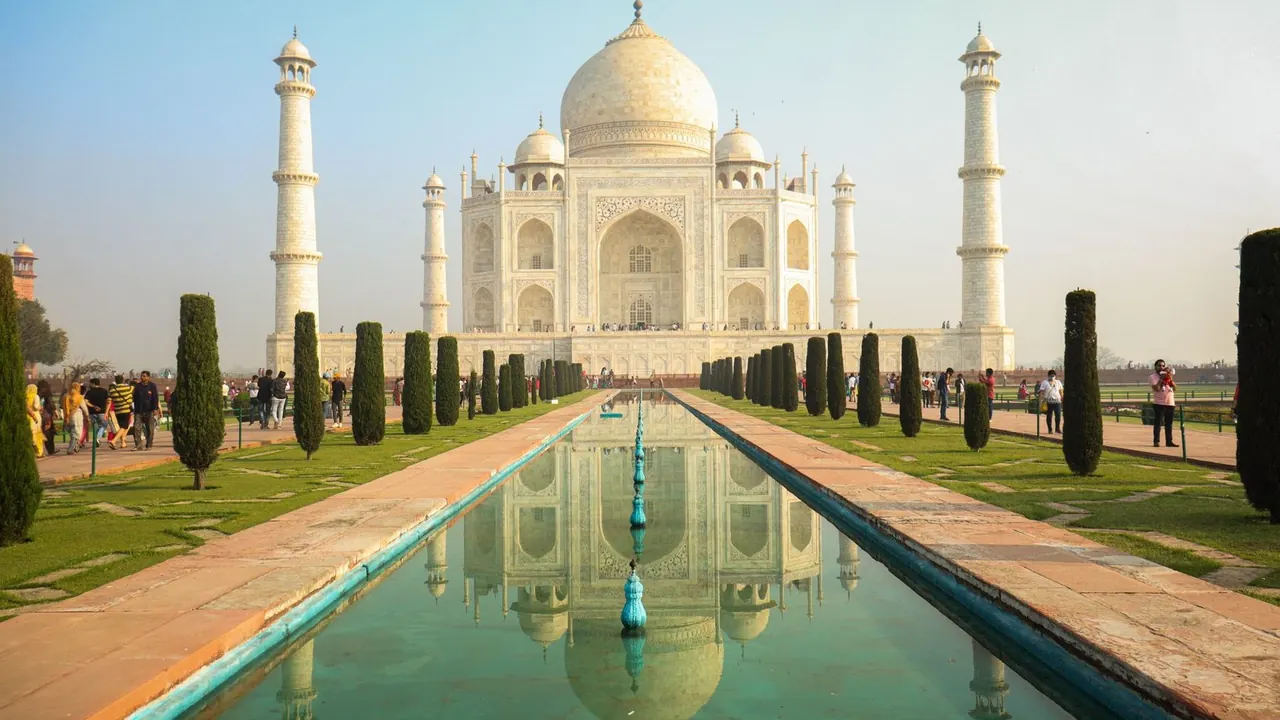
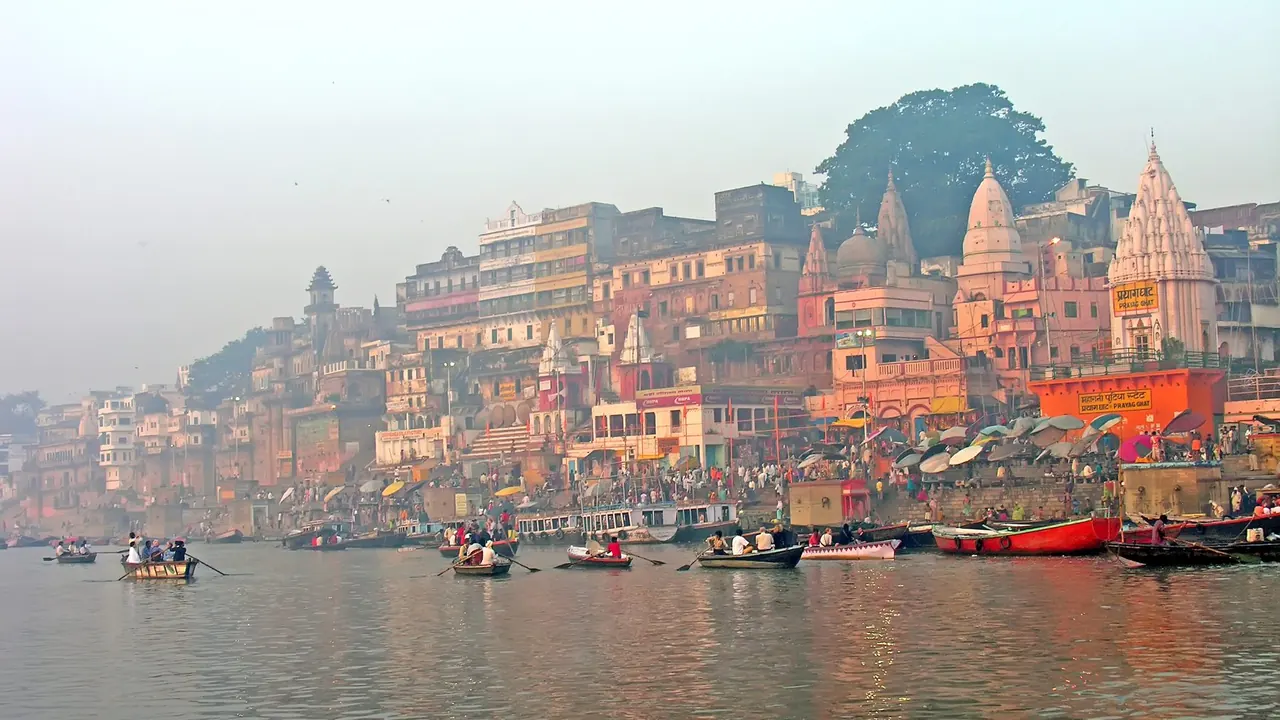
Photos: Agra by Sanket Sawale, Pexels License; Varanasi by Dennis G. Jarvis, CC BY-SA 2.0, cropped.
Agra or Varanasi?
Our verdict in twelve categories, each scored against the same fixed benchmark cities, and the climate month by month, so you can choose for your trip.
Choose Agra for
- day trips
- families
- nature and the outdoors
Agra suits a traveller who wants the great Mughal monuments and a tidy, well-paced visit. The Taj Mahal, Agra Fort and the Baby Taj fill two full days, and the surrounding region adds Fatehpur Sikri, the Keoladeo bird wetlands and the Krishna towns of Mathura and Vrindavan. It is also the easier of the two with children, mostly because hotels with pools give them somewhere to cool off in the afternoon.
Choose Varanasi for
- live music and the arts
- shopping
- wellness
Varanasi is for adults who want to be moved rather than simply impressed. Its draw is daily religious life on the Ganges, from dawn boats along the ghats to the evening aarti. The city also has a classical music tradition that Agra cannot match, Banarasi silk straight from the weavers and better street food. It is louder and more intense, and it rewards a slower stay with rest built into each day.
Scoreboard
Twelve categories on one fixed scale from 0 to 100. The shaded stretch is the gap between the two.
Your match
Pick a travel style or drag the sliders, and both match scores follow your weighting.
Wins on day trips and families with your weighting.
Wins on live music and the arts and shopping with your weighting.
What matters to you?
Category by category
What the scores mean for a trip.
Beaches & swimming
Neither city has anywhere to swim outdoors. The Yamuna at Agra is scenery for the Taj, and the Ganges at Varanasi is sacred and polluted, used by pilgrims for ritual dips rather than by visitors.
The real difference is hotel pools. Many of Agra's better hotels have one, whereas in Varanasi only a few larger hotels away from the old city do. Choosing a guesthouse on the ghats usually means going without a pool.
Food & drink
Varanasi is the better city to eat in, as long as you like vegetarian street food. Dawn kachori in the old city lanes, lassi in clay cups, winter malaiyo whisked overnight and paan rolled to order around Godowlia give a short visit plenty to look for.
Agra's cooking is Mughlai and richer, with kormas, biryani and tandoor kebabs, plus bedai for breakfast in the bazaars and petha everywhere. Away from the old quarter, though, most meals happen in tour-group restaurants near the Taj, and the interest fades after a day or two.
Culture & sights
Both rank among India's essential sights, but they are very different experiences. Agra is about monumental architecture: the marble and inlay of the Taj, the red sandstone palaces of Agra Fort, the fine stonework of Itimad-ud-Daulah and Akbar's tomb at Sikandra. You admire them, and two days covers them well.
Varanasi's great sight is the life of the city itself. Pilgrims bathe and pray along more than eighty ghats, cremations burn at Manikarnika, and lanes lead up to Kashi Vishwanath. Neither city is strong on museums, though Varanasi has Bharat Kala Bhavan at the university.
Nightlife
Both cities go to sleep early, since mornings start before dawn. In Agra an evening out means a drink in a hotel bar or on a rooftop facing the Taj dome. In Varanasi alcohol is frowned upon near the ghats, so the evening centres on the aarti, followed by chai and music in the Assi Ghat cafés.
Nature & outdoors
Agra has more for anyone who likes wildlife, though the city itself offers little green beyond its Mughal gardens. Keoladeo at Bharatpur, an hour away, is one of Asia's great bird wetlands in winter. Further south, the Chambal adds gharials and river dolphins, and Sur Sarovar sits on the city's edge.
Varanasi's outdoors is the river: a rowing boat along the ghats at sunrise and a walk on the sandbank opposite. For real scenery you need the two-hour drive to the Vindhya hills and Chandraprabha's waterfalls after the monsoon.
Day trips
Agra has more good day trips nearby. Fatehpur Sikri, Akbar's abandoned capital about 40km away, is first class and combines easily with Bharatpur or the water palaces of Deeg. Mathura and Vrindavan bring Krishna temples and pilgrims, and Gwalior's hilltop fort is a train ride south.
Varanasi has one essential trip, Sarnath, half an hour away, where the Buddha first preached. Chunar Fort and the mosques of Jaunpur make worthwhile shorter outings, but after those the choices thin out quickly.
Good for families
Neither is easy with children, but Agra is the more workable of the two. Older children tend to respond to the Taj and the fort walls, the bear rescue centre on the Mathura road is a real treat, and a hotel pool makes the hot afternoons bearable.
Varanasi offers almost nothing for children. Its lanes are narrow and dirty, cremations happen in plain sight and calm spaces are few. Families who do go usually stay briefly and stick to a dawn boat ride and Sarnath.
Getting around
Agra needs wheels. Its sights are spread along and away from the Yamuna, the roads are congested and the pavements poor, so most visitors hire a car and driver for the day. The final approach to the Taj is on foot, by electric cart or by cycle rickshaw.
In Varanasi the best stretch is the one you walk: the ghats connect from Assi to Raj Ghat, and boats run the same route from the water. Beyond the river it gets harder. The old city lanes are too narrow for cars, and anything further means a cycle rickshaw or an auto through heavy traffic.
Shopping & style
Varanasi is the better place to shop, because of Banarasi silk. Brocade saris and fabrics woven with gold and silver thread can be bought straight from the workshops in the weavers' quarters, alongside brassware, wooden toys and musical instruments.
Agra's speciality is pietra dura, the marble inlay used on the Taj, along with leather goods and carpets. In both cities touts on commission steer visitors to particular shops, but in Agra the showroom trade is harder to avoid.
Affordability
The real gap is what the sights cost. In Agra foreigners pay high entry fees at the Taj Mahal and the other Mughal monuments, and that is most of a visitor's spending. In Varanasi the ghats and the evening aarti are free, so the main temptation is silk.
Apart from that, both are very cheap, with low-cost guesthouses, street food and rickshaw rides. Costs rise only in the luxury hotels facing the Taj or the palace hotels on the Ganges.
Live music & performing arts
This is the clearest gap between the two. Agra has no musical tradition of its own to speak of, whereas Varanasi has bred its own schools of classical singing, tabla and dance. You can hear them in small recitals in music schools, all through the night at the Sankat Mochan festival in spring, and at the Dhrupad Mela on Tulsi Ghat. The nightly aarti and the month-long Ramlila at Ramnagar are performances in their own right.
Agra mostly offers shows staged for visitors about Shah Jahan and Mumtaz Mahal, plus dance evenings in hotels. Its one real event is the spring Taj Mahotsav at Shilpgram.
Wellness & relaxation
Varanasi gives more to someone looking for calm, though in the form of contemplation rather than pampering. Yoga and meditation teachers gather around Assi Ghat, and a slow boat at first light can be deeply calming, even if the city around it is exhausting.
In Agra, rest mostly happens inside hotels, with Ayurvedic spas, lawns and pools. Outside them, the walled gardens of Itimad-ud-Daulah and Sikandra are the city's quietest corners in the late afternoon.
When should you go?
Pick your month. The climate figures are measured averages, not a forecast.
Agra in July
Varanasi in July
Daytime high, °C
Rainfall in the month, mm
Where the figures come from
Agra has no rain gauge within 25 km of the centre, so its rainfall comes from a gridded climate dataset read at the city rather than from a gauge further away.
Varanasi has no weather station within reach, so its figures come from a gridded climate model rather than a measured record, and read a broad area rather than the city itself.
Temperature and rainfall are climate normals, averaged over the years shown. Agra: 1942-2025 (rainfall 1991-2020) normals, Agra (6.2 km from centre). Varanasi: 2001-2020 normals, NASA POWER reanalysis grid, no weather station within 90 km.
Both cities are at their best from November to February, when days are warm and dry. Agra is the cooler of the two in midwinter, at around 20°C in January against Varanasi's 24°C, so early mornings at the Taj can feel brisk. From April to June both become too hot for sightseeing, and Varanasi is the harsher of the pair, reaching 43°C in May.
The monsoon reaches Varanasi a little earlier, with heavy rain from June. In Agra the real downpours come in July and August, peaking at about 262mm. October is a reasonable shoulder month in both, warm but drying out, and March still works for early starts before the heat builds.
Which traveller are you?
For a culture and arts trip, Agra has the finer architecture and covers it in two days. Varanasi is the richer stay, though: its sights are living ritual, and its evenings bring classical music and devotional performance that Agra lacks.
On a family trip with children, Agra is the more workable of the two. Sightseeing fits into the cooler early mornings, there is an animal outing children enjoy, and afternoons can be spent at the hotel. Varanasi asks far more of young travellers.
For an outdoors trip, Agra is the better base if birds and river wildlife appeal more than hiking, because proper reserves lie within an easy drive. In Varanasi, being outdoors mostly means being on or beside the river.
Before you go
| Measure | Agra | Varanasi |
|---|---|---|
| Official language | Hindi, English | Hindi, English |
| Currency | Indian Rupee (INR) | Indian Rupee (INR) |
| Sockets | CM230 V, 50 Hz | CM230 V, 50 Hz |
| Driving side | Left | Left |
| Time zone | UTC+5:30 | UTC+5:30 |
| Emergency number | 108 or 112 | 108 or 112 |
| Elevation | 171 m | 76 m |
| Main airport | Agra Airport / Agra Air Force Station (AGR)6 km from centre2 non-stop destinations | Lal Bahadur Shastri International Airport (VNS)21 km from centre16 non-stop destinations |
By the numbers
| Measure | Agra | Varanasi |
|---|---|---|
| City population | 1,585,705 | 1,198,491 |
| People per km² | 8,417 | 14,598 |
| Museums within 10 km | 0 | 2 |
| UNESCO World Heritage sites within 50 km | 4 | 1 |
Where else could you go?
Every comparison below shares a destination with this one, so you can follow Agra or Varanasi somewhere new.