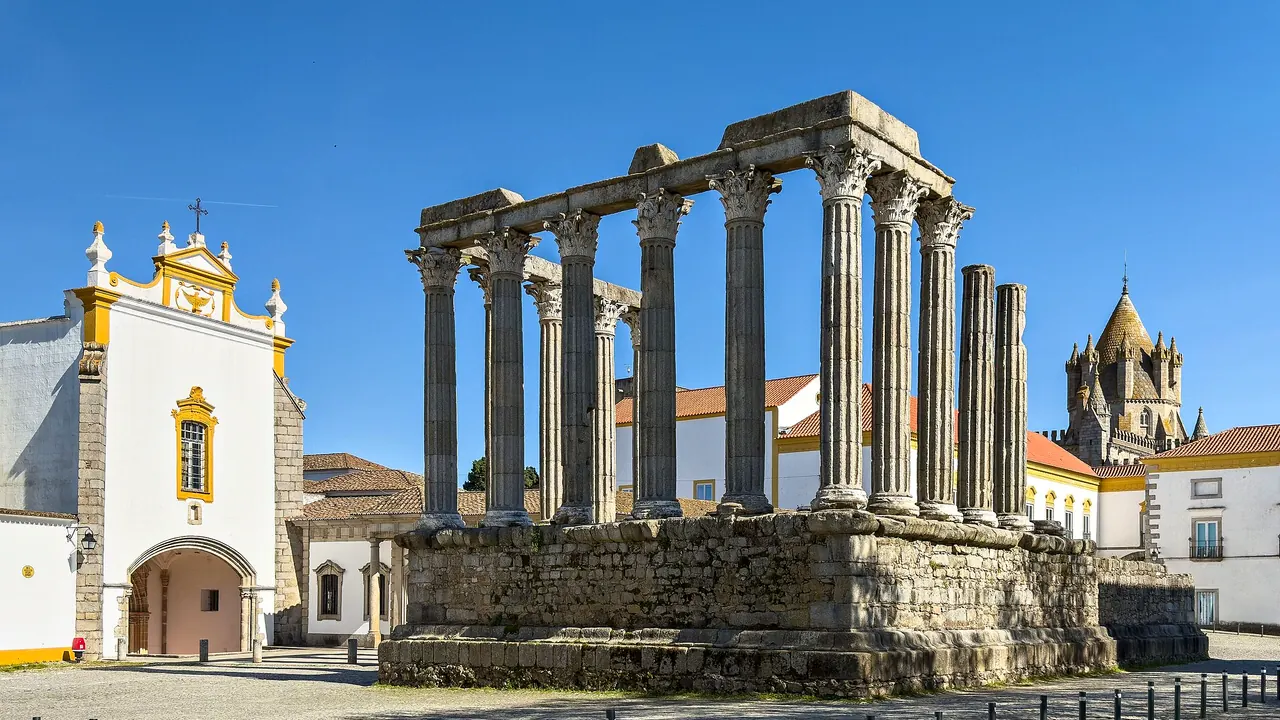
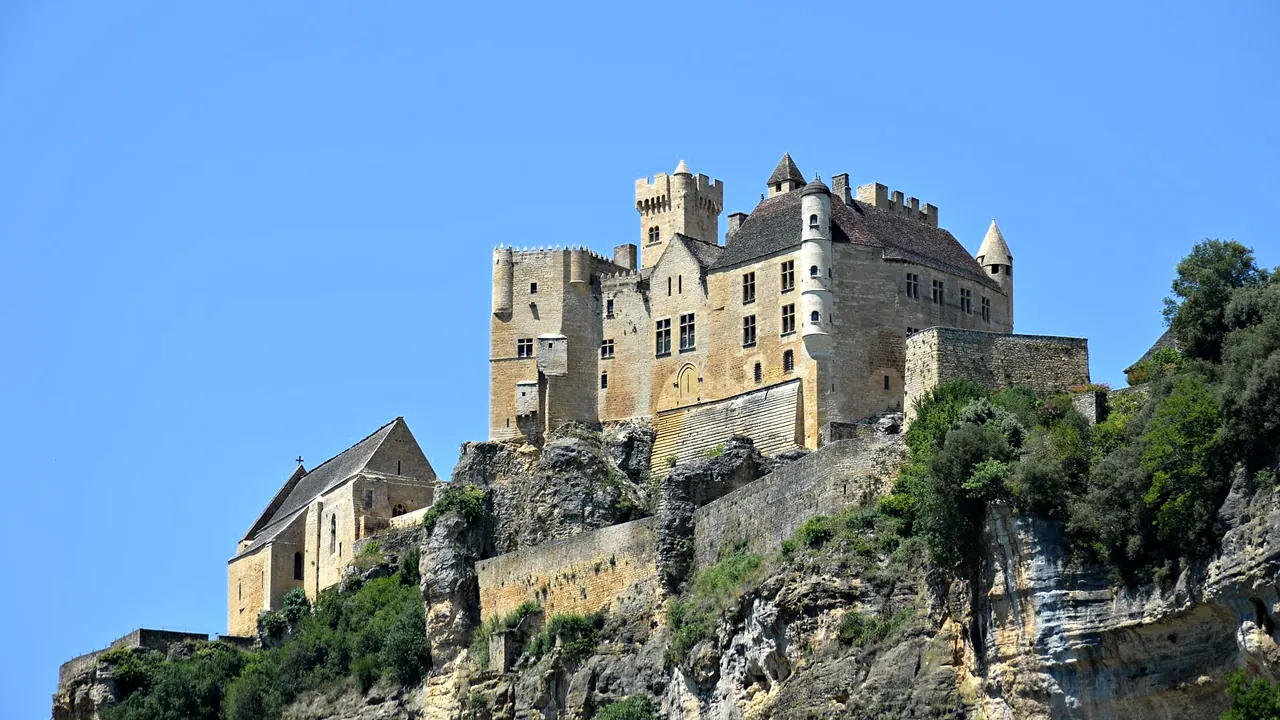
Photos: Alentejo by Kent Wang, CC BY 4.0, cropped; Dordogne by Edouard CHASSAIGNE, Pexels License.
Alentejo or Dordogne?
Our verdict in twelve categories, each scored against the same fixed benchmark cities, and the climate month by month, so you can choose for your trip.
Choose Alentejo for
- beaches
- prices
- nightlife
Alentejo suits travellers who want space, sun and a smaller bill. It pairs a long, empty Atlantic coast with an interior of hilltop towns, Évora's Roman and medieval core and big estate reds, and its summers are hotter and drier. Walkers and surfers have the cliff paths of the Rota Vicentina. The trip works best split between two bases, one inland and one by the sea.
Choose Dordogne for
- culture and sights
- families
- food and drink
For a heritage-rich family vacation in green river country, the Dordogne is the better pick. The painted caves of the Vézère and the castles facing each other along the river all sit close to a base near Sarlat. Canoe trips and siege-engine displays keep school-age children busy, and the markets are among the best in France. The trade-off is that swimming happens in rivers and pools, not the sea.
Scoreboard
Twelve categories on one fixed scale from 0 to 100. The shaded stretch is the gap between the two.
Your match
Pick a travel style or drag the sliders, and both match scores follow your weighting.
Wins on beaches and prices with your weighting.
Wins on culture and sights and families with your weighting.
What matters to you?
Category by category
What the scores mean for a trip.
Beaches & swimming
Alentejo has a real coastline, and one of the emptiest in southern Europe. There are long dune beaches at Comporta and Melides and cliff coves around Porto Covo and Zambujeira. The Atlantic stays cool and the swell calls for care, so the Mira estuary and the warm Alqueva river beaches are the gentler choices.
The Dordogne is three hours from the sea. Swimming there means gravel banks on the Dordogne and the Vézère below Beynac or La Roque-Gageac, a few lakes with sandy shores, or the pool at a rented house. It makes a pleasant summer afternoon, but it is not a beach vacation.
Food & drink
Both are serious eating regions built on rural cooking and estate wine, but the ingredients differ. Alentejo cooks with bread, olive oil, herbs and acorn-fed black pork, and adds Serpa sheep's cheese and convent egg sweets. Its estates around Reguengos and Vidigueira pour big reds, some of them fermented in clay amphorae.
The Dordogne is duck and goose country, with confit, foie gras, walnuts, cèpes and winter truffles, and its markets in Sarlat and Périgueux are an outing in themselves. Bergerac adds the sweet whites of Monbazillac. In both regions there is little to eat beyond the local cooking.
Culture & sights
The Dordogne's heritage is deeper and more tightly packed. The painted caves, rock shelters and cliffside museum of the Vézère valley are prehistory of world importance. Sarlat, the river castles and the bastide town of Monpazier add the Middle Ages, and nearly all of it lies within half an hour of one base.
Alentejo's highlights are strong but spread out. They include Évora's Roman temple, cathedral and Chapel of Bones, the Almendres standing stones, the star-shaped walls of Elvas, the walled villages of Marvão and Monsaraz, and Mértola's mosque-church. Seeing them takes several bases or long drives.
Nightlife
Neither region is for a night out, but Alentejo has a little more going on after dinner. Évora's student bars keep its squares busy on term-time weekends, and in July and August Zambujeira and Milfontes have beach bars full of young Portuguese. In the Dordogne the villages are silent by eleven, and the liveliest summer evening is a night market with communal tables and dancing in the square.
Nature & outdoors
Alentejo has the wilder outdoors. The Fishermen's Trail follows the cliffs of the Southwest Alentejo and Vicentine Coast Natural Park, and the coast has dependable surf. Inland there are wildflower plains in spring, great bustards on the Castro Verde steppe and dark skies over Alqueva.
The Dordogne is gentler and more wooded, with wide rivers under limestone cliffs and oak and chestnut woods. It is best seen from a canoe drifting past La Roque-Gageac and Beynac. Quiet lanes and the old railway greenway near Sarlat suit easy cycling, but nothing here would draw a serious hiker.
Day trips
Both regions are made for touring by car, and either will fill a week. From Évora you can visit the marble towns of Estremoz, Borba and Vila Viçosa, rug-making Arraiolos, the potters of São Pedro do Corval and the wine estates. Roman Mérida lies across the Spanish border, and Lisbon is about an hour and a half away.
The Dordogne's outings sit closer together and differ more from one another. There is clifftop Domme, Brantôme on its river island and Rocamadour climbing its cliff. Further out are the Lot valley, Saint-Émilion and a long day in Bordeaux.
Good for families
The Dordogne is the more complete family destination, especially for eight-to-fourteen-year-olds. It has easy canoe trips, Castelnaud's siege engines and armour, reconstructed prehistoric sites and tree-top parks, plus campsites and gîtes set up for children. The steps and cliff paths make pushchairs hard work.
Alentejo suits families who want quiet more than activities. Its strengths are farm stays with pools and animals, calm water at Milfontes and Alqueva, and restaurants happy to see children late in the evening. Apart from the safari park near Santiago do Cacém, though, little is built for children, and the inland summer heat is hard on small ones.
Getting around
A car is the realistic way to see either region, and the roads in both are good and quiet. What differs is scale. Alentejo is large, with about two hours between the coast and Évora, so most visitors split their stay between two bases. Trains from Lisbon reach Évora and Beja and buses link the larger towns, but the hill villages, wine estates and beaches are beyond them.
The Dordogne is more compact, with its main sights rarely more than an hour apart, so one base can cover most of it. In July and August, though, the river road through La Roque-Gageac and Beynac backs up, and parking in Sarlat on market day fills early. Outside the hottest weeks, cycling between nearby villages works well there.
Shopping & style
Alentejo's shopping runs to crafts and the Dordogne's to food, which gives Alentejo more to take home that isn't eaten within the week. You can buy hand-stitched rugs in Arraiolos, painted clay figurines at Estremoz's Saturday market, pottery from the potters' village of São Pedro do Corval, and cork goods. Comporta adds a few chic boutiques.
In the Dordogne, most visitors fill the car boot with foie gras, confit, walnut oil and Bergerac wine from the markets of Sarlat or Issigeac. Summer brings brocantes and antiques fairs, but Sarlat's shops mostly repeat the same regional products, and there is no fashion to speak of.
Affordability
Alentejo is noticeably cheaper, especially inland. Village set lunches are generous, estate wine is cheap even on restaurant lists, and guesthouses in Évora or Mértola are well priced. The exceptions are the design hotels of Comporta and Melides and the coast in August.
The Dordogne costs what rural France costs. Set menus, market food and campsites keep it reasonable, but houses with pools near Sarlat are expensive in July and August. Tickets for caves and castles and canoe hire add up over a week for a family. In both regions, allow for car hire.
Live music & performing arts
There is little on stage in either region, and neither has opera or a resident orchestra. Alentejo has something of its own in cante alentejano, the UNESCO-listed polyphonic singing heard in Serpa and in village taverns, though you need luck to catch it. Évora's old municipal theatre and Marvão's hilltop classical festival add a little more.
The Dordogne crowds its programme into summer festivals: theatre in Sarlat's squares, mime and street theatre in Périgueux, and classical concerts in Romanesque churches. Outside summer, both regions are quiet.
Wellness & relaxation
Springs at Cabeço de Vide and Moura have been used since Roman times, and many wine and olive estates in Alentejo have a pool and spa among the cork oaks. Add very dark, silent nights in the countryside, and it is the easier of the two for a restful stay, though the treatments are mostly in hotels rather than public baths.
The Dordogne has no bathing tradition, and its spas are limited to a few château hotels. Its calm comes from a pool at a stone farmhouse and empty lanes. That is truest in the Périgord Vert and in late spring or September, since the August crowds around Sarlat work against it.
When should you go?
Pick your month. The climate figures are measured averages, not a forecast.
Alentejo in July
Dordogne in July
Daytime high, °C
Rainfall in the month, mm
Temperature and rainfall are climate normals, averaged over the years shown. Alentejo: 1991-2020 normals, Evora / C. Coord (4.3 km from centre). Dordogne: 1991-2020 normals, Gourdon (21.2 km from centre).
Alentejo is the hotter and drier of the two. Where most visitors stay, summer is almost rainless, with July highs around 33°C and barely 2mm of rain. June to September is beach weather on the coast, but the interior is too hot for walking town streets in the middle of the day. Spring and early October are the comfortable months for Évora and the hill towns. The rain arrives in October at around 91mm and carries on through a mild winter.
The Dordogne is cooler and greener. It peaks near 28°C in July and August, which is warm enough for river swimming from late June into early September without the Alentejo's fierce heat. Rain falls in every month and is heaviest in April and May, at about 83mm, and winters are grey and short on sunshine. Late May, June and September are the best months for walking and touring.
Which traveller are you?
For a beach and sun trip, choose Alentejo. It has real Atlantic beaches, from the dunes of Comporta to the schist coves of Zambujeira, and calm estuary water at Milfontes, all under near-rainless summers. The Dordogne swims in rivers and lakes, three hours from the sea.
On a culture and arts trip, the Dordogne gives you more with less driving. The Vézère's painted caves, the prehistory museum at Les Eyzies, Sarlat's golden-stone old town and the river castles all lie close to one base. Évora, Elvas and Marvão are much further apart.
On a family trip with school-age children, the Dordogne is better set up. It has gentle canoe trips, Castelnaud's armour and siege engines, tree-top parks, and campsites built around children. Alentejo offers farm stays and calm river beaches but very few attractions made for children.
Before you go
| Measure | Alentejo | Dordogne |
|---|---|---|
| Official language | Portuguese | French |
| Currency | Euro (EUR) | Euro (EUR) |
| Sockets | CF230 V, 50 Hz | CE230 V, 50 Hz |
| Driving side | Right | Right |
| Time zone | UTC, UTC+1 in summer | UTC+1, UTC+2 in summer |
| Emergency number | 112 | 112 |
| Main airport | Lisbon Humberto Delgado Airport (LIS)157 non-stop destinations | Bergerac Dordogne-Périgord airport (EGC)9 non-stop destinations |
| Public holidays this year | 14 days | 11 days |
By the numbers
| Measure | Alentejo | Dordogne |
|---|---|---|
| Population | 705,478 | 417,614 |
| People per km² | - | 46 |
Where else could you go?
Every comparison below shares a destination with this one, so you can follow Alentejo or Dordogne somewhere new.
- Algarvevs Alentejo
- Andalusiavs Alentejo
- Loire Valleyvs Dordogne
- Douro Valleyvs Alentejo
- Provencevs Dordogne
- Basque Countryvs Dordogne