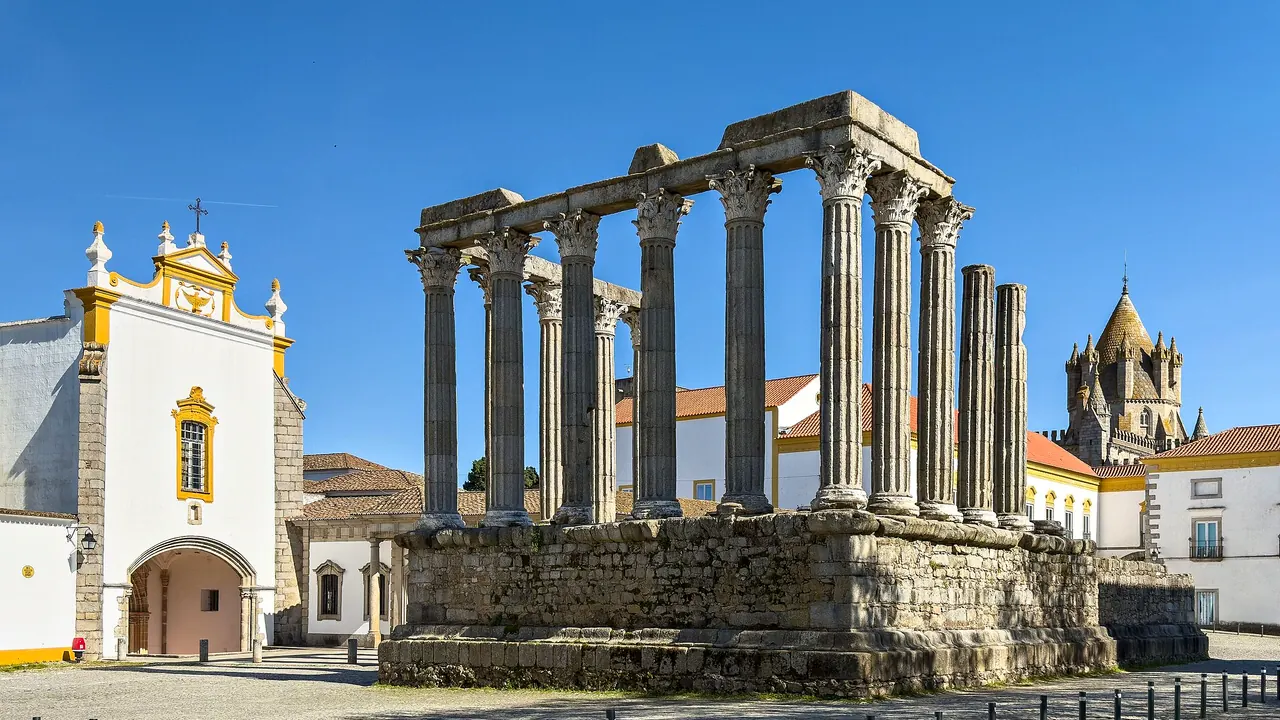
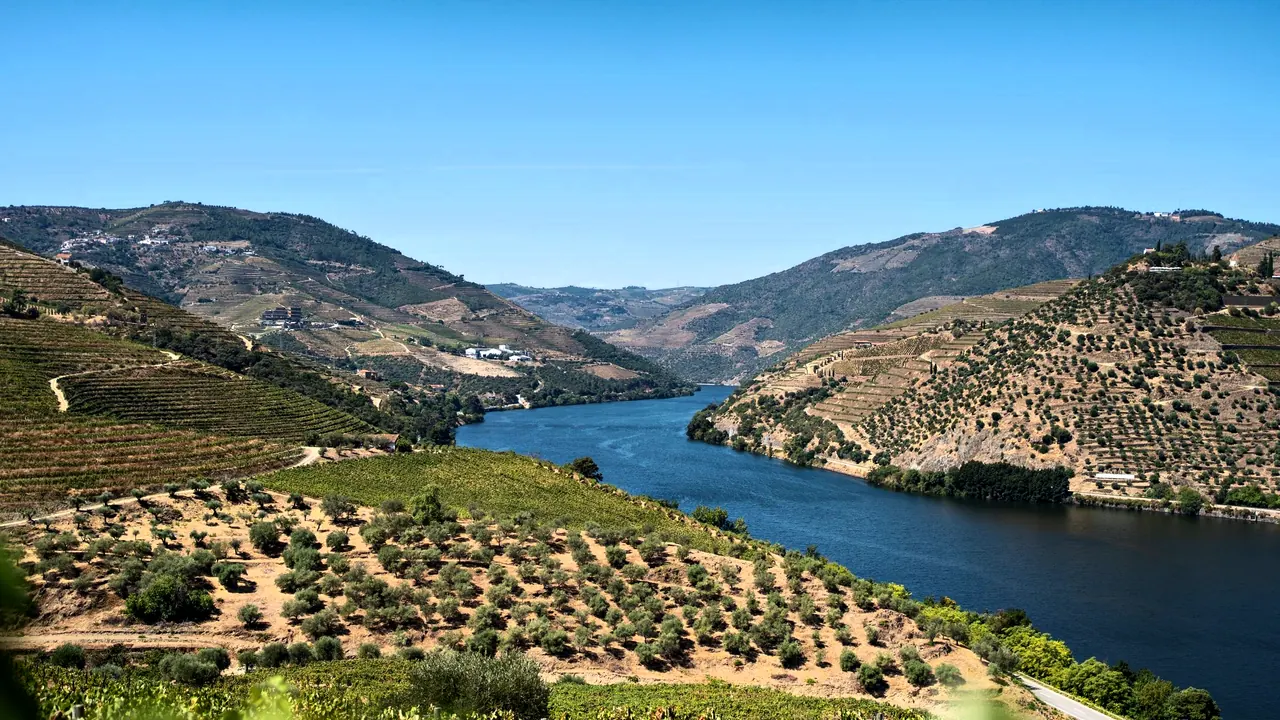
Photos: Alentejo by Kent Wang, CC BY 4.0, cropped; Douro Valley by Finn Ruijter, Pexels License.
Alentejo or Douro Valley?
Our verdict in twelve categories, each scored against the same fixed benchmark cities, and the climate month by month, so you can choose for your trip.
Choose Alentejo for
- beaches
- families
- shopping
The Alentejo is the broader trip. Walled Évora and the hilltop towns give it real history, the Atlantic coast gives it empty beaches, and the plains in between are easy to drive. It suits travellers who want to mix sightseeing, swimming and long rural lunches over a week or more. It also suits families who need space and a farm-stay pool more than theme parks.
Choose Douro Valley for
- wellness
If wine is the reason for going, choose the Douro Valley. Here you get the terraced gorge between Régua and Pinhão, port and dry reds tasted at the quintas that make them, and estate hotels with spas looking over the vines. It makes a short, focused stay for couples and adults who want scenery and calm, and they have to accept there is no beach and little for children.
Scoreboard
Twelve categories on one fixed scale from 0 to 100. The shaded stretch is the gap between the two.
Your match
Pick a travel style or drag the sliders, and both match scores follow your weighting.
Wins on beaches and families with your weighting.
Wins on wellness with your weighting.
What matters to you?
Category by category
What the scores mean for a trip.
Beaches & swimming
Only one of these two has a coastline. The Alentejo's Atlantic shore runs from the dune beaches of Comporta and Melides down to the schist coves at Porto Covo and Zambujeira, and you can find space even in August. The open sea is cool and the swell calls for care, so for calm water go to the Mira estuary at Milfontes or the river beaches on the Alqueva.
In the Douro Valley, swimming means a few grassy river beaches on the Douro, Tua and Paiva, or more often the quinta pool. That is fine for cooling off on a hot afternoon, but the water is no reason to choose the Douro.
Food & drink
The two eat equally well, but in the Alentejo the attraction is the food and in the Douro it is the wine. The Alentejo means bread-based migas and açorda, acorn-fed black pork, sheep's cheese from Serpa and convent sweets, with generous reds from Reguengos and Vidigueira, some fermented in clay amphorae.
In the Douro Valley, the reason to come is port and the valley's dry wines, tasted on quinta terraces between Régua and Pinhão. The food served alongside is hearty mountain cooking such as roast kid and meat-stuffed bola de Lamego. In both regions there is little choice beyond the local cooking.
Culture & sights
The Alentejo has far more to see. Évora alone has a walled UNESCO centre, a Roman temple and the Chapel of Bones, and the Almendres standing stones are just outside town. Beyond Évora are the star-shaped fortifications of Elvas, the walled hill villages of Marvão and Monsaraz, the ducal palace at Vila Viçosa and the mosque-church at Mértola.
In the Douro, the main monument is the landscape: centuries of stone terraces listed as a World Heritage wine region. Lamego's baroque stairway, the Mateus Palace and the Côa Valley rock engravings are fine sights, but they are spread out, and no town has a historic core to match Évora.
Nightlife
Neither region suits a night out, though the Alentejo has a little more. Évora's student bars fill its squares on term-time weekends, and beach bars at Milfontes and Zambujeira stay open late in high summer. In the Douro, the villages are quiet soon after dinner, and apart from a few bars in Vila Real and the odd summer festa, a proper night out means Porto.
Nature & outdoors
For the outdoors the two are equally good, but the landscapes are very different. The Alentejo's best is on the coast: the Fishermen's Trail along cliffs with storks nesting on sea stacks, reliable surf and kayaking on the Mira. Inland there are cork-oak plains, great bustards on the Castro Verde steppe and dark skies around the Alqueva.
The Douro offers one dramatic gorge rather than a coast. You can look down on the river bends from São Leonardo de Galafura, walk between vineyards, cycle the old Corgo railway line or take a boat on the river. The terraces are white with almond blossom in late winter and turn red and gold in autumn.
Day trips
The Alentejo has slightly more on the doorstep. From Évora you can see a different town each day, from the marble triangle of Estremoz, Borba and Vila Viçosa to the rug makers of Arraiolos and the potters of São Pedro do Corval. Roman Mérida across the border and Lisbon by train widen the choice.
The Douro's outings take longer to reach, but they are varied. Porto is a full day out by the riverside train. Amarante, Guimarães and Braga lie to the west, and Viseu, with the Dão wine country around it, lies to the south.
Good for families
Families fare much better in the Alentejo. Farm stays with pools and animals are common, children are welcome at dinner late into the evening, there is a safari park near Santiago do Cacém, and the estuary at Milfontes gives small children calm water.
The Douro Valley is built around tastings. Boat trips, the scenic train and grape treading at harvest give children a few good moments, but most families treat it as two or three days within a longer trip.
Getting around
In both regions you will want a car, but driving is far easier in the Alentejo. Its roads are good and empty across the plains, trains reach Évora and Beja, and the walled towns are small enough to walk around. The distances are what make it harder, and most visitors split their stay between a coastal base and an inland one.
In the Douro, the riverside railway and the boats cover the core of the valley. The quintas and viewpoints, though, are up narrow, twisting roads, and since tasting is the point of the trip, many visitors pay for a driver.
Shopping & style
In both regions shopping means local goods rather than fashion, but the Alentejo has much more to buy. There are hand-stitched rugs in Arraiolos, painted clay figurines and a large Saturday market in Estremoz, a whole village of potteries near Monsaraz, and a few smart boutiques in Comporta. In the Douro, shopping comes down to bottles from the estates, almonds and honey, and the black pottery of Bisalhães.
Affordability
Both are cheap places to eat and drink, and in each the cost depends mostly on where you sleep. In the Alentejo, the extra cost comes from Comporta's design hotels, coastal rooms in August and the car you can hardly do without. In the Douro it comes from quinta hotels, paid tastings, private drivers and the harvest season. A visitor who stays in Régua or Lamego and drives keeps the cost down.
Live music & performing arts
The Alentejo has more live music, and some of it belongs only to the region. Its cante alentejano is slow choral singing listed by UNESCO, heard in village taverns and at Serpa's centre devoted to it. Évora has a nineteenth-century theatre, and Marvão holds a classical festival on its hilltop.
The Douro offers a modest theatre in Vila Real, brass bands at village festas and the pilgrimage festivities in Lamego. For fado or concerts you would go to Porto.
Wellness & relaxation
The Douro Valley has more to offer on a spa stay. Its larger estate hotels have vinotherapy treatments and infinity pools above the terraces, Caldas de Aregos has used its sulphur springs for centuries, and the thermal town of São Pedro do Sul is within reach.
The Alentejo relaxes you more through its pace than through treatments: long lunches, quiet plains and a pool at a country estate. It has old springs at Cabeço de Vide and Moura, but most of its spas are in hotels.
When should you go?
Pick your month. The climate figures are measured averages, not a forecast.
Alentejo in July
Douro Valley in July
Daytime high, °C
Rainfall in the month, mm
Where the figures come from
Douro Valley has no weather station within reach, so its figures come from a gridded climate model rather than a measured record, and read a broad area rather than one spot.
Temperature and rainfall are climate normals, averaged over the years shown. Alentejo: 1991-2020 normals, Evora / C. Coord (4.3 km from centre). Douro Valley: 1991-2020 normals, TerraClimate 4 km grid at the town, no weather station within 90 km.
The Alentejo is at its best in spring and early autumn. April and May are warm, sunny and green, June is hot and almost dry, and the second half of September brings the heat down again before the rain returns. At the inland point where its figures are taken, July and August reach about 33°C with almost no rain, which is hard going in the walled towns but bearable on the coast. Beach weather runs from June to September. October is the wettest month at 91mm, and the rain stays near that level until the new year, though winter there still gets a fair share of sunshine.
The Douro Valley is milder in summer at the point where its figures are taken, with highs nearer 26°C, but it is much wetter the rest of the year, with close to 178mm in December. Late May, June and September are the most comfortable months for walking between the vineyards. The autumn rain arrives in October in both regions, but in the Douro it is far heavier.
Which traveller are you?
On a beach and sun trip, the Alentejo is the only real option. It has a long, quiet Atlantic coast you can base yourself on for a week, as long as you can live with cool water and some swell. The Douro is inland, so swimming there is limited to cooling off.
On a family trip with children, choose the Alentejo. There is room to roam, the pace is easy, children are welcome at a late dinner, and parents can split the stay between the coast and the countryside. In the Douro, children mostly end up waiting while the adults taste wine.
On a relaxing and wellness trip, the Douro Valley suits couples who want to stay a few days at one wine estate with treatments on site and the river below. The Alentejo suits those who want quiet and space more than pampering.
Before you go
| Measure | Alentejo | Douro Valley |
|---|---|---|
| Official language | Portuguese | Portuguese |
| Currency | Euro (EUR) | Euro (EUR) |
| Sockets | CF230 V, 50 Hz | CF230 V, 50 Hz |
| Driving side | Right | Right |
| Time zone | UTC, UTC+1 in summer | UTC, UTC+1 in summer |
| Emergency number | 112 | 112 |
| Main airport | Lisbon Humberto Delgado Airport (LIS)157 non-stop destinations | Francisco de Sá Carneiro Airport (OPO)134 non-stop destinations |
| Public holidays this year | 14 days | 14 days |
By the numbers
| Measure | Alentejo | Douro Valley |
|---|---|---|
| Population | 705,478 | - |
Where else could you go?
Every comparison below shares a destination with this one, so you can follow Alentejo or Douro Valley somewhere new.
- Algarvevs Alentejo
- Andalusiavs Alentejo
- Costa del Solvs Alentejo
- Andalusiavs Douro Valley
- Algarvevs Douro Valley
- Basque Countryvs Douro Valley