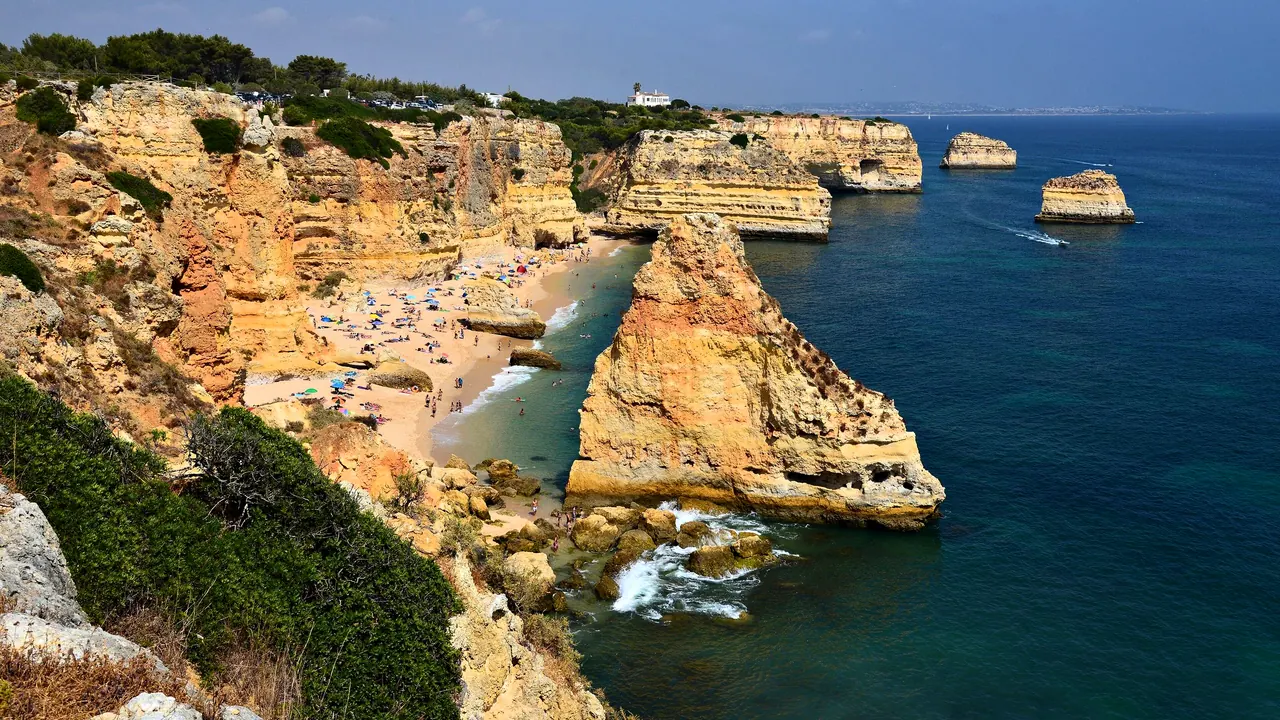
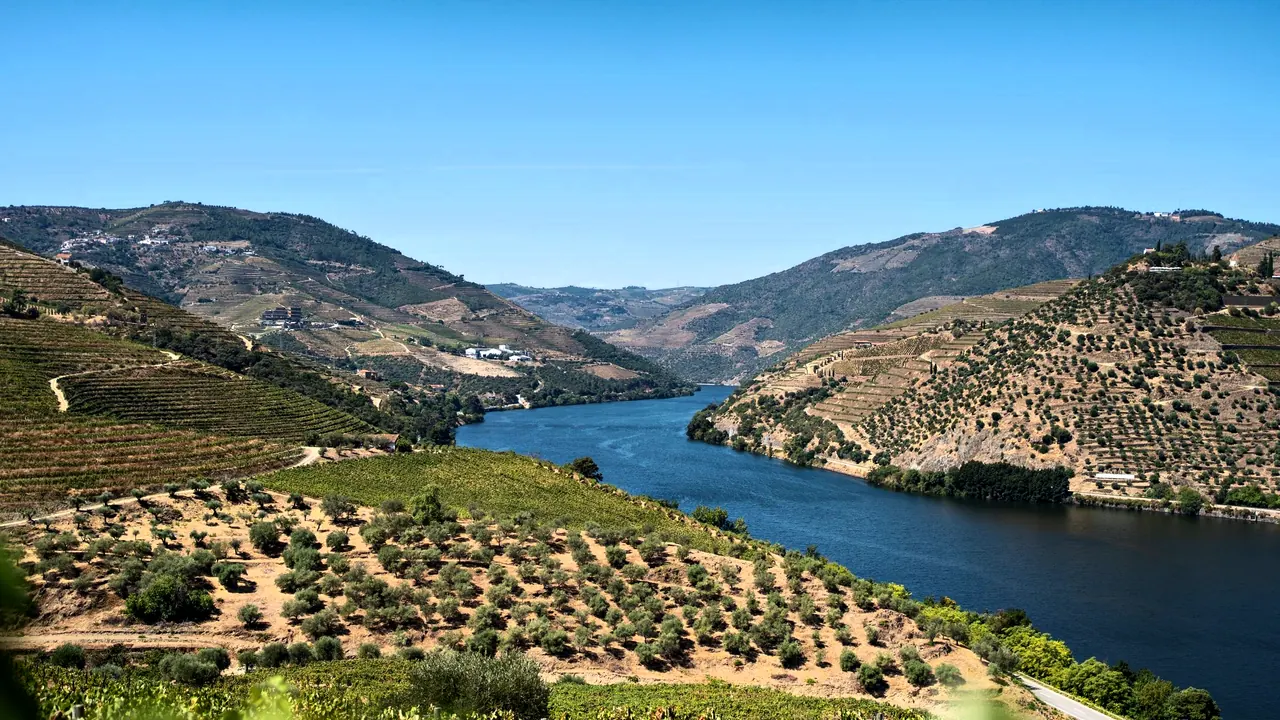
Photos: Algarve by Tobi 87, CC BY-SA 3.0, cropped; Douro Valley by Finn Ruijter, Pexels License.
Algarve or Douro Valley?
Our verdict in twelve categories, each scored against the same fixed benchmark cities, and the climate month by month, so you can choose for your trip.
Choose Algarve for
- beaches
- families
- nightlife
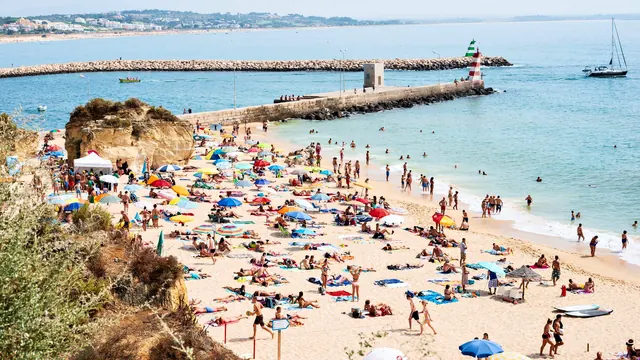
The Algarve is the choice for a sun-and-sea vacation that runs at an easy pace. It has sandy coves under cliffs between Lagos and Albufeira and long barrier-island beaches off the Ria Formosa. Water parks, boat trips and late summer bars keep children and groups busy. It suits families above all, and anyone who wants the evening to carry on after dinner.
Choose Douro Valley for
- culture and sights
- day trips
- prices
Wine drinkers and slow travellers will be happier in the Douro Valley. Here the days move between quinta tastings, terraced slopes and river viewpoints, and the nights end over a glass of port. There is no sea, little for children and almost nothing to do after dark. In return the valley gives you more heritage, better outings to towns such as Guimarães and Braga, and cheaper meals.
Scoreboard
Twelve categories on one fixed scale from 0 to 100. The shaded stretch is the gap between the two.
Your match
Pick a travel style or drag the sliders, and both match scores follow your weighting.
Wins on beaches and families with your weighting.
Wins on culture and sights and day trips with your weighting.
What matters to you?
Category by category
What the scores mean for a trip.
Beaches & swimming
This is the widest gap between the two. The Algarve has three kinds of coast: sandy coves beneath ochre cliffs between Lagos and Albufeira, long, quiet beaches on the Ria Formosa islands east of Faro, and surf beaches on the wild west coast. The water is the fresh Atlantic, warmest in the east, and the famous coves fill up in high summer.
The Douro Valley has no sea at all. Swimming means a river beach on the Douro, Tua or Paiva, or more often the pool at your quinta. That is pleasant on a hot afternoon but no reason to choose the valley.
Food & drink
Both are good places to eat and drink, but the Douro Valley has the edge if your trip is about what is in the glass. Port, aged tawnies and the valley's dry reds are tasted at the estates where they are made, with roast kid, smoked sausages and bola de Lamego on the table. The range is narrow, though, and village evenings end early.
The Algarve is a fish coast instead, with sardines and bream grilled over charcoal, clam cataplana and goose barnacles. These are best eaten around Olhão's market halls and the harbours of Tavira and Portimão. Choose your base with care, because the resort strips serve the same grills to everyone.
Culture & sights
Neither is built around great monuments, but the Douro Valley gives a little more. Its terraced vineyards are a World Heritage landscape, and the Côa Valley rock engravings, the baroque stairway at Lamego and Mateus Palace add real substance. They are spread out, though, and there is no dense old town to wander.
The Algarve's heritage comes in smaller, walkable pieces: Silves castle, Tavira's spires and bridge, Faro's walled centre and the fortress at Sagres. They fit neatly around beach days but rarely fill a whole day.
Nightlife
The Algarve has a real summer scene. There are neon bars and dawn clubs on Albufeira's Strip, backpacker lanes in Lagos and a dressier marina at Vilamoura, though it all fades after September and Tavira stays quiet all year. The Douro Valley has next to nothing beyond a long dinner, a few student bars in Vila Real and the odd village festa, so going out means going back to Porto.
Nature & outdoors
Both are strong for the outdoors, but the landscapes are very different. The Algarve's is a coast: cliff-top walks on the Seven Hanging Valleys trail, kayaks into the Benagil grottoes, surf and the Rota Vicentina paths in the west, and flamingos on the Ria Formosa saltpans.
The Douro's is a deep schist gorge terraced with vines, olives and almonds. You can take it in from viewpoints such as São Leonardo de Galafura, walk between quintas or cycle the old Corgo railway. In both, the midsummer heat pushes walking into spring and autumn, when the Douro adds autumn colour and late-winter almond blossom.
Day trips
The Douro Valley has the wider range of outings. You can take the riverside train to Porto or drive to the bridge town of Amarante, medieval Guimarães and Braga, or to Viseu and the Dão wine country, though most of these need some driving.
From the Algarve the standout is Seville, about two hours from the eastern end, along with Mértola and the car-free islands of Culatra and Armona. After the region's own towns the choice thins out within a week, because Lisbon and Évora are too far.
Good for families
The Algarve is an easy coast for families. It has shallow, sheltered water around Alvor, Armação de Pêra and the lagoon islands, plus water parks, Zoomarine and villas with pools. The drawbacks are the steep stairs down to the central coves and the midday heat in high summer.
The Douro Valley is a vacation for adults. A river cruise, the scenic train and grape-treading at harvest are good moments, but long winding drives and tastings fill the rest. Families usually give it two or three days within a wider trip.
Getting around
Both work best with a car, but the Algarve is easier. The A22 links Lagos and Tavira in about an hour. The walkable centres of Lagos, Tavira and Faro make a stay without a car possible, though the coastal railway and the sparse buses are slow.
In the Douro the train and river boats cover the valley floor, but the quintas and viewpoints are up narrow, twisting roads. Since tasting is the point of the trip, many visitors hire a driver or stay at an estate they can walk around.
Shopping & style
The Algarve has the broader shopping, though neither region is a reason to travel for it. It offers local craft and produce, with Loulé's market hall at its centre, ceramics near Porches and sea salt from the eastern saltpans. For anything ordinary that you forgot to pack, there are malls near Faro and Portimão and boutiques on Vilamoura's marina.
The Douro has one thing worth buying: wine taken straight from the estates, often aged tawnies and vintage port you will not find at home. Olive oil and Bisalhães black pottery are small extras. Leave room in the luggage for bottles, and don't expect much else.
Affordability
The Douro Valley is the cheaper of the two for eating out and for the town guesthouses in Régua and Lamego, where big plates and good wine cost little. The cost lies in the estate hotels, drivers and tastings that bring most visitors, and harvest is the most expensive time.
Eating out in the Algarve is also good value, but coastal accommodation pushes costs up in July and August, and the golf enclaves around Almancil are expensive. In both, staying in a town and coming outside the peak season keep the cost moderate.
Live music & performing arts
In the Algarve, live performance mostly happens outdoors in summer, with world music in Loulé's old town and medieval fairs in Silves and Castro Marim. The municipal theatres in Faro and Loulé run modest seasons, and fado is mostly a restaurant show put on for visitors.
The Douro has less again. Its music comes from village festas with brass bands and folk groups, Lamego's pilgrimage festivities and the odd harvest supper at an estate. Vila Real's theatre is the only regular venue, so for concerts, opera or proper fado you have to go to Porto.
Wellness & relaxation
Neither region is a true spa destination, and the rest each one offers is quite different. The Algarve offers resort calm: a hotel spa between Albufeira and Quinta do Lago, mornings by the pool and afternoons on the sand, with yoga and surf retreats near Aljezur for those who like their rest active. It suits a couple who want treatments alongside sea days, but only in Tavira, the west or outside August, as the central resorts in high summer are far from restful.
In the Douro the setting does the work. The days slow to the pace of the vines, and an estate hotel with a pool above the terraces gives a quiet that is hard to find on the coast. It suits travellers who want to switch off completely, and the old spring towns of Caldas de Aregos and São Pedro do Sul are close by for anyone who wants the baths as well.
When should you go?
Pick your month. The climate figures are measured averages, not a forecast.
Algarve in July
Douro Valley in July
Daytime high, °C
Rainfall in the month, mm
Where the figures come from
Algarve's temperatures are measured 26 km from the centre, at Faro / Aeroporto.
Algarve has no rain gauge within 25 km of the centre, so its rainfall comes from a gridded climate dataset read at the destination rather than from a gauge further away.
Douro Valley has no weather station within reach, so its figures come from a gridded climate model rather than a measured record, and read a broad area rather than one spot.
Temperature and rainfall are climate normals, averaged over the years shown. Algarve: 1991-2020 normals, Faro / Aeroporto (26.4 km from centre). Douro Valley: 1991-2020 normals, TerraClimate 4 km grid at the town, no weather station within 90 km.
The Algarve has a long season. On the coast the summer is dry and very sunny, with highs near 29°C in July and August. The sea is warm enough for swimming from June to October and reaches about 20°C. Spring and autumn are better for walking and sightseeing. The rain starts in October and is heaviest in December, at about 95mm, but the winter stays mild.
The Douro Valley is cooler and much wetter. Summer brings highs of around 26°C and little rain, but the heat in the gorge makes July and August hard work outdoors. October to January are the wettest months, with up to 178mm of rain, and winter days are cool. The best times to go are late spring and September, before the autumn rains.
Which traveller are you?
On a beach and sun trip, the Algarve wins easily. It has cliff-backed coves, lagoon islands and a long, dry summer. The Douro is an inland valley a long drive from the Atlantic, with only river beaches and quinta pools for swimming.
On a family trip with children, the Algarve is far easier. There is shallow water around the Ria Formosa islands, water parks inland from Albufeira, Zoomarine, and resorts with kids' clubs. In the Douro, children get a boat ride and a pool between long drives and adult tastings.
For a wine-tasting trip, the Douro Valley is the place. Port and the valley's dry reds are poured at the quintas between Régua and Pinhão, children and adults can tread grapes at harvest, and you can buy bottles you rarely find elsewhere. The Algarve's table is about grilled fish rather than wine.
Before you go
| Measure | Algarve | Douro Valley |
|---|---|---|
| Official language | Portuguese | Portuguese |
| Currency | Euro (EUR) | Euro (EUR) |
| Sockets | CF230 V, 50 Hz | CF230 V, 50 Hz |
| Driving side | Right | Right |
| Time zone | UTC, UTC+1 in summer | UTC, UTC+1 in summer |
| Emergency number | 112 | 112 |
| Main airport | Faro - Gago Coutinho International Airport (FAO)91 non-stop destinations | Francisco de Sá Carneiro Airport (OPO)134 non-stop destinations |
| Public holidays this year | 14 days | 14 days |
By the numbers
| Measure | Algarve | Douro Valley |
|---|---|---|
| Population | 438,864 | - |
| People per km² | 88 | - |
| Swim season, months above 21 °C | None | - |
Where else could you go?
Every comparison below shares a destination with this one, so you can follow Algarve or Douro Valley somewhere new.
- Alentejovs Algarve
- Lisbonvs Algarve
- Andalusiavs Algarve
- Alentejovs Douro Valley
- Costa del Solvs Algarve
- Andalusiavs Douro Valley