Portugal
Alentejo
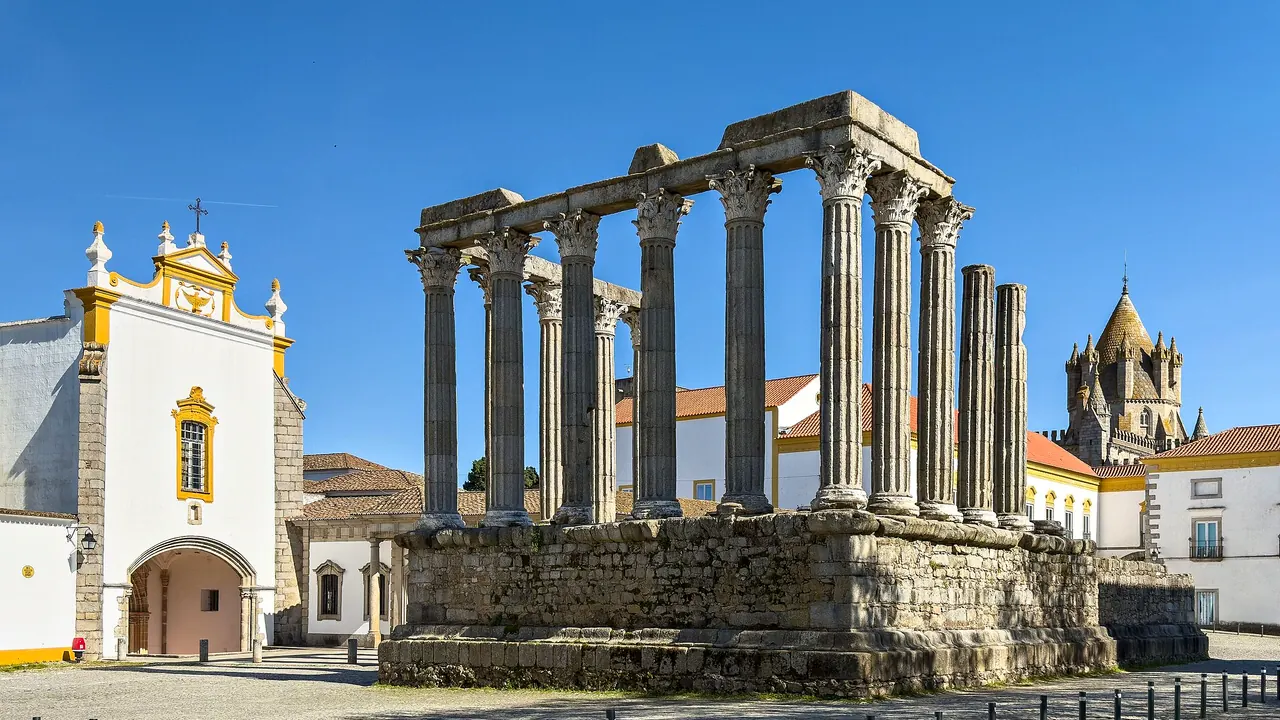
The Roman temple of Evora with the cathedral behind
- Day trips72
- Nature & outdoors70
- Culture & sights68
Match
53
Every category weighted equally
- Beach & sun55
- Culture & arts52
- Food & nightlife48
- Family trip58
- Outdoors60
- Relax & unwind56
- Shopping & style49
- On a budget54
Alentejo in twelve categories
Our verdict on each, scored 0 to 100 against the same fixed benchmark cities, so a score means the same thing on every page.
Beaches & swimming. Scores 60 out of 100.
Food & drink. Scores 66 out of 100.
Culture & sights. Scores 68 out of 100.
Nightlife. Scores 18 out of 100.
Nature & outdoors. Scores 70 out of 100.
Day trips. Scores 72 out of 100.
Good for families. Scores 52 out of 100.
Getting around. Scores 45 out of 100.
Shopping & style. Scores 38 out of 100.
Affordability. Scores 65 out of 100.
Live music & performing arts. Scores 28 out of 100.
Wellness & relaxation. Scores 48 out of 100.
Alentejo category by category
Beaches & swimming
60The Alentejo coast is one of the emptiest stretches of Atlantic shore in southern Europe. In the north, Comporta and Melides have long dune beaches backed by pine and rice fields. Further south, Porto Covo, Vila Nova de Milfontes and Zambujeira do Mar sit above coves cut into dark schist cliffs. Even in August you can usually find a quiet patch of sand.
The catch is the sea. The water rarely gets much above 19°C, and the swell and currents on the open beaches call for care. Swimmers often prefer the sheltered sand of the Mira estuary at Milfontes. Inland, the river beaches on the Alqueva reservoir near Monsaraz and Mourão have warm, calm water. Swimming weather runs from June to September.
Food & drink
66This is the part of Portugal the rest of the country drives to for lunch. The cooking is rural and built on bread, olive oil, herbs and pork. You'll find açorda and migas, lamb stews, dogfish soup scented with coriander, and black pork from pigs that feed on acorns under the cork oaks. Serpa and Nisa make serious sheep's cheeses, and the convents left behind a long list of egg-yolk sweets.
Wine is the other draw. Estates around Reguengos de Monsaraz, Borba, Redondo and Vidigueira pour generous reds, and some still ferment in clay amphorae. The best eating is in simple village tascas and in Évora, which also has the region's more ambitious restaurants. There is little variety beyond the local cuisine.
Culture & sights
68Évora is the cultural centre: a walled UNESCO-listed town with a Roman temple, a fortress-like cathedral, the bone-lined Chapel of Bones and whitewashed lanes that change little from century to century. Outside town are the Almendres Cromlech and other standing stones, some of the oldest monuments on the Iberian Peninsula.
The rest of the region's heritage is spread out in hilltop towns. Elvas has a vast star-shaped ring of fortifications, also on the UNESCO list. Marvão and Monsaraz are walled villages on high ground. Vila Viçosa has the ducal palace of the Braganças and streets paved in local marble. Mértola keeps a mosque that became a church. To see much of it you need several bases, or a lot of driving.
Nightlife
18Evenings here mean a long dinner, a bottle of local red and an early night. Évora has a university and a handful of bars around its squares, which keep the old town lively on term-time weekends. In July and August, Zambujeira do Mar and Milfontes stay up later, with beach bars and young Portuguese crowds. Anyone who wants a real night out drives to Lisbon.
Nature & outdoors
70The best of the outdoors is on the southwest coast, inside the Southwest Alentejo and Vicentine Coast Natural Park. The Fishermen's Trail of the Rota Vicentina runs along sandy cliff paths above coves and storks' nests on sea stacks, and inland routes link the villages behind it. The coast also has dependable surf and good kayaking on the Mira river.
Inland the land rolls gently under cork and holm oak, with wheat plains that turn gold in early summer. The best walking comes in spring, when the plains are green and covered in wildflowers, and in autumn. In midsummer the interior often goes past 40°C. Other draws are the Guadiana valley around Mértola, the Castro Verde steppe for great bustards and other birds, the granite hills of São Mamede near Marvão and the dark skies around the Alqueva lake.
Day trips
72From Évora there is a different small town for every day of a week. Estremoz, Borba and Vila Viçosa make up the marble triangle, with castles, pottery and white quarry stone everywhere. Arraiolos is famous for its hand-stitched rugs. São Pedro do Corval, near Monsaraz, is lined with potters' workshops. The wine estates around Reguengos and Redondo host tastings.
Further afield, Spain's Roman Mérida and Badajoz are each about two hours away, and Lisbon is about an hour and a half by train or car. From the coast, the outings are the fishing villages of Porto Covo and Sines, and the old hill town of Santiago do Cacém. Many of the towns are alike, so variety comes from the wine, the crafts and crossing the border.
Good for families
52The Alentejo suits families who want space and quiet more than attractions. Farm stays with pools and animals are common, villages are safe and unhurried, and Portuguese restaurants welcome children late into the evening. Near Santiago do Cacém there is a safari park. For small children, the calm water of the Mira estuary at Milfontes and the Alqueva river beaches are better than the open Atlantic beaches, where the swell can be strong.
The interior can pass 40°C in summer, so families with young children do best on the coast in high summer or inland in spring. Expect long drives between places, and few attractions made for children.
Getting around
45A car is effectively essential. The good news is that the roads are good and quiet, and driving across the plains is easy. Trains link Lisbon with Évora and Beja, and buses connect the larger towns. But the hill villages, wine estates and coastal beaches are hard to reach without your own wheels.
The region is large. From the coast to Évora or Monsaraz is about two hours, so most visitors stay in two bases rather than one. Once you arrive, the walled towns are small and walkable, though their cobbled lanes are often steep.
Shopping & style
38Shopping here means crafts and produce, not fashion. Arraiolos has made hand-stitched wool rugs for centuries. Estremoz is known for painted clay figurines, and its big Saturday market sells pottery, antiques and food. São Pedro do Corval, near Monsaraz, is a whole village of potteries. Cork goods, olive oil, cheese and wine bought at the estates complete the list. Évora has some pleasant small shops, and Comporta has a few chic boutiques. Beyond that there is little to browse.
Affordability
65The interior is one of the cheaper parts of Western Europe to travel in. Village restaurants serve generous set lunches, the estate wine is cheap even on restaurant lists, and guesthouses in Évora, Estremoz or Mértola are well priced. The coast is different in high summer. Comporta and Melides attract a wealthy crowd and have design hotels to match, and rooms in Milfontes and Zambujeira fill up and cost more in August. Car hire and fuel add to the cost, since a car is hard to avoid.
Live music & performing arts
28The region's own music is cante alentejano, slow polyphonic singing by groups of men and women. It is on UNESCO's intangible heritage list. Choirs still sing it in village taverns and at local feast days, and Serpa, its heartland, has a centre devoted to it. Even so, you can't plan on hearing it unless your trip falls on a festival or a choir's performance.
Évora has a nineteenth-century municipal theatre with a modest programme of plays and concerts. Most of the formal music comes in spring and summer. Sacred and early music is played in churches and monasteries across the region, and the castle town of Marvão hosts a classical festival on its hilltop. For most of the year, though, there is little to see on stage, and serious opera or theatre means going to Lisbon.
Wellness & relaxation
48The Alentejo's real wellness offer is its pace. Lunch runs long, the plains are silent and nights in the countryside are very dark. Many visitors stay at a wine or olive estate with a pool and spa among the cork oaks. Small spa towns such as Cabeço de Vide and Moura have springs used since Roman times. But there is no real culture of public baths, and the spa offer is mostly in hotels. The restorative part is slowing down in a whitewashed village or a quiet country house, not taking the waters.
Where to stay in Alentejo
Most visitors split a trip between two bases, one inland and one on the coast, as the drive between them takes about two hours. For a first visit, Évora is the obvious inland choice. The walled old town is easy to explore on foot, it has the region's widest choice of restaurants and a few bars in term time, and the marble towns, standing stones and wine estates are all an easy day's drive away. For a quieter stay, sleep in Monsaraz or on a farm near Reguengos, close to the warm river beaches of the Alqueva lake and its very dark night skies.
On the coast, Vila Nova de Milfontes suits families and walkers best. The Mira estuary has calm water for children, the Fishermen's Trail passes the town, and evenings run later in July and August. Zambujeira do Mar is smaller and draws a young crowd in summer. Further north, Comporta and Melides have long, empty dune beaches and a more polished, more expensive stay.
On a second visit, look further out. Marvão, in the granite hills of the northeast, suits walkers. Mértola, on the Guadiana, is a slow base for birdwatching on the Castro Verde steppe, and Estremoz is a simple, well-priced base for the marble towns. Wherever you stay you will need a car. In midsummer the coast is the more comfortable choice, and spring is the season for the interior.
When should you go?
Pick a month to see what it is like. The climate figures are measured averages, not a forecast.
Alentejo in July
Daytime high, °C
Rainfall in the month, mm
The whole year
Shaded against this destination’s own year: the deepest cell is its best month for that figure and the palest its weakest.
Temperature and rainfall are climate normals, averaged over the years shown. Alentejo: 1991-2020 normals, Evora / C. Coord (4.3 km from centre).
Before you go
| Measure | Alentejo |
|---|---|
| Official language | Portuguese |
| Currency | Euro (EUR) |
| Sockets | CF230 V, 50 Hz |
| Driving side | Right |
| Time zone | UTC, UTC+1 in summer |
| Emergency number | 112 |
| Main airport | Lisbon Humberto Delgado Airport (LIS)157 non-stop destinations |
| Public holidays this year | 14 days |
By the numbers
| Measure | Alentejo |
|---|---|
| Population | 705,478 |
Compare Alentejo with
Every comparison with a written verdict behind it.