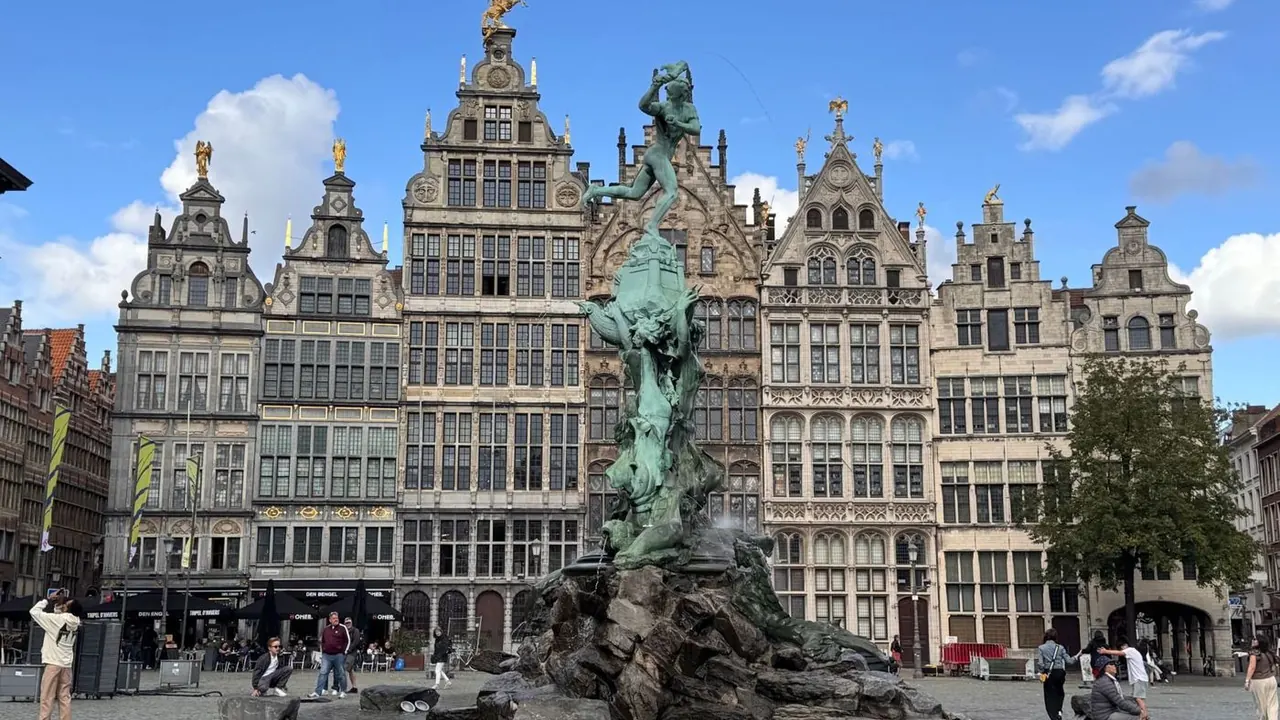
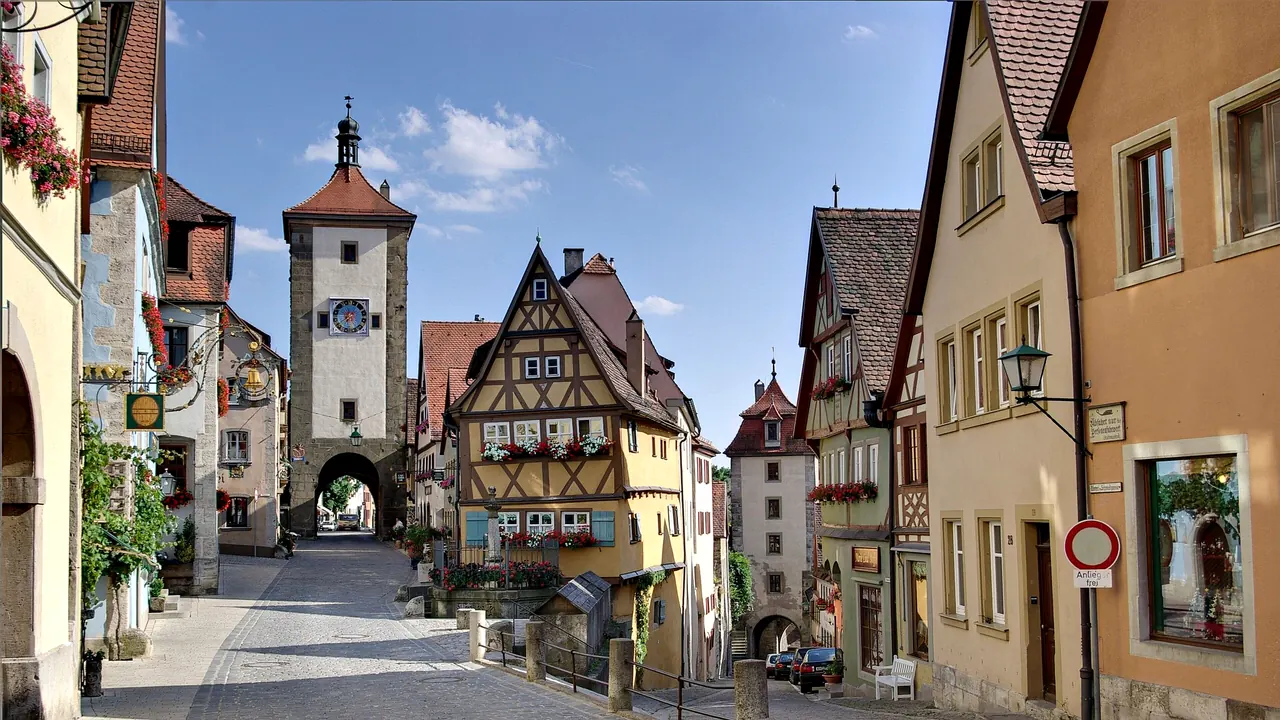
Photos: Antwerp by Norbert Jakab, Pexels License; Rothenburg ob der Tauber by Berthold Werner, Public domain.
Antwerp or Rothenburg ob der Tauber?
Our verdict in twelve categories, each scored against the same fixed benchmark cities, and the climate month by month, so you can choose for your trip.
Choose Antwerp for
- nightlife
- shopping
- live music and the arts
Antwerp is the choice for a proper city stay. It has Rubens altarpieces and a Renaissance printing house, Flemish beer in old brown cafés, avant-garde fashion boutiques and nights that run late. Ghent, Bruges, Brussels and Rotterdam are all reachable by train for day trips. Travellers who want several days of varied things to do, with no car, will get far more out of it.
Choose Rothenburg ob der Tauber for
- wellness
- prices
- nature and the outdoors
Rothenburg suits a slower, smaller trip built around one thing done very well: walking a medieval walled town that has barely changed. The evenings are quiet and the food is plain Franconian cooking. Its strength is the setting, with the ramparts at dusk, the Tauber valley below the walls and thermal baths within reach. It works best as a short stop on a driving tour of the Romantic Road.
Scoreboard
Twelve categories on one fixed scale from 0 to 100. The shaded stretch is the gap between the two.
Your match
Pick a travel style or drag the sliders, and both match scores follow your weighting.
Wins on nightlife and shopping with your weighting.
Wins on wellness and prices with your weighting.
What matters to you?
Category by category
What the scores mean for a trip.
Beaches & swimming
Neither is a place to swim, though Antwerp gets you nearer the water. Sint-Annastrand, on the left bank of the Scheldt, is a strip of sand for sitting rather than bathing, because the tidal river is not safe to swim in. In summer locals cool off in the outdoor pools and recreation lakes on the city's edge. The North Sea at Blankenberge and Knokke is under two hours away by train, which makes a long day out for water that stays cool even in August.
Rothenburg lies far inland in Franconia, on a hilltop hundreds of kilometres from any coast. Swimming means the town's outdoor pool, or a drive of about an hour to the grassy bathing areas of the Franconian lakes, such as the Altmühlsee.
Food & drink
Antwerp eats and drinks far better. Stoofvlees braised in dark beer, frites from proper friteries and the bolleke of local amber ale make even simple meals worth having. Above that, Het Zuid and Het Eilandje have a serious modern restaurant scene with a few starred tables.
Rothenburg offers one solid cuisine and little else: Schäufele, bratwurst and dumplings, washed down with Silvaner from the round Bocksbeutel bottle. Both towns have a main square where menus are aimed at tourists. In Antwerp the way out is a walk to another district. In Rothenburg it is a family-run guesthouse or wine tavern off the Marktplatz.
Culture & sights
Antwerp has more to see and more depth to it. It has Rubens's altarpieces in the cathedral and his house and studio, the Plantin-Moretus printing house, and a fine-arts collection running to Ensor. On top of that come Central Station, the Art Nouveau streets of Zurenborg and the MAS on the docks, enough for two or three full days.
In Rothenburg the town itself is the sight. You walk the covered wall, stand at the Plönlein and climb the Rathaus tower for the rooftops. Riemenschneider's carved altar in St Jakob's and the Medieval Crime Museum are the main indoor visits. It is a remarkable townscape, but you can see it in much less time.
Nightlife
Antwerp has a real night out. Brown cafés and student bars stay busy past midnight, and house and techno clubs fill old warehouses near the docks. The city also has one of the best-known gay scenes in the Low Countries.
Rothenburg's evening highlight is following the night watchman on his lantern-lit tour, then a glass in a wine tavern. The lanes are mostly silent by eleven. For anything livelier you would have to go to Würzburg or Nuremberg.
Nature & outdoors
Both offer gentle, low-key outdoors rather than scenery to travel for, but the setting differs. Rothenburg's countryside starts at the town gate. Paths drop from the walls into the Tauber valley past mills and the Topplerschlösschen, and the valley cycle path runs downstream through vineyards.
Around Antwerp the land is flat and built up, so green space means city parks such as Rivierenhof. Further out, there are bike rides on the Scheldt polder dykes and walks on the heath and dunes of the Kalmthoutse Heide.
Day trips
Antwerp is one of the best bases in Europe for day trips without a car. Frequent trains reach Mechelen, Brussels, Leuven and Ghent in under an hour, and Bruges, Rotterdam and Delft are all easy days out.
Rothenburg's excursions are strong too. On the Romantic Road there is walled Dinkelsbühl, and Nördlingen with its ring of walls inside a meteorite crater, and Würzburg's Residenz and Nuremberg's castle are about an hour away. Most of these need a car, because the rail links are thin.
Good for families
Antwerp copes better with a longer family stay. The zoo is right beside Central Station, children enjoy the MAS rooftop, the trams and the foot tunnel under the Scheldt, and the flat centre is easy with a pushchair. Cafés are relaxed about children, which helps on the many grey days.
Rothenburg is a storybook for a day or two. Children can walk the ramparts, climb the Rathaus tower and follow the night watchman, and older ones tend to love the Crime Museum. After that there is little made for them, and the cobbles and steep valley paths are hard going with a pushchair.
Getting around
Both centres are best on foot, but Antwerp is far easier beyond them. Trams and the underground premetro reach Het Eilandje and Zurenborg, shared bikes and cycle lanes cover the rest, and Central Station connects to the whole of Belgium and the Netherlands.
Rothenburg's old town takes about fifteen minutes to cross, and cars are kept outside the gates. Leaving it is the hard part. Most rail journeys need a change at Steinach, and regional buses are sparse, so anyone exploring the region really needs a car.
Shopping & style
Antwerp is a real shopping city, and its strength is clothes. Its designer boutiques favour conceptual Belgian labels over the global luxury houses found in every capital, so they suit someone who wants to come home with pieces they could not buy anywhere else. It covers everyday needs as well, and has secondhand auctions at the Vrijdagmarkt, so a whole afternoon of browsing is easy.
Rothenburg is a place to buy one kind of keepsake, not a place to go shopping. Its year-round Christmas shops are the draw, and a December visit adds one of Germany's most atmospheric Christmas markets. Anyone looking for clothes, design or ordinary shopping will find almost nothing, because nearly everything on sale is aimed at visitors. A Bocksbeutel of Franconian wine makes the best gift to take home.
Affordability
Neither is cheap, but Rothenburg goes a little further. Inside the walls there is a tourist premium, yet beer and wine in the inns are fairly priced and the sights charge modest fees. A room just outside the walls or in a nearby village saves a good deal.
In Antwerp the cost is in sit-down dinners at Belgian prices. Rooms undercut the nearby capitals, and frites, café beer, lunch menus and walking the compact centre keep a mid-range budget under control.
Live music & performing arts
With a resident opera, a ballet company and a symphony orchestra, Antwerp has a season you can plan an evening around. Opera Ballet Vlaanderen performs in the historic house on the Frankrijklei, and the Antwerp Symphony Orchestra plays in the Queen Elisabeth Hall. deSingel programmes the contemporary dance Flanders is known for, and AMUZ puts on early music in a Baroque church. Most theatre, though, is in Dutch.
Rothenburg has no regular shows at all. Its stage is history. There is the costumed Meistertrunk play, which retells the wine-drinking feat that saved the town in the Thirty Years' War, along with summer productions in a small open-air theatre and organ and choral concerts in St Jakob's.
Wellness & relaxation
Antwerp is a city for museums and shopping rather than rest. Flanders has a solid sauna culture, but the large sauna and wellness complexes are out in the suburbs and the countryside, mostly reached by car. In town, unwinding means a hotel spa, a day spa or a slow afternoon in the Stadspark or a brown café.
Rothenburg is the calmer place and has better water within reach. Once the coach groups leave in the evening, and again early in the morning, the walls and the Tauber valley go deeply quiet. Proper thermal baths are about an hour's drive away: the Franken-Therme at Bad Windsheim, with its salt-water pool you float in, and the old spa town of Bad Mergentheim.
When should you go?
Pick your month. The climate figures are measured averages, not a forecast.
Antwerp in July
Rothenburg ob der Tauber in July
Daytime high, °C
Rainfall in the month, mm
Where the figures come from
Antwerp has no rain gauge within 25 km of the centre, so its rainfall comes from a gridded climate dataset read at the city rather than from a gauge further away.
Antwerp's sunshine is measured 47 km from the centre, at Uccle.
Rothenburg ob der Tauber's sunshine is measured 27 km from the centre, at Feuchtwangen-heilbronn.
Temperature and rainfall are climate normals, averaged over the years shown. Antwerp: 1991-2020 normals, Antwerpen / Deurne (5.2 km from centre). Rothenburg ob der Tauber: 1991-2020 normals, Rothenburg ob der Tauber (0.9 km from centre).
Antwerp has a mild, damp climate, close to the sea. Winter highs stay around 7°C and summer peaks near 23°C, and rain falls all year, heaviest from late autumn into December at about 83mm. May to September is the best time for walking and café terraces, with the longest sunny spells in early summer. Winter is grey but rarely bitter, which suits a museum-heavy trip.
Rothenburg has the sharper inland climate. January highs of about 3°C make the cobbles cold, raw going, while July and August reach 25°C. High summer is also clearly sunnier than in Antwerp, and the town is a little drier through the year. Late spring to early autumn is the time to walk the walls and the valley. Neither place is warm enough for a beach trip in any month.
Which traveller are you?
For a food and nightlife trip, Antwerp wins easily. It has stoofvlees, mussels and Trappist beer lists in the brown cafés, modern cooking in Het Zuid and Het Eilandje, and bars with no fixed closing time. Rothenburg has hearty inns and is quiet by eleven.
On a shopping trip, Antwerp is the place. Belgian designer boutiques line the Nationalestraat and Kammenstraat, the Meir has the high-street chains, and there are antiques on the Kloosterstraat and the diamond quarter. Rothenburg sells mainly Christmas decorations, nutcrackers and souvenirs.
For a relaxing and wellness trip, Rothenburg fits better. Once the day visitors leave, the walls and the Tauber valley go quiet, and the thermal baths at Bad Windsheim and Bad Mergentheim are about an hour's drive away. Antwerp's sauna complexes sit out in the suburbs.
Before you go
| Measure | Antwerp | Rothenburg ob der Tauber |
|---|---|---|
| Official language | French, German, Dutch | German |
| Currency | Euro (EUR) | Euro (EUR) |
| Sockets | CE230 V, 50 Hz | CF230 V, 50 Hz |
| Driving side | Right | Right |
| Time zone | UTC+1, UTC+2 in summer | UTC+1, UTC+2 in summer |
| Emergency number | 112 | 112 |
| Elevation | 7 m | 430 m |
| Main airport | Brussels Airport (BRU)36 km from centre191 non-stop destinations | Nuremberg Airport (NUE)66 km from centre56 non-stop destinations |
| Public holidays this year | 14 days | 12 days |
By the numbers
| Measure | Antwerp | Rothenburg ob der Tauber |
|---|---|---|
| City population | 529,247 | 11,331 |
| People per km² | 2,542 | 272 |
| Museums within 10 km | 37 | 6 |
| UNESCO World Heritage sites within 50 km | 9 | 2 |
Where else could you go?
Every comparison below shares a destination with this one, so you can follow Antwerp or Rothenburg ob der Tauber somewhere new.
- Brusselsvs Antwerp
- Ghentvs Antwerp
- Nurembergvs Rothenburg ob der Tauber
- Bambergvs Rothenburg ob der Tauber
- Rotterdamvs Antwerp
- Brugesvs Antwerp