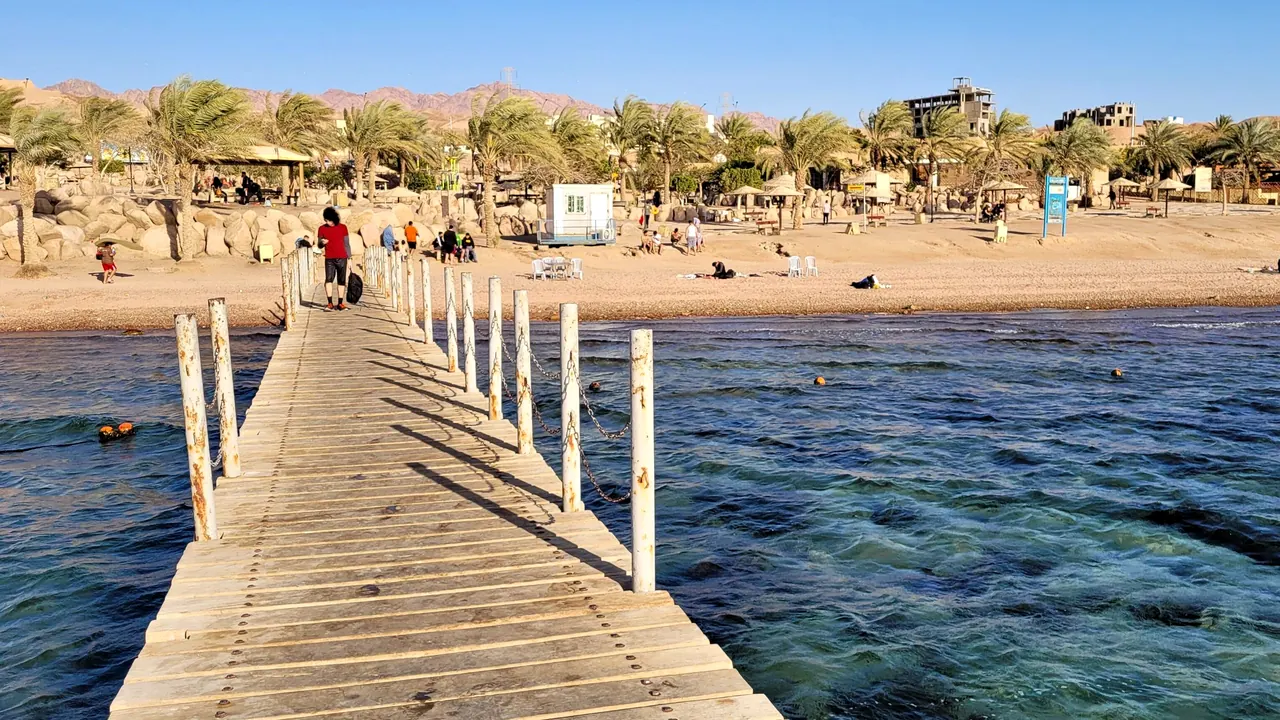
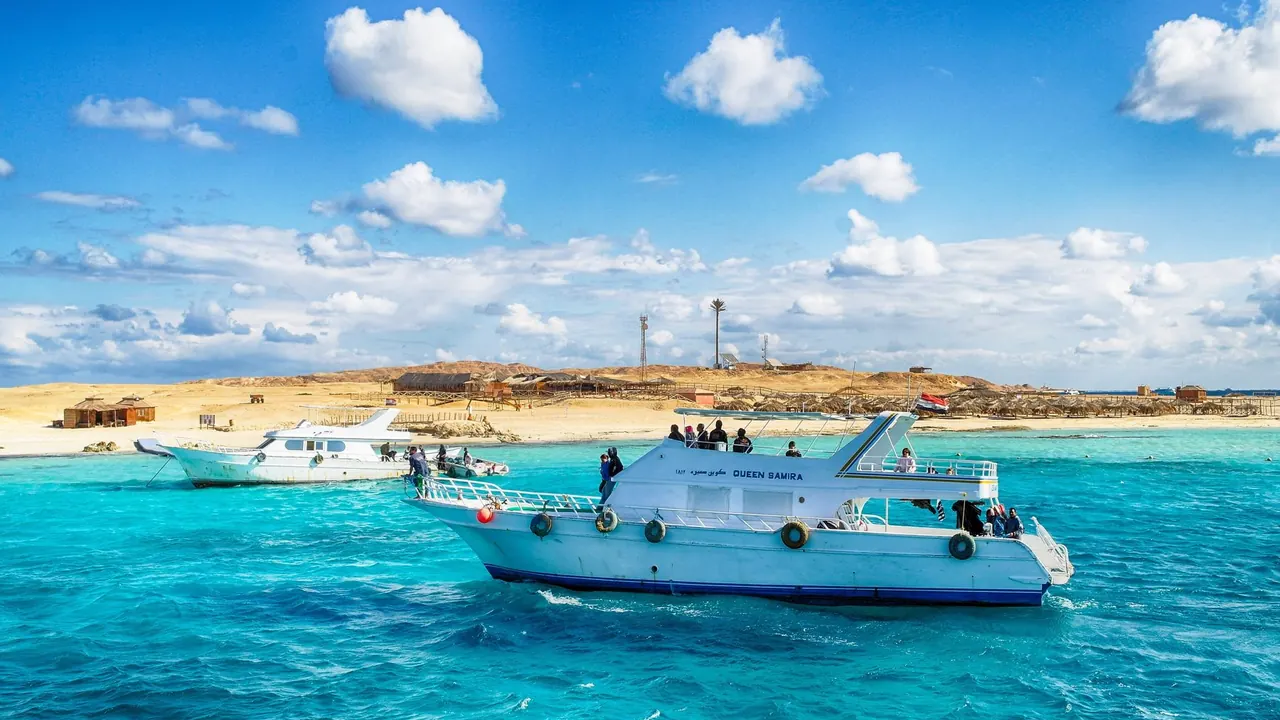
Photos: Aqaba by عباد ديرانية, CC BY-SA 4.0, cropped; Hurghada by Andrey Korchagin, CC BY-SA 2.0, cropped.
Aqaba or Hurghada?
Our verdict in twelve categories, each scored against the same fixed benchmark cities, and the climate month by month, so you can choose for your trip.
Choose Aqaba for
- day trips
- getting around
- culture and sights
Aqaba suits the traveller who wants the Red Sea as a base rather than the whole point. Its reefs start a short swim from shore, and Wadi Rum's red desert and the carved city of Petra are both close enough for a day out. It is a smaller, quieter town with a walkable centre. Choose it for snorkelling or diving in the morning and a Bedouin camp under dark skies at night.
Choose Hurghada for
- prices
- nightlife
- beaches
For a straightforward sun-and-sea vacation that costs little, Hurghada is the stronger pick. Its long resort coast, all-inclusive hotels with water parks and the sandy Giftun islands make it easy with children. Evenings along Sheraton Road and the marina run late. What you give up is easy access to great sights, because Luxor is a long road away.
Scoreboard
Twelve categories on one fixed scale from 0 to 100. The shaded stretch is the gap between the two.
Your match
Pick a travel style or drag the sliders, and both match scores follow your weighting.
Too close to call, 1 point apart
Wins on day trips and getting around with your weighting.
Wins on prices and nightlife with your weighting.
What matters to you?
Category by category
What the scores mean for a trip.
Beaches & swimming
Hurghada is the better beach destination. Its coast runs for about 40km, there is soft sand on the Giftun islands and in the quieter bays towards Makadi and Sahl Hasheesh, and the resorts have their own stretches of beach. The catch is that the north wind can make the sea choppy in the afternoon. In front of many hotels you also have to reach the water from a jetty over the reef flats.
Aqaba's beaches are smaller. The free public beaches near the centre are narrow, coarse and conservative, so most visitors pay for the resort beaches at Tala Bay or south of town. Its strength is the calm, very clear water of the gulf, with coral starting a few metres out.
Food & drink
Neither town is a reason to travel for food, but Aqaba gives slightly more back to those who eat out. Sayadieh, fish cooked with spiced rice and onion, is its own dish. Falafel and hummus breakfasts are easy to find, and tax-free status keeps drinks cheaper.
In Hurghada the hotel buffet sets the tone for most visitors. The better meals are in El Dahar, where you'll find koshary, ful and taameya, and at the harbour, where you choose your fish from the ice. The marina menus are aimed at tourists and are rarely memorable.
Culture & sights
Aqaba has a little more history on show, though it is still only a morning's worth. There is the Mamluk fort on the waterfront, the excavated walls of early Islamic Ayla, a small museum and the remains of what may be one of the oldest purpose-built churches.
Hurghada grew from a fishing village into a resort, so its sights are newer. They include the Hurghada Museum's pharaonic pieces, the large El Mina mosque, the Coptic cathedral and a wander through El Dahar's ordinary market streets.
Nightlife
Hurghada has the livelier evenings. Away from the hotel discos and animation shows, Sheraton Road in Sakkala and the marina have bars, shisha lounges and big beach clubs with foam parties in high season. They run into the small hours, although the scene has little local character.
In Aqaba the evening means a family stroll along the corniche, a shisha café and a late meal. Drinks are found in resort bars and a few pubs for divers, and most visitors go to bed early ahead of a dive or a desert trip.
Nature & outdoors
Underwater the two are closely matched. Aqaba comes out ahead because it also has Wadi Rum about an hour inland, with its arches, sand valleys and climbing routes, and the granite hills behind the town give short hikes. Its reefs are also easy to reach from the shore: the Japanese Garden, a sunken cargo ship and a tank laid down as an artificial reef.
Hurghada's reefs are mostly reached by boat, around the Giftun islands, where turtles, dolphins and sometimes dugongs can be seen. Its steady wind makes El Gouna and Soma Bay serious kitesurfing spots, which Aqaba cannot match. On land there are quad-bike and jeep trips, but the desert is bare and there is little hiking.
Day trips
Aqaba has the better day out. Petra is about two hours away, and Little Petra can be added on the same day, so you can return to your hotel the same evening. Eilat and Sinai look close on the map, but the borders make them awkward to visit.
Hurghada's great sight is Luxor, with Karnak and the Valley of the Kings, but it is about four hours each way. That means a pre-dawn start or an overnight stay. Closer to town there is El Gouna's lagoon marina, half an hour away.
Good for families
Hurghada is set up more fully for children. Big resorts have water parks and sheltered splash areas, and outside the hotels there is an aquarium, semi-submarine and dolphin-watching trips, plus quad bikes for older children. Busy roads, broken pavements and pushy sellers make the town itself less comfortable with children.
Aqaba is calmer but has less to keep children busy: shallow edges to the sea, glass-bottomed boats and resort kids' clubs. Children are warmly welcomed in local life. For older children, a night in a Wadi Rum camp is often the highlight.
Getting around
Aqaba is the easier of the two. The corniche, fort and markets sit in a compact centre you can cover on foot when it is not too hot. The roads to Petra and Wadi Rum are good for anyone who hires a car, although the southern resorts still need taxis or shuttles.
Hurghada stretches for tens of kilometres along one coast road, with few pavements and stressful crossings. You get around by shared white minibuses or by taxis whose fare you agree before getting in. Many visitors simply rely on the transfers that come with their excursions.
Shopping & style
Shopping is thin in both, but what you bring home differs. In Aqaba it is Dead Sea mud and salts, spices and sand bottles, and the tax-free zone keeps perfume, electronics and alcohol cheaper. In Hurghada it is papyrus, alabaster and galabeyas, bought by hard haggling with insistent sellers in El Dahar.
Affordability
Hurghada is the cheaper place for a beach vacation by a wide margin. All-inclusive packages cover most daily costs, and dive courses and boat trips cost far less than on most reef coasts. Excursions are cheaper booked locally than through hotels, and it pays to haggle in the bazaars.
Aqaba is cheap only at the local level: falafel, fish meals in town, taxis and simple central hotels. Resort stays, beach-club passes, desert tours and Petra's entrance push a comfortable trip towards Mediterranean resort prices. Drinks are the main saving.
Live music & performing arts
Neither town has a theatre or concert scene, so any performance you see is one put on for visitors. In Aqaba the memorable one is Bedouin music around a Wadi Rum campfire, and serious concerts mean going to Amman. Hurghada offers tanoura dancers and belly dancing at folklore evenings, along with hotel shows.
Wellness & relaxation
Both are places to unwind rather than to take a cure, and the difference is in the setting. Aqaba has traditional Turkish baths in town with a local, no-frills feel, and resort spas that use Dead Sea mud. The Dead Sea itself and the springs of Ma'in are further north.
Hurghada's spas are hotel facilities. Treatments are cheap and some offer Cleopatra-themed rituals, but quality varies and there is no bathing tradition outside the resorts.
When should you go?
Pick your month. The climate figures are measured averages, not a forecast.
Aqaba in July
Hurghada in July
Daytime high, °C
Rainfall in the month, mm
Temperature and rainfall are climate normals, averaged over the years shown. Aqaba: 1991-2020 normals, Eilat (5.8 km from centre). Hurghada: 1991-2020 normals, Hurguada (15.2 km from centre).
Both coasts are almost rainless all year, so the season comes down to heat. From October to April the days run from mild to warm, fine for the beach and comfortable for walking. Aqaba is a very sunny place, with long bright days even in midwinter. January is its coolest month, with highs near 21°C. At both places the sea is coolest in February and March but still mild enough for a swim. Through the winter Hurghada stays a degree or so warmer, both on land and in the water.
Summer is harder in Aqaba. Highs reach about 40°C in July and August, against 37°C in Hurghada, where the north wind also takes some of the edge off the heat. From June to September, desert trips and town walks in Aqaba are a struggle. The sea is warmest in August at both, close to 29°C off Hurghada. If you want swimming and sightseeing on the same trip, spring and autumn suit both places best.
Which traveller are you?
On a trip on a tight budget, Hurghada is the clear choice. All-inclusive packages cover rooms, meals and many drinks, and dive courses and boat trips are cheap. In Aqaba, a comfortable beach stay on the resort strip costs much more.
On a family trip with children, Hurghada again comes out ahead. Many hotels have water slides, splash pools and full water parks, and the town has a large aquarium, dolphin boats and semi-submarine trips. Aqaba has calm water and kids' clubs but few attractions built for children.
For an outdoors trip, Aqaba is the better base. It has shore dives and wrecks off South Beach, and Wadi Rum's sandstone mountains are about an hour away for jeep trips, climbing and nights in Bedouin camps. Hurghada's land scenery is barer, with little hiking.
Before you go
| Measure | Aqaba | Hurghada |
|---|---|---|
| Official language | Arabic | Arabic |
| Currency | Jordanian Dinar (JOD) | Egyptian Pound (EGP) |
| Sockets | BCFGJ230 V, 50 Hz | CF220 V, 50 Hz |
| Driving side | Right | Right |
| Time zone | UTC+3 | UTC+2, UTC+3 in summer |
| Emergency number | 911 | Police 122, ambulance 123, fire 180 |
| Elevation | 6 m | 11 m |
| Main airport | King Hussein International Airport (AQJ)9 km from centre5 non-stop destinations | Hurghada International Airport (HRG)9 km from centre113 non-stop destinations |
| Public holidays this year | - | 15 days |
By the numbers
| Measure | Aqaba | Hurghada |
|---|---|---|
| City population | 140,000 | 214,247 |
| People per km² | 3,733 | - |
| Museums within 10 km | 5 | 1 |
| UNESCO World Heritage sites within 50 km | 2 | 0 |
| Swim season, months above 21 °C | 12 months | 12 months |
Where else could you go?
Every comparison below shares a destination with this one, so you can follow Aqaba or Hurghada somewhere new.
- Eilatvs Aqaba
- Sharm el-Sheikhvs Hurghada
- Petravs Aqaba
- Dahabvs Aqaba
- Dahabvs Hurghada
- Sharm el-Sheikhvs Aqaba