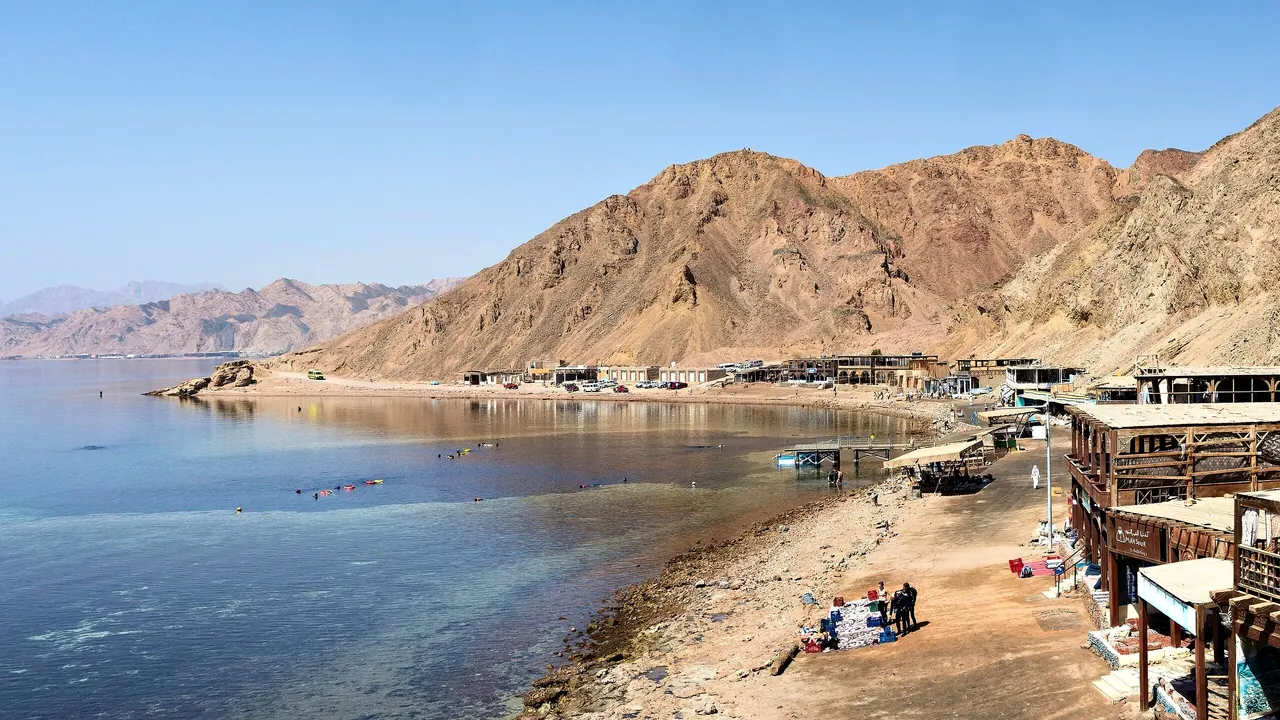
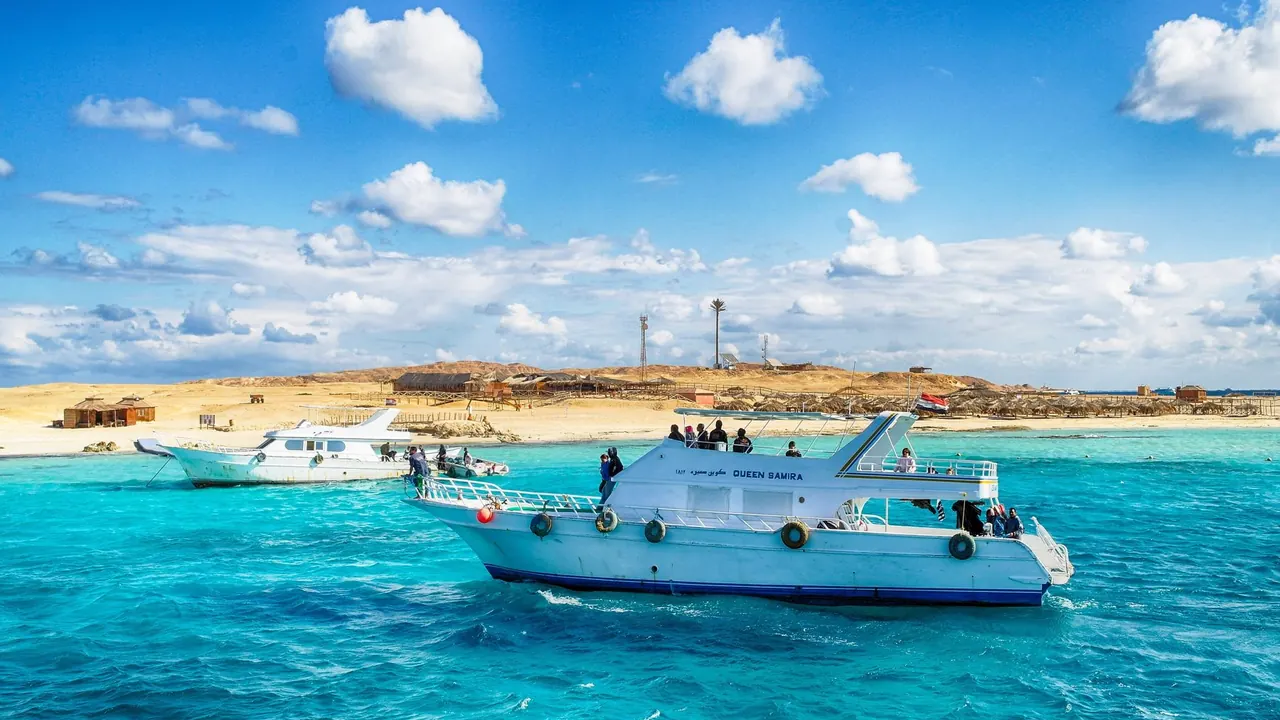
Photos: Dahab by Petar Milošević, CC BY-SA 4.0, cropped; Hurghada by Andrey Korchagin, CC BY-SA 2.0, cropped.
Dahab or Hurghada?
Our verdict in twelve categories, each scored against the same fixed benchmark cities, and the climate month by month, so you can choose for your trip.
Choose Dahab for
- nature and the outdoors
- wellness
- prices
Dahab suits travellers who come for the water itself rather than for a beach. Reefs start a step off the promenade, the Blue Hole and the Canyon are among the best-known dive sites in the Red Sea, and the town is a centre for freediving, with the granite mountains of South Sinai rising right behind it. It is cheaper, slower and better for yoga and long stays, but it has almost no nightlife, sights or shops.
Choose Hurghada for
- nightlife
- families
- beaches
Hurghada is the easier pick for a classic resort vacation of sand, pool and sun, especially with children. The hotels along its long coast have kids' clubs, water parks and sheltered beaches, there is a proper night out on the resort strip, and Luxor's temples are within reach for a long day or an overnight trip. You give up Dahab's character and its reefs right off the shore, and you spend most of your time inside the resort.
Scoreboard
Twelve categories on one fixed scale from 0 to 100. The shaded stretch is the gap between the two.
Your match
Pick a travel style or drag the sliders, and both match scores follow your weighting.
Wins on nature and the outdoors and wellness with your weighting.
Wins on nightlife and families with your weighting.
What matters to you?
Category by category
What the scores mean for a trip.
Beaches & swimming
Hurghada is the stronger choice if you want a beach to lie on. Around 40km of coast is lined with resort sand, the Giftun islands offer the best strands a short boat ride out, and the bays towards Makadi and Sahl Hasheesh are quieter. The catch is that the beach you get depends on your hotel, and reef flats often mean a jetty here too.
Dahab barely has a beach in the usual sense. Its seafront is rock, jetty and cushioned cafés with ladders down to the reef, and only the Lagoon offers sand and shallow water. The swimming is outstanding for snorkellers, though, because the coral starts a few strokes out.
Food & drink
Neither is a food destination, and the eating is much the same in both. You choose a fish from the ice and have it grilled, and the best meals are simple Egyptian dishes such as koshary and foul in the older quarters, Assala in Dahab and El Dahar in Hurghada. The difference is the setting: in Dahab you eat at low tables on cushions by the bay among backpacker cafés, while in Hurghada most meals are taken at the hotel buffet and only some visitors head out to the fishing harbour.
Culture & sights
Hurghada has a little more to see, though not much. The Hurghada Museum's pharaonic collection fills a couple of hours, and the El Mina mosque, the Coptic cathedral and the market streets of El Dahar show the ordinary town behind the hotels.
Dahab has no museums or monuments at all. What it offers is its Bedouin character in Assala and around town, and its one real piece of heritage, St Catherine's Monastery, takes a full day.
Nightlife
Hurghada is the place for a night out. Outside the hotel discos and pool bars, Sheraton Road and the marina have a strip of bars, shisha lounges and big beach clubs that run into the small hours in summer and at weekends. It is made for tourists and has little local flavour.
In Dahab, an evening means a beer or shisha on cushions by the water with divers and instructors. A few promenade bars play music, but there are no clubs, and early dive starts mean most of the town is quiet well before midnight.
Nature & outdoors
Dahab has the more remarkable surroundings, both underwater and on land. The Gulf of Aqaba drops to deep blue just off the shore, so the Canyon and the Blue Hole can be dived without a boat, and freedivers come from around the world to train there. Behind the town, South Sinai's granite mountains, the Coloured Canyon and Ras Abu Galum make real walking and camel country, and Mount Sinai is close enough for a sunrise climb.
Hurghada's nature is also at sea, but mostly a boat ride away. Trips run to the Giftun reefs, to famous wrecks and to see dolphins, and El Gouna and Soma Bay are excellent for kitesurfing. Inland, the Red Sea mountains are bare and mostly reached by quad bike or jeep, with little hiking.
Day trips
Both towns have one great outing and very little else, and the difference is how far away it is. From Dahab, St Catherine's Monastery and Mount Sinai are about two hours inland, close enough to combine with the night climb. Sharm el-Sheikh and Nuweiba add little.
From Hurghada, Luxor's Karnak and Valley of the Kings are bigger sights, but they mean about four hours on the road each way, so an overnight stay is often wiser. Closer to town, El Gouna's marina and the Roman granite quarries in the desert fill an afternoon or a guided day.
Good for families
Hurghada is much the better bet with children, provided you choose the hotel well. Many resorts have splash pools, water slides, kids' clubs and full water parks, and outside them there are glass-bottom boats, semi-submarines, dolphin trips and a large aquarium.
Dahab works mainly for families whose children already swim confidently. The Lagoon is calm and sandy, older children can snorkel from shore, and a camel ride goes down well, but nothing else is built for children, the reef needs reef shoes, and serious medical care is an hour away in Sharm el-Sheikh.
Getting around
Both are awkward beyond a small core, but in different ways. Dahab's life is concentrated on a flat, largely car-free promenade about 2km long that you can walk for days. Without public transport, though, the Lagoon, Assala and the Blue Hole need a taxi, a pickup or a dive-centre transfer, and arriving means about an hour by road from Sharm el-Sheikh airport.
Hurghada has no walkable centre to speak of, as hotels are spread for tens of kilometres along a busy coast road with few pavements. Shared minibuses, plentiful taxis and hotel shuttles fill the gap, and many guests simply leave the resort on organised excursions.
Shopping & style
Hurghada has more choice, though it is still souvenir country. El Dahar's markets and Sheraton Road sell spices, papyrus, alabaster and galabeyas with hard bargaining, and the malls on the main road have everyday brands and supermarkets for self-caterers.
Dahab has just the promenade stalls with Bedouin embroidery, scarves and jewellery. The one thing really worth buying there is dive and freediving gear.
Affordability
Both are cheap, but Dahab stretches a budget further for independent travellers. Simple guesthouses and camps, Assala's local meals and inexpensive dive and freediving courses are why so many people stay for weeks.
Hurghada keeps costs down in another way, through all-inclusive packages that bundle room, meals and drinks. The extras add up, though, especially imported alcohol, marina restaurants and excursions booked through the hotel.
Live music & performing arts
Neither town has a theatre, concert hall or real music scene. What differs is the kind of entertainment on offer: in Dahab it is an occasional band or DJ in a promenade bar and Bedouin music around a desert-camp fire. In Hurghada it is staged for hotel guests, with animation shows, belly dancing and tanoura dancers at folklore evenings.
Wellness & relaxation
Dahab is the better place to switch off, because its calm comes from the town itself. The pace is slow, sunsets fall over the Sinai mountains, and a long-stay community has grown up around yoga, breathwork and freediving, with cheap classes and massage.
Hurghada relaxes you inside the resort, with sunbeds and a pool, and its hotel spas offer the hammam, steam room and salt treatments that Dahab largely lacks. Step outside, though, and the town is noisy and full of sellers.
When should you go?
Pick your month. The climate figures are measured averages, not a forecast.
Dahab in July
Hurghada in July
Daytime high, °C
Rainfall in the month, mm
Where the figures come from
Dahab has no weather station within reach, so its figures come from a gridded climate model rather than a measured record, and read a broad area rather than the city itself.
Temperature and rainfall are climate normals, averaged over the years shown. Dahab: 1991-2020 normals, TerraClimate 4 km grid at the town, no weather station within 90 km. Hurghada: 1991-2020 normals, Hurguada (15.2 km from centre).
The two coasts share almost the same desert climate, so you choose by season rather than by city. Neither gets rain worth planning around. Hurghada has a handful of wet days from October to January, while Dahab stays dry all year. Spring and autumn are the best seasons in both, from March to April and October to November, when days are warm enough for the beach and still fine for walking or a desert trip. From June to September daytime highs reach about 37°C, which makes hiking in Dahab's mountains or walking along Hurghada's coast road hard work outside early morning and evening.
Winter is mild rather than hot, with highs of around 21°C in Dahab in January and slightly warmer in Hurghada. The sea in both stays swimmable all year. It cools to about 22°C in February and March and warms to 28°C or a little more in August, with Hurghada's water marginally the warmer of the two in summer.
Which traveller are you?
For an outdoors trip, Dahab is clearly better. You can dive or snorkel straight off the shore at the Blue Hole and Eel Garden, kitesurf on the Lagoon, ride a camel to Ras Abu Galum and climb Mount Sinai at night for the sunrise.
On a family trip with children, Hurghada is far easier. Resorts are built around kids, with splash pools, water slides, clubs and shallow beaches, and there are glass-bottom boats and an aquarium outside them. Dahab has the Lagoon and little else designed for children.
On a food and nightlife trip, Hurghada gives you more evenings. Neither town is a place to come for its food, but Sheraton Road and the marina have bars and beach clubs that stay open late, while Dahab is mostly asleep before midnight.
Before you go
| Measure | Dahab | Hurghada |
|---|---|---|
| Official language | Arabic | Arabic |
| Currency | Egyptian Pound (EGP) | Egyptian Pound (EGP) |
| Sockets | CF220 V, 50 Hz | CF220 V, 50 Hz |
| Driving side | Right | Right |
| Time zone | UTC+2, UTC+3 in summer | UTC+2, UTC+3 in summer |
| Emergency number | Police 122, ambulance 123, fire 180 | Police 122, ambulance 123, fire 180 |
| Elevation | 21 m | 11 m |
| Main airport | Sharm El Sheikh International Airport (SSH)58 km from centre116 non-stop destinations | Hurghada International Airport (HRG)9 km from centre113 non-stop destinations |
| Public holidays this year | 15 days | 15 days |
By the numbers
| Measure | Dahab | Hurghada |
|---|---|---|
| City population | 4,479 | 214,247 |
| Museums within 10 km | 0 | 1 |
| UNESCO World Heritage sites within 50 km | 0 | 0 |
| Swim season, months above 21 °C | 12 months | 12 months |
Where else could you go?
Every comparison below shares a destination with this one, so you can follow Dahab or Hurghada somewhere new.
- Sharm el-Sheikhvs Dahab
- Sharm el-Sheikhvs Hurghada
- Aqabavs Dahab
- Eilatvs Dahab
- Luxorvs Hurghada
- Petravs Dahab