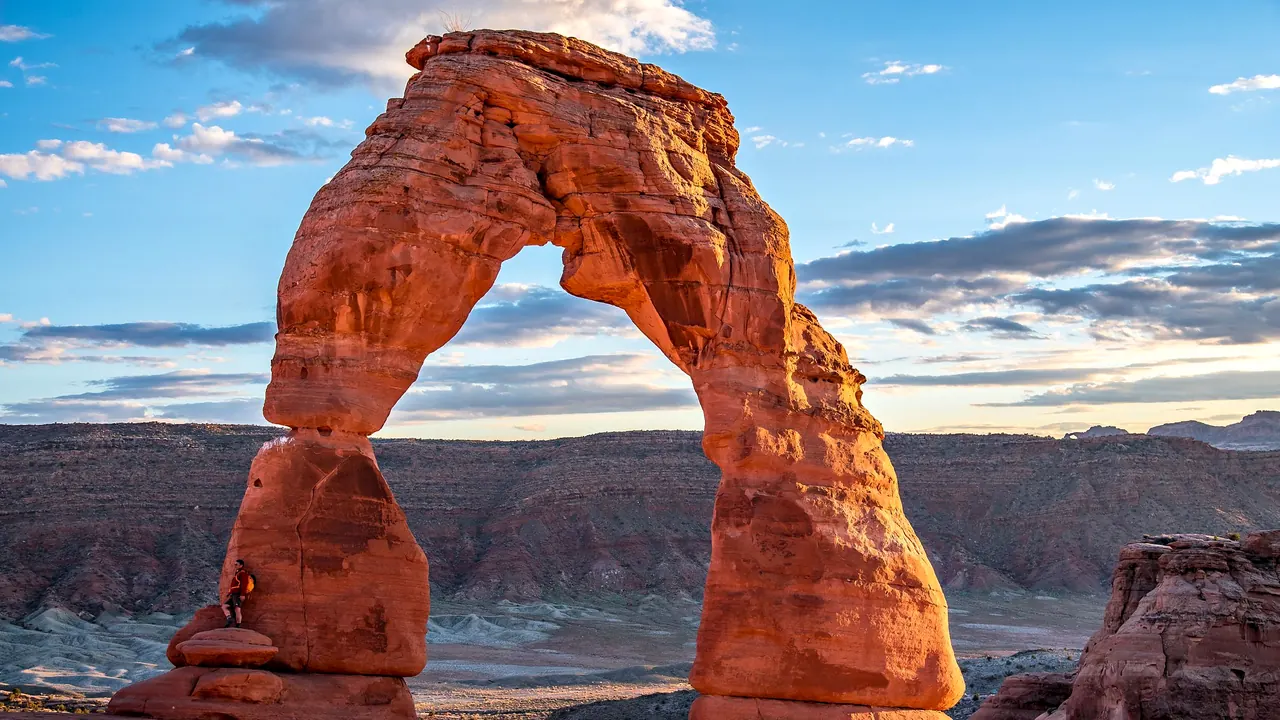
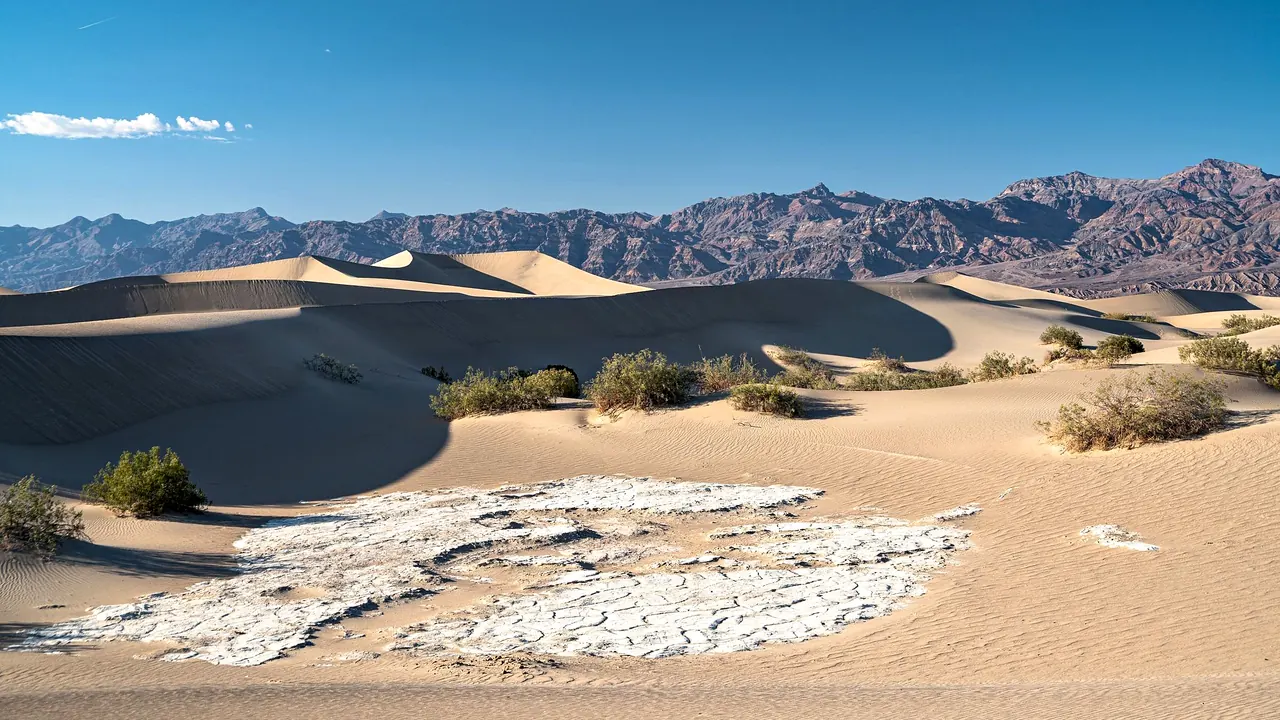
Photos: Arches by Jan Tang, Pexels License; Death Valley by Anthony Brown, Pexels License.
Arches or Death Valley?
Our verdict in twelve categories, each scored against the same fixed benchmark cities, and the climate month by month, so you can choose for your trip.
Choose Arches for
- food and drink
- shopping
- families
Arches is the more active choice. Moab sits minutes from the park gate, so the trip is one small town as a base with short drives to Delicate Arch, the Windows and the canyon rims of Canyonlands. Afternoons can go on slickrock biking, rafting on the Colorado or climbing at Fisher Towers. It suits travellers who want to do things in the landscape rather than only look at it, and families with children who can manage a few kilometres on rock. Moab also gives you more choice of where to eat and a little more to browse.
Choose Death Valley for
- wellness
- day trips
Death Valley is the bigger, emptier and stranger place. It is a park you cross by car between salt flats, dunes, badlands and a volcanic crater, often with an hour between areas. Go there for a winter escape when Utah is cold, for the warm spring-fed pools at Furnace Creek and the rustic hot springs at Tecopa, and for stops outside the park such as the ghost town of Rhyolite or Manzanar. In return you give up water sports, choice at the table and any real town to come back to.
Scoreboard
Twelve categories on one fixed scale from 0 to 100. The shaded stretch is the gap between the two.
Your match
Pick a travel style or drag the sliders, and both match scores follow your weighting.
Wins on food and drink and shopping with your weighting.
Wins on wellness and day trips with your weighting.
What matters to you?
Category by category
What the scores mean for a trip.
Beaches & swimming
Neither is a swimming destination, and they differ only in what takes the place of a beach. Around Arches the Colorado is a river for rafting rather than bathing, with a small reservoir south of Moab and the odd creek pool after a hike. Death Valley has no open water at all, and its spring-fed pools at Furnace Creek are kept for resort guests.
Food & drink
Moab gives Arches the edge at the table. It has brewpubs, taco places, green chile cooking, breakfast diners and a few more ambitious dinner spots along Main Street, all within minutes of the park. The food fills you up rather than stays in the memory, and Utah's liquor rules make ordering wine harder.
In Death Valley, eating is a matter of planning. The lodge dining rooms and saloons at Furnace Creek, Stovepipe Wells and Panamint Springs, the general stores and the diners in Beatty and Shoshone are the whole list, and most visitors drive in with a cool box. Dates from the farm near Tecopa, served in shakes and bread, are the one local flavour.
Culture & sights
Both have little built heritage, but they tell different stories. Around Arches the past is mostly rock art: petroglyph panels at Courthouse Wash, beside Wolfe Ranch and along Potash Road, plus dinosaur trackways and a small local museum in Moab.
Death Valley's history is industrial. There are the ruins of the borax works that sent out the twenty-mule teams, the beehive charcoal kilns at Wildrose and abandoned mine camps on the back roads, and the visitor centre explains the borax era and the Timbisha Shoshone. Either fills a few hours, not a trip.
Nightlife
Evenings end early in both, so the difference is small. Moab at least has a few brewpubs and bars where climbers and bikers talk over the day, while Death Valley has only the saloons at Furnace Creek and Stovepipe Wells, quiet by mid-evening. In both places the night really belongs to the sky: a Milky Way walk among the fins and arches, or a moonless winter night in the valley bright enough to cast shadows.
Nature & outdoors
Both are world-class desert country, but Arches pairs its scenery with more ways to use it. Arches, fins and balanced rocks crowd along one short park road. Canyonlands and Dead Horse Point add enormous canyon views within the hour, and the La Sal Mountains bring pine forest and alpine trails. Mountain biking, rafting, canyoneering and climbing come on top of the walking.
Death Valley is about scale and extremes: the salt crust of Badwater below sea level, Telescope Peak towering above it, dunes, golden badlands, marble narrows and a volcanic crater. Much of the best of it lies on rough dirt roads. With no rivers or lakes, it is a place for hiking and looking rather than for sport.
Day trips
Death Valley has more to drive to outside the park. The ruined bank and bottle house at Rhyolite near Beatty make a striking stop, and Tecopa and Shoshone lie to the south. About two hours west are Lone Pine and the preserved Manzanar camp, and Las Vegas is a similar distance east.
From Moab the choice is thinner. Green River and its museum of river exploration are about an hour away, and Bluff with its Ancestral Puebloan ruins takes close to two. Mesa Verde and Monument Valley only work as overnight trips.
Good for families
Arches is the easier of two demanding choices. Several arches lie at the end of short paths, the sandy slot to Sand Dune Arch delights younger children, and calm stretches of the Colorado suit gentle float trips. Small Moab keeps everything close.
Death Valley can thrill older children with dune sliding at Stovepipe Wells and the crunch of salt at Badwater. But the distances are long, supplies are scarce and the heat outside winter is a real danger to small children. Both parks have Junior Ranger programmes, and timing matters in both: spring or autumn at Arches, winter in Death Valley.
Getting around
You need a car in both, but Arches asks far less of it. Moab is minutes from the entrance, the park road is short and Canyonlands is an easy drive. The main nuisance is trailhead car parks filling by mid-morning in spring and autumn. Moab's centre is walkable, and a bike path runs towards the park.
Death Valley is all about distance. Expect an hour or more between areas and fuel stations far apart, and the nearest big airport is two hours away in Las Vegas. Highlights such as the Racetrack and Titus Canyon are reached only on dirt roads that need a high-clearance vehicle.
Shopping & style
Moab's Main Street at least gives Arches somewhere to browse. It has outfitters and bike shops with proper desert gear, rock and fossil shops, and galleries with landscape work and some Native American jewellery and pottery. Death Valley offers general stores and lodge gift counters with maps, books and borax souvenirs, plus the Tecopa dates, so stock up in Las Vegas or Pahrump on the way in.
Affordability
Neither is cheap, but Arches is easier to do on less. Moab charges gateway-town prices in spring and autumn, yet the hiking is free and the campgrounds on public land along the river keep the cost of a bed down. Guided rafting, canyoneering and jeep tours are where the money goes.
Inside Death Valley, the few lodgings charge remote-resort rates, and fuel in the valley costs far more than in nearby towns. Camping with your own food is the cheap way in. A motel in Beatty or Pahrump also saves money, but adds long daily drives.
Live music & performing arts
Neither has a regular stage, and each has one unusual exception. Arches has the stronger one in the Moab Music Festival at the end of summer, whose chamber concerts reach settings such as a sandstone grotto that you get to by boat. Death Valley's is the Amargosa Opera House at Death Valley Junction, a small adobe theatre with an imagined audience painted on its walls, and many visitors stop just to see the building.
Wellness & relaxation
Death Valley is the more restful of the two. The spring-fed pools at Furnace Creek stay warm through the winter and the resort there has a spa. Tecopa's plain mineral soaks are best after dark under the stars, though the long drives make most stays busier than they sound.
Arches has no hot springs or bathhouses, only a few massage studios and the odd riverside resort, and its days start early. Its calm comes from a quiet campsite at dusk, watching the light fade on the red cliffs.
When should you go?
Pick your month. The climate figures are measured averages, not a forecast.
Arches in July
Death Valley in July
Daytime high, °C
Rainfall in the month, mm
Where the figures come from
Arches has no rain gauge within 25 km of the centre, so its rainfall comes from a gridded climate dataset read at the destination rather than from a gauge further away.
Death Valley has no weather station within reach, so its figures come from a gridded climate model rather than a measured record, and read a broad area rather than one spot.
Temperature and rainfall are climate normals, averaged over the years shown. Arches: 2006-2020 (rainfall 1991-2020) normals, Moab / Crescent Junction (19.4 km from centre). Death Valley: 1991-2020 normals, TerraClimate 4 km grid at the town, no weather station within 90 km.
The two run on opposite calendars. Arches is at its best in spring and autumn. April, May, September and October bring comfortable walking days, while July reaches 35°C and pushes hikes into the early morning. December and January are quiet but cold, with daytime highs of around 2°C. Rain is light all year, and October is the wettest month at 25mm.
Death Valley is at its best exactly when Arches is not. From November to March, daytime highs run from around 18°C into the mid-twenties, ideal for canyons and dunes. By July the valley floor reaches 46°C and walking after mid-morning becomes dangerous. It is drier still than Arches, with almost no rain from spring to autumn. Neither has a beach season, and in both places swimming means a pool.
Which traveller are you?
An outdoors trip suits Arches, where each day can bring a different sport from the same base: a dawn hike, then the bike or the river, then dinner back in Moab. Death Valley strings its walks together with long drives.
Travellers after rest and wellness should look to Death Valley, best in winter when Arches is cold: mild days, warm water at the end of each one and a deep, empty quiet. Arches runs on early starts and hard days on the trail.
With children along, a family trip runs more smoothly from Moab, where the park, a pool and a meal all lie minutes apart and the days can stay short. Death Valley means long hours in the car and heat that leaves little margin outside winter.
Before you go
| Measure | Arches | Death Valley |
|---|---|---|
| Currency | US Dollar (USD) | US Dollar (USD) |
| Sockets | AB120 V, 60 Hz | AB120 V, 60 Hz |
| Driving side | Right | Right |
| Time zone | UTC-7, UTC-6 in summer | UTC-8, UTC-7 in summer |
| Emergency number | 911 | 911 |
| Main airport | Canyonlands Regional Airport (CNY)2 non-stop destinations | Harry Reid International Airport (LAS)160 non-stop destinations |
| Public holidays this year | 12 days | 13 days |
Where else could you go?
Every comparison below shares a destination with this one, so you can follow Arches or Death Valley somewhere new.
- Canyonlandsvs Arches
- Sequoiavs Death Valley
- Kings Canyonvs Death Valley
- Bryce Canyonvs Arches
- Joshua Treevs Death Valley
- Yosemitevs Death Valley