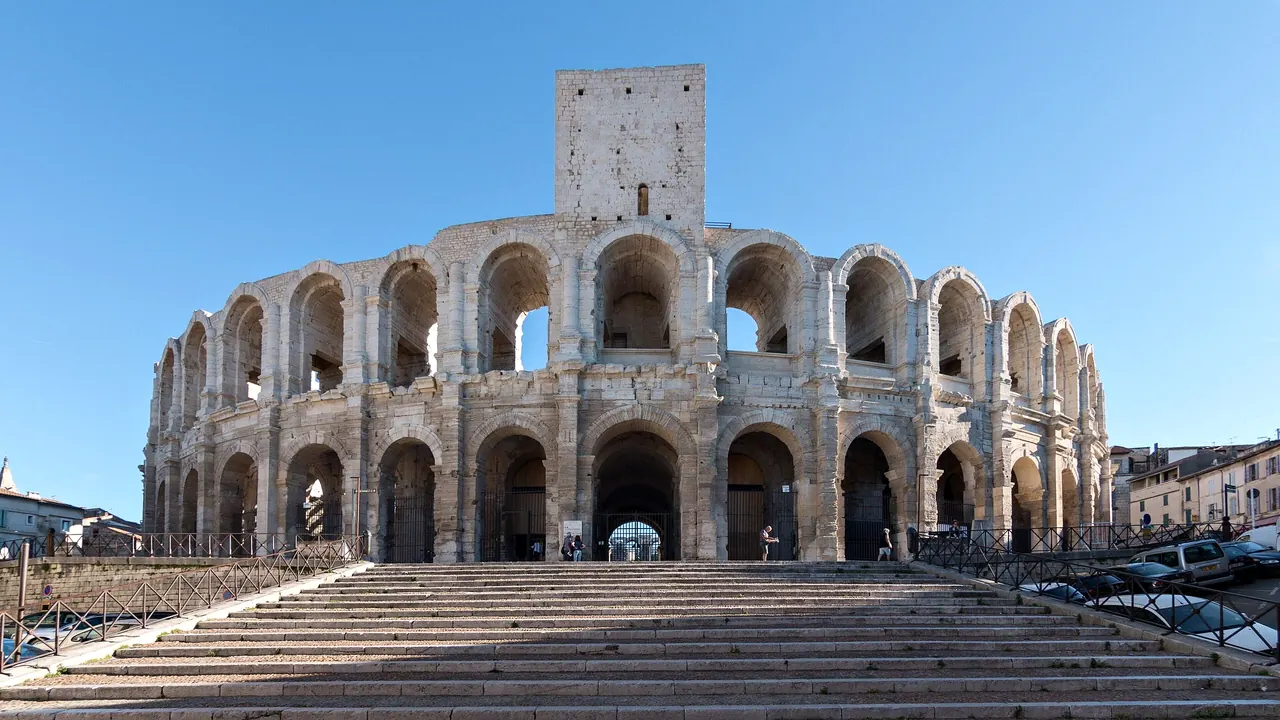
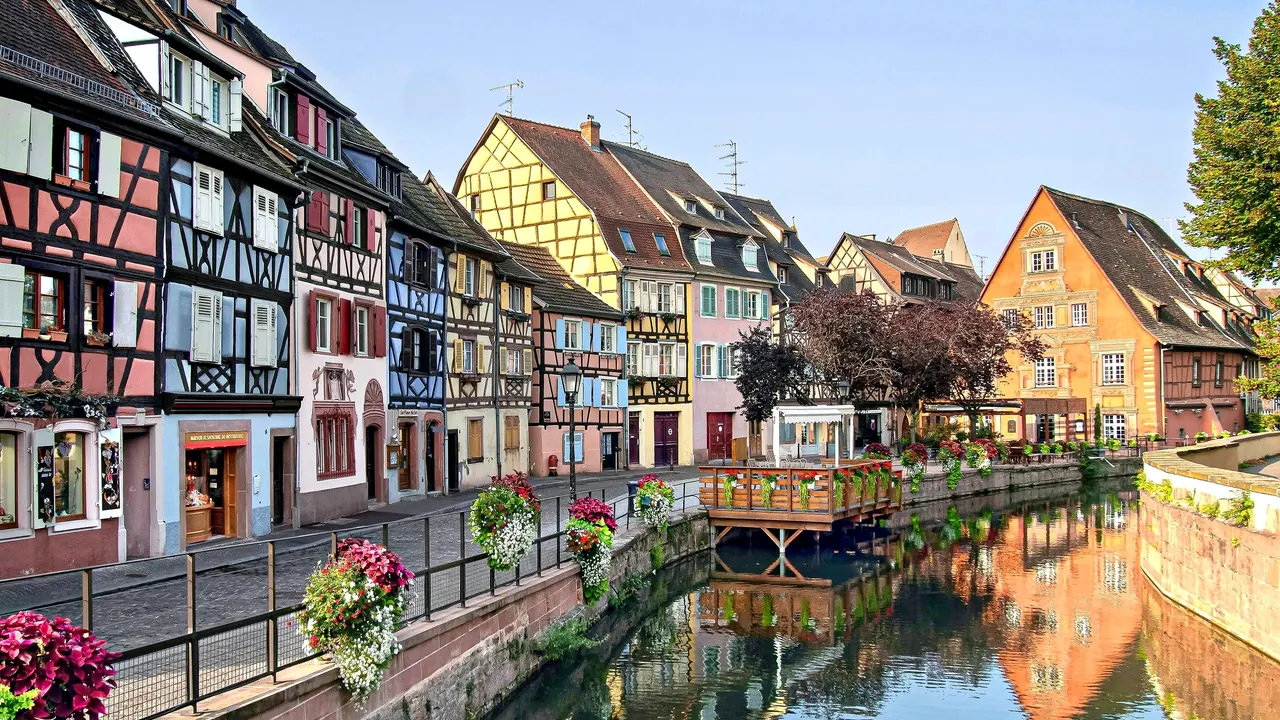
Photos: Arles by Martin Kraft, CC BY-SA 3.0, cropped; Colmar by Rolf Kranz, CC BY-SA 4.0, cropped.
Arles or Colmar?
Our verdict in twelve categories, each scored against the same fixed benchmark cities, and the climate month by month, so you can choose for your trip.
Choose Arles for
- beaches
- culture and sights
- nightlife
Arles is the one for travellers who want the Roman south. Its arena, theatre and Romanesque cloister sit together in a few sunny streets, the wild Camargue begins at the edge of town, and the open Mediterranean beaches are close enough for a day at the sea. It suits adults who like history, birds and long hot lunches, and who don't mind a quiet town after dark.
Choose Colmar for
- families
- food and drink
- getting around
If you care more about the table and the glass, or you are bringing children, choose Colmar. Alsatian cooking and the wine villages beat anything Arles offers at dinner, and storks, boat rides, animal parks and a major theme park make family days easy to fill. Summers are cooler and greener here, and the Vosges rise right behind the vineyards.
Scoreboard
Twelve categories on one fixed scale from 0 to 100. The shaded stretch is the gap between the two.
Your match
Pick a travel style or drag the sliders, and both match scores follow your weighting.
Too close to call, 1 point apart
Wins on beaches and culture and sights with your weighting.
Wins on families and food and drink with your weighting.
What matters to you?
Category by category
What the scores mean for a trip.
Beaches & swimming
Arles has a real coast within reach. About 40km across the Camargue, Saintes-Maries-de-la-Mer has sand and dunes, and further on the huge open beaches of Piémanson and Beauduc leave room to spread out. The water is shallow and gentle, though you need a car and there is little shade, so think of it as days at the sea rather than a beach vacation.
Colmar sits inland between the Vosges and the Rhine, and its swimming is limited to municipal pools and small lakes in the mountain valleys.
Food & drink
Colmar eats better. Alsatian cooking, from choucroute and baeckeoffe to tarte flambée and munster cheese, fills cosy winstubs, and the wine is right on the doorstep, with tastings in villages a few minutes' drive away. There is also a small fine-dining tier along the wine route. Its weakness is the run of tired menus on the most photographed streets.
Arles is at its best at its Saturday market on the Boulevard des Lices and over long lunches of gardiane, Camargue rice and tellines with local rosé. Beyond that the restaurant choice is narrow, and many places close in winter.
Culture & sights
Arles comes out a little ahead thanks to the depth of its Roman past. The arena, antique theatre, cryptoporticus and Alyscamps, together with the carved portal of Saint-Trophime, form a UNESCO-listed group within a short walk. The Roman barge in the Museum of Ancient Arles, the Luma tower and the summer photography festival add range.
Colmar's appeal is a whole late-medieval townscape of painted half-timbered houses and canals, plus one great work of art, Grünewald's Isenheim Altarpiece in the Unterlinden Museum. Either town is well covered in two full days.
Nightlife
Neither town is for a big night out, but the evenings feel different. In Arles you have dinner on a square and a drink at the café tables of the Place du Forum. The exception is the ferias at Easter and in September, when street bodegas keep the town up late for a few days.
Colmar's evenings centre on wine bars, pubs and terraces around Petite Venise, and it is quiet early all year. If you want more, Strasbourg is a short train ride away, while from Arles it means driving to Montpellier or Marseille.
Nature & outdoors
Both towns have fine country right outside, but of very different kinds. From Arles you enter the flat, open Camargue of lagoons, salt flats and reed beds, with flamingos, white horses and migrating birds, best explored on horseback or by bike along the dykes. The limestone Alpilles add hill walking.
Colmar looks up at the Vosges: forested mountains, glacial lakes, the high Route des Crêtes, and waymarked paths through the vines, with some modest skiing in winter. In Arles the outdoors is about wildlife, in Colmar about walking and views.
Day trips
Both are excellent bases, each for its own region. From Arles you can reach Roman and papal Provence: Avignon is about 20 minutes by train, Nîmes not much further, and the Pont du Gard, Les Baux and Saint-Rémy are a short drive.
Colmar's strength is the chain of wine villages on its doorstep, such as Eguisheim, Riquewihr and Kaysersberg, with Strasbourg half an hour by train and Basel and Freiburg across the borders. In both regions a car makes the villages far easier.
Good for families
Colmar is the easier choice with children. The town is flat and gentle, with boat rides through Petite Venise and storks nesting overhead. Just outside are the stork and otter park at Hunawihr, the free-roaming macaques and eagle show near Kintzheim, and Europa-Park about an hour away.
In Arles children can climb the arena towers and explore the dark cryptoporticus, and the Camargue offers pony rides and flamingos. However, the summer heat, mosquitoes and cobbled lanes make it better suited to older children who enjoy history and animals.
Getting around
Colmar is slightly easier. Its flat centre is walkable in minutes, quick regional trains run to Strasbourg and Mulhouse, and the quiet vineyard roads make a hired bicycle a real way to travel between villages.
Arles is just as compact on foot and has a free shuttle loop, plus direct trains to Avignon, Nîmes and Marseille. But the Camargue's ranches, reserves and beaches are hard to reach without a car, and most longer stays end up needing one.
Shopping & style
Arles is the place for Provençal things: printed cottons, santons, pottery, gardian shirts and hats, and Camargue salt and rice from the stalls on the Boulevard des Lices. It is also a publishing town, so its bookshops are worth a browse in their own right, and photography books and prints are easy to find.
Colmar's shopping leans towards the table: wine bought straight from the producers, kougelhopf moulds and glazed Soufflenheim pottery, printed Alsatian linen and gingerbread. Its high point is the Christmas markets spread across several squares. Neither town offers much fashion. In Colmar that means a few independent boutiques, and from Arles people go to Aix or Marseille.
Affordability
Day to day the two cost about the same, as typical French provincial towns with reasonable set lunches. What pushes the bill up differs. In Arles it is July, the ferias and the photography festival, along with the car most visitors hire. In Colmar it is summer and the Christmas market weeks, when old-town rooms book out. Cheap or free wine tastings, and staying in a nearby village, help balance it.
Live music & performing arts
Neither town has much on stage outside its festival weeks, but the settings differ. Arles performs in the open air. In summer there are concerts in the Roman theatre and the arena and a world music festival in July, and the ferias and the Camargue bull games, where the bull is not killed, fill the arena. It is more spectacle than a night at the theatre, and it fades once autumn comes.
Colmar's offer is smaller and mostly indoors, in an Italian-style municipal theatre where the Opéra national du Rhin tours, with a classical festival in early July and jazz in autumn. For a full opera or orchestral season, people go from Arles to Avignon or Marseille, and from Colmar to Strasbourg or Basel.
Wellness & relaxation
Neither has thermal baths or a spa culture, so relaxing here is about slowing down. In Arles that means shaded squares, siestas through the heat, evenings by the Rhône and converted mas with pools out in the Camargue and the Alpilles. In Colmar it means quiet canal-side evenings once the day-trippers have gone, unhurried walks through the vines and hotel spas in the wine villages.
When should you go?
Pick your month. The climate figures are measured averages, not a forecast.
Arles in July
Colmar in July
Daytime high, °C
Rainfall in the month, mm
Where the figures come from
Arles's temperatures are measured 28 km from the centre, at Nimes / Courbessac.
Arles has no rain gauge within 25 km of the centre, so its rainfall comes from a gridded climate dataset read at the city rather than from a gauge further away.
Temperature and rainfall are climate normals, averaged over the years shown. Arles: 1991-2020 (sunshine 1981-2010) normals, Nimes / Courbessac (28 km from centre). Colmar: 1991-2020 normals, Ihringen (21.1 km from centre).
Arles is a southern town. It is pleasantly warm by May, and in July and August it reaches 31°C, hot enough that walking the stone streets at midday is hard work. Midsummer is also the sea season, with the water off the Camargue at about 22°C in August. Autumn brings the rain, with October the wettest month at 105mm. Spring and early autumn are the best times for sightseeing and the delta. Even in winter Arles gets far more sunshine than Colmar.
Colmar is milder in summer and much colder in winter. The warmest months peak around 27°C, which is comfortable for walking, but the wettest stretch runs from May to August, so expect summer showers. From November to February daytime highs fall to about 6°C and the skies are often grey. Late spring and September, when the vines are turning, are the most pleasant times in Alsace.
Which traveller are you?
For a beach and sun trip, Arles is the only real choice. It has dry, sunny summers and the long, wild Camargue strands at Saintes-Maries, Piémanson and Beauduc. Colmar is far from any coast, so swimming there means a pool or a mountain lake.
On a family trip with children, Colmar makes days easier. Kids get boat rides through Petite Venise, storks on the rooftops, the monkey park and eagle show near Kintzheim, and Europa-Park across the Rhine. In Arles they have ponies and flamingos, but also heat, mosquitoes and cobbles.
For a food and nightlife trip, Colmar wins at the table. Wood-panelled winstubs, choucroute and baeckeoffe come with Riesling and Gewurztraminer from cellars a short drive away. Evenings are quiet in both towns, so the night out comes down to a long dinner, which Alsace does better.
Before you go
| Measure | Arles | Colmar |
|---|---|---|
| Official language | French | French |
| Currency | Euro (EUR) | Euro (EUR) |
| Sockets | CE230 V, 50 Hz | CE230 V, 50 Hz |
| Driving side | Right | Right |
| Time zone | UTC+1, UTC+2 in summer | UTC+1, UTC+2 in summer |
| Emergency number | 112 | 112 |
| Elevation | 0 m | 185 m |
| Main airport | Marseille Provence Airport (MRS)54 km from centre126 non-stop destinations | EuroAirport Basel–Mulhouse–Freiburg (BSL)55 km from centre112 non-stop destinations |
| Public holidays this year | 11 days | 11 days |
By the numbers
| Measure | Arles | Colmar |
|---|---|---|
| City population | 51,811 | 66,970 |
| People per km² | 68 | 1,006 |
| Museums within 10 km | 3 | 9 |
| UNESCO World Heritage sites within 50 km | 5 | 3 |
| Swim season, months above 21 °C | 2 months | - |
Where else could you go?
Every comparison below shares a destination with this one, so you can follow Arles or Colmar somewhere new.
- Avignonvs Arles
- Freiburgvs Colmar
- Baselvs Colmar
- Montpelliervs Arles
- Strasbourgvs Colmar
- Aix-en-Provencevs Arles