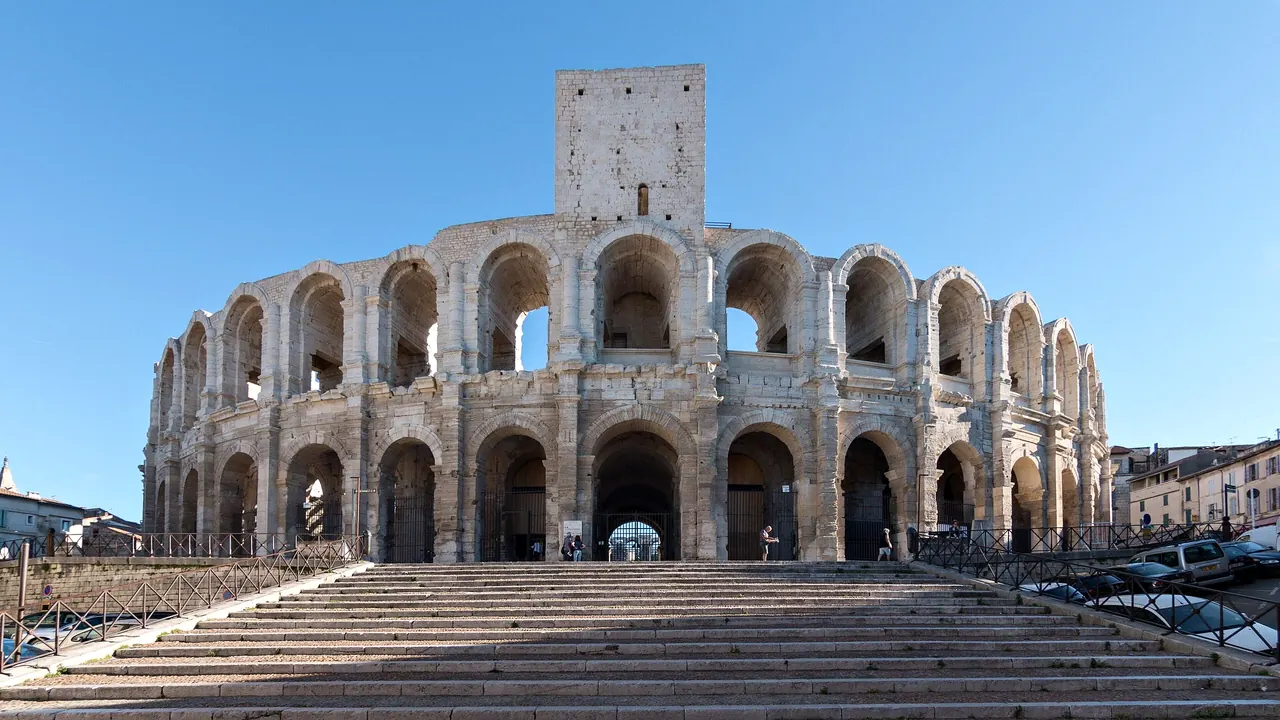
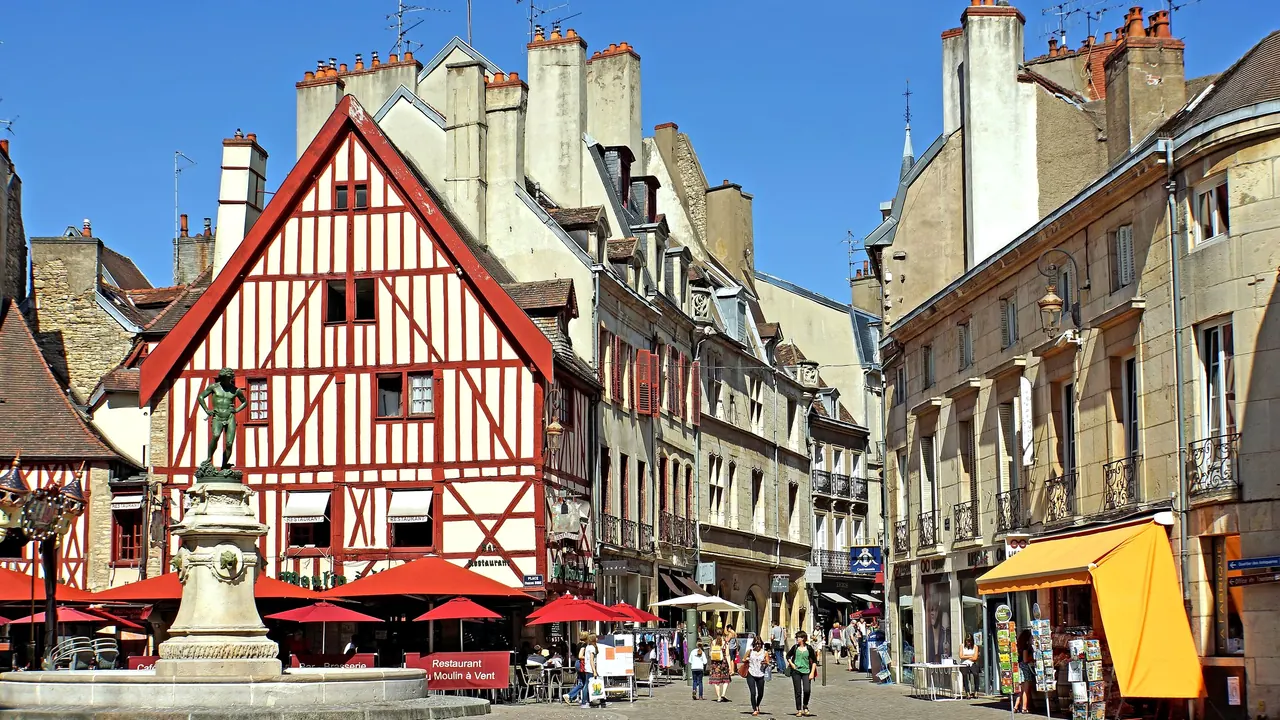
Photos: Arles by Martin Kraft, CC BY-SA 3.0, cropped; Dijon by Dennis G. Jarvis, CC BY-SA 2.0, cropped.
Arles or Dijon?
Our verdict in twelve categories, each scored against the same fixed benchmark cities, and the climate month by month, so you can choose for your trip.
Choose Arles for
- beaches
- nature and the outdoors
- day trips
Arles suits travellers who want the south: Roman stones in a small town, the open marshes and flamingos of the Camargue on the doorstep, and a long, hot summer with the sea within a drive. It also makes the stronger base for touring, with Avignon, Nîmes, the Pont du Gard and the Alpilles villages all close. Choose it if you are happy to hire a car and live by the sun.
Choose Dijon for
- food and drink
- getting around
- live music and the arts
Dijon is the better pick for eating, drinking and an easy city stay. Burgundian cooking, Les Halles and wine bars pouring village Burgundies by the glass give it the deeper table, and trams, a pedestrian centre and fast trains from Paris make it simple without a car. Evenings are a little livelier, there is a proper opera house, and the Côte de Nuits starts at the edge of town.
Scoreboard
Twelve categories on one fixed scale from 0 to 100. The shaded stretch is the gap between the two.
Your match
Pick a travel style or drag the sliders, and both match scores follow your weighting.
Too close to call, 1 point apart
Wins on beaches and nature and the outdoors with your weighting.
Wins on food and drink and getting around with your weighting.
What matters to you?
Category by category
What the scores mean for a trip.
Beaches & swimming
Arles has a real seaside within reach. A drive across the Camargue brings you to the sand and dunes at Saintes-Maries-de-la-Mer or the huge empty strands of Piémanson and Beauduc, with shallow, warm water in high summer, though you will need a car and should expect little shade, the mistral and mosquitoes.
Dijon is several hours from any coast. Its only bathing is the supervised lawn-and-sand area at Lac Kir and the town pools, fine for a hot afternoon but not a reason to come.
Food & drink
Dijon eats better. Burgundian classics such as boeuf bourguignon, coq au vin and jambon persillé, the city's own mustard, pain d'épices and cassis, and the iron market hall of Les Halles add up to a serious food town. With the Côte de Nuits on its doorstep, wine bars pour village Burgundies by the glass, and there is a proper fine-dining tier.
Arles has its own character in gardiane bull stew, Camargue rice and tellines, and its Saturday market on the Boulevard des Lices is a great sight. Beyond that, though, the restaurant choice is thin and many places close in winter.
Culture & sights
The two are close, but Arles has the edge for sights. Its arena, antique theatre, cryptoporticus, Alyscamps and the carved portal of Saint-Trophime make up a UNESCO-listed Roman and Romanesque ensemble within a short walk, and the Van Gogh links, the Luma tower and the summer photography festival add modern layers.
Dijon is medieval and Renaissance rather than Roman. The Palace of the Dukes of Burgundy, the ducal tombs in the Musée des Beaux-Arts, Notre-Dame's gargoyles and owl, and Sluter's Well of Moses fill two or three rewarding days in a city of half-timbered streets.
Nightlife
In Arles the meal is the evening. You eat late on the Place du Forum or one of the small squares, maybe have one more glass, and that is the night done. There are only a handful of bars and the occasional gig, and anyone who wants to dance has to drive to Montpellier or Marseille. The ferias at Easter and in September are the only exception, when street bodegas keep the whole town up for a few nights.
Dijon gives you more places to choose from and keeps going later. Its students keep a whole street of small bars and pubs busy on Rue Berbisey, and the terraces of the market quarter and the main squares add to it, so you can move on after dinner instead of heading home. It is still a night of wine, beer and conversation rather than clubbing, and it is liveliest in term time and on summer weekends. At other times it winds down well before the small hours.
Nature & outdoors
Arles offers far more in the outdoors. The Camargue begins at the edge of town, a wide delta of lagoons, salt flats and reed beds with flamingos, white horses and black bulls, best explored on horseback, by bike along the dykes or on foot in the bird reserve. The limestone Alpilles add proper walking and cycling among olives and pines.
Dijon's countryside is gentler. There are walks and climbing cliffs in the combes west of town, flat cycling on the Burgundy Canal towpath and through the vineyards towards Beaune, and the Morvan hills further out, but no landscape as distinctive as the delta.
Day trips
Both are excellent bases, and Arles is slightly the richer one. Avignon and Nîmes are short train rides away, and the Pont du Gard, Les Baux, Saint-Rémy, Aigues-Mortes, Aix and Marseille all fit into a day, mixing Roman monuments, hill villages and walled towns.
Dijon's excursions centre on wine. The Route des Grands Crus leads through Gevrey-Chambertin and Vougeot to Beaune, and the Cistercian abbey of Fontenay, Semur-en-Auxois and Vézelay give a quieter, monastic counterpoint.
Good for families
Both work for families without being built for them. In Arles the fun is mostly outdoors and needs a car: pony rides at Camargue ranches, flamingos at the bird park and shallow delta beaches, plus clambering round the arena, with summer heat and mosquitoes to manage.
Dijon is easier day to day, with a pedestrian centre, the planetarium and natural history museum at the Jardin de l'Arquebuse, play areas in the Parc de la Colombière and paddling at Lac Kir. Its wine tastings, though, are for parents.
Getting around
Dijon is simpler to get around. Its centre is walkable, two tram lines reach the outskirts and Lac Kir, regional trains run to Beaune, and the TGV links to Paris quickly, so you can manage without a car for much of a stay.
Arles is just as walkable inside the old town, with a free shuttle and good trains to Avignon, Nîmes and Marseille. Its countryside is another story: buses to the Camargue and the Alpilles are infrequent, and most people staying a few days hire a car.
Shopping & style
Neither is a fashion destination, and both are best for local goods. Arles leans towards Provençal crafts: printed cottons, santons, gardian shirts, Camargue salt and rice from the Saturday market, and good bookshops and photography prints.
Dijon is about the larder and the cellar, with mustards, cassis, pain d'épices, cheese around Les Halles and plenty of wine merchants, plus a department store and chains on Rue de la Liberté.
Affordability
Dijon is a little easier on the budget. Moderate hotels, fair set lunches, cheap wine by the glass and a city you can walk or tram around keep the basics down, though tastings, wine tours and good bottles soon add up.
Arles is reasonable by Provençal standards, but the car most visitors hire adds to the cost, and rooms grow scarce and dearer in July and around the ferias and photography festival.
Live music & performing arts
Dijon has the steadier programme. The Opéra de Dijon stages opera, concerts and dance in the Grand Théâtre and the acoustically admired Auditorium, alongside a national drama centre, all running through the academic year.
Arles comes alive on stage mainly in summer and outdoors: concerts in the Roman theatre and arena, the Les Suds world music festival in July, and bullfights and brass bands at the ferias. Outside that season, there is little beyond a modest town theatre.
Wellness & relaxation
Here they are level. Neither has a thermal or bathing tradition, and spa treatments are limited to a few hotels. What differs is the setting for slowing down: in Arles it is summer siestas, shaded squares and pool-side retreats in old farmhouses in the Camargue and Alpilles, while Dijon offers slow afternoons in the vineyards and, in some village hotels, grape-based treatments.
When should you go?
Pick your month. The climate figures are measured averages, not a forecast.
Arles in July
Dijon in July
Daytime high, °C
Rainfall in the month, mm
Where the figures come from
Arles's temperatures are measured 28 km from the centre, at Nimes / Courbessac.
Arles has no rain gauge within 25 km of the centre, so its rainfall comes from a gridded climate dataset read at the city rather than from a gauge further away.
Temperature and rainfall are climate normals, averaged over the years shown. Arles: 1991-2020 (sunshine 1981-2010) normals, Nimes / Courbessac (28 km from centre). Dijon: 1991-2020 normals, Dijon (7 km from centre).
Arles is a summer and shoulder-season town. July and August reach about 31°C with plenty of sunshine and very little rain, which is ideal for the beaches of the Camargue, where the sea warms to about 22°C, but too hot for midday walking among the Roman ruins. May, June and September are the sweet spot for sightseeing and the delta. The rain arrives in autumn, peaking at around 105mm in October, and winters are mild and fairly bright.
Dijon runs cooler and greyer. Summer highs sit around 27°C, which is comfortable for walking the old centre and cycling the vineyards, but rain is spread through the year with no dry season. Winter is cold, with highs near 6°C and short, dull days, so late spring to early autumn is the time to go, with September adding the vineyards in harvest colours.
Which traveller are you?
On a beach and sun trip, Arles is the clear choice. Dijon is far inland with only a lake, while Arles has hot, dry summers and the wide, wild sands of Saintes-Maries, Piémanson and Beauduc within a drive.
For a food and nightlife trip, Dijon wins. Its Burgundian cooking, Les Halles market and wine bars serving local crus by the glass beat Arles's narrower dining, and the student bars of Rue Berbisey keep evenings going longer than Arles's quiet squares.
On an outdoors trip, Arles offers more. The Camargue's lagoons, flamingos and white horses can be explored on horseback, by bike or on foot, and the Alpilles add real hiking, whereas Dijon's combes and canal towpaths are gentler.
Before you go
| Measure | Arles | Dijon |
|---|---|---|
| Official language | French | French |
| Currency | Euro (EUR) | Euro (EUR) |
| Sockets | CE230 V, 50 Hz | CE230 V, 50 Hz |
| Driving side | Right | Right |
| Time zone | UTC+1, UTC+2 in summer | UTC+1, UTC+2 in summer |
| Emergency number | 112 | 112 |
| Elevation | 0 m | 220 m |
| Main airport | Marseille Provence Airport (MRS)54 km from centre126 non-stop destinations | Lyon Saint-Exupéry Airport (LYS)178 km from centre141 non-stop destinations |
| Public holidays this year | 11 days | 11 days |
By the numbers
| Measure | Arles | Dijon |
|---|---|---|
| City population | 51,811 | 161,830 |
| People per km² | 68 | 3,890 |
| Museums within 10 km | 3 | 8 |
| UNESCO World Heritage sites within 50 km | 5 | 1 |
| Swim season, months above 21 °C | 2 months | - |
Where else could you go?
Every comparison below shares a destination with this one, so you can follow Arles or Dijon somewhere new.
- Avignonvs Arles
- Montpelliervs Arles
- Aix-en-Provencevs Arles
- Marseillevs Arles
- Lausannevs Dijon
- Genevavs Dijon