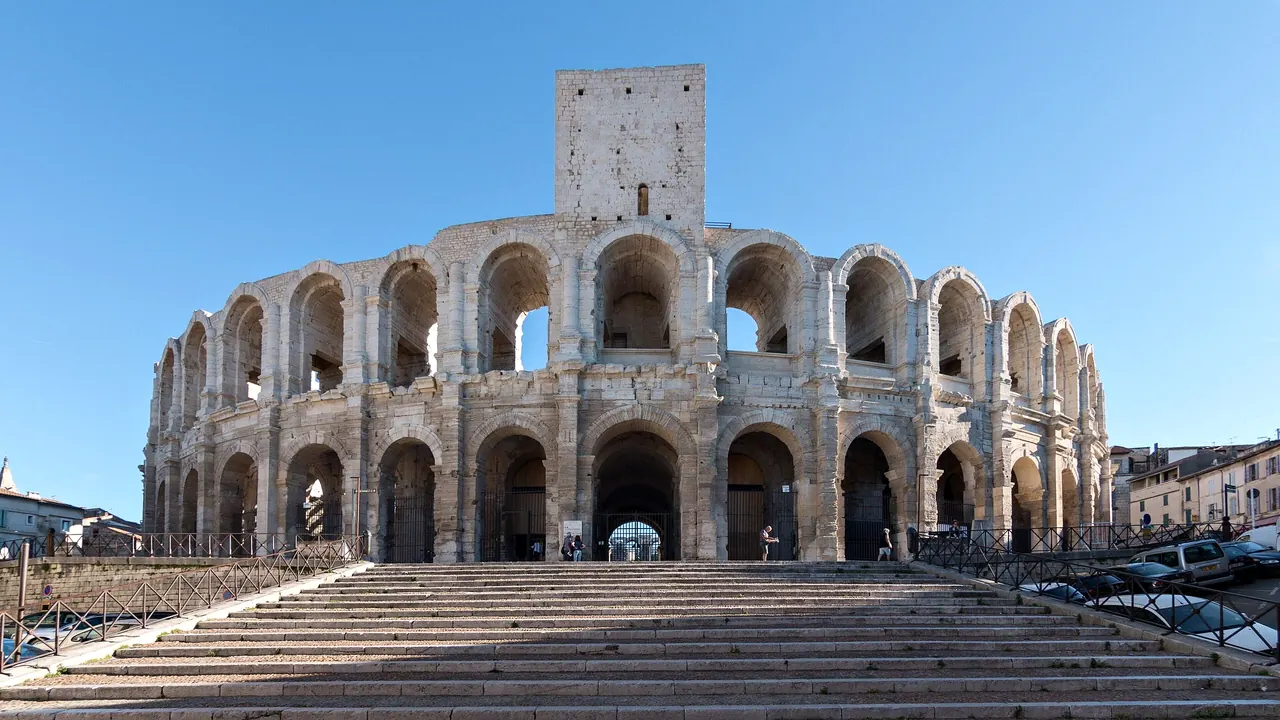
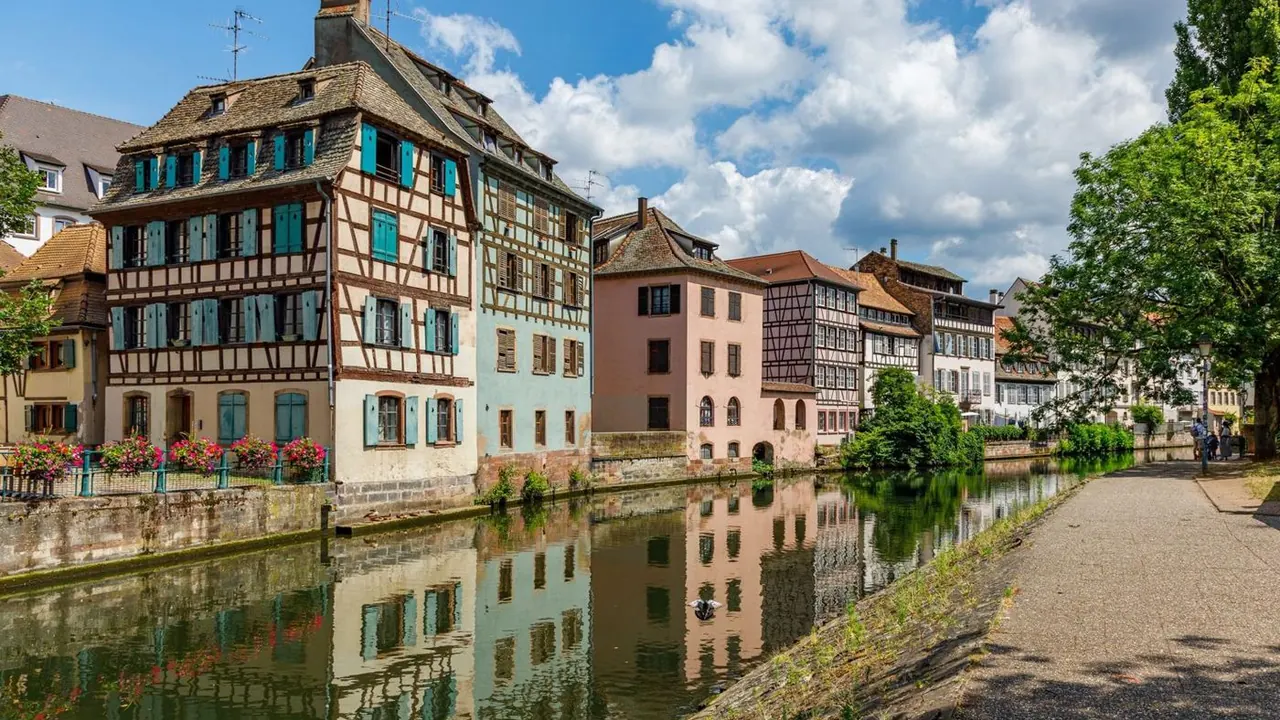
Photos: Arles by Martin Kraft, CC BY-SA 3.0, cropped; Strasbourg by Edoardo Colombo, Pexels License.
Arles or Strasbourg?
Our verdict in twelve categories, each scored against the same fixed benchmark cities, and the climate month by month, so you can choose for your trip.
Choose Arles for
- beaches
- nature and the outdoors
- day trips
Arles suits travellers who want the south: hot sun, Roman stones and the wide, flat wilds of the Camargue on the doorstep. It works best as a base for exploring, with Avignon, Nîmes, the Alpilles villages and the delta beaches all close by, and for people who are happy with quiet evenings and a hired car.
Choose Strasbourg for
- wellness
- families
- getting around
Strasbourg is the better pick for a city stay that runs smoothly from start to finish. Trams, bikes and a car-free centre make it easy, the winstub cooking is richer and more varied, and opera, theatre and a proper bathhouse fill the evenings and rest days. Families and anyone without a car will find it far less work.
Scoreboard
Twelve categories on one fixed scale from 0 to 100. The shaded stretch is the gap between the two.
Your match
Pick a travel style or drag the sliders, and both match scores follow your weighting.
Wins on beaches and nature and the outdoors with your weighting.
Wins on wellness and families with your weighting.
What matters to you?
Category by category
What the scores mean for a trip.
Beaches & swimming
Arles has real sea within a drive. The Camargue shore offers long, flat sand and dunes at Saintes-Maries-de-la-Mer and huge open strands beyond Salin-de-Giraud, with shallow, warm water in summer. Expect wind, mosquitoes and little shade. It is worth a day or two rather than a whole beach vacation.
Strasbourg has nothing comparable. Swimming there means the lifeguarded gravel-pit lakes such as the Baggersee, which has grassy banks and the tram stops nearby. They are pleasant on a hot day, but they are no reason to choose the city.
Food & drink
Strasbourg is the stronger place to eat. Its winstubs serve choucroute, baeckeoffe and tarte flambée with Alsace whites, foie gras is a local tradition, and there is a solid fine-dining tier in the city and the surrounding villages. Just avoid the tourist menus around the cathedral.
Arles eats well but within a narrower range: gardiane bull stew, Camargue rice, tellines and long rosé lunches on the Place du Forum. Its high point is the Saturday market on the Boulevard des Lices, and many restaurants close in winter.
Culture & sights
The two are equally rewarding, but in different ways. Arles is about antiquity: an arena still in use, the Roman theatre, the cryptoporticus and the Alyscamps, as well as the carved cloister of Saint-Trophime and the Van Gogh connection, all within a short walk and seen in about two days.
Strasbourg's heritage is medieval and imperial. It has the pink sandstone cathedral with its astronomical clock, the half-timbered lanes of Petite France and the German-built Neustadt, plus the Palais Rohan museums and the European institutions. It takes a day or so longer to see properly.
Nightlife
Neither is a party town, but Strasbourg has more going on after dinner. Its university fills the bars and beer cellars of the Krutenau and around Place Saint-Étienne, and the riverside terraces stay busy on summer evenings.
In Arles an evening is a late meal and a drink on a square, and then the town goes quiet. The exception is the Easter and September ferias, when street bodegas keep the town up for a few nights.
Nature & outdoors
Arles has the edge thanks to the Camargue, which begins at the edge of town. Its lagoons and salt flats are home to flamingos, white horses and black bulls, and you can explore them on horseback, by bike along the dykes or on foot through the bird reserve. The Alpilles add limestone hiking.
Strasbourg's own green spaces are gentler: riverside forests, the Orangerie and level cycle routes along the Rhine. The serious walking is an hour away in the Vosges and the Black Forest, with castle ruins, fir woods and some winter snow.
Day trips
Both are excellent bases, and Arles is slightly better. Avignon and Nîmes are a short train ride away, and the Pont du Gard, Les Baux, Saint-Rémy, Aigues-Mortes and Aix are all within a short drive, so you could fill a fortnight without repeating yourself.
Strasbourg's trips cross a border. Colmar and the Alsace wine villages lie to the south, and Baden-Baden, Freiburg, Heidelberg and Basel are across the Rhine. Trains cover the cities easily, but the vineyards are easier with a car or a bike.
Good for families
Strasbourg is far easier with children. The flat, pedestrianised centre, the trams, the boat trips round the Grande Ile and the storks and playgrounds of the Orangerie make days simple, and Europa-Park is about an hour away.
Arles appeals more to older children who like history and animals. They can climb the arena towers, explore the dark cryptoporticus and ride ponies on the Camargue ranches. Cobbles, heat, mosquitoes and the need for a car make it harder going with young children.
Getting around
Strasbourg is much easier to get around. A tram network links the station, the old town, the European quarter and even Kehl across the Rhine, and separated cycle lanes run everywhere, so you have no need for a car until you head for the wine villages.
Arles is easy on foot, with everything within about fifteen minutes and good trains to the nearby cities. Out in the Camargue and the villages, though, the buses are sparse, and most visitors staying several days end up hiring a car.
Shopping & style
Strasbourg has more choice. It has chain stores and a department store around Place Kléber, independent shops near the cathedral, and Alsace wines, Soufflenheim pottery and kougelhopf moulds to take home, while December brings the long-established Christmas market.
Shopping in Arles is smaller and more local. The Saturday market is the main event, along with Provençal cottons, santons, gardian shirts and a good run of bookshops and photography prints. For fashion, people go to Aix or Marseille.
Affordability
Costs are much the same, at the level of a provincial French town, but the extras differ. In Arles the hire car most visitors need adds to the bill, and rooms are dearer in July and during the ferias. In Strasbourg the trams and bikes are cheap and many sights are free, but hotels rise sharply during the Christmas market and Parliament sessions.
Live music & performing arts
Strasbourg has the more serious programme, with a national opera company on Place Broglie, a philharmonic orchestra, the Théâtre National de Strasbourg and the Musica festival of contemporary music each autumn. It runs through the year, but tickets need planning.
Arles is mostly a summer affair. There are concerts in the Roman theatre and arena, the Les Suds world music week in July, and brass bands and the course camarguaise around the ferias. In the cooler months the town theatre's season is modest.
Wellness & relaxation
Strasbourg is the better place for actual bathing. The Bains municipaux has tiled pools, a hammam and saunas used by locals, and Baden-Baden's Friedrichsbad and Caracalla baths are less than an hour away.
Arles offers a slower kind of rest: a siesta through the heat, shaded squares, evenings by the Rhône and converted farmhouses with pools. Spa treatments are limited to a few better hotels.
When should you go?
Pick your month. The climate figures are measured averages, not a forecast.
Arles in July
Strasbourg in July
Daytime high, °C
Rainfall in the month, mm
Where the figures come from
Arles's temperatures are measured 28 km from the centre, at Nimes / Courbessac.
Arles has no rain gauge within 25 km of the centre, so its rainfall comes from a gridded climate dataset read at the city rather than from a gauge further away.
Temperature and rainfall are climate normals, averaged over the years shown. Arles: 1991-2020 (sunshine 1981-2010) normals, Nimes / Courbessac (28 km from centre). Strasbourg: 1991-2020 normals, Strasbourg (9.1 km from centre).
Arles is a Mediterranean town and runs much warmer and sunnier all year. Late spring and early autumn are the best times for walking the Roman sites and getting out into the Camargue. July and August reach 31°C, which is hot work in the streets but right for the delta beaches, where the sea warms to about 22°C. Summer is very dry and bright. Autumn brings the heavy rain, peaking around 105mm in October, and the winters are mild but cooler and greyer.
Strasbourg has a continental climate with real seasons. Summer highs of about 26°C make June to September comfortable for walking and cycling, though this is also the wettest part of the year, with frequent showers. Winter is cold and dull, with January highs near 5°C and very little sunshine, so the city suits people who like a crisp, wintry trip more than those chasing the sun. Arles is the clear choice from spring to autumn if warmth matters, and Strasbourg is the easier of the two in mid-summer heat.
Which traveller are you?
On a beach and sun trip, Arles is the obvious choice. Its summers are hot, dry and bright, and the open Camargue shore is a short drive away. Strasbourg is far inland, with only lakes for a hot afternoon.
On a family trip with children, Arles works for older ones who love history and animals, though most outings take planning and a drive. Strasbourg is far easier, with short tram hops and more made with children in mind.
For a relaxing and wellness trip, Arles gives rest of the idle kind, with slow southern days and shade through the heat. Strasbourg is the better pick for real bathing, with steam and thermal water in town and just across the Rhine.
Before you go
| Measure | Arles | Strasbourg |
|---|---|---|
| Official language | French | French |
| Currency | Euro (EUR) | Euro (EUR) |
| Sockets | CE230 V, 50 Hz | CE230 V, 50 Hz |
| Driving side | Right | Right |
| Time zone | UTC+1, UTC+2 in summer | UTC+1, UTC+2 in summer |
| Emergency number | 112 | 112 |
| Elevation | 0 m | 132 m |
| Main airport | Marseille Provence Airport (MRS)54 km from centre126 non-stop destinations | Strasbourg Airport (SXB)10 km from centre43 non-stop destinations |
| Public holidays this year | 11 days | 11 days |
By the numbers
| Measure | Arles | Strasbourg |
|---|---|---|
| City population | 51,811 | 293,771 |
| People per km² | 68 | 3,752 |
| Museums within 10 km | 3 | 21 |
| UNESCO World Heritage sites within 50 km | 5 | 3 |
| Swim season, months above 21 °C | 2 months | - |
Where else could you go?
Every comparison below shares a destination with this one, so you can follow Arles or Strasbourg somewhere new.
- Avignonvs Arles
- Baden-Badenvs Strasbourg
- Montpelliervs Arles
- Colmarvs Strasbourg
- Freiburgvs Strasbourg
- Aix-en-Provencevs Arles