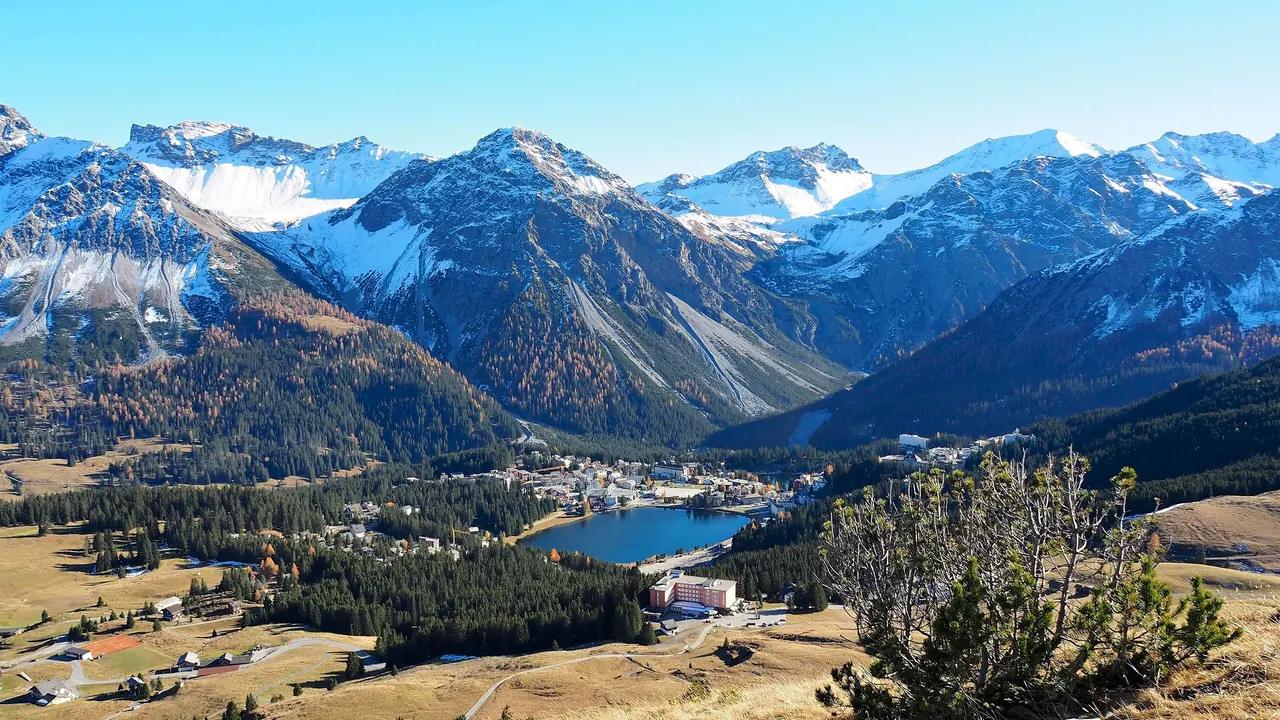
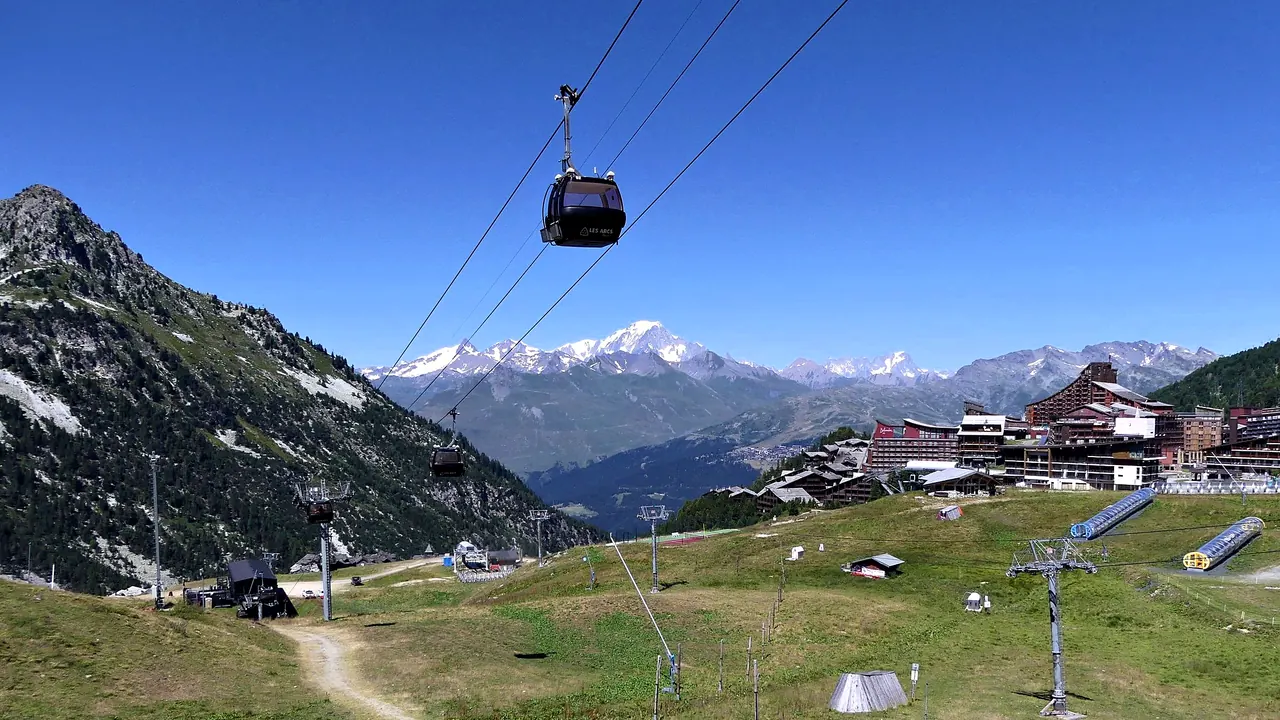
Photos: Arosa by Andres Passwirth, CC BY-SA 4.0, cropped; Les Arcs by Florian Pépellin, CC BY-SA 4.0, cropped.
Arosa or Les Arcs?
Our verdict in twelve categories, each scored against the same fixed benchmark cities, and the climate month by month, so you can choose for your trip.
Choose Arosa for
- wellness
- beaches
- getting around
Arosa suits travellers who want a quieter, more restorative mountain stay, with hotel spas, sun terraces and a village that goes to bed early. In summer it is also the gentler of the two for walkers, the lakes are warm enough for a brief swim, and the train up from Chur means you never need a car. That calm comes at a steep cost.
Choose Les Arcs for
- prices
- families
- culture and sights
For an active week built around skiing or high mountain sport, Les Arcs is the stronger choice. Paradiski gives far more terrain, the car-free villages and ski schools are designed around children, and the self-catering apartments make costs easier to control than in a Swiss resort. Anyone who comes for rest rather than effort will find it less suited.
Scoreboard
Twelve categories on one fixed scale from 0 to 100. The shaded stretch is the gap between the two.
Your match
Pick a travel style or drag the sliders, and both match scores follow your weighting.
Too close to call, level with your weighting
Wins on wellness and beaches with your weighting.
Wins on prices and families with your weighting.
What matters to you?
Category by category
What the scores mean for a trip.
Beaches & swimming
Neither resort is a swimming destination, but Arosa at least has water on its doorstep. The Untersee lido has a lawn and a jetty, and the colder Obersee and Schwellisee give a few weeks of lake dips in July and August. Les Arcs has no natural swimming near the villages, and the heated residence pools are the substitute. A real lake swim there means a two-hour drive to Annecy or Lac du Bourget.
Food & drink
Both kitchens run on mountain cheese and comfort food, so the difference lies in the region rather than the quality. Arosa serves Graubünden dishes such as capuns, barley soup and air-dried meat on hut terraces, and the luxury hotels add a small fine-dining tier.
Les Arcs is Savoyard country, with tartiflette, diots and Beaufort on every menu. Because so many guests cook for themselves, the cheese counters and the markets of Bourg-Saint-Maurice count for as much as the restaurants.
Culture & sights
Neither offers much sightseeing, and what there is differs in kind. Arosa's heritage is the late-medieval Bergkirchli alone on its meadow and the story of the sanatorium years, told in the valley museum and still visible in a few grand hotels.
Les Arcs has no old core at all. Its draw is Charlotte Perriand's modernist architecture at Arc 1600 and Arc 1800, which rewards anyone interested in design. The older baroque chapels and stone hamlets lie down in the Tarentaise valley.
Nightlife
In both resorts the nights revolve around après-ski, and both go silent between seasons. Arosa's evenings are smarter and calmer, moving from the slope-side bars to the hotel bars, and the January gay ski week brings the liveliest nights of the year.
Les Arcs is rowdier at the foot of the slopes, with DJs and table-dancing in Arc 1800 and Arc 2000. Even so, the many families in apartments mean that most nights end early.
Nature & outdoors
Both are serious mountain bases, but Les Arcs works on a bigger scale. Paradiski, linked to La Plagne by the double-decker cable car, runs from the Aiguille Rouge at over 3,200m down to the valley floor. In summer it adds the Vanoise National Park, rafting on the Isère, paragliding and via ferrata.
Arosa's basin is smaller and gentler. The link with Lenzerheide still makes a large ski area, and the altitude keeps the snow reliable. Summer here means lake circuits, high routes over the passes to Davos and marmots on the meadows, and the bear sanctuary is an extra that Les Arcs cannot match.
Day trips
Both resorts sit at the end of the line, and their range of outings is similarly modest. From Arosa everything starts with the hour on the railway down to Chur, a ride worth taking for itself, and Chur has its old town and Romanesque cathedral. Maienfeld or Liechtenstein make longer days out.
Les Arcs looks mainly to other mountain places by road, such as the Beaufortain villages, Val d'Isère and Annecy two hours away. In summer the Little St Bernard Pass opens the way to Aosta in Italy. Arosa's outings are easier without a car, while Les Arcs offers more variety in summer.
Good for families
Les Arcs was laid out from the start around the family ski week, whereas Arosa is a mountain village that happens to suit children well. In Arosa the days fill with sledging runs, lake walks, short hikes to farm restaurants and the bear sanctuary, cable cars lift small legs to the viewpoints and free buses carry tired ones home. When it rains, though, there is little beyond the indoor pool and the ice rink.
In Les Arcs the planning shows. Kindergartens and gentle beginner areas sit right by the villages, themed fun slopes keep children amused, and skating, snow play areas and pools fill the afternoons. In summer, lake-side play areas and mountain-bike lessons take over. The catch is the effort of hauling gear and toddlers through snow at this altitude.
Getting around
You need a car in neither resort, but Arosa is simpler to get around. The Rhaetian Railway brings you up from Chur, and free buses link the station, the lake, Innerarosa and the lift stations along a single hillside.
Les Arcs is reached by funicular from the main-line station at Bourg-Saint-Maurice. Its four villages lie well apart along a winding road, the shuttles slow down in snow, and trips into the valley are much easier with a car.
Shopping & style
Neither resort is a place to shop. The two differ less in how much they offer than in what you carry home. Arosa's main street serves hotel guests and skiers with outdoor gear, rental counters, a few fashion boutiques and Swiss chocolate. For anything more you take the train an hour down to the old town of Chur.
Les Arcs is just as practical, with rental shops, small supermarkets and gift shops in each village, but it has more to buy that comes from the region. Beaufort and other Savoyard cheeses, charcuterie and génépi are the things to take home, and the best place to buy them is down in Bourg-Saint-Maurice.
Affordability
Arosa's costs start with its hotels, which lean upscale and charge Swiss mountain prices in the peak winter weeks. Restaurant bills, lift passes and ski rental are just as steep, and the only real savings are a simple guesthouse or an apartment where you cook for yourself.
Les Arcs is built mostly of self-catering apartments rather than luxury hotels, so the cheaper approach comes naturally. If you cook in and avoid the French school vacation weeks, for example by coming in January or late March, a week costs noticeably less. In both resorts summer is the cheaper season.
Live music & performing arts
Each resort has a short summer season of chamber music in its chapels and halls. Arosa's uses the old Bergkirchli, and Les Arcs has held a July festival since the 1970s. What sets Arosa apart is its December comedy festival, with stand-up and cabaret partly staged outdoors in the snow, while winter in Les Arcs offers little beyond bands at après-ski.
Wellness & relaxation
Arosa is the better place to rest. It grew up as a health resort for its dry, sunny air, it keeps a slow rhythm, and its larger hotels run extensive spas facing the peaks.
Les Arcs has pools and saunas in most residences and a few proper spas aimed at tired skiers, but in winter the lifts set the pace. To take the waters you go an hour down the valley to Brides-les-Bains or Salins-les-Thermes.
When should you go?
Pick your month. The climate figures are measured averages, not a forecast.
Arosa in July
Les Arcs in July
Daytime high, °C
Rainfall in the month, mm
Where the figures come from
Arosa's temperatures are measured 31 km from the centre, at Samedan.
Arosa has no rain gauge within 25 km of the centre, so its rainfall comes from a gridded climate dataset read at the destination rather than from a gauge further away.
Les Arcs's temperatures are measured 43 km from the centre, at Grand St. Bernard / Grand Saint Bernard.
Les Arcs's station stands 199 m above the city centre, so the centre is likely a little warmer than the figures say.
Les Arcs has no rain gauge within 25 km of the centre, so its rainfall comes from a gridded climate dataset read at the destination rather than from a gauge further away.
Temperature and rainfall are climate normals, averaged over the years shown. Arosa: 2015-2025 (rainfall 1991-2020) normals, Samedan (31.2 km from centre). Les Arcs: 1991-2020 normals, Grand St. Bernard / Grand Saint Bernard (43.4 km from centre).
Arosa is the milder of the two in summer. From June to August daytime highs reach around 20°C, which is good for hiking and just warm enough for a lake dip, but these are also the wettest months, at about 150mm each. Winter brings freezing days and less rain or snow, so January and February are the most settled months on the slopes, while late autumn is cool, damp and quiet.
Les Arcs is much colder all year. Even in July and August highs only reach about 12°C, and from November to April the days stay at or below freezing, which keeps the snow in good condition. July is both the driest and the sunniest month, with about 211 hours of sun. November and December are the wettest and darkest months, so early winter is the least rewarding time to visit, and midsummer suits hikers who don't mind a fresh day.
Which traveller are you?
For a relaxing and wellness trip, Arosa is the clear pick. Its past as a health resort, its hotel spas looking out on the peaks and its quiet, early evenings make it restful, whereas Les Arcs runs to the energy of ski week.
On a family trip with children, Les Arcs has the edge. The car-free villages, apartments opening onto the snow and ski schools that take the very youngest make a ski week easy, while Arosa, despite its lakes and bear sanctuary, struggles to fill rainy days.
On a tight budget, Les Arcs is the easier of two costly resorts. Self-catering apartments, supermarket cheese counters and quieter weeks in January or late March keep spending down, while Arosa stays very expensive whatever the season and offers few real savings.
Before you go
| Measure | Arosa | Les Arcs |
|---|---|---|
| Official language | French, German, Italian, Romansh | French |
| Currency | Swiss Franc (CHF) | Euro (EUR) |
| Sockets | CJ230 V, 50 Hz | CE230 V, 50 Hz |
| Driving side | Right | Right |
| Time zone | UTC+1, UTC+2 in summer | UTC+1, UTC+2 in summer |
| Emergency number | 112 | 112 |
| Elevation | 1,775 m | 2,273 m |
| Main airport | Zürich Airport (ZRH)114 km from centre226 non-stop destinations | Geneva International Airport (GVA)92 km from centre150 non-stop destinations |
| Public holidays this year | 9 days | 11 days |
By the numbers
| Measure | Arosa | Les Arcs |
|---|---|---|
| Population | 3,185 | - |
| People per km² | 21 | - |
| Museums within 10 km | 1 | 0 |
| UNESCO World Heritage sites within 50 km | 2 | 0 |
Where else could you go?
Every comparison below shares a destination with this one, so you can follow Arosa or Les Arcs somewhere new.
- La Rosièrevs Les Arcs
- Lenzerheidevs Arosa
- Davosvs Arosa
- La Plagnevs Les Arcs
- Tignesvs Les Arcs
- Klostersvs Arosa