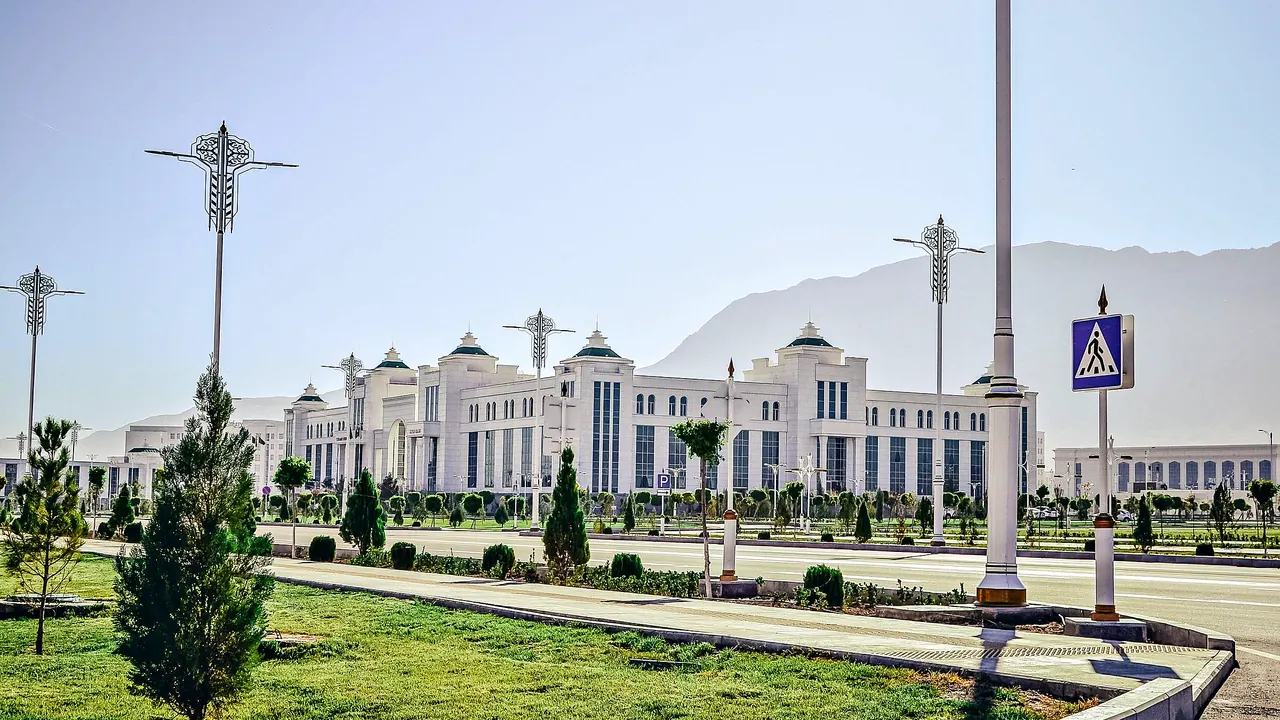
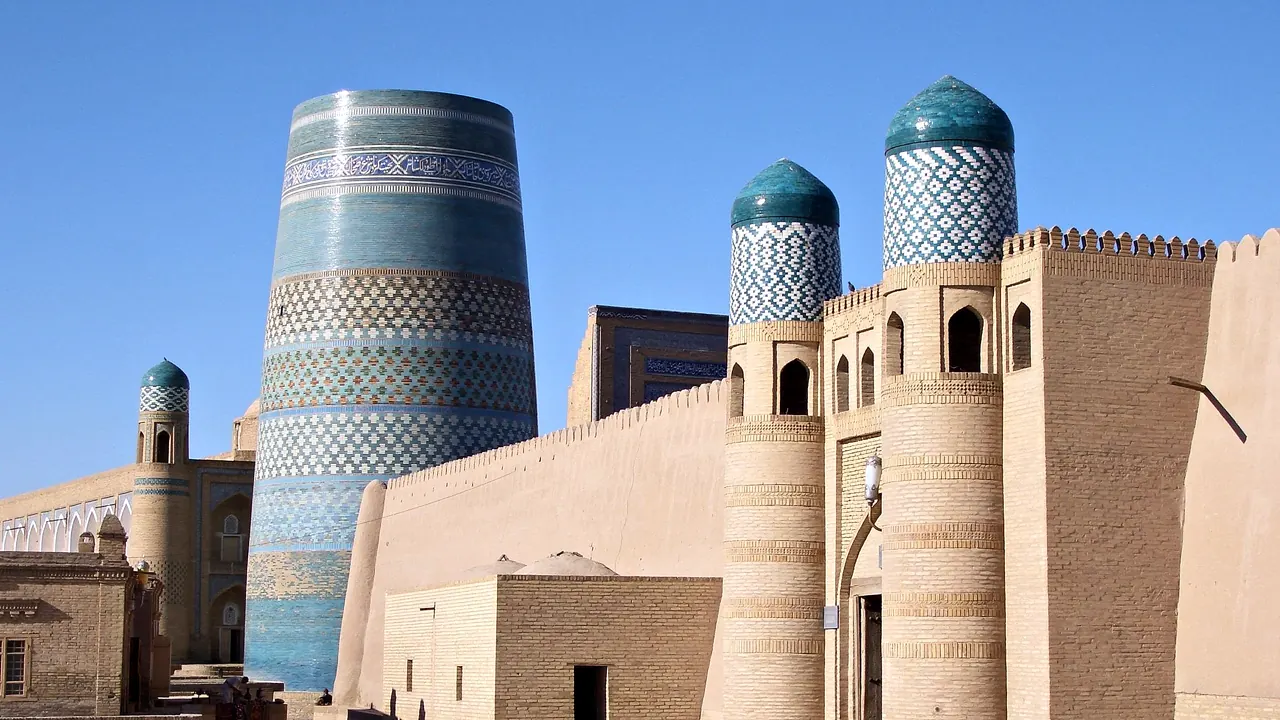
Photos: Ashgabat by IGaragin, Pexels License; Khiva by Bosinus, CC BY-SA 3.0, cropped.
Ashgabat or Khiva?
Our verdict in twelve categories, each scored against the same fixed benchmark cities, and the climate month by month, so you can choose for your trip.
Choose Ashgabat for
- nature and the outdoors
- live music and the arts
- food and drink
Ashgabat suits a traveller who is curious about a capital unlike any other: white marble boulevards, gilded monuments lit up at night, and serious museums of carpets and Parthian treasures. It also works as a base for the outdoors, with the Kopet Dag foothills right on its edge, and it has state theatres and a philharmonic hall. Expect to depend on a guide, a driver and pricey hotels, so it rewards a planned, supported trip more than a loose, independent one.
Choose Khiva for
- prices
- culture and sights
- getting around
Khiva is the choice if you want the Silk Road itself, a complete walled town of madrasas, minarets and palaces that you can cross on foot. Staying in family guesthouses inside the walls keeps it cheap and simple, and the train arrives right by the old town. Outside the walls there is little landscape to explore and almost nothing to do after dark, so it suits a short, focused stay built around history.
Scoreboard
Twelve categories on one fixed scale from 0 to 100. The shaded stretch is the gap between the two.
Your match
Pick a travel style or drag the sliders, and both match scores follow your weighting.
Wins on nature and the outdoors and live music and the arts with your weighting.
Wins on prices and culture and sights with your weighting.
What matters to you?
Category by category
What the scores mean for a trip.
Beaches & swimming
Neither city offers any sea swimming, and on hot afternoons both come down to a hotel pool. Ashgabat has one small advantage: the warm sulphurous underground lake at Kow Ata, about two hours away, makes an unusual soak. Khiva lies deep in the Khorezm desert and has nothing comparable.
Food & drink
Neither is a place to travel for food, but what you eat differs. In Ashgabat the heart of it is the bazaar, with plov, shashlik and meat pastries, and sit-down meals tend to be Turkish, Russian or international, often in hotel restaurants.
Khiva has a more distinctive regional kitchen. Its dill-green shivit oshi noodles and egg-filled tuhum barak dumplings are found nowhere else in Uzbekistan, and you eat them on rooftop terraces above the old town. The catch is that the menus repeat, so variety runs out after a few days.
Culture & sights
Khiva is the clear winner for sightseeing. Ichan Kala is a whole Silk Road town preserved behind mud-brick walls, from the carved wooden columns of the Juma Mosque to the blue-tiled harem courtyards of Tash Hauli, and you can see all of it on foot.
Ashgabat offers something stranger. The marble capital itself, rebuilt after the 1948 earthquake, is the spectacle, especially when it is floodlit at night. Its real depth is in the Carpet Museum and the National Museum's finds from Nisa and Margiana, which have a richer collection than Khiva's small madrasa museums.
Nightlife
Both towns are quiet after dark, and anyone looking for bars or clubs will be disappointed in either. Ashgabat at least has hotel bars, beer restaurants and a few discreet clubs that close before midnight. In Khiva the evening is dinner on a terrace facing the minarets and a stroll through lanes that soon empty.
Nature & outdoors
Ashgabat has real landscape on its doorstep. The bare folds of the Kopet Dag rise straight from the southern edge of town, with short walks, the Gökdere picnic valley and the walnut groves of Nokhur further along the range. In spring poppies cover the plain. Further afield, the Darvaza gas crater makes a famous overnight trip into the Karakum.
Khiva sits on a flat irrigated oasis of cotton fields and mulberry-lined canals, with no hills or trails at all. Its one outdoor experience is across the Amu Darya in the Kyzylkum, riding camels among the dunes and sleeping in a yurt camp.
Day trips
Both offer a modest set of outings, all of them archaeological. From Ashgabat they are close: Old Nisa, the Parthian royal fortress, is a short drive away, and the Anau mosque ruins and the Geok Depe battlefield fill out further easy half days.
From Khiva there is really one excursion, the Elliq Qala desert fortresses such as Ayaz Kala and Toprak Kala. They lie farther out, but their huge walls rising from the sand are the more dramatic sight, and with a driver you can see several in a day.
Good for families
Ashgabat has a few things built for children: a large amusement park themed on Turkmen fairy tales, a circus, and malls with play areas, with parks and fountain squares to run around in. The drawback is distance, since the sights lie far apart and every outing means a taxi.
Khiva has no attractions made for children, but it is so small that the hotel and a shady courtyard are never more than a few minutes away. Older children tend to enjoy climbing a minaret, walking the walls or riding a camel in the desert, and local families are openly warm towards them.
Getting around
Khiva is much easier to handle on your own. Ichan Kala is tiny, flat and largely car-free, the railway station is a short walk from the walls, and most visitors never need a vehicle until they head out to the desert.
Ashgabat was built for cars and parades, with kilometres of avenue between monuments. Walking only works within one district, buses are hard to use without Russian or Turkmen, and most visitors end up with taxis or a guide and driver.
Shopping & style
Shopping is about level in the two, but it means different things. Ashgabat gives you one big outing: Tolkuchka, the huge weekend market out where the city meets the desert. Most serious buyers go there for a hand-knotted carpet, and they bargain over shawls, silver and sheepskin hats on the way. Buying a rug is a proper undertaking, export papers included. In the centre there are marble malls with few foreign brands, so browsing away from the market is thin.
Khiva works on a smaller scale. There is no single market to aim for. Instead you wander between workshops in the old town and watch carvers shape boxes and panels or weavers knotting silk rugs, so you often buy straight from the person who made the piece. The embroidery and pottery stalls in between soon start to look alike, and like Ashgabat, Khiva has no fashion or boutiques.
Affordability
Khiva is far cheaper to visit. Family guesthouses around the walls are comfortable and modestly priced, meals of noodles and plov cost little, and even the boutique hotels in restored madrasas stay reasonable. Sharing a driver to the fortresses keeps the main excursion affordable too.
Ashgabat looks cheap on the street, with low prices at the bazaar and for taxis, but a foreign visitor's costs are set by expensive hotels and the guide-and-driver arrangements most trips rely on. That makes ordinary budget travel hard to arrange.
Live music & performing arts
Ashgabat has proper stages, which Khiva lacks. The Magtymguly National Music and Drama Theatre puts on opera and ballet, and there is also the Pushkin drama theatre, a philharmonic hall and a state circus. Schedules are hard to find in advance, and you are only likely to hear the bagshy singers with their dutar at cultural events.
Khiva's performances are folk shows: lazgi dancing in madrasa courtyards or at hotel dinners, and sometimes dorboz tightrope walkers on the squares. These are lively to watch but occasional and staged for visitors.
Wellness & relaxation
Neither town is somewhere to be pampered, and in both the spa offer stops at a sauna in a larger hotel. The difference lies just outside Ashgabat. Two hours west, Kow Ata is a genuine soaking trip: a cavern holding warm mineral water deep underground, at about 33°C in every season, where bathing is a local habit rather than a show put on for visitors. Back in the capital, the empty avenues are quiet but do little to help you unwind.
Khiva has nothing like that, and its old bathhouse is only for looking at. Rest here comes from the pace of the town. By evening the tour groups have thinned out and Ichan Kala goes quiet, so a long pot of green tea on a roof terrace while the brickwork dims is as close to unwinding as a day in Khiva gets.
When should you go?
Pick your month. The climate figures are measured averages, not a forecast.
Ashgabat in July
Khiva in July
Daytime high, °C
Rainfall in the month, mm
Where the figures come from
Khiva's temperatures are measured 27 km from the centre, at Urgench.
Khiva has no rain gauge within 25 km of the centre, so its rainfall comes from a gridded climate dataset read at the destination rather than from a gauge further away.
Temperature and rainfall are climate normals, averaged over the years shown. Ashgabat: 1991-2020 normals, Ashgabat Keshi (4.8 km from centre). Khiva: 1991-2020 normals, Urgench (26.8 km from centre).
Both are desert towns with blazing summers, so spring and autumn are the seasons for walking. Ashgabat is the warmer of the two all year. April and October reach around 24°C there, ideal for the monuments and the foothills, while July climbs to about 39°C and is very hard going on foot. Most of its modest rain falls from late winter into spring, peaking in March, and the summer months are almost completely dry and very sunny.
Khiva runs a few degrees cooler in the warm season but has much harsher winters, with January highs close to 2°C and cold winds over the open oasis. Its best weeks are late April, May and September, when days sit in the mid to high twenties, around 28°C in September. It is drier than Ashgabat in most months, and in high summer the two are equally parched, so rain is rarely something to plan around in either place.
Which traveller are you?
On a culture and arts trip, Khiva is the stronger choice. Ichan Kala is an intact walled Silk Road town of madrasas, palaces and tiled minarets, all within a short walk, while Ashgabat's interest lies mainly in its marble monuments and a few fine museums.
For a trip on a tight budget, Khiva wins clearly. Family guesthouses inside the walls are modestly priced and often include a big breakfast, and meals cost little. In Ashgabat, expensive hotels and the usual guide and driver arrangements push costs up.
On an outdoors trip, Ashgabat has far more to offer. The Kopet Dag ridges rise right behind the city, with walks, picnic valleys and the village of Nokhur further along. Khiva's flat oasis has no trails, and its only outdoor outing is a desert camel ride.
Before you go
| Measure | Ashgabat | Khiva |
|---|---|---|
| Official language | Turkmen | Uzbek |
| Currency | Turkmenistan New Manat (TMT) | Uzbekistan Sum (UZS) |
| Sockets | BCF220 V, 50 Hz | CFI220 V, 50 Hz |
| Driving side | Right | Right |
| Time zone | UTC+5 | UTC+5 |
| Emergency number | 112 | 112 |
| Elevation | 219 m | 109 m |
| Main airport | Ashgabat International Airport (ASB)5 km from centre19 non-stop destinations | Urgench International Airport (UGC)32 km from centre21 non-stop destinations |
By the numbers
| Measure | Ashgabat | Khiva |
|---|---|---|
| Population | 1,030,063 | 105,300 |
| People per km² | 1,346 | - |
| Museums within 10 km | 3 | 0 |
| UNESCO World Heritage sites within 50 km | 1 | 1 |
Where else could you go?
Every comparison below shares a destination with this one, so you can follow Ashgabat or Khiva somewhere new.
- Bukharavs Khiva
- Bukharavs Ashgabat
- Samarkandvs Khiva
- Tashkentvs Khiva
- Samarkandvs Ashgabat
- Dushanbevs Ashgabat