Australia
Adelaide
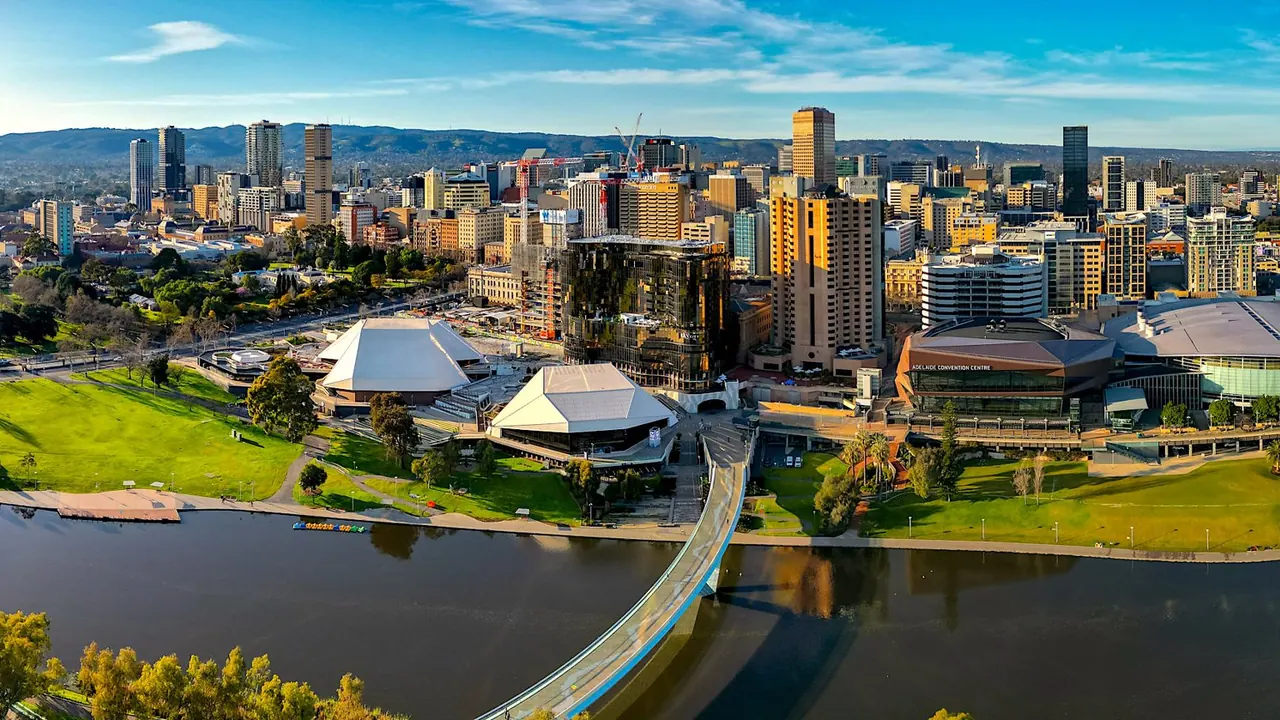
The Adelaide skyline and the footbridge over the River Torrens
- Food & drink72
- Families70
- Beaches68
Photo: Ardash Muradian, CC BY-SA 2.0, cropped
Match
56
Every category weighted equally
- Beach & sun57
- Culture & arts55
- Food & nightlife55
- Family trip59
- Outdoors59
- Relax & unwind57
- Shopping & style55
- On a budget54
Adelaide in twelve categories
Our verdict on each, scored 0 to 100 against the same fixed benchmark cities, so a score means the same thing on every page.
Beaches & swimming. Scores 68 out of 100.
Food & drink. Scores 72 out of 100.
Culture & sights. Scores 48 out of 100.
Nightlife. Scores 42 out of 100.
Nature & outdoors. Scores 66 out of 100.
Day trips. Scores 60 out of 100.
Good for families. Scores 70 out of 100.
Getting around. Scores 57 out of 100.
Shopping & style. Scores 44 out of 100.
Affordability. Scores 40 out of 100.
Live music & performing arts. Scores 63 out of 100.
Wellness & relaxation. Scores 42 out of 100.
Adelaide category by category
Beaches & swimming
68Adelaide has a long run of sandy metropolitan beaches facing west onto Gulf St Vincent, sheltered water with little surf that suits relaxed swimming. Glenelg is the classic outing, reached by the old tram from the city centre in about half an hour, with a jetty, a foreshore lawn and summer crowds. Henley Beach, Brighton and Semaphore are quieter, each with its own jetty and a strip of cafés, and the sunsets over the water are part of the ritual.
The water reaches about 21°C to 22°C in late summer and is cool for much of the year, so this is a December to April pleasure. For clearer water and more dramatic sand, the Fleurieu Peninsula beaches around Port Willunga, Port Noarlunga's reef and Victor Harbor are within an hour's drive.
Food & drink
72Eating and drinking are among the main reasons to come. The Adelaide Central Market, one of the largest covered produce markets in the southern hemisphere, is the place to start, with cheese, smallgoods, seafood and bakers under one roof, and Chinatown sits right beside it. South Australian produce is the thread through it all: King George whiting, Spencer Gulf prawns and oysters, Hills cheeses and Barossa charcuterie with its German roots.
Wine is woven into everyday life, with wine bars across the city pouring bottles from regions an hour away, and a craft beer and gin culture alongside. Gouger Street, Rundle Street and the inner suburbs hold a broad range from Vietnamese and Greek to ambitious modern Australian tasting menus. The scene is good and fair rather than vast, and late dining options thin out early.
Culture & sights
48Adelaide's cultural offer is concentrated along North Terrace, a single boulevard holding the Art Gallery of South Australia, with a strong collection of Australian and Aboriginal art, the South Australian Museum and its major Aboriginal cultural collection, and the State Library's ornate Mortlock Wing. The planned grid of the 1830s, ringed by parklands, gives the centre an orderly character, with sandstone and bluestone churches, the old university buildings and Ayers House among the colonial landmarks.
It is a pleasant, well-kept set that fills a day or two comfortably, but there is no single sight a traveller would cross the world for, and most visitors spend more time in the wine regions and hills than in museums.
Nightlife
42Going out in Adelaide centres on small bars tucked into laneways around Peel Street, Leigh Street and the West End, where wine lists lean heavily on local producers. Rundle Street in the East End has pubs and terraces, and Hindley Street carries the louder, younger club crowd late on weekends. Old corner pubs in the inner suburbs fill up on warm evenings.
For most of the year the scene is relaxed and on the early side, and midweek nights are quiet. The exception is festival season in late summer, when pop-up bars in the parklands and late crowds give the city a very different energy for a few weeks.
Nature & outdoors
66The Adelaide Hills rise on the eastern edge of the city, and within half an hour a visitor can be walking up to Mount Lofty Summit through eucalypt forest, following the waterfalls and gorge of Morialta, or spotting koalas and kangaroos in the bush. The city itself is wrapped in a continuous ring of parklands, with the Botanic Garden and the River Torrens paths good for walking and cycling.
Dolphins live in the Port River estuary and can be seen by kayak, and the Fleurieu Peninsula's cliffs and the Heysen Trail offer bigger coastal walks. The landscape is gentle rather than dramatic, and hot, dry summers push serious walking into spring and autumn. Kangaroo Island's wildlife is the great prize, but needs more than a day.
Day trips
60Day trips from Adelaide are mostly about wine country, and few cities have so much of it so close. The Barossa Valley, about an hour north-east, has German-settler villages, Lutheran church spires and some of the oldest vines still producing anywhere. McLaren Vale lies under an hour south, its vineyards running down towards the sea, and the cool-climate Adelaide Hills wineries are closer still. The Clare Valley, known for Riesling and its stone towns, is about two hours north.
Hahndorf, a main street of Prussian-settler cottages in the Hills, makes an easy half day, and Victor Harbor and Port Elliot on the Fleurieu Peninsula give a seaside town outing, with a horse-drawn tram across the causeway to Granite Island. Beyond wine and these small towns the list runs out quickly. There is no other city or historic site of wider fame within reach, so the outings suit travellers who enjoy tasting, lunching and browsing villages more than sightseeing.
Good for families
70Adelaide is a very easy city with children: compact, safe, flat in the centre and unhurried. Adelaide Zoo sits by the Botanic Garden, Cleland Wildlife Park in the Hills lets children meet kangaroos and koalas up close, and Monarto Safari Park, about an hour away, has open-range African animals. Calm, shallow beaches at Glenelg and Henley suit small swimmers, and the tram ride there is an outing in itself.
The parklands are full of playgrounds, including large adventure playgrounds by the river, and the museum's dinosaur and natural history halls appeal to younger visitors. There is no theme park of note, and summer heatwaves can make afternoons hard work, so the city suits families who want space and ease rather than big attractions.
Getting around
57The city centre is a flat, square grid of wide streets set inside the parklands, easy to cover on foot or by bike, and a free city loop bus and the free central tram section help further. The tram runs straight from the centre to the beach at Glenelg, and buses reach the other beaches and inner suburbs on a single card.
Beyond that the network is sparse. Suburban trains cover only a few lines, and the Adelaide Hills, the Barossa, McLaren Vale and the Fleurieu coast, which are much of the reason to visit, realistically need a hire car or a tour. Distances are short and traffic is light by big-city standards, so driving is easy.
Shopping & style
44Shopping is pleasant but modest. Rundle Mall is the pedestrian heart of the centre, with department stores, chains and the old arcades, and Rundle Street beyond it has a few independent fashion shops. King William Road in Hyde Park and the Burnside area hold the more boutique end. Luxury labels are few.
The things visitors carry home are local: wine bought at the cellar door, chocolates from a long-established Adelaide maker, South Australian opal, and produce from the Central Market. Aboriginal art galleries in the centre sell work from desert and regional communities. Anyone travelling to shop will find the range narrow.
Affordability
40Adelaide is one of the more affordable major cities in Australia, but Australia is an expensive country, so it is not a budget destination. Hotel rooms in the centre are generally easier on the pocket than in the larger east-coast cities, and outside the late-summer festival season availability is good. Public transport is reasonably priced and the city loop is free.
Eating out and especially drinking cost more than in much of Europe, though the Central Market and Asian eateries around Chinatown keep everyday meals reasonable. Cellar-door tastings are often modest in cost, but touring the wine regions adds car hire or tour fees to the budget.
Live music & performing arts
63Adelaide's performing arts life peaks in late summer, when the city earns its reputation as Australia's festival city. The Adelaide Fringe, one of the largest open-access arts festivals anywhere, fills parklands, pubs and pop-up tents with comedy, cabaret and theatre for weeks, while the Adelaide Festival brings international theatre, dance and opera, and WOMADelaide gathers world music in the Botanic Park.
Outside that season the programme is steadier and smaller: the Adelaide Festival Centre by the river hosts touring musicals, the State Theatre Company and State Opera, and the Adelaide Symphony Orchestra plays a regular concert series. Pubs keep a live band circuit going, but a visitor coming in winter will find a decent rather than remarkable calendar.
Wellness & relaxation
42Adelaide has no bathing tradition of its own, and wellness here means day spas, hotel spas and a handful of retreats in the Adelaide Hills and wine regions, some pairing treatments with vineyard stays. What the city does offer is an unhurried pace: short distances, little traffic, wide streets and parklands that make slowing down easy.
A restful stay here looks like long lunches, garden walks and quiet evenings rather than thermal baths or a spa circuit. Visitors who want serious bathing or treatment culture will need to look elsewhere.
When should you go?
Pick a month to see what it is like. The climate figures are measured averages, not a forecast.
Adelaide in July
Daytime high, °C
Rainfall in the month, mm
The whole year
Shaded against this city’s own year: the deepest cell is its best month for that figure and the palest its weakest.
Temperature and rainfall are climate normals, averaged over the years shown. Adelaide: 1991-2020 normals, Adelaide (West Terrace / ngayirdapira) (3.1 km from centre).
Before you go
| Measure | Adelaide |
|---|---|
| Official language | English |
| Currency | Australian Dollar (AUD) |
| Sockets | I230 V, 50 Hz |
| Driving side | Left |
| Time zone | UTC+9:30, UTC+10:30 in summer |
| Emergency number | 000 |
| Elevation | 1 m |
| Main airport | Adelaide International Airport (ADL)6 km from centre35 non-stop destinations |
| Public holidays this year | 12 days |
By the numbers
| Measure | Adelaide |
|---|---|
| City population | 1,387,290 |
| People per km² | 1,071 |
| Museums within 10 km | 13 |
| UNESCO World Heritage sites within 50 km | 0 |
| Swim season, months above 21 °C | 3 months |
Compare Adelaide with
Every comparison with a written verdict behind it.