Australia
Blue Mountains
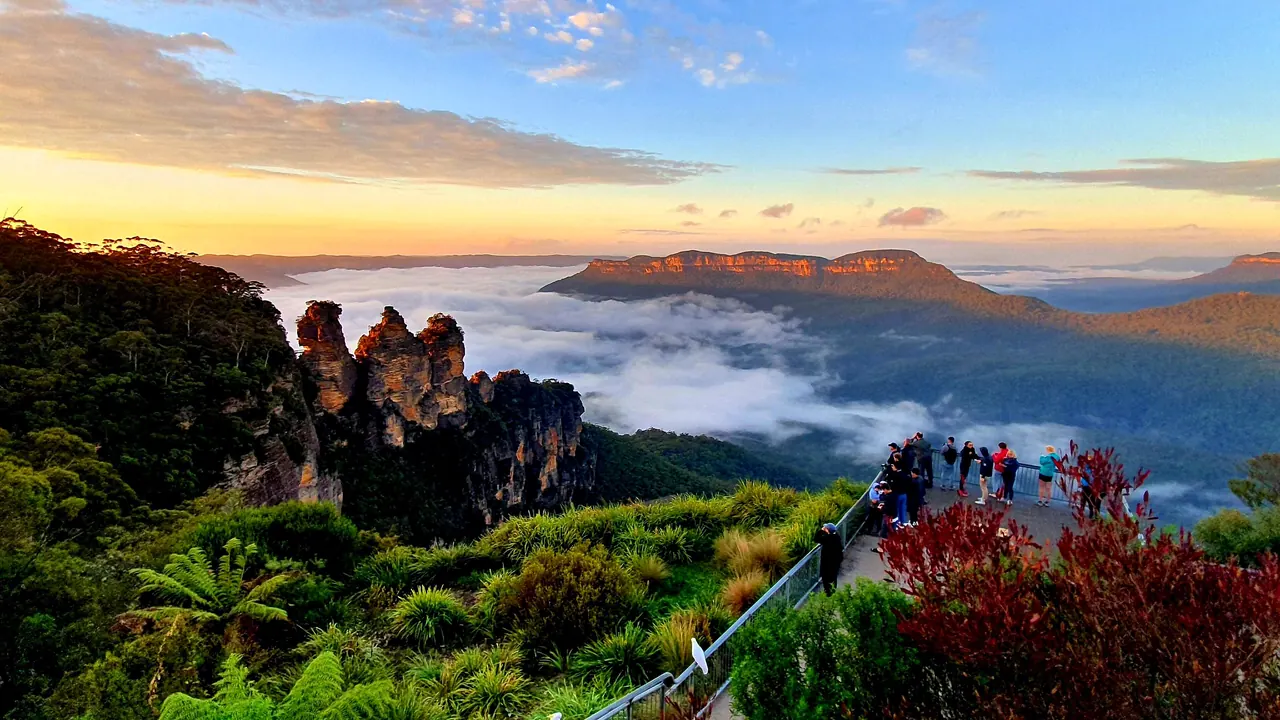
The Three Sisters at sunrise from Echo Point
- Nature & outdoors88
- Getting around58
- Day trips55
Photo: Abracadebra68, CC BY-SA 4.0, cropped
Match
39
Every category weighted equally
- Beach & sun38
- Culture & arts37
- Food & nightlife32
- Family trip44
- Outdoors48
- Relax & unwind42
- Shopping & style36
- On a budget38
Blue Mountains in twelve categories
Our verdict on each, scored 0 to 100 against the same fixed benchmark cities, so a score means the same thing on every page.
Beaches & swimming. Scores 10 out of 100.
Food & drink. Scores 36 out of 100.
Culture & sights. Scores 30 out of 100.
Nightlife. Scores 8 out of 100.
Nature & outdoors. Scores 88 out of 100.
Day trips. Scores 55 out of 100.
Good for families. Scores 50 out of 100.
Getting around. Scores 58 out of 100.
Shopping & style. Scores 28 out of 100.
Affordability. Scores 36 out of 100.
Live music & performing arts. Scores 14 out of 100.
Wellness & relaxation. Scores 50 out of 100.
Blue Mountains category by category
Beaches & swimming
10This is high sandstone country with no coast, and nobody comes here for beaches. In summer locals swim in creek pools and waterholes, such as the Blue Pool and Jellybean Pool near Glenbrook in the lower mountains, and in the water below some of the falls. The water is fresh, shaded and usually cold, and at altitude the swimming season is short.
If the sea matters to you, the beaches of Sydney are about two hours away by train or car. That makes them a separate outing, not part of a mountain stay.
Food & drink
36Most eating here is the food of a weekend retreat: long breakfasts, country cafés, bakeries and afternoon teas in the old guesthouses along the ridge. Leura and Blackheath have the best concentration, including a handful of serious restaurants that cook with produce from the surrounding farmland and wine from the Central West. Katoomba is more casual and cheaper, with pubs and cafés around its main street.
There is no regional cuisine, and evenings are quiet, with kitchens closing early in the smaller villages. High tea with a view over the valleys is the local ritual. It is a pleasant part of a stay, but not a reason to come.
Culture & sights
30The built heritage comes from the region's past as a resort for Sydney. Katoomba has Art Deco shopfronts and grand old guesthouses, and Leura has Federation cottages and formal gardens. On the cliff edge at Medlow Bath stands an extravagant Edwardian hotel. The Norman Lindsay Gallery at Faulconbridge keeps the artist's house and garden, and the Blue Mountains Cultural Centre in Katoomba holds a regional gallery and a display on the World Heritage area.
The mountains are Darug and Gundungurra country, and you can see rock engravings and hand stencils on some walking tracks. The colonial road over the range left inns and stone bridges at Mount Victoria and Hartley. Two days covers it all comfortably.
Nightlife
8Evenings are quiet. Katoomba has a few pubs and a small bar or two that fill up on weekends, and the other villages wind down after dinner. Most visitors spend the night by a fire after a day on the tracks, and the nearest real night out is in Sydney.
Nature & outdoors
88The mountains are really a plateau cut by gorges. Sheer orange and grey sandstone cliffs fall into valleys of eucalypt forest that stretch out of sight, and the blue haze that gives the range its name hangs over them. The landscape is World Heritage listed. Its great quality is how close it is: walking tracks leave from the edge of Katoomba, Leura, Wentworth Falls and Blackheath. They run along clifftops past the Three Sisters and Govetts Leap, and down stairways cut into the rock to waterfalls and the valley floor. The Grand Canyon track, the National Pass and the descent into the Grose Valley are classics.
The narrow slot canyons around Blackheath and Mount Wilson are some of the best canyoning anywhere, with abseiling and rock climbing on the same cliffs. The Six Foot Track gives a multi-day walk, and you can ride horses in the Megalong Valley. The Jenolan Caves, a vast limestone system, are about ninety minutes south of Katoomba. Lyrebirds and wallabies are common. Spring and autumn are best. Summer brings heat and bushfire closures, and winter brings crisp, sometimes frosty days.
Day trips
55The biggest day out is Sydney. Trains run down from every mountain station and reach the harbour in about two hours, so you can stay in the cool hills and spend a day in the city. On the way, Parramatta has some of the oldest colonial buildings in the country, including the World Heritage-listed Old Government House set in its parkland.
West over the range, Bathurst is a gold-rush city with grand Victorian streets and its famous motor-racing circuit, a little over an hour by car from Katoomba. To the north-east, the old colonial towns of Windsor and Richmond on the Hawkesbury River make a gentle heritage outing. The Mudgee wine region, with its cellar doors and country town, sits at the far edge of an easy day. Beyond these the list is short, and most other excursions lead into the landscape rather than to another town.
Good for families
50Families mostly come for short adventures. The steep Scenic Railway and the cableways at Katoomba thrill most children, and the guided tours through the lit chambers of the Jenolan Caves are a full day's highlight. Many lookouts and easy tracks, such as the Prince Henry Cliff Walk or the circuit at Wentworth Falls, suit small legs. Horse riding in the Megalong Valley and the old steam-era railway near Lithgow add variety.
The towns are safe, relaxed and full of space. On the other hand, there is little built for children beyond these few attractions. The longer walks involve hundreds of steep steps, and many lookouts sit above unfenced drops, so younger children need close watching.
Getting around
58The towns lie in a line along one ridge, following the railway and the Great Western Highway, and that makes the basics simple. Trains from Sydney stop at Glenbrook, Wentworth Falls, Leura, Katoomba, Blackheath and Mount Victoria, and several of the best walks start within reach of a station. In Katoomba and Leura a hop-on sightseeing bus links the main lookouts.
Beyond the ridge it gets harder. Local buses are infrequent, and the Megalong Valley, Mount Wilson, the more distant lookouts and the Jenolan Caves are much easier with a car. The roads are good, but the highway gets busy on weekends and during school vacation periods.
Shopping & style
28Shopping here means browsing on a slow afternoon. Leura Mall, the tree-lined main street, has homewares, gift and clothing boutiques, chocolate and sweet shops, and galleries. Katoomba and Blackheath are better for antiques, second-hand books and vintage goods in old shopfronts, and there are local art and craft studios across the mountains. Serious shopping means a trip back to Sydney.
Affordability
36This is a costly region on weekends and during school vacation periods, when visitors from Sydney fill the guesthouses and boutique stays in Leura and Blackheath. Café meals and dinners cost about what they do in any Australian city. The main paid attractions, such as the cableways and the cave tours, are expensive.
The best things are free, though. Almost every lookout and walking track costs nothing, and the train from Sydney is cheap. Katoomba has the widest range of plainer motels, hostels and cottages. Staying midweek, or outside the cold-weather peak, makes a real difference to the cost.
Live music & performing arts
14The live arts here are local and small. You will find community theatre in Katoomba and Springwood, occasional folk and acoustic sets in pubs, and concerts in the mountain halls. The calendar has the most life in winter, when Katoomba holds its midwinter street festival and the guesthouses stage Christmas-in-July dinners with carols. Opera, orchestras and theatre mean a trip to Sydney.
Wellness & relaxation
50The mountains have been Sydney's retreat since the late nineteenth century, and the pace still reflects that. Life here means quiet villages, cool air, fireplaces in winter and long evenings with valley views. Leura, Katoomba and Blackheath have day spas, and several clifftop retreat hotels have treatment rooms. Small yoga and meditation retreats are also scattered through the bush.
There are no thermal springs and no bathing tradition. Rest here means a restful cottage stay, not taking the waters. It suits couples who want a slow weekend of walks, massages and good breakfasts.
Where to stay in Blue Mountains
Katoomba is the practical base, and the obvious one for a first visit. It has a station, the widest choice of plainer motels, hostels and cottages, and casual pubs and cafés along its main street. The Three Sisters, the Scenic Railway and the cableways are all close by, which suits families and anyone arriving by train. Leura, one stop down the line, is quieter and prettier, with Federation cottages, formal gardens and the boutiques of Leura Mall. It suits couples who want long breakfasts, good dinners and a slow weekend.
Blackheath, higher up the ridge, is the walker's choice. Govetts Leap and the tracks into the Grose Valley start at the edge of the village, the canyons are nearby, and a few serious restaurants make up for evenings that end early. Wentworth Falls is a smaller, calmer village with its own clifftop circuit, good for a quiet stay with easy access to the tracks.
The towns sit in a line along one ridge, so a single base covers most trips, and the others are a short train ride away. If you want the Megalong Valley, Mount Wilson or the Jenolan Caves, bring a car. Weekend and school vacation stays fill quickly, so it is worth coming midweek.
When should you go?
Pick a month to see what it is like. The climate figures are measured averages, not a forecast.
Blue Mountains in July
Daytime high, °C
Rainfall in the month, mm
The whole year
Shaded against this destination’s own year: the deepest cell is its best month for that figure and the palest its weakest.
Temperature and rainfall are climate normals, averaged over the years shown. Blue Mountains: 1991-2020 normals, Katoomba (1.4 km from centre).
Before you go
| Measure | Blue Mountains |
|---|---|
| Official language | English |
| Currency | Australian Dollar (AUD) |
| Sockets | I230 V, 50 Hz |
| Driving side | Left |
| Time zone | UTC+10, UTC+11 in summer |
| Emergency number | 000 |
| Main airport | Sydney Kingsford Smith International Airport (SYD)99 non-stop destinations |
| Public holidays this year | 11 days |
By the numbers
| Measure | Blue Mountains |
|---|---|
| Population | 30,049 |
| People per km² | 21 |
Compare Blue Mountains with
Every comparison with a written verdict behind it.