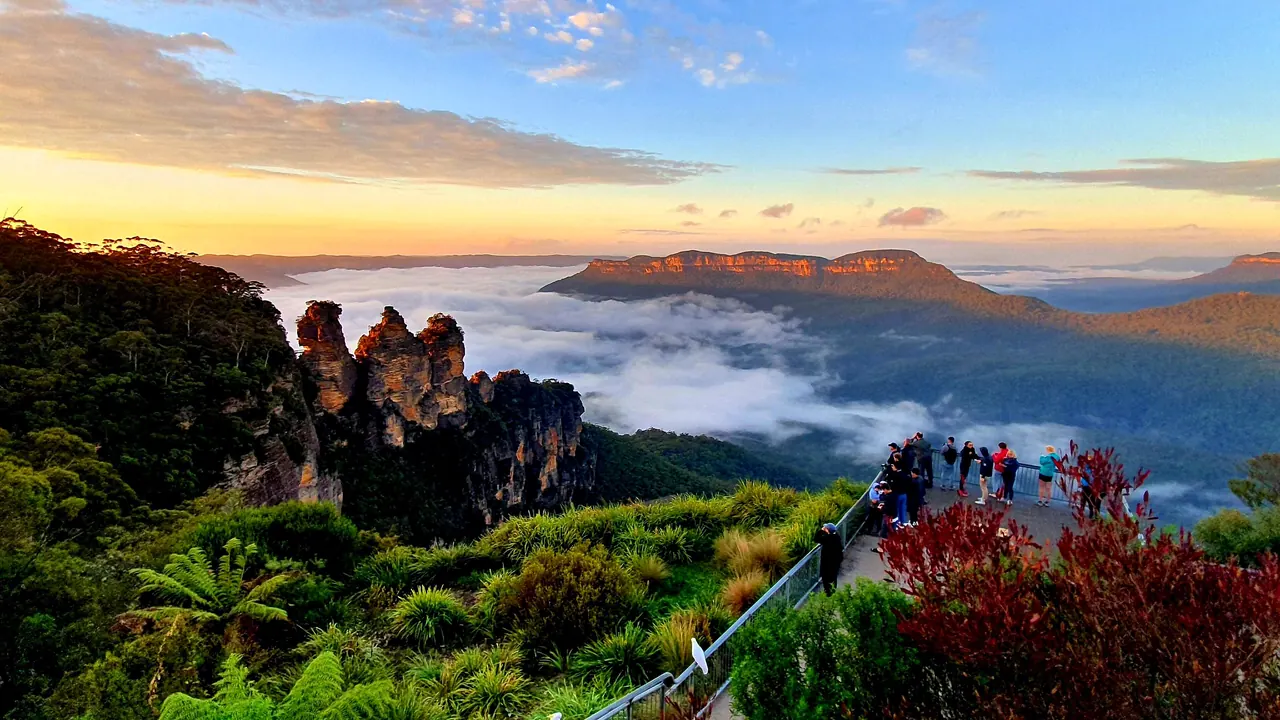
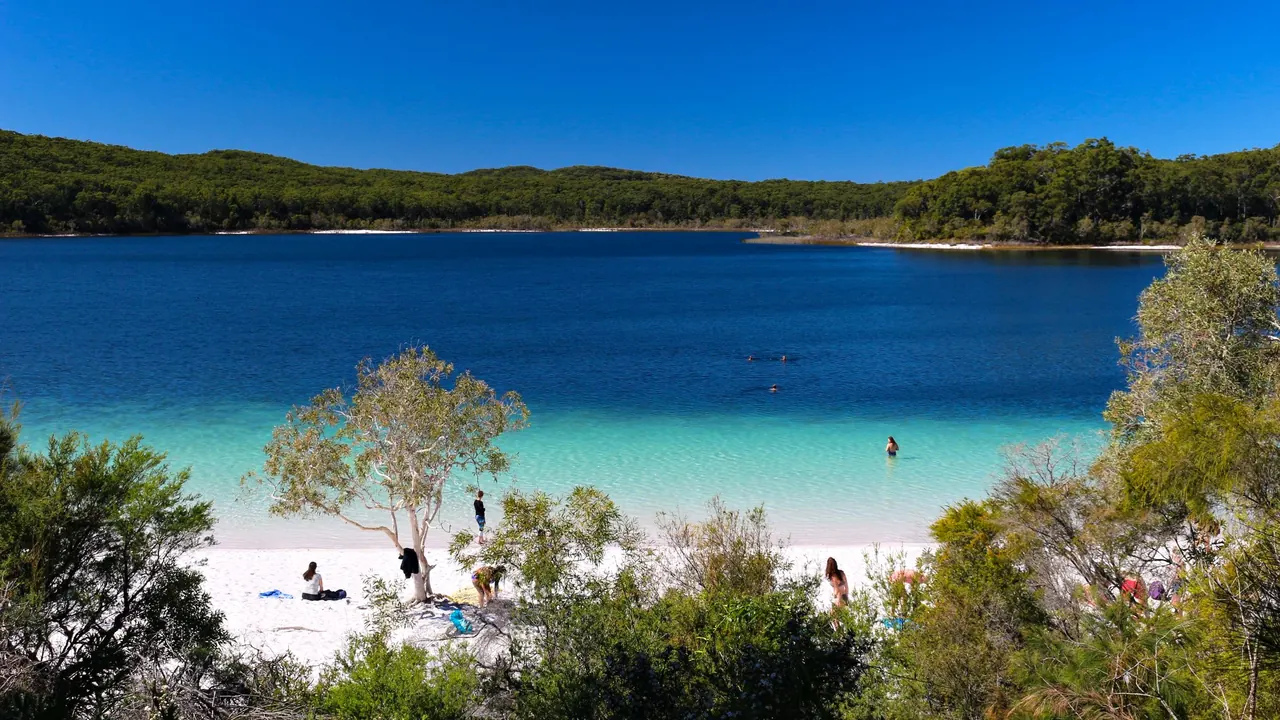
Photos: Blue Mountains by Abracadebra68, CC BY-SA 4.0, cropped; K'gari by Lucas·G, CC BY-SA 4.0, cropped.
Blue Mountains or K'gari?
Our verdict in twelve categories, each scored against the same fixed benchmark cities, and the climate month by month, so you can choose for your trip.
Choose Blue Mountains for
- day trips
- getting around
- shopping
Pick the Blue Mountains if you want an outdoors break with some comfort around it. Walks start at the edge of villages along a railway line, and the evenings bring guesthouse breakfasts, high tea, day spas and Art Deco streets. It works without a car and with children of most ages, and Sydney is close enough for a day in the city.
Choose K'gari for
- beaches
K'gari is for travellers who want wild country and freshwater swimming and will accept the effort it takes. You cross by barge, drive sand tracks by 4WD and plan around the tides, all to float in clear dune lakes, watch dingoes on the beach and look for whales offshore. There is almost nothing besides the landscape, so it suits a self-contained adventure better than a varied stay.
Scoreboard
Twelve categories on one fixed scale from 0 to 100. The shaded stretch is the gap between the two.
Your match
Pick a travel style or drag the sliders, and both match scores follow your weighting.
Wins on day trips and getting around with your weighting.
Wins on beaches with your weighting.
What matters to you?
Category by category
What the scores mean for a trip.
Beaches & swimming
K'gari wins easily, although not on its ocean beach, where rips and sharks make swimming unsafe. The swimming is in Lake McKenzie and the other dune lakes, the cold flow of Eli Creek, the Champagne Pools and the flat water on the western shore near Kingfisher Bay.
The Blue Mountains have no coast at all. In summer, the creek pools around Glenbrook and the plunge pools below waterfalls offer a cold, shaded dip, and the nearest sea is a separate day out in Sydney.
Food & drink
Neither is a place for a food trip, but the Blue Mountains eat noticeably better. Leura and Blackheath have country cafés, bakeries, high tea in old guesthouses and a few serious restaurants using local produce and Central West wine.
On K'gari, food is a matter of supplies. There are a few resort and settlement restaurants, and most campers bring groceries over on the ferry.
Culture & sights
The Blue Mountains give you more to see between walks. There are the Art Deco shopfronts of Katoomba, Federation cottages in Leura, the Norman Lindsay Gallery, colonial inns at Mount Victoria and Hartley, and Aboriginal rock engravings on some tracks. Two days covers it.
K'gari's human sights come down to the wreck of the Maheno, logging relics at Central Station and ranger talks on Butchulla history, so culture there is something you pass on the way to the lakes.
Nightlife
Both are places for early nights. Katoomba has a few pubs and a bar or two that fill up at weekends, and Sydney is a train ride away. On K'gari the evening means a campfire or the night sky over the dunes, since the resort bars close early.
Nature & outdoors
Both are World Heritage landscapes of the highest order, and they could hardly be more different. The Blue Mountains are vertical country: sandstone cliffs, eucalypt valleys, stairways down to waterfalls, and canyoning and climbing around Blackheath. All of it starts from the village streets.
K'gari is sand made strange. There is rainforest growing out of dunes at Pile Valley, more than a hundred freshwater lakes, coloured cliffs at the Pinnacles, dingoes on the beach and humpbacks passing Indian Head in the cooler months. Walkers will prefer the mountains, while wildlife watchers and 4WD drivers will lean to the island.
Day trips
The Blue Mountains work as a base. The train runs down to Sydney Harbour and colonial Parramatta, and you can drive to gold-rush Bathurst, the Hawkesbury towns of Windsor and Richmond, or the cellar doors around Mudgee.
K'gari is the destination itself. Leaving means a barge to Hervey Bay or Rainbow Beach, which are quiet towns, so your days are spent moving around the island rather than away from it.
Good for families
The Blue Mountains are simpler with children. The steep Scenic Railway, the cableways, the lit chambers of the Jenolan Caves and short walks like the Prince Henry Cliff Walk give a good mix, though unfenced lookouts need watching.
K'gari can be unforgettable for adventurous school-age children who float down Eli Creek and camp in the dunes. It is hard with toddlers, because wild dingoes mean constant supervision, and the days involve long, bumpy drives on sand. Kingfisher Bay is the gentlest base there.
Getting around
The Blue Mountains are far easier. The villages sit in a line along the railway from Sydney, many walks start near a station, and a hop-on bus links the lookouts around Katoomba and Leura. You only need a car for Megalong Valley, Mount Wilson or Jenolan.
K'gari has no sealed roads at all. After the barge or ferry, everything means high-clearance 4WD on soft tracks and on the beach at low tide, so most first-timers join a guided tour.
Shopping & style
Leura Mall is the closest thing to a shopping street in either place. It is a tree-lined run of homewares, gift and clothing boutiques, chocolate shops and galleries, and Katoomba and Blackheath add antiques, second-hand books, vintage goods and craft studios. That is enough for a slow afternoon of browsing, though not for a spree.
On K'gari, the general stores sell fuel, ice and supplies, and the resort has a gift shop. Buy what you need on the mainland before the barge.
Affordability
The lookouts and walking tracks in the Blue Mountains are free, and the train up from Sydney is cheap. Beds are the main cost, since guesthouses in Leura and Blackheath fill up and charge more at weekends and in school vacations. Katoomba's hostels, motels and cottages are plainer and cheaper, and staying midweek helps most.
K'gari costs a lot before you have seen anything: the barge crossing, 4WD hire or a guided tour, and a small number of resort rooms. Food and fuel also cost more than on the mainland. Travellers with their own vehicle and camping gear can bring the cost down a long way.
Live music & performing arts
Neither is somewhere to go for a show, but the Blue Mountains at least have a small local scene. There is community theatre and the odd acoustic set in a pub, and it is liveliest around Katoomba's midwinter festival, while proper concert halls are down in Sydney. On K'gari, an occasional musician at the resort bar is all there is.
Wellness & relaxation
The Blue Mountains have been a retreat for a long time, and it shows. There are day spas in Leura, Katoomba and Blackheath, treatment rooms in clifftop hotels, yoga retreats in the bush, and fireside evenings in cool air.
K'gari offers a different kind of rest: still mornings by a lake and no phone signal. Pampering is limited to the Kingfisher Bay resort, and long drives on sand can work against the calm.
When should you go?
Pick your month. The climate figures are measured averages, not a forecast.
Blue Mountains in July
K'gari in July
Daytime high, °C
Rainfall in the month, mm
Where the figures come from
K'gari's temperatures are measured 25 km from the centre, at Hervey Bay.
K'gari has no rain gauge within 25 km of the centre, so its rainfall comes from a gridded climate dataset read at the destination rather than from a gauge further away.
Temperature and rainfall are climate normals, averaged over the years shown. Blue Mountains: 1991-2020 normals, Katoomba (1.4 km from centre). K'gari: 1991-2020 normals, Hervey Bay (25.4 km from centre).
The two run on almost opposite calendars. The Blue Mountains are at their best in spring and autumn, when the days are mild for long walks on the clifftops. Summer is warm rather than hot, at about 24°C, but it is also the wettest stretch and brings bushfire closures. Winter is cold, around 10°C by day in July, with frosty mornings, though it stays fairly dry and suits fireside weekends.
K'gari is subtropical and warm all year. Summer reaches about 30°C and is wet and stormy, with February the rainiest month. Winter and early spring are the clearest time, with days in the low twenties and the least rain in September. The sea peaks around 27°C in late summer and falls to about 20°C in August, but the lakes and creeks are where you actually swim.
Which traveller are you?
On a beach and sun trip, K'gari is the clear choice. Its ocean beach is for looking at rather than swimming, but the silica-white lakes, Eli Creek and the Champagne Pools give warm-weather swimming that the mountains' cold creek pools cannot match.
On a family trip with children, the Blue Mountains are easier. The Scenic Railway, cableways, cave tours and short cliff walks fit a child's day, the towns are linked by train, and there are no dingoes to guard toddlers against.
For a relaxing and wellness trip, the Blue Mountains are the better choice. Day spas in Leura and Blackheath, clifftop retreat hotels and cosy cottages make for a slow weekend. K'gari's quiet is real, but long drives on sand and a single resort spa limit it.
Before you go
| Measure | Blue Mountains | K'gari |
|---|---|---|
| Official language | English | English |
| Currency | Australian Dollar (AUD) | Australian Dollar (AUD) |
| Sockets | I230 V, 50 Hz | I230 V, 50 Hz |
| Driving side | Left | Left |
| Time zone | UTC+10, UTC+11 in summer | UTC+10 |
| Emergency number | 000 | 000 |
| Main airport | Sydney Kingsford Smith International Airport (SYD)99 non-stop destinations | Hervey Bay Airport (HVB)3 non-stop destinations |
| Public holidays this year | 11 days | 11 days |
By the numbers
| Measure | Blue Mountains | K'gari |
|---|---|---|
| Population | 30,049 | 152 |
| People per km² | 21 | - |
| Swim season, months above 21 °C | - | 10 months |
Where else could you go?
Every comparison below shares a destination with this one, so you can follow Blue Mountains or K'gari somewhere new.
- Sunshine Coastvs K'gari
- Whitsundaysvs K'gari
- Great Ocean Roadvs Blue Mountains
- Sunshine Coastvs Blue Mountains
- Tasmaniavs Blue Mountains
- Kangaroo Islandvs Blue Mountains