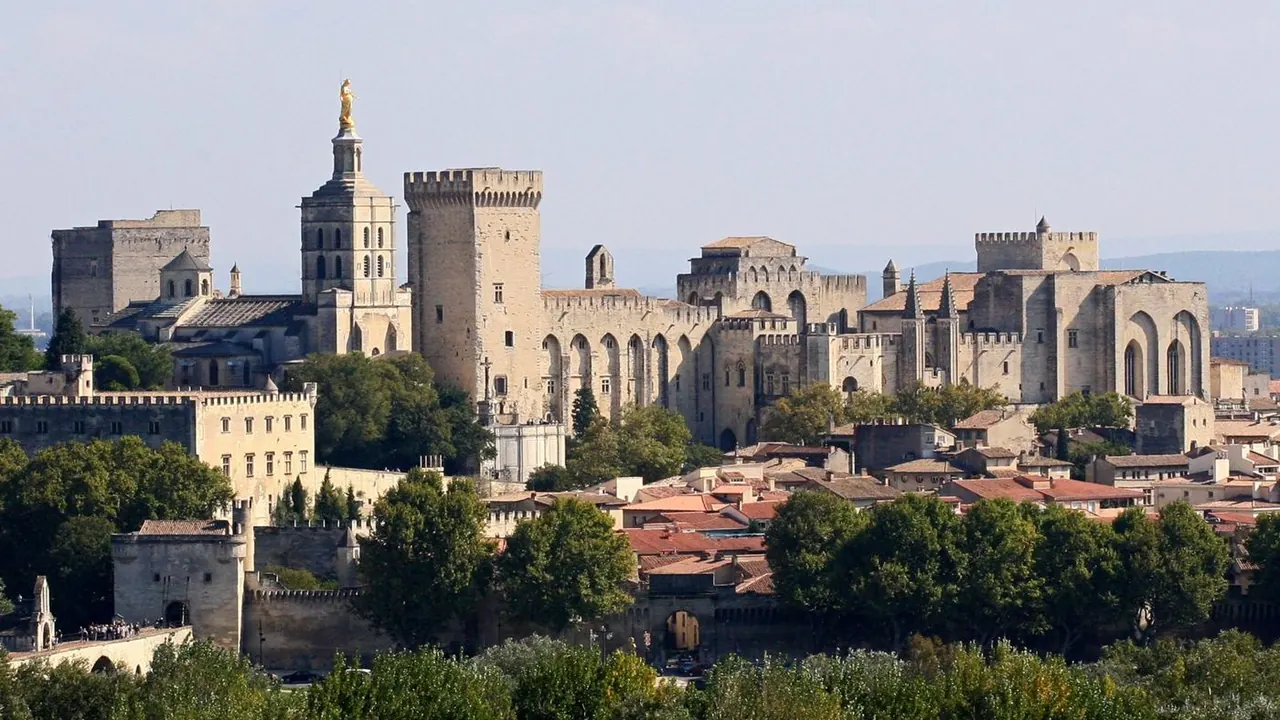
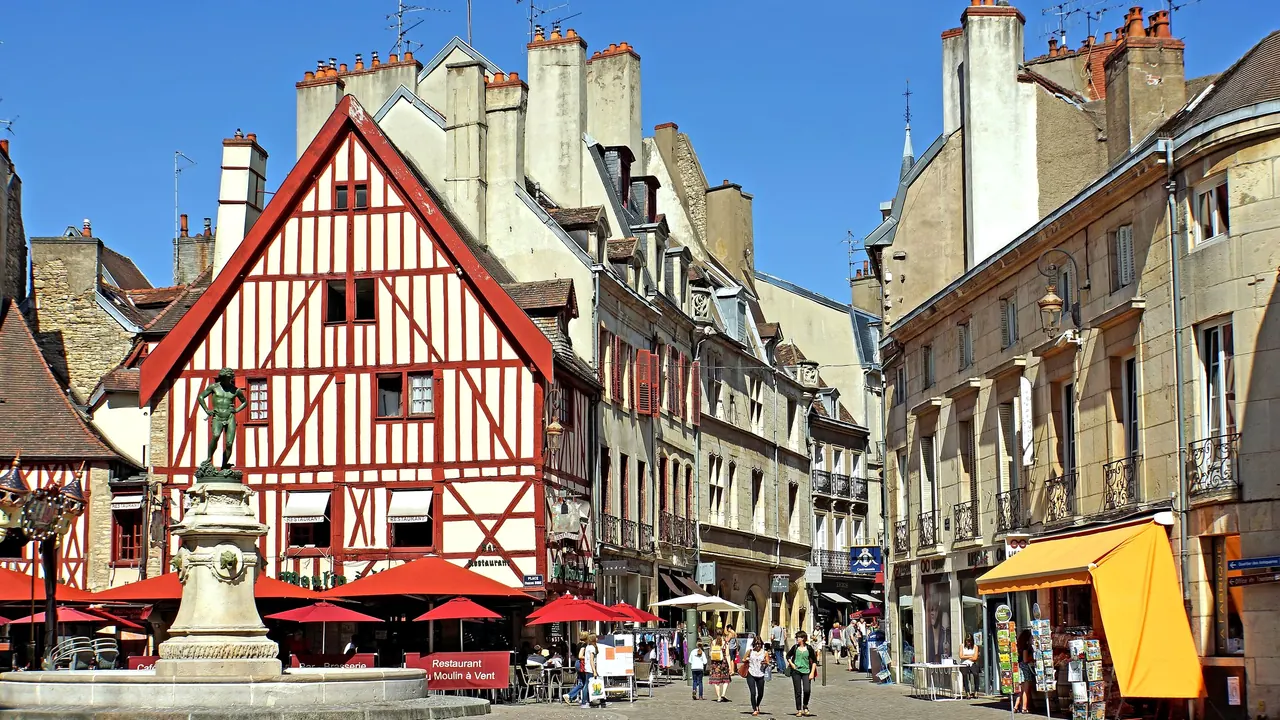
Photos: Avignon by BlueBreezeWiki, CC BY-SA 3.0, cropped; Dijon by Dennis G. Jarvis, CC BY-SA 2.0, cropped.
Avignon or Dijon?
Our verdict in twelve categories, each scored against the same fixed benchmark cities, and the climate month by month, so you can choose for your trip.
Choose Avignon for
- live music and the arts
- nature and the outdoors
- day trips
Avignon suits travellers who want southern sun and a base for exploring. The papal palace and ramparts take a couple of days, and after that the town is a launch pad for Roman Nîmes and Arles, the Luberon villages, Mont Ventoux and the Camargue. Theatre lovers have the strongest reason of all to come in July, when the festival takes over every courtyard. Bring or hire a car to make the most of it.
Choose Dijon for
- food and drink
- getting around
- prices
Dijon is the better choice if the trip is about the table and the cellar. Burgundian cooking, village wines poured by the glass and the Route des Grands Crus starting at the edge of town give it a depth of eating and drinking Avignon cannot match. It is also easier to manage without a car, a little kinder on the budget and cooler in high summer, which makes it a good fit for a relaxed long weekend by train.
Scoreboard
Twelve categories on one fixed scale from 0 to 100. The shaded stretch is the gap between the two.
Your match
Pick a travel style or drag the sliders, and both match scores follow your weighting.
Wins on live music and the arts and nature and the outdoors with your weighting.
Wins on food and drink and getting around with your weighting.
What matters to you?
Category by category
What the scores mean for a trip.
Beaches & swimming
Neither is a beach destination, but Avignon gets closer. On hot afternoons you can drive about half an hour to swim in the clear pools of the Gardon below the Pont du Gard, and the Camargue sands and Le Grau-du-Roi make a reasonable day out to the Mediterranean.
Dijon is several hours from any coast. Its only open-water swimming is the supervised bathing area at Lac Kir on the edge of town, which is pleasant for a local afternoon but not worth planning a trip around.
Food & drink
Avignon eats in the Provençal way: tians, daube, herb-scented lamb, tapenade and summer fruit from the plain, with the market at Les Halles on Place Pie as its best showcase. Châteauneuf-du-Pape and the Côtes du Rhône are close by, but the cafés on the main squares cater mostly to visitors, so you have to look in the side streets for the better cooking.
Dijon goes deeper. Boeuf bourguignon, jambon persillé, snails and Époisses are joined by the city's own mustard, pain d'épices and cassis. There is a genuine fine-dining tier, the Cité de la Gastronomie in the old hospital, and wine bars pouring village Burgundies rarely found by the glass elsewhere. Neither city offers much beyond French regional cooking.
Culture & sights
The two are closely matched, but their character differs. Avignon has one monument of world rank in the Palais des Papes, part of a UNESCO ensemble with the cathedral, the Rocher des Doms and the broken Pont Saint-Bénezet. Almost 4km of ramparts enclose it, along with the Petit Palais, the Musée Calvet and the Collection Lambert for contemporary art.
Dijon's strength lies in its streetscape and its museum rather than in a single landmark. The ducal palace holds the Musée des Beaux-Arts with the mourner-ringed Valois tombs. Around it lie half-timbered houses, Renaissance mansions, the gargoyles and lucky owl of Notre-Dame, and Sluter's Well of Moses at Champmol.
Nightlife
Both are quiet places after dark, so the difference is in timing. Avignon is sleepy for most of the year, with aperitifs on Place Pie and the streets quiet by midnight, but in July the festival keeps squares and terraces packed into the small hours.
Dijon's large university gives it steadier evenings during term, mostly wine bars and pubs along Rue Berbisey and around Place Émile Zola, plus a handful of clubs. Neither is a place for serious clubbing.
Nature & outdoors
Avignon is surrounded by some of the most celebrated landscape in southern France. Mont Ventoux rises to 1,910m, and the Luberon's ochre trails, the Dentelles de Montmirail, the Alpilles and the gorges of the Gardon are all within easy reach. To the south lie the flamingos and white horses of the Camargue. The catch is summer heat and days of mistral.
Dijon offers gentler walking and cycling: climbing and trails in the Combe à la Serre and Combe de Lavaux, flat rides along the Burgundy Canal and the signed vineyard route to Beaune. For wilder country you need the Morvan, about an hour and a half away.
Day trips
Both make excellent bases, but Avignon's range is exceptional. Within half an hour lie the arenas of Nîmes and Arles, the Maison Carrée, Orange's Roman theatre and the Pont du Gard. Beyond them are Les Baux, Saint-Rémy, the Luberon villages, Châteauneuf-du-Pape and fast trains to Marseille and Aix.
Dijon's excursions centre on wine and abbeys: the Route des Grands Crus through Gevrey-Chambertin and Vougeot to Beaune, then Fontenay Abbey, Semur-en-Auxois, Alésia and Vézelay. In both regions the villages are much easier to reach with a car.
Good for families
Families will find both towns calm and manageable, though neither is built around children. Avignon has the papal palace's augmented-reality tablet tour, the bridge from the nursery song and the playground on the Rocher des Doms. Its best family days, such as swimming at the Pont du Gard or seeing the Camargue's animals, need a car, and cobbles and July crowds can be hard work.
Dijon's mostly pedestrian centre is easier with a pushchair. The natural history museum and planetarium at the Jardin de l'Arquebuse, the lawns of the Parc de la Colombière and paddling at Lac Kir fill a day or two.
Getting around
Dijon is the simpler city to get around. Station, market, palace and cathedral are a few minutes apart on foot, two tram lines reach the outskirts, and regional trains run straight down the wine route to Beaune. Paris is well under two hours away by TGV.
Avignon is also walkable inside its walls, but the cobbles and the mistral make it more tiring, and the TGV station lies outside town on a shuttle line. Regional trains handle Arles, Nîmes and Orange well, but the hill villages and Ventoux really require a hire car or a tour.
Shopping & style
Avignon's shops lean towards Provence in fabric and scent: printed cottons, lavender, olive-wood and soap in the lanes around Rue des Marchands and Rue Joseph Vernet, with a few independent design boutiques among them. For food to take home, such as tapenade, calissons, olive oil and Rhône wine, go to Les Halles or straight to the producers. Serious antiques hunting means a trip out to L'Isle-sur-la-Sorgue.
Dijon's haul is almost all edible: mustard in dozens of flavours, pain d'épices, cassis and Burgundy from its wine merchants and cellars. Rue de la Liberté has a department store and French chains, and unlike Avignon, Dijon has its antiques dealers in town, in the lanes off the main street. Neither city suits a fashion or luxury spree.
Affordability
Dijon is the easier city on the budget. Rooms are moderate, bistro set lunches are fair, wine by the glass is cheaper than in most of France, and the small centre costs nothing to cross. The real expense is the wine itself, as tastings, tours and good bottles add up fast.
Avignon costs more because it is a major tourist stop. Rooms inside the walls get steep in July when the festival is on, and exploring Provence usually means paying for a hire car. Spring and autumn bring prices down noticeably.
Live music & performing arts
Avignon wins this outright because of July. The Festival d'Avignon stages major productions in the Cour d'honneur of the papal palace, and the Off fringe fills every cellar and courtyard with over a thousand shows a day. The rest of the year there is still opera on Place de l'Horloge, a dozen small theatres and a jazz club.
Dijon has a sound year-round season instead: opera and dance at the Grand Théâtre and the acoustically fine Auditorium, a national drama centre and a venue for touring bands. Its programme follows the academic year and thins out in summer, the reverse of Avignon's rhythm.
Wellness & relaxation
Neither town has a bathing tradition, so rest here is about pace more than treatments. Avignon has the slight edge, thanks to the country around it. Many visitors who come to switch off skip the walled town and rent a rural guesthouse in the vines, where a pool and an empty afternoon make up the whole plan. Inside the walls there are spas in the better hotels and a few independent massage studios. Avoid July if you want quiet, and expect a long spell of mistral to grow tiresome.
Dijon has fewer places to book: a handful of hotel spas and, out in the wine villages, some treatments made with grapes. Its appeal is the calm of a provincial city, with unhurried squares and slow afternoons among the vineyards, and it has no festival month to break that calm.
When should you go?
Pick your month. The climate figures are measured averages, not a forecast.
Avignon in July
Dijon in July
Daytime high, °C
Rainfall in the month, mm
Where the figures come from
Avignon has no rain gauge within 25 km of the centre, so its rainfall comes from a gridded climate dataset read at the city rather than from a gauge further away.
Avignon's sunshine is measured 65 km from the centre, at Marseille / Marignane.
Temperature and rainfall are climate normals, averaged over the years shown. Avignon: 2005-2020 (sunshine 1991-2020, rainfall 1991-2020) normals, Avignon / Morières-lès-Avignon (8.6 km from centre). Dijon: 1991-2020 normals, Dijon (7 km from centre).
Avignon has the hotter, sunnier climate of Provence. May, June and September are the sweet spot, warm enough for outdoor lunches and a swim in the Gardon without the full force of high summer. July and August reach about 32°C under nearly cloudless skies, which is fine for river swimming and evening terraces but hard work for sightseeing at midday. Rain comes mostly in autumn, peaking at around 109mm in October, and winter days are mild but short of warmth.
Dijon runs several degrees cooler all year. Its July high of about 27°C is comfortable for walking the old centre and cycling the vineyards, and late spring through September is the best stretch. Rain is spread fairly evenly through the year rather than arriving in one wet season. Winters are cold and grey, with highs around 6°C and far less sunshine than Avignon, so Dijon makes a much weaker case than its southern rival between November and February.
Which traveller are you?
On an outdoors trip, Avignon is the clear pick. Mont Ventoux, the Luberon cliffs, the Alpilles, canoeing the Gardon to the Pont du Gard and the Camargue's lagoons are far more varied and dramatic than Dijon's gentle combes and canal towpaths.
For a food and nightlife trip, Dijon comes out ahead on the food side. Its Burgundian classics, mustard and cassis, Les Halles and wine bars pouring village Burgundies lead the way, and Rue Berbisey's student bars keep evenings going through term time.
For a short city break, Dijon is easier. The TGV from Paris takes well under two hours, the pedestrian centre puts palace, market and cathedral minutes apart, and a train to Beaune adds wine without needing a car.
Before you go
| Measure | Avignon | Dijon |
|---|---|---|
| Official language | French | French |
| Currency | Euro (EUR) | Euro (EUR) |
| Sockets | CE230 V, 50 Hz | CE230 V, 50 Hz |
| Driving side | Right | Right |
| Time zone | UTC+1, UTC+2 in summer | UTC+1, UTC+2 in summer |
| Emergency number | 112 | 112 |
| Elevation | 10 m | 220 m |
| Main airport | Marseille Provence Airport (MRS)65 km from centre126 non-stop destinations | Lyon Saint-Exupéry Airport (LYS)178 km from centre141 non-stop destinations |
| Public holidays this year | 11 days | 11 days |
By the numbers
| Measure | Avignon | Dijon |
|---|---|---|
| City population | 92,188 | 161,830 |
| People per km² | 1,420 | 3,890 |
| Museums within 10 km | 11 | 8 |
| UNESCO World Heritage sites within 50 km | 6 | 1 |
Where else could you go?
Every comparison below shares a destination with this one, so you can follow Avignon or Dijon somewhere new.