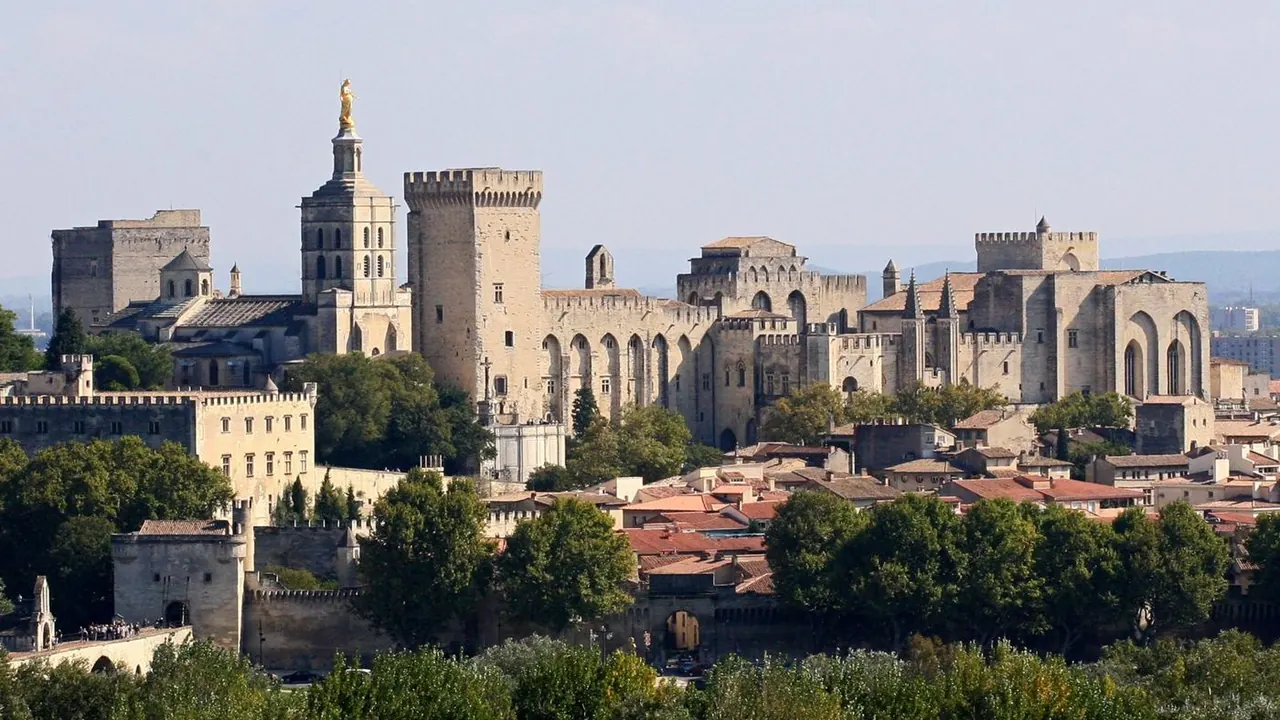
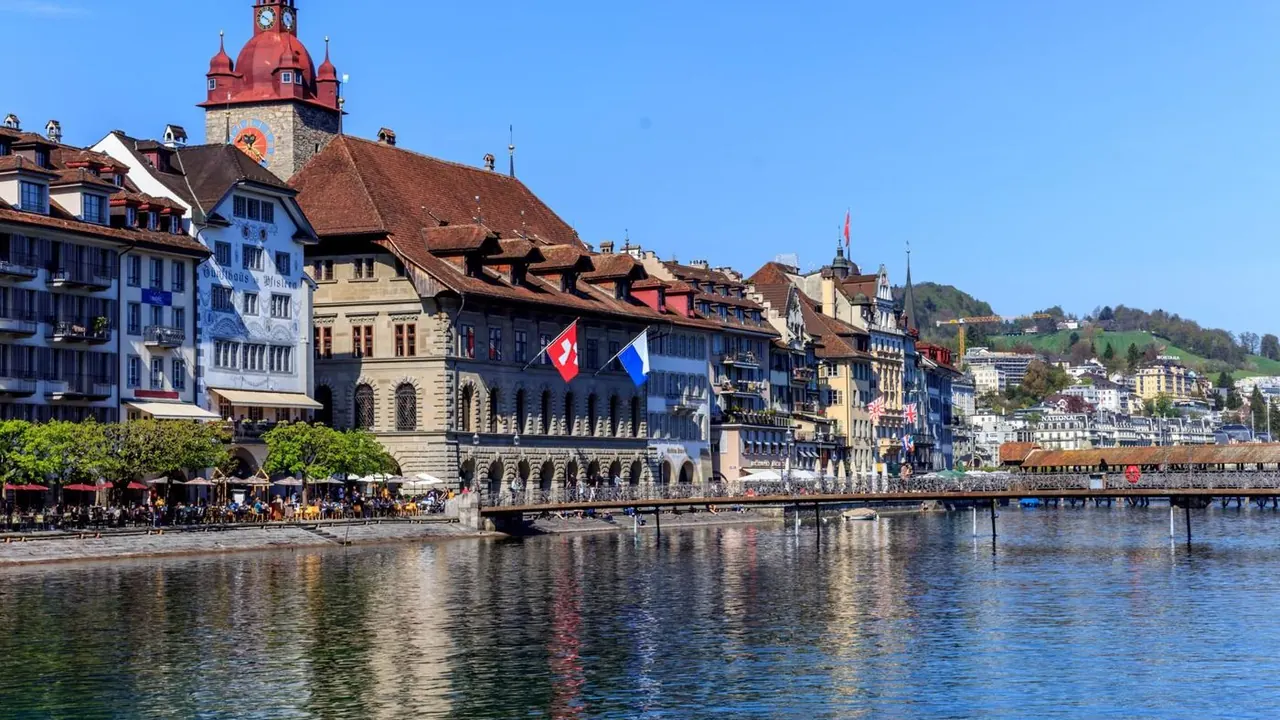
Photos: Avignon by BlueBreezeWiki, CC BY-SA 3.0, cropped; Lucerne by ILOVESwitzerland, Pexels License.
Avignon or Lucerne?
Our verdict in twelve categories, each scored against the same fixed benchmark cities, and the climate month by month, so you can choose for your trip.
Choose Avignon for
- prices
- food and drink
- day trips
Avignon suits the traveller who wants history, wine and the south. The papal palace and the ramparts fill the first days, and after that the town works as a base for Roman Nîmes and Arles, the Pont du Gard, the Luberon villages and the Rhône vineyards. Meals are better and the bill is far kinder than in Switzerland. The catch is that the countryside really calls for a car, and the town goes quiet after dark outside July.
Choose Lucerne for
- getting around
- nature and the outdoors
- families
Choose Lucerne for scenery and ease. Mountains rise straight from the lake, and steamers, cogwheel trains and cable cars leave almost from the station door, so a day on Pilatus or Rigi needs no planning beyond a timetable and no car at all. It is the easier choice with children and the calmer place to unwind, but it is very expensive, and the food is plain beside Provence.
Scoreboard
Twelve categories on one fixed scale from 0 to 100. The shaded stretch is the gap between the two.
Your match
Pick a travel style or drag the sliders, and both match scores follow your weighting.
Too close to call, 1 point apart
Wins on prices and food and drink with your weighting.
Wins on getting around and nature and the outdoors with your weighting.
What matters to you?
Category by category
What the scores mean for a trip.
Beaches & swimming
Neither city has a beach, but Lucerne at least lets you swim in town. The Lido, the old wooden lake baths and the lawns at Ufschötti put clean, calm water a short walk from the Old Town in July and August, with more bathing spots in the lakeside villages by boat.
In Avignon the Rhône is no good for swimming, so a dip means the clear pools of the Gardon below the Pont du Gard, about half an hour by car, or a longer drive to the Camargue sands at Saintes-Maries-de-la-Mer. Most visitors end up using the hotel pool.
Food & drink
Avignon eats far better. Provençal cooking, from daube and tians to tapenade and the apricots and melons of the plain, is on every menu, Les Halles makes a fine morning stop, and Châteauneuf-du-Pape and the Côtes du Rhône are poured by the glass in ordinary bistros.
Lucerne offers dependable Swiss comfort food: Chügelipastete, fondue, rösti and lake perch in wood-panelled guild houses. It is well made but narrow and costly, and many tables near the Chapel Bridge cater to coach parties. For a trip where meals matter, Avignon is the obvious pick.
Culture & sights
Avignon has the weightier heritage. The Palais des Papes is a monument of European rank, and with the cathedral, the broken Pont Saint-Bénezet and almost 4km of ramparts it forms a UNESCO ensemble. Museums such as the Petit Palais and the Collection Lambert, plus the charterhouse across the river at Villeneuve, give it depth.
Lucerne's sights are fewer but very well known: the Chapel Bridge and Water Tower, the climbable towers of the Musegg Wall and the Lion Monument. The Rosengart Collection's Picasso and Klee are the art highlight. It is a charming Old Town rather than a historic capital.
Nightlife
Both are early-to-bed towns for most of the year, and each wakes up for one big moment. In Avignon that is July, when the theatre festival keeps the squares full into the small hours. The rest of the time evenings are aperitifs on Place Pie and a few student bars, with almost no clubbing.
Lucerne has a little more structure, with cocktail bars and a small club scene in the Neustadt and around the station, but the lakefront empties by midnight. Its outburst is Fasnacht before Lent, when the town stays out in costume until dawn.
Nature & outdoors
Lucerne's landscape is in another league. Alpine peaks stand right above the lake: Pilatus by the steepest cogwheel railway, Rigi with its ridge walks, and the year-round snow of Titlis within an hour. Steamers make it easy to combine a boat, a train and a hike in a single day, and winter adds skiing.
Avignon's country is fine in its own way, with the bare summit of Mont Ventoux, the Luberon's ochre trails, the Alpilles and the flamingo lagoons of the Camargue. But it is spread out, best in spring and autumn, and mostly needs a car.
Day trips
Avignon is the stronger base for outings. Roman Provence lies within half an hour: the arenas of Nîmes and Arles, the theatre at Orange and the Pont du Gard. Beyond them are Les Baux, the wine villages of Gigondas and Châteauneuf, the antiques of L'Isle-sur-la-Sorgue and the Luberon hill villages, plus Marseille by fast train.
Lucerne's trips are more about Swiss towns: Bern's arcaded old town, Basel's museums and Zurich, all within an hour by rail, and the lake voyage to the Rütli meadow and the William Tell country around Altdorf. They are easier to reach without a car, but there is less variety.
Good for families
Lucerne is the better bet with children. The Swiss Museum of Transport is a full day on its own, and paddle steamers, cogwheel trains and the summer toboggan on Pilatus turn the journeys into the treat. The flat, safe centre and the lakeside lawns make breaks easy, though rainy days can run short of ideas.
Avignon has a few good moments, such as the tablet tour of the Palais des Papes, dancing on the bridge from the song and the playground on the Rocher des Doms. The better family days, canoeing at the Pont du Gard or seeing the Camargue's horses, all mean driving, and cobbles and July crowds wear small legs out.
Getting around
Lucerne is far easier to get around. Station, boat piers and Old Town sit together on the lakefront, and the same integrated Swiss tickets carry you onto steamers, mountain railways and cable cars, so a car is never needed.
Avignon is easy on foot inside the walls and well linked by train to Arles, Nîmes, Orange and Marseille. Once you head for the hill villages, the vineyards or Ventoux, though, buses are sparse and a hire car or a tour becomes the only realistic way.
Shopping & style
Neither city is a shopping destination, but Lucerne has a clearer speciality. Its watch and jewellery houses on Schwanenplatz are a serious draw, alongside army knives and chocolate, though fashion and design are thin.
Avignon's best buys are things to eat and drink: olive oil, tapenade, calissons and wine from Les Halles or the estates, plus Provençal cottons and lavender in the lanes off Rue Joseph Vernet. Antiques hunters go out to L'Isle-sur-la-Sorgue.
Affordability
Avignon costs much less. It is a provincial French town with tourist prices in places, but bistro lunch menus are fair, the walled town is free to explore, and spring and autumn rooms are reasonable. July and a hire car are the main expenses.
Lucerne is among the most expensive places you can choose. Rooms, ordinary meals and especially the mountain railways add up fast, and a Swiss travel pass and lakeside picnics only soften the blow.
Live music & performing arts
Both are small cities with world-class festivals, but for different art forms. Avignon belongs to theatre: in July the Festival d'Avignon fills the Cour d'honneur of the papal palace and the Off spreads well over a thousand shows a day through every cellar and courtyard. The opera house and small theatres keep going the rest of the year.
Lucerne is about classical music. The Lucerne Festival brings leading orchestras to Jean Nouvel's acoustically famous lakefront hall, mainly in late summer, and the Lucerne Symphony Orchestra plays there year round. Timing your visit matters in both.
Wellness & relaxation
Lucerne is the more restful of the two. Quiet evenings, lakeside promenades, a steamer afternoon with nothing to do but watch the shore, and the Botta-designed mineral bath high on the Rigi with its mountain view make for easy unwinding, if you avoid the Old Town at midday.
Avignon offers hotel spas and a slow rhythm of long lunches under plane trees. The best rest is outside the walls, in a farmhouse guesthouse with a pool among the vines. July in town is anything but calm, and days of mistral can grate.
When should you go?
Pick your month. The climate figures are measured averages, not a forecast.
Avignon in July
Lucerne in July
Daytime high, °C
Rainfall in the month, mm
Where the figures come from
Avignon has no rain gauge within 25 km of the centre, so its rainfall comes from a gridded climate dataset read at the city rather than from a gauge further away.
Avignon's sunshine is measured 65 km from the centre, at Marseille / Marignane.
Lucerne has no rain gauge within 25 km of the centre, so its rainfall comes from a gridded climate dataset read at the city rather than from a gauge further away.
Lucerne's sunshine is measured 42 km from the centre, at Zurich Town / Ville..
Temperature and rainfall are climate normals, averaged over the years shown. Avignon: 2005-2020 (sunshine 1991-2020, rainfall 1991-2020) normals, Avignon / Morières-lès-Avignon (8.6 km from centre). Lucerne: 2005-2025 (sunshine 1991-2020, rainfall 1991-2020) normals, Emmen (4.2 km from centre).
Avignon has a properly Mediterranean year. May and June are the best time: warm, very sunny and good for walking the old town. July and August are hot, with highs of 31°C that make the bare stone squares hard going in the afternoon. September stays warm and bright, but it brings the first heavy autumn rain, around 85mm, and October and November stay wet. Winters are mild but grey for the south.
Lucerne is cooler and wetter all year. Summer peaks at about 24°C, pleasant for hiking and for a lake swim in July and August. But May to August is also the rainiest stretch, at around 141mm a month, and low cloud can hide the peaks. Winter brings highs near 4°C and very little sun, which suits skiing more than sightseeing. In spring and autumn Avignon is clearly the warmer and brighter of the two. In high summer Lucerne is the more comfortable for being on your feet all day.
Which traveller are you?
On a trip with a tight budget, Avignon is the clear choice. Set lunches in the side-street bistros, wine from the producers and an old town that costs nothing to walk keep spending reasonable, whereas in Lucerne even simple meals and the mountain railways strain any budget.
For an outdoors trip, Lucerne wins. Pilatus, Rigi, the Stanserhorn and the Titlis glacier are all reached by public transport, with lake steamers linking hikes. Avignon has Mont Ventoux, the Luberon and the Camargue, but they are mostly reached by car and the summer heat is fierce.
On a family trip with children, Lucerne is easier. The Transport Museum fills a whole day, the boats and cogwheel trains entertain on their own, and the flat, safe centre suits pushchairs. Avignon's cobbles, July crowds and car-dependent days out make harder work for parents.
Before you go
| Measure | Avignon | Lucerne |
|---|---|---|
| Official language | French | French, German, Italian, Romansh |
| Currency | Euro (EUR) | Swiss Franc (CHF) |
| Sockets | CE230 V, 50 Hz | CJ230 V, 50 Hz |
| Driving side | Right | Right |
| Time zone | UTC+1, UTC+2 in summer | UTC+1, UTC+2 in summer |
| Emergency number | 112 | 112 |
| Elevation | 10 m | 436 m |
| Main airport | Marseille Provence Airport (MRS)65 km from centre126 non-stop destinations | Zürich Airport (ZRH)49 km from centre226 non-stop destinations |
| Public holidays this year | 11 days | 12 days |
By the numbers
| Measure | Avignon | Lucerne |
|---|---|---|
| City population | 92,188 | 86,234 |
| People per km² | 1,420 | 2,963 |
| Museums within 10 km | 11 | 14 |
| UNESCO World Heritage sites within 50 km | 6 | 1 |
Where else could you go?
Every comparison below shares a destination with this one, so you can follow Avignon or Lucerne somewhere new.