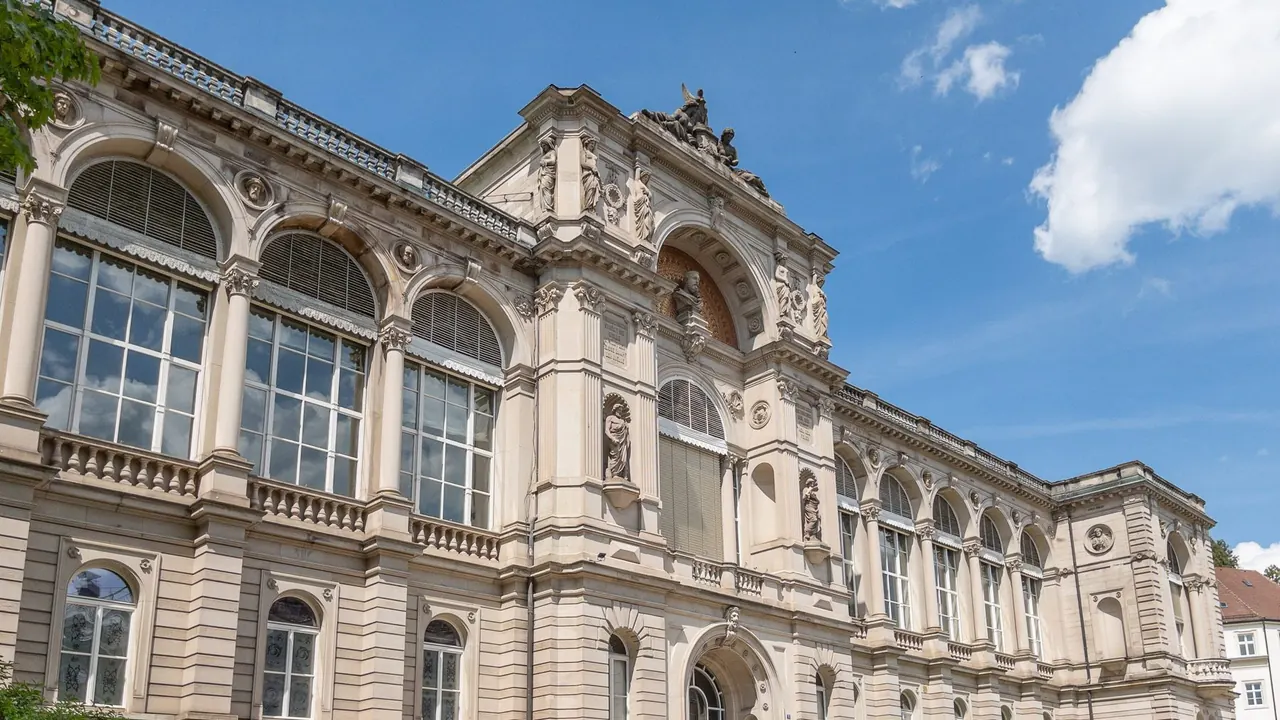
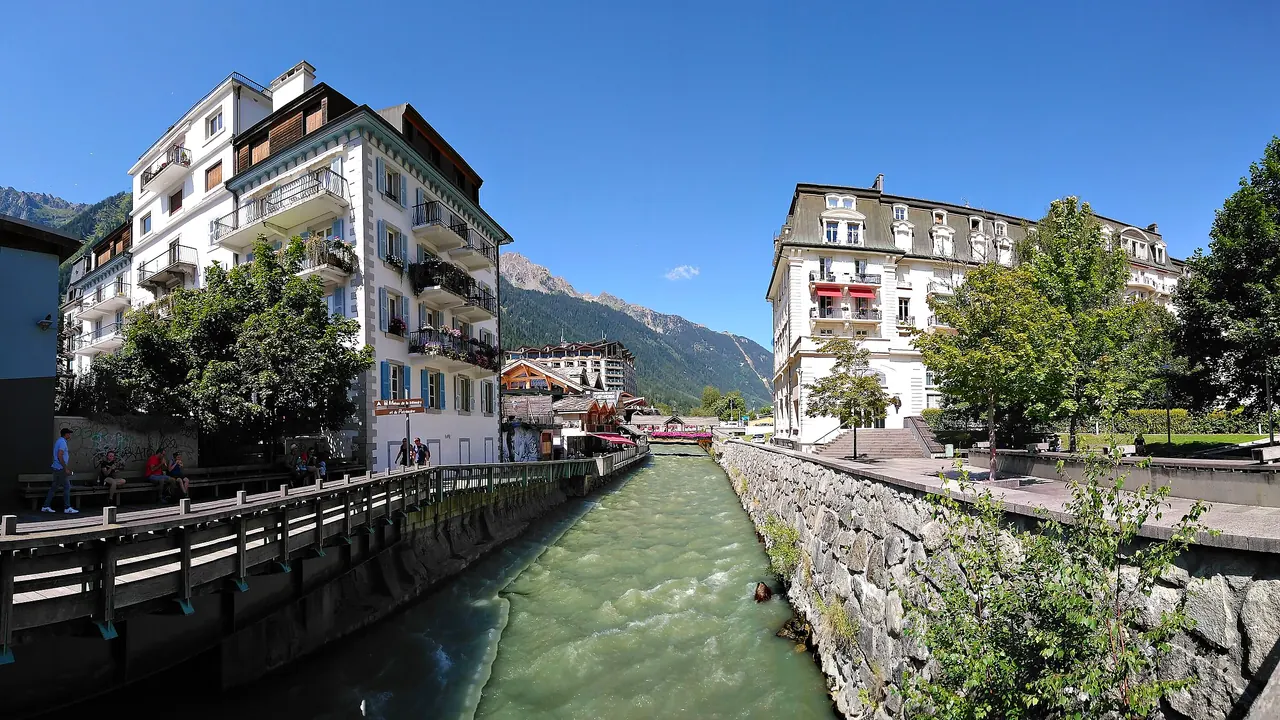
Photos: Baden-Baden by Kent Wang, CC BY-SA 2.0, cropped; Chamonix by Tiia Monto, CC BY-SA 3.0, cropped.
Baden-Baden or Chamonix?
Our verdict in twelve categories, each scored against the same fixed benchmark cities, and the climate month by month, so you can choose for your trip.
Choose Baden-Baden for
- live music and the arts
- wellness
- culture and sights
Baden-Baden is the choice for a slow, restorative trip with some polish to it. You spend your days between the Friedrichsbad and Caracalla, walk the Lichtentaler Allee, and go to a concert at the Festspielhaus in the evening. It also makes the better base for seeing the wider region, with Strasbourg, Heidelberg, Alsace and the Black Forest all within easy reach. Pick it if you want rest, music and well-kept nineteenth-century surroundings more than adrenaline.
Choose Chamonix for
- nature and the outdoors
- nightlife
- families
Chamonix is for people who come to use the mountains rather than look at them from a terrace. Cable cars lift you straight into glacier country, trails and ski runs start from the valley, and evenings end in a loud, sociable bar scene that Baden-Baden doesn't have. It suits active couples, groups of friends and outdoorsy families who will happily trade museums and calm for some of the best mountain terrain in Europe.
Scoreboard
Twelve categories on one fixed scale from 0 to 100. The shaded stretch is the gap between the two.
Your match
Pick a travel style or drag the sliders, and both match scores follow your weighting.
Wins on live music and the arts and wellness with your weighting.
Wins on nature and the outdoors and nightlife with your weighting.
What matters to you?
Category by category
What the scores mean for a trip.
Beaches & swimming
Neither town is a place for a swimming vacation, and both treat a swim as a hot-afternoon extra. Baden-Baden offers outdoor pools and the flooded gravel pits of the Rhine plain, which are flat and practical but nothing to travel for.
Chamonix has slightly more appealing water. Lac de Passy has a grassy, sandy shore with Mont Blanc behind it, and the clear water of Lake Annecy makes a fine summer day out. Both lakes are only really swimmable in July and August.
Food & drink
These two eat about equally well, but they eat very differently. Baden-Baden's strength is wine and a French-tinged regional cuisine, with Riesling and Pinot Noir from the Rebland villages, venison, Flammkuchen and the famous cherry gateau, plus top-flight restaurants a drive away in the northern Black Forest.
Chamonix is all melted cheese and mountain terraces: fondue, raclette and tartiflette, eaten at refuges facing the glaciers or put together as a picnic from the town's cheese shops. Expect resort sameness in town and a lot of closures between seasons.
Culture & sights
Baden-Baden has far more to see. The Kurhaus casino rooms, the Trinkhalle colonnade, the hillside villas and the Roman bath ruins make up a complete nineteenth-century spa town. Add the Frieder Burda and Kunsthalle galleries, the Fabergé museum, Brahms's summer house and the Russian church, and you have a full day or two of sightseeing.
Chamonix's heritage is narrower but has character: the birthplace of alpinism, host of the first Winter Olympics, and home to the Musée Alpin and the climbers' cemetery. It is worth a morning, after which you will be looking at the peaks again.
Nightlife
Chamonix is clearly livelier after dark. Après-ski starts in the late afternoon, then the crowd moves to a lane of bars in the old town where guides, seasonal workers and visitors stay out late, and a couple of small clubs run into the early hours. It is young, loud and mostly English-speaking, and much quieter in summer and between seasons.
Baden-Baden's evenings are dressed-up and early. The gilded casino is the signature night out, followed by a glass in a hotel or wine bar. Anyone wanting to dance has to travel to Karlsruhe or Strasbourg.
Nature & outdoors
Baden-Baden has pleasant upland right on its doorstep. The Merkur funicular, the Battert cliffs, the fir forests and the Black Forest High Road up to the Hornisgrinde moorland make for good walking and biking, and they are at their best in autumn.
Chamonix is in another category. The Mont Blanc massif rises almost 4km above the valley, and lifts carry you to 3,842m on the Aiguille du Midi. Glaciers, serious skiing, the Vallée Blanche, via ferrata and paragliding are all part of an ordinary day here. Baden-Baden's walks top out on wooded ridges and moorland. In Chamonix the trails are only getting started at that height, with the glaciers and granite needles still far above.
Day trips
Baden-Baden is the stronger base for excursions. Within about an hour you can be at Strasbourg's cathedral, among the Alsace wine villages, at Colmar, or at Heidelberg's castle and Freiburg's minster, and the UNESCO sites of Speyer and Maulbronn are close by too. The choice is wide and the roads are flat and quick.
Chamonix's outings have the novelty of crossing borders: Courmayeur and Roman Aosta through the tunnel, Martigny by mountain railway, and Annecy and Geneva just over an hour away. Beyond those, mountain roads slow you down and the remaining options are mostly other resorts.
Good for families
Chamonix suits active families better. It has nursery slopes and sledging in winter, and in summer there are lake walks, a luge, treetop courses, the Merlet animal park and the little red train to the Mer de Glace, all within the town's own valley. The catches are cost, altitude limits for toddlers and little to do on wet days.
Baden-Baden is safe and calm, but it is built for adults. The Friedrichsbad turns away young children, so families mostly use the town as a quiet base for Europa-Park and Karlsruhe's zoo.
Getting around
Chamonix is a little easier to get around without a car. Its flat centre has the main lift stations in town, and buses and the Mont Blanc Express run free along the valley with the guest card, though ski buses are crowded and evening services thin out.
Baden-Baden's centre is compact but hilly in places, and the station sits out in Oos, a bus ride away. Trains are good for Karlsruhe and Freiburg, but the High Road, the wine villages and Alsace really need a car.
Shopping & style
Baden-Baden has the more polished shopping streets. Sophienstraße and Lange Straße are lined with jewellers, watchmakers, fashion boutiques and delicatessens, made for a leisurely browse, though there are no department stores or markets.
Chamonix is narrower but expert in its field. Generations-old outdoor shops make it a place where climbers and skiers buy serious equipment, and alongside them are Savoyard cheese, génépi and crystals from the massif. For anything else, both towns send you to a bigger neighbour.
Affordability
Neither is cheap, but Baden-Baden is the easier of the two on the wallet. Guesthouses, wine taverns, bakeries and buses are sensibly priced by German standards, and the bill mainly climbs if you stay grand and bathe every day.
Chamonix adds costly extras to already high room rates: lift passes, the big cable cars, guides and paragliding flights. Free valley transport, self-catering, picnics and trails that start at the valley floor do help, as does avoiding the peak winter and summer weeks.
Live music & performing arts
Baden-Baden is far ahead for anyone who wants a night at the opera or a symphony concert. The Festspielhaus, one of Germany's largest houses, brings international orchestras and opera productions, and the town also has its own philharmonic in the Kurhaus and a small nineteenth-century theatre. Brahms and Clara Schumann both worked here.
Chamonix offers summer jazz, some of it played high in the mountains, plus church concerts and mountain film nights, but there is no regular season. For opera you would have to drive to Geneva.
Wellness & relaxation
This is Baden-Baden's defining strength. It has Roman-era hot springs, the domed Friedrichsbad with its silent sequence of rooms and pools, and the large Caracalla complex next door, all in a town that runs at a deliberately unhurried pace.
Chamonix's version of relaxation comes after a hard day. Its Italian-style day spa has hot outdoor pools facing the glaciers, and the thermal springs of Saint-Gervais are close by. But early starts, climbers and high-season crowds mean the town itself is rarely restful.
When should you go?
Pick your month. The climate figures are measured averages, not a forecast.
Baden-Baden in July
Chamonix in July
Daytime high, °C
Rainfall in the month, mm
Where the figures come from
Chamonix's temperatures are measured 35 km from the centre, at Bourg-St-Maurice.
Chamonix has no rain gauge within 25 km of the centre, so its rainfall comes from a gridded climate dataset read at the city rather than from a gauge further away.
Temperature and rainfall are climate normals, averaged over the years shown. Baden-Baden: 1991-2020 normals, Baden-Baden-Geroldsau (3.9 km from centre). Chamonix: 1999-2020 (rainfall 1991-2020) normals, Bourg-St-Maurice (34.9 km from centre).
The two towns warm up at almost the same pace. Both are cold and grey from December to February, and in high summer Baden-Baden peaks at about 25°C while Chamonix's valley reaches the upper twenties. Baden-Baden is at its best for walking and wine-village outings from May to September, its sunniest stretch, and it rarely gets too hot for the streets. Rain is steady all year at roughly 100mm a month, so a wet afternoon is possible in any season. October brings autumn colour to the forest, and the short, dark days of November to February suit the thermal baths better than sightseeing.
Chamonix has two clear seasons. Winter is for skiing, and summer, with valley highs near 27°C in July, is for hiking and climbing. July and August are also the driest months in the valley. The wet weather builds from late autumn, with December the wettest month at around 170mm, and spring and autumn sit in between. Up high it is always far colder than these valley figures suggest.
Which traveller are you?
On a relaxing and wellness trip, Baden-Baden is the obvious choice. Bathing in the hot springs is the whole point of the town, and the silent Friedrichsbad ritual and the slow, early-to-bed pace make for real rest. Chamonix's spa is a treat after skiing, not a retreat.
For an outdoors trip, Chamonix is in a different league. Cable cars to the Aiguille du Midi, the Mer de Glace, Lac Blanc, the Tour du Mont Blanc, ski touring and guided climbs make Baden-Baden's gentle Black Forest trails feel modest.
On a culture and arts trip, go to Baden-Baden. The town itself is an intact Belle Époque spa, and it adds the Frieder Burda and Kunsthalle galleries, a major opera and concert house, and Strasbourg and Heidelberg nearby. Chamonix's culture is mountaineering history, covered in half a day.
Before you go
| Measure | Baden-Baden | Chamonix |
|---|---|---|
| Official language | German | French |
| Currency | Euro (EUR) | Euro (EUR) |
| Sockets | CF230 V, 50 Hz | CE230 V, 50 Hz |
| Driving side | Right | Right |
| Time zone | UTC+1, UTC+2 in summer | UTC+1, UTC+2 in summer |
| Emergency number | 112 | 112 |
| Elevation | 181 m | 995 m |
| Main airport | Karlsruhe Baden-Baden Airport (FKB)12 km from centre43 non-stop destinations | Geneva International Airport (GVA)68 km from centre150 non-stop destinations |
| Public holidays this year | 12 days | 11 days |
By the numbers
| Measure | Baden-Baden | Chamonix |
|---|---|---|
| City population | 56,952 | 8,705 |
| People per km² | 406 | 75 |
| Museums within 10 km | 11 | 3 |
| UNESCO World Heritage sites within 50 km | 3 | 0 |
Where else could you go?
Every comparison below shares a destination with this one, so you can follow Baden-Baden or Chamonix somewhere new.
- Strasbourgvs Baden-Baden
- Annecyvs Chamonix
- Genevavs Chamonix
- Stuttgartvs Baden-Baden
- Lausannevs Chamonix
- Heidelbergvs Baden-Baden