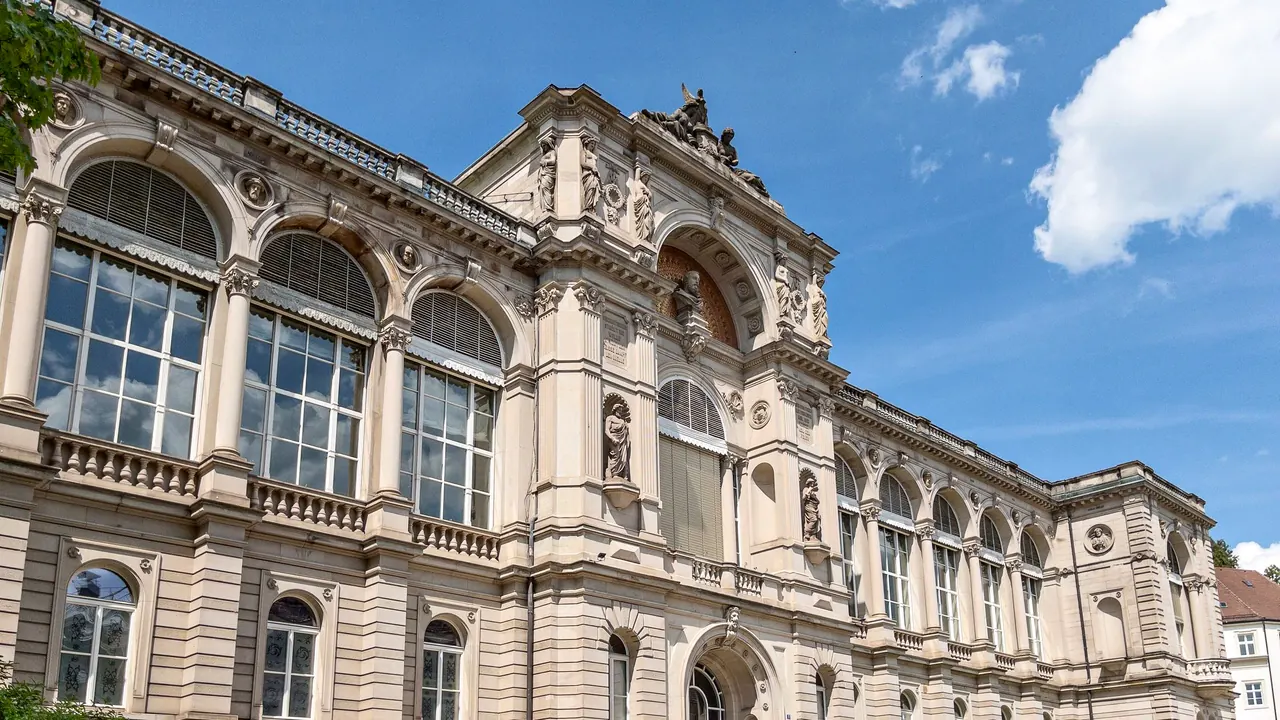
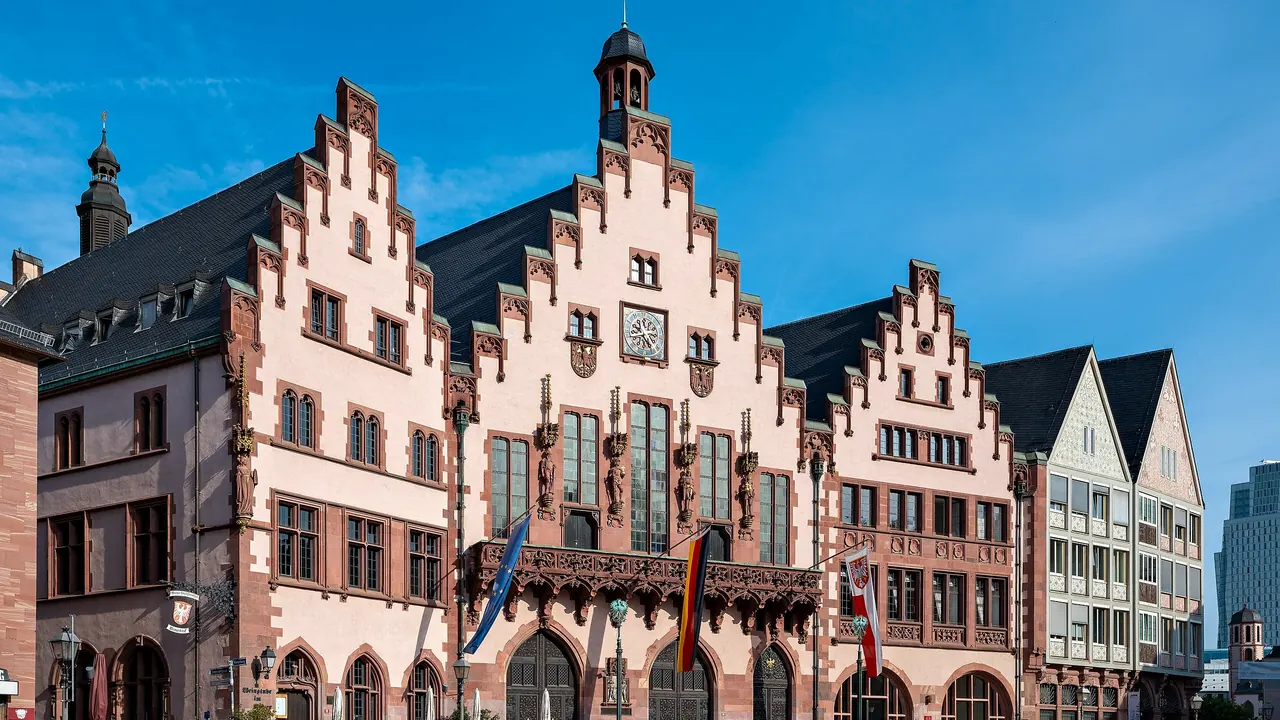
Photos: Baden-Baden by Kent Wang, CC BY-SA 2.0, cropped; Frankfurt by Thomas Wolf, CC BY-SA 3.0 DE, cropped.
Baden-Baden or Frankfurt?
Our verdict in twelve categories, each scored against the same fixed benchmark cities, and the climate month by month, so you can choose for your trip.
Choose Baden-Baden for
- wellness
- nature and the outdoors
Baden-Baden suits a slow, restorative trip. The Friedrichsbad and Caracalla baths are at the heart of a small Belle Époque resort, the Black Forest begins at the edge of town, and evenings end early over Rebland wine or a concert at the Festspielhaus. It works best for couples and older travellers who want to rest and walk, and who don't mind paying for comfort.
Choose Frankfurt for
- nightlife
- shopping
- getting around
Pick Frankfurt if you would rather keep busy. The Museumsufer and the Städel give it the deeper museum list, and the apple-wine taverns of Sachsenhausen and the bars of the Bahnhofsviertel give it a proper night out. Its rail hub puts Heidelberg, the Rhine Gorge and Cologne within easy reach. It is also the easier city with children or without a car.
Scoreboard
Twelve categories on one fixed scale from 0 to 100. The shaded stretch is the gap between the two.
Your match
Pick a travel style or drag the sliders, and both match scores follow your weighting.
Wins on wellness and nature and the outdoors with your weighting.
Wins on nightlife and shopping with your weighting.
What matters to you?
Category by category
What the scores mean for a trip.
Beaches & swimming
Neither is near a coast, so in both a swim means a lake or a pool. Baden-Baden's summer swimming is in the flooded gravel pits out on the Rhine plain. Frankfurt has the Langener Waldsee in the forest south of the city, with sandy shores and warm water in high summer. In Baden-Baden the water people come for is thermal, and mostly indoors.
Food & drink
Frankfurt has more to eat. Its apple-wine taverns in Sachsenhausen serve tart Apfelwein from stoneware jugs, with Handkäs mit Musik at long shared tables, and that is a meal you won't find elsewhere. The Kleinmarkthalle is the best stop for regional produce, and a large international population adds Turkish, Italian and Asian cooking plus cheap eating in the Bahnhofsviertel.
Baden-Baden draws on a richer regional kitchen, with Black Forest ham, venison, Flammkuchen and a French influence. Its real strength is the Riesling and Pinot Noir of the taverns in Varnhalt, Neuweier and Steinbach. But the town is small, the centre leans on hotel dining and cake, and the most celebrated restaurants are a drive away in the northern Black Forest.
Culture & sights
Frankfurt has the bigger museum offer. More than a dozen institutions line the Museumsufer, led by the old masters of the Städel, with the Schirn's exhibitions and the Senckenberg alongside. The old centre around the Römer and the red sandstone cathedral is mostly a reconstruction after 1944, set against a skyline of towers unlike anything else in Germany.
Baden-Baden works the other way round. The town itself is the sight: an intact nineteenth-century spa resort with the Kurhaus, the Trinkhalle and the Lichtentaler Allee. The Museum Frieder Burda and the Kunsthalle make a good pair for modern art. It fills a day or two of sightseeing, where Frankfurt fills two or three.
Nightlife
This is one of the widest gaps between the two. Baden-Baden's night out is the gilded casino in the Kurhaus, with its dress code, followed by a hotel bar or a wine bar. The crowd is older and the streets are quiet by late evening.
Frankfurt has real choice. There are techno and house clubs rooted in the city's electronic-music history, cocktail bars in the Bahnhofsviertel, rowdier cider pubs in Alt-Sachsenhausen and neighbourhood bars along Berger Straße. It only gets properly busy on Friday and Saturday, so plan a visit around a weekend.
Nature & outdoors
Baden-Baden has the forest on its doorstep. The Merkur funicular and the Battert cliffs lead straight onto trails into the northern Black Forest. The High Road climbs past the Mummelsee to the Hornisgrinde moorland, with waterfalls, mountain biking and a little skiing in winter.
Frankfurt's countryside takes more effort to reach and is softer once you get there. The Taunus and the Großer Feldberg are under an hour away by S-Bahn and bus. The Stadtwald, the Main cycle paths and the Rheingau vineyards are good for gentle walking and cycling rather than anything wilder.
Day trips
Both are well placed, but Frankfurt's high-speed rail gives it the edge. Heidelberg, the castle-lined Rhine Gorge and Cologne are each about an hour away. Mainz, Wiesbaden, Darmstadt and Würzburg are close too, and none of them needs a car.
Baden-Baden's outings have a French flavour. Strasbourg is about an hour away, with Colmar and the Alsace wine villages beyond, and Freiburg and Heidelberg are easy by train. For Alsace and the small Black Forest towns, though, a car helps a great deal.
Good for families
Frankfurt is the easier city with children. The Senckenberg's dinosaur hall, the central zoo, the Palmengarten glasshouses and the boat trips past the skyline fill several days, and trams and the S-Bahn take pushchairs without fuss.
Baden-Baden is safe and calm, and children enjoy the funicular and the forest trails. But the town is built around adult bathing, and the Friedrichsbad does not admit young children. Its biggest family draw is Europa-Park, about an hour south, so families tend to spend their days out of town.
Getting around
Both centres are compact enough to walk. Frankfurt adds an integrated network of U-Bahn, S-Bahn and trams that reaches the Taunus, Wiesbaden and Mainz, and an airport about a quarter of an hour from the centre by train, so you never need a car.
In Baden-Baden the baths, the Kurhaus and the museums are close together, though some streets climb steeply. The station is a bus ride away in Oos. Trains along the Rhine valley are easy, but the wine villages, the High Road and Alsace really call for a car.
Shopping & style
Browsing in Baden-Baden is polished but small in scale. Sophienstraße and Lange Straße hold jewellers, watchmakers, boutiques and delicatessens for a well-off spa crowd. The souvenirs are cuckoo clocks and local wine, and for anything more the town sends you to Strasbourg.
For range, Frankfurt is well ahead. There are department stores and malls on the Zeil, luxury houses around Goethestraße, independent shops on Berger Straße and Schweizer Straße, and a flea market on the Main bank.
Affordability
Neither is cheap, but Frankfurt gives you more room to keep costs down. Its hotels are priced for business travellers and become very expensive during trade fairs, but weekends and summer are often noticeably cheaper. Cider taverns, Turkish grills and the Museumsufer pass keep the days themselves modest.
Baden-Baden was built for the wealthy and still prices itself that way, and you pay for every visit to the baths. Simple guesthouses, bakeries and wine taverns help, but a stay built around the spas adds up quickly.
Live music & performing arts
Baden-Baden's stage is almost entirely classical, but for a town of its size it is remarkable. The vast Festspielhaus brings international orchestras and opera, the town's philharmonic plays in the Kurhaus, and there is an ornate nineteenth-century theatre, all tied to the memory of Brahms and Clara Schumann. It is a serious draw for a concert, but jazz, rock and drama are thin.
Frankfurt covers far more ground. Its opera company is highly regarded for adventurous productions, and the Alte Oper hosts orchestral concerts. The Schauspiel stages serious German-language drama and Mousonturm shows contemporary dance. There is also an English-language theatre, and the jazz cellars have a history going back to the post-war years.
Wellness & relaxation
Nothing in Frankfurt compares with this. Baden-Baden sits on hot springs the Romans used. The domed Friedrichsbad takes you through a silent, unclothed sequence of hot rooms and pools, and the modern Caracalla complex is next door. The whole town moves at the same slow pace, with grand hotel spas and long walks along the Lichtentaler Allee.
Frankfurt has no bathing tradition of its own and relies on the spa towns around it. Wiesbaden's Kaiser-Friedrich-Therme is a Roman-Irish bath of the same kind as the Friedrichsbad, and Bad Homburg has a large thermal complex. In the city itself, the Palmengarten is the calmest place to slow down.
When should you go?
Pick your month. The climate figures are measured averages, not a forecast.
Baden-Baden in July
Frankfurt in July
Daytime high, °C
Rainfall in the month, mm
Temperature and rainfall are climate normals, averaged over the years shown. Baden-Baden: 1991-2020 normals, Baden-Baden-Geroldsau (3.9 km from centre). Frankfurt: 1991-2020 normals, Frankfurt Westend (2 km from centre).
The two have almost the same temperatures through the year. Summer highs reach about 25°C in July and August, which is warm enough for a lake or an outdoor pool even though neither has a beach. In winter, daytime highs barely climb past 6°C. Sunshine peaks in midsummer in both and drops sharply from November to January. May, June and September are the most comfortable months for walking the streets, and for the forest trails around Baden-Baden.
Rain is where they differ. Baden-Baden gets over 100mm in most months and has no real dry season, so pack for showers whenever you go. In winter its warm thermal baths make the damp easier to bear. Frankfurt gets roughly half as much rain. February to April is its driest stretch, at around 40mm a month, and from May through the summer it turns wetter. Its cold months are best spent in the museums.
Which traveller are you?
On a relaxing and wellness trip, Baden-Baden is the clear choice. The Friedrichsbad and Caracalla are a short walk away rather than a train ride, and the quiet evenings, grand hotel spas and walks along the Lichtentaler Allee keep the whole stay unhurried.
For a food and nightlife trip, Frankfurt wins comfortably. An evening can start with Apfelwein and Grüne Soße at a Sachsenhausen tavern and end in a Bahnhofsviertel cocktail bar or a techno club. Baden-Baden winds down soon after the casino closes its doors.
On an outdoors trip, Baden-Baden puts you closer to the trails. The Merkur funicular, the Battert cliffs and the Black Forest High Road lead straight into fir forest and moorland. Frankfurt's Taunus walks are gentler and need a train and a bus to reach.
Before you go
| Measure | Baden-Baden | Frankfurt |
|---|---|---|
| Official language | German | German |
| Currency | Euro (EUR) | Euro (EUR) |
| Sockets | CF230 V, 50 Hz | CF230 V, 50 Hz |
| Driving side | Right | Right |
| Time zone | UTC+1, UTC+2 in summer | UTC+1, UTC+2 in summer |
| Emergency number | 112 | 112 |
| Elevation | 181 m | 101 m |
| Main airport | Karlsruhe Baden-Baden Airport (FKB)12 km from centre44 non-stop destinations | Frankfurt Main Airport (FRA)13 km from centre281 non-stop destinations |
| Public holidays this year | 12 days | 10 days |
By the numbers
| Measure | Baden-Baden | Frankfurt |
|---|---|---|
| Population | 56,952 | 760,656 |
| People per km² | 406 | 3,063 |
| Museums within 10 km | 11 | 53 |
| UNESCO World Heritage sites within 50 km | 3 | 4 |
Where else could you go?
Every comparison below shares a destination with this one, so you can follow Baden-Baden or Frankfurt somewhere new.
- Strasbourgvs Baden-Baden
- Stuttgartvs Baden-Baden
- Heidelbergvs Frankfurt
- Heidelbergvs Baden-Baden
- Freiburgvs Baden-Baden
- Colmarvs Baden-Baden