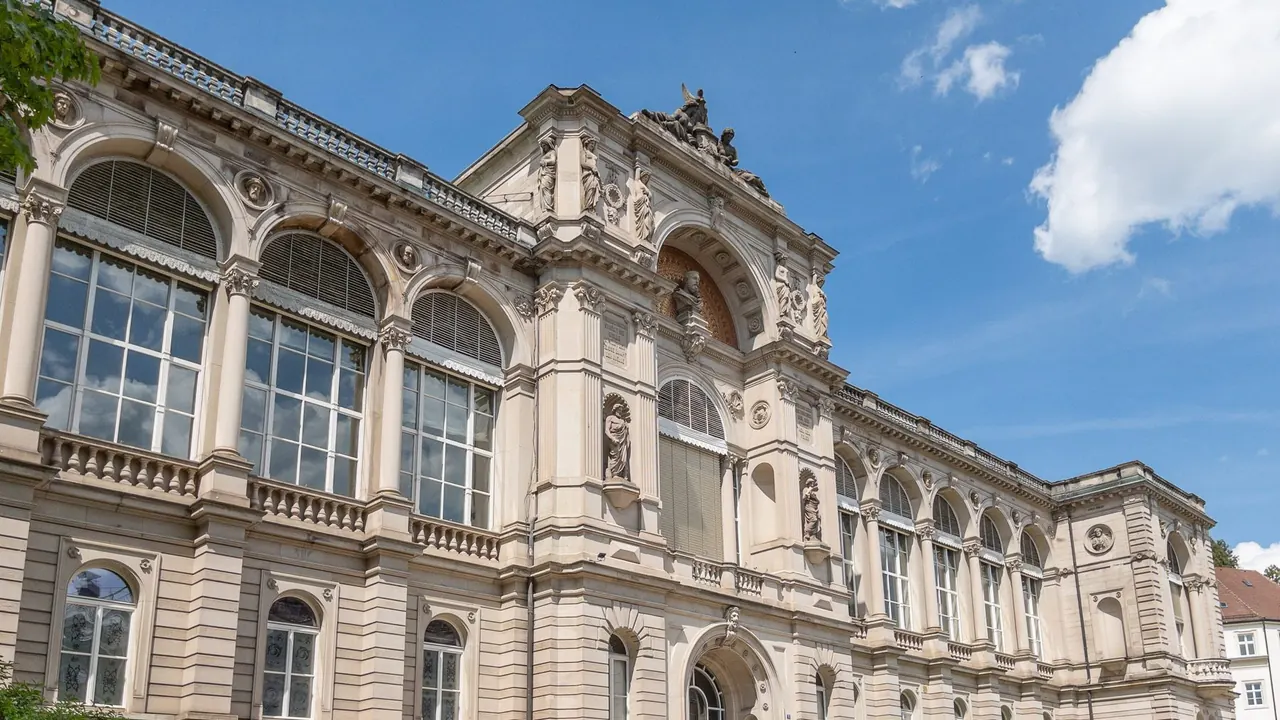
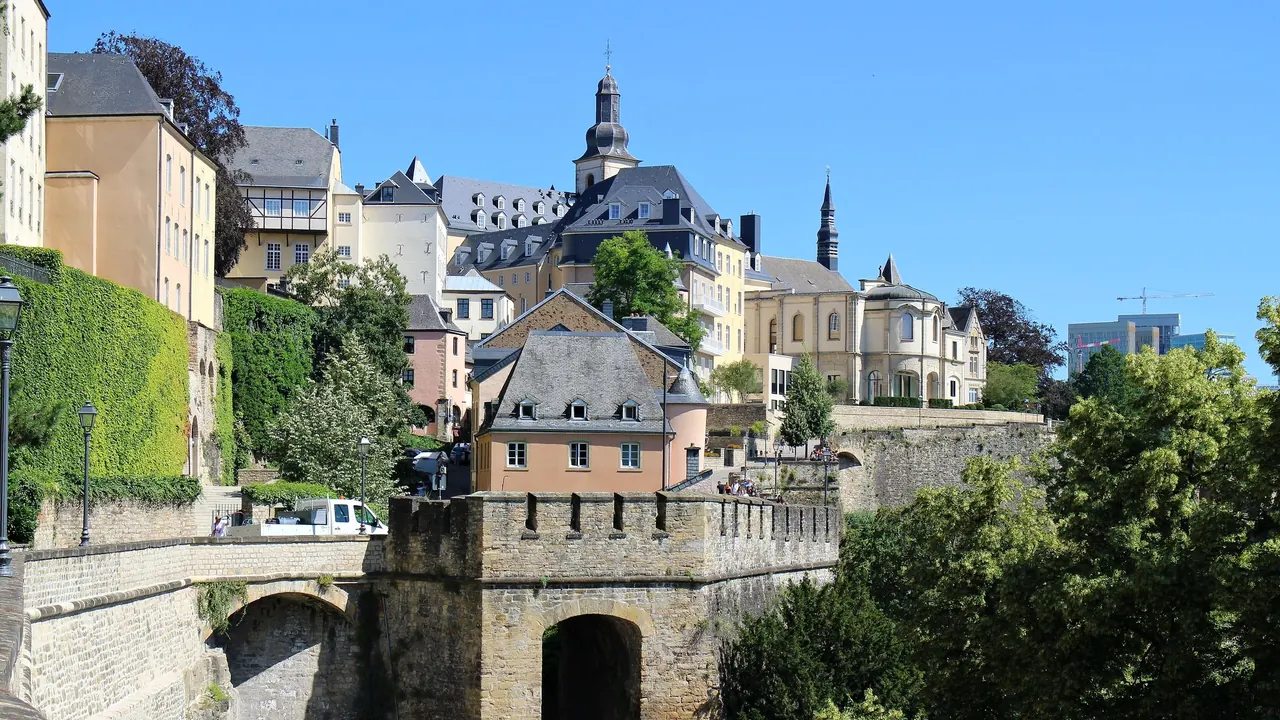
Photos: Baden-Baden by Kent Wang, CC BY-SA 2.0, cropped; Luxembourg by Suicasmo, CC BY-SA 4.0, cropped.
Baden-Baden or Luxembourg?
Our verdict in twelve categories, each scored against the same fixed benchmark cities, and the climate month by month, so you can choose for your trip.
Choose Baden-Baden for
- wellness
- prices
- nature and the outdoors
Baden-Baden is the choice for a slow, restorative stay built around the thermal baths, with the Black Forest on the doorstep for walks and drives and a Festspielhaus concert to dress up for. It suits couples and older travellers who are happy with quiet evenings, and once you are there it costs a little less than its neighbour.
Choose Luxembourg for
- getting around
- nightlife
- beaches
Anyone who wants a small capital rather than a resort will find Luxembourg the better short break. Its fortress old town stands on a rock above wooded gorges, Clausen and the Grund have a modest but livelier evening scene, and free trams, buses and trains make exploring without a car easy. It is the pricier of the two, so a long weekend usually suits it best.
Scoreboard
Twelve categories on one fixed scale from 0 to 100. The shaded stretch is the gap between the two.
Your match
Pick a travel style or drag the sliders, and both match scores follow your weighting.
Too close to call, 1 point apart
Wins on wellness and prices with your weighting.
Wins on getting around and nightlife with your weighting.
What matters to you?
Category by category
What the scores mean for a trip.
Beaches & swimming
Neither town is somewhere to swim outdoors, and in both, summer bathing mostly means flooded gravel pits. Around Baden-Baden that means outdoor pools and the pits of the Rhine plain to the west. They are fine for a hot afternoon, but the town's water culture is thermal, not open-air.
Luxembourg has a little more. Besides the Remerschen pits in the Moselle valley, the wooded reservoir of the Upper Sûre, about an hour north, has designated bathing spots, and the water there reaches around 20°C in July and August.
Food & drink
Both eat well, and both pour Riesling from vineyards just outside town. Baden-Baden cooks regional German food with a French accent: Flammkuchen, venison, Black Forest ham and cherry gateau. Evenings go to the wine taverns of Neuweier and Varnhalt, and the celebrated restaurants of the northern Black Forest are a drive away.
Luxembourg's food is more of a mix, French at the top end and Portuguese and Italian in the neighbourhood places. It has more fine dining within the city itself, and Moselle crémant is poured by the glass. Casual eating is thin in both, and in Luxembourg a lunch menu is the way round it.
Culture & sights
In both places the town is the main sight, but they come from different worlds. Baden-Baden is a preserved nineteenth-century resort, with the Kurhaus casino rooms, the Trinkhalle colonnade and the hillside villas. The Museum Frieder Burda and the Staatliche Kunsthalle cover art, and the Brahms house is there for music lovers.
Luxembourg's draw is older and more dramatic. The UNESCO-listed fortress sits on its sandstone plateau, you can walk through the Bock casemates, and the old town looks straight down onto the Grund. Add the national museum and MUDAM on Kirchberg, and Luxembourg has the slightly stronger set, though either is well covered in two days.
Nightlife
Baden-Baden's evenings revolve around the Kurhaus casino and its dress code, followed by hotel and wine bars. The crowd is older and the streets are quiet by late evening.
Luxembourg has more going on, though not a great deal. The Rives de Clausen packs in bars and a couple of clubs, the Grund has riverside pubs and Hollerich has the later venues. A young international crowd makes Thursday and Friday the nights to go out. Neither suits serious clubbing.
Nature & outdoors
From Baden-Baden you step straight into the northern Black Forest. The Merkur funicular and the Battert cliffs lead into fir forest, and the High Road climbs past the Mummelsee to moorland above 1,100m. There is mountain biking in summer and a little skiing in winter.
Luxembourg is greener within the city itself, with wooded gorges cutting through the centre, and the mossy rock passages of the Müllerthal make a fine day's walk. Its Ardennes hills and Moselle cycle paths are gentler country, though, with less height and no skiing.
Day trips
Baden-Baden's outings run in three directions. West over the Rhine are Strasbourg and the Alsace wine route to Riquewihr and Colmar, while Heidelberg's castle to the north and Freiburg's minster to the south are each about an hour by train. Speyer's cathedral and the monastery at Maulbronn are around an hour by car, and Alsace and the Black Forest towns are far easier with one.
Luxembourg's best trips also cross borders, to Roman Trier and Gothic Metz, each under an hour by train. Within the country, Vianden's castle, Echternach and the Moselle wine villages are reached by free bus or by train and bus. The two are evenly matched: Baden-Baden's list has the bigger names, and Luxembourg's is easier without a car.
Good for families
Both are safe and calm, and both suit a short family stay better than a long one. Baden-Baden's best family day is outside town, at Europa-Park about an hour south, and the Friedrichsbad does not admit young children.
Luxembourg keeps the fun in the city. The casemate tunnels and ramparts feel like an adventure, the natural history museum is aimed at younger visitors, and lifts carry buggies down to the river. It has no theme park, so Baden-Baden has the one big day out, while Luxembourg's are smaller and closer to hand.
Getting around
On foot, Baden-Baden works well. The baths, the Kurhaus, the museums and the Lichtentaler Allee are all a short walk from each other, though some streets climb steeply. Arriving is the awkward part, because the station is in Oos, a few kilometres out, and the last stretch is a bus ride.
Luxembourg makes getting about easier, because trams, buses and trains are free across the whole country. A tram runs from the station through the centre to Kirchberg. The city is built on several levels, and public lifts down to the Grund and Pfaffenthal and a funicular up to Kirchberg save the climbs. Cross-border commuters fill the roads at rush hour, so a car is more trouble than help.
Shopping & style
Baden-Baden's shops are aimed at its spa guests, while Luxembourg's serve a wealthy resident population, and that sets the tone in each. Sophienstraße and Lange Straße in Baden-Baden lean towards jewellers, watchmakers and delicatessens, good for a slow browse, and the souvenirs are cuckoo clocks and local wine.
Luxembourg has a little more range, with luxury brands on the Grand-Rue, chains on Avenue de la Gare, malls on the city's edge and a twice-weekly market on Place Guillaume II. The thing to buy there is Villeroy & Boch porcelain, and crémant is the bottle to take home.
Affordability
Neither is cheap, but Baden-Baden is easier on the wallet. Its grand hotels and paid bath visits add up quickly, yet simple guesthouses, bakeries and wine taverns are fairly priced by German standards.
Luxembourg is dearer across the board, with hotels aimed at business travellers and eating out above the Western European norm. Free transport, free museums and lunch menus help, and weekends can bring lower room rates, but many visitors still sleep in Trier or Metz.
Live music & performing arts
Classical music leads in both, and Baden-Baden has the deeper roots. Its Festspielhaus, built into the old railway station, is one of Germany's largest opera and concert houses, the town's philharmonic plays in the Kurhaus, and Brahms and Clara Schumann both worked here.
Luxembourg's Philharmonie on Kirchberg has excellent acoustics and draws touring orchestras, and the Grand Théâtre and the Rotondes add dance, drama and family shows. Rock and pop tours also stop in Luxembourg, which Baden-Baden largely misses out on.
Wellness & relaxation
This is where the two differ most. In Baden-Baden the baths are the point of the trip: the domed Friedrichsbad with its silent sequence of hot rooms and scrubs, Caracalla's pools and saunas, and a whole town paced around them.
Luxembourg is restful in its own way, with quiet evenings and peaceful walks in the Pétrusse valley. Its thermal water is at Mondorf-les-Bains, though, half an hour out, so bathing there is a pleasant day trip rather than the shape of the stay.
When should you go?
Pick your month. The climate figures are measured averages, not a forecast.
Baden-Baden in July
Luxembourg in July
Daytime high, °C
Rainfall in the month, mm
Temperature and rainfall are climate normals, averaged over the years shown. Baden-Baden: 1991-2020 normals, Baden-Baden-Geroldsau (3.9 km from centre). Luxembourg: 1991-2020 normals, Luxembourg / Luxembourg (6.3 km from centre).
Both have a mild central European climate, with warm summers and grey winters, and their good months line up closely. From June to early September daytime highs sit in the low to mid twenties, peaking around 25°C in Baden-Baden and 24°C in Luxembourg. That is ideal for Black Forest trails or the fortress ramparts. Only July and August are warm enough for a swim, and that means lakes and gravel pits. Sunshine follows the same curve in both: long and bright from May to August, scarce from November to January.
The real difference is rain. Baden-Baden sits against the hills and gets roughly 100mm to 120mm in most months, summer included, while Luxembourg usually sees nearer 70mm and stays the drier of the two all year. Winters are cold in both, a degree or two colder in Luxembourg, and that weather suits Baden-Baden's indoor baths better than street sightseeing. Late spring and September give the best balance in either place, and autumn brings turning forests and the grape harvest to both.
Which traveller are you?
For a relaxing and wellness trip, Baden-Baden is the clear choice. The silent ritual of the Friedrichsbad, Caracalla's pools and saunas and long walks along the Lichtentaler Allee shape the whole stay. In Luxembourg, the nearest thermal water means a day trip to Mondorf-les-Bains.
For a short city break, Luxembourg fits better. Free public transport, lifts down to the Grund and a compact fortress old town make two days easy, and Thursday and Friday nights in Clausen offer more after dark than Baden-Baden's casino and hotel bars.
On an outdoors trip, Baden-Baden has the edge. The Merkur funicular and the Battert cliffs lead straight into fir forest, and the Black Forest High Road climbs to the Hornisgrinde moorland. Luxembourg's Müllerthal gorges are lovely, but the country is lower and gentler.
Before you go
| Measure | Baden-Baden | Luxembourg |
|---|---|---|
| Official language | German | French, German, Luxembourgish |
| Currency | Euro (EUR) | Euro (EUR) |
| Sockets | CF230 V, 50 Hz | CF230 V, 50 Hz |
| Driving side | Right | Right |
| Time zone | UTC+1, UTC+2 in summer | UTC+1, UTC+2 in summer |
| Emergency number | 112 | 112 |
| Elevation | 181 m | 300 m |
| Main airport | Karlsruhe Baden-Baden Airport (FKB)12 km from centre43 non-stop destinations | Luxembourg-Findel International Airport (LUX)6 km from centre115 non-stop destinations |
| Public holidays this year | 12 days | 12 days |
By the numbers
| Measure | Baden-Baden | Luxembourg |
|---|---|---|
| City population | 56,952 | 137,678 |
| People per km² | 406 | 2,663 |
| Museums within 10 km | 11 | 19 |
| UNESCO World Heritage sites within 50 km | 3 | 4 |
Where else could you go?
Every comparison below shares a destination with this one, so you can follow Baden-Baden or Luxembourg somewhere new.
- Strasbourgvs Baden-Baden
- Stuttgartvs Baden-Baden
- Heidelbergvs Baden-Baden
- Freiburgvs Baden-Baden
- Colmarvs Baden-Baden
- Maastrichtvs Luxembourg