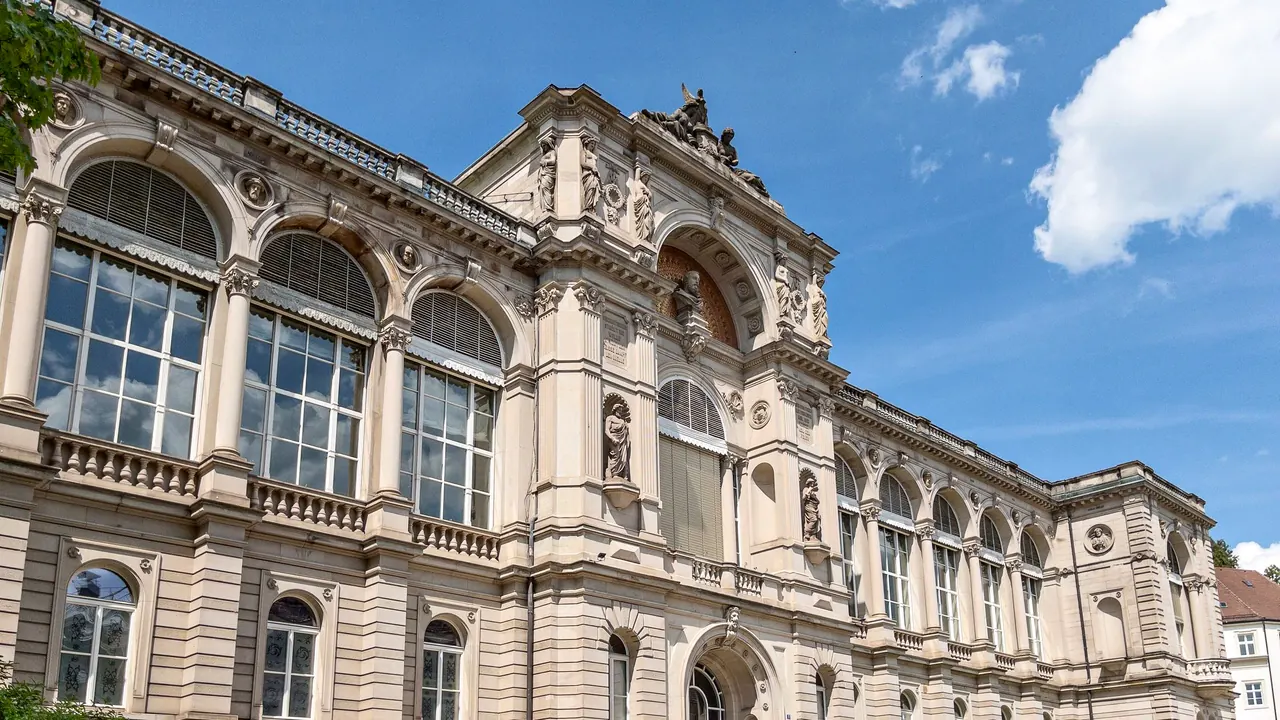
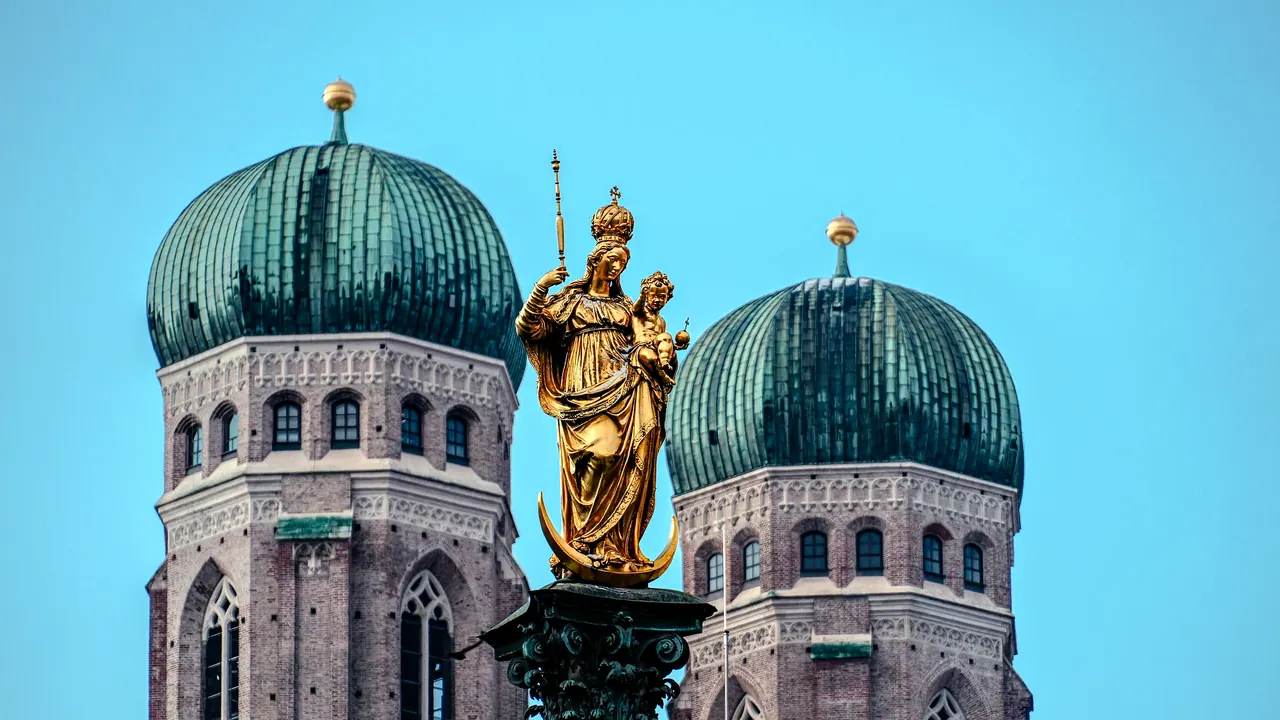
Photos: Baden-Baden by Kent Wang, CC BY-SA 2.0, cropped; Munich by 0xd1ma, Pexels License.
Baden-Baden or Munich?
Our verdict in twelve categories, each scored against the same fixed benchmark cities, and the climate month by month, so you can choose for your trip.
Choose Baden-Baden for
- wellness
Baden-Baden is for travellers whose idea of a good trip is proper rest: the silent sequence of hot rooms in the Friedrichsbad, an afternoon in the Caracalla pools, a stroll along the Lichtentaler Allee and an early night. It also suits a slow touring vacation by car, with Strasbourg, Alsace and the northern Black Forest close at hand, and an evening concert at the Festspielhaus to round things off.
Choose Munich for
- nightlife
- shopping
- families
Pick Munich for almost any other kind of trip. It has the bigger museums, a world-class opera house, beer gardens and a real night out, public transport that takes you everywhere, and plenty for children. The Alps and the royal castles are within reach by train. A small spa town gives you a day or two of sightseeing, while Munich keeps a busy traveller occupied for much longer.
Scoreboard
Twelve categories on one fixed scale from 0 to 100. The shaded stretch is the gap between the two.
Your match
Pick a travel style or drag the sliders, and both match scores follow your weighting.
Wins on wellness with your weighting.
Wins on nightlife and shopping with your weighting.
What matters to you?
Category by category
What the scores mean for a trip.
Beaches & swimming
Neither city is a beach destination, but Munich at least gives a summer swimmer somewhere to go. People sunbathe on the Isar's gravel banks at the Flaucher, and the clear alpine lakes of Starnberg and the Ammersee, under an hour by S-Bahn, make easy lake days in high summer.
Baden-Baden's outdoor swimming comes down to gravel pits on the Rhine plain and open-air pools. Its water is the thermal kind, taken indoors.
Food & drink
Both sit in good eating regions, but Munich gives you more to work through. Its beer halls and gardens, the Viktualienmarkt and hearty dishes such as Schweinshaxe and white sausage come with a respectable tier of starred restaurants and decent Italian and Turkish cooking.
Baden-Baden's strength is wine rather than range: Riesling and Pinot Noir from the Rebland villages, Flammkuchen with a French accent, and cherry gateau. The town centre leans on hotel dining and cafés, so the most celebrated tables are a drive away in the Black Forest.
Culture & sights
Baden-Baden is worth seeing as a whole town, a Belle Époque spa resort that has kept its original shape. There is the Kurhaus with its casino rooms, the colonnaded Trinkhalle, the Lichtentaler Allee and the villas on the slopes, with Roman bath ruins under the old town. For art there is good modern work at the Museum Frieder Burda and the Kunsthalle, and music lovers can visit the house where Brahms spent his summers.
Munich has far more to see, because the Wittelsbach rulers built up great collections over centuries. You can see old masters in the Alte Pinakothek, the Blue Rider painters in the Lenbachhaus, the state rooms of the Residenz and Nymphenburg, and the Deutsches Museum, and each of these could take a morning or more. Much of Munich's old town was rebuilt after wartime bombing, so for streets that survived from the period, Baden-Baden is the more intact of the two.
Nightlife
Munich offers a real choice of nights out. There are beer halls, cocktail and gay bars around Gärtnerplatz, student pubs in Schwabing and a handful of techno clubs that stay open until morning at weekends, plus the Oktoberfest each autumn.
A night out in Baden-Baden means the casino in the gilded Kurhaus rooms, a hotel bar or a wine bar, and the streets are calm by late evening. Anyone who wants to dance has to go to Karlsruhe or Strasbourg.
Nature & outdoors
Both have real hill country nearby, but Munich reaches higher. Trains run to the Wetterstein, the Zugspitze and Tegernsee for alpine hiking and proper skiing, the Five Lakes suit cycling and sailing, and in town there are the English Garden and the paths along the Isar.
Baden-Baden's forest starts at the edge of town, with the Merkur funicular, the Battert cliffs and the Panoramaweg, and the High Road climbs on to the Mummelsee and the Hornisgrinde. This is wooded upland at its best in autumn, gentler than the Alps, with only modest skiing.
Day trips
Both make excellent bases. Munich is slightly the better one, and almost everything is reachable by train: Augsburg, Nuremberg, Regensburg, Salzburg and Innsbruck, plus Neuschwanstein and Herrenchiemsee among the royal castles.
Baden-Baden's list crosses into France, with Strasbourg about an hour away and the Alsace wine route beyond it, as well as Heidelberg, Freiburg, Speyer and Maulbronn. Many of its best outings are easier with a car.
Good for families
Munich is the more natural choice with children. Hellabrunn zoo, the transport museum, Sea Life in the Olympic Park and the English Garden's lawns are all in the city, and Legoland is within driving distance.
Baden-Baden is safe and easy to walk, and the funicular and forest trails go down well with children, but the town is aimed at adults. Families staying there usually spend their days at Europa-Park, about an hour south.
Getting around
Munich runs on one integrated network of U-Bahn, S-Bahn, trams and buses that reaches the museums, Nymphenburg, the airport and the lakes, and its flat streets suit cycling. A car is more of a burden than a help.
Baden-Baden's centre is small enough to walk, though some streets are steep, and buses link it to the railway station out in Oos. Trains serve the bigger cities well, but a car makes the wine villages, the High Road and Alsace much easier to reach.
Shopping & style
Munich is a full shopping city. It has luxury houses on Maximilianstrasse, department stores along Neuhauser Strasse and Kaufingerstrasse, independent boutiques in Glockenbach and Schwabing, and specialist tailors for dirndls and lederhosen.
Baden-Baden's Sophienstraße and Lange Straße are polished but short, with jewellers, watchmakers and delicatessens aimed at a spa clientele, and not much more than cuckoo clocks and wine beyond them. Shopping there is something to do while browsing, not a reason to go.
Affordability
Neither is cheap, and the costs fall in different places. In Baden-Baden the grand hotels set the tone and every visit to the baths is paid for, though guesthouses, wine taverns and bakeries are reasonable.
In Munich the hotel rooms are what hurt, especially during the Oktoberfest and the trade fairs. Picnics in the beer gardens, free parks and lakes, and token entry fees at some museums on Sundays help bring the bill down.
Live music & performing arts
Baden-Baden's classical music centres on one large festival house, while Munich has a world-class opera company, three major orchestras and a run of theatres. The Festspielhaus, built into Baden-Baden's old railway station, brings in leading orchestras, soloists and opera productions. The town's philharmonic plays in the Kurhaus and the small nineteenth-century theatre stages drama and opera, but there is very little jazz or rock.
In Munich the Bavarian State Opera plays most of the year at the National Theatre, and concerts fill the Herkulessaal and the Prinzregententheater. The rococo Cuvilliés Theatre stages chamber opera, and German-language drama runs at the Residenztheater and Kammerspiele. Jazz clubs and touring rock and pop acts at the Olympic Park offer plenty beyond classical music.
Wellness & relaxation
This is Baden-Baden's strongest ground. The town grew up around its Roman hot springs, and a stay revolves around the domed Friedrichsbad and the Caracalla pools, with grand hotel spas and a pace set entirely for rest.
Munich has its own bathing culture, from the Art Nouveau Müller'sches Volksbad to the huge thermal complex at Erding. There, though, a spa visit is one part of a busy city trip rather than the whole point of it.
When should you go?
Pick your month. The climate figures are measured averages, not a forecast.
Baden-Baden in July
Munich in July
Daytime high, °C
Rainfall in the month, mm
Temperature and rainfall are climate normals, averaged over the years shown. Baden-Baden: 1991-2020 normals, Baden-Baden-Geroldsau (3.9 km from centre). Munich: 1991-2020 normals, München (1.9 km from centre).
The two have almost the same temperatures through the year. Both are cold and grey from November to February, warm up through April and May, and reach about 25°C in July and August, which is pleasant for walking rather than too hot. Baden-Baden is a little milder in late autumn. Late spring and September are comfortable for sightseeing in both, and in Munich June to August are the months warm enough for a swim in the lakes.
Rain is where they differ. Baden-Baden is wet all year, with around 100mm or more in nearly every month, so there is no dry season to aim for. Munich's winters are much drier, at about 50mm a month, but its summers are just as wet, at around 120mm a month from June to August. Munich also gets a little more winter sunshine, while Baden-Baden's December is especially dull.
Which traveller are you?
For a relaxing and wellness trip, Baden-Baden is the clear choice. The whole town exists for its hot springs, from the silent Friedrichsbad ritual to the Caracalla pools, and the rest of the day follows the same slow pace of park walks, cake and early nights.
On a food and nightlife trip, Munich wins comfortably. Beer halls and gardens under the chestnut trees and the Viktualienmarkt come first. Later the evening can move on to cocktail bars around Gärtnerplatz or to weekend techno clubs, which is far more than Baden-Baden's casino and wine bars offer.
On a family trip with children, Munich is easier. There is the big zoo on the Isar, the hands-on Deutsches Museum, beer gardens with playgrounds and lake beaches you can reach by S-Bahn. In Baden-Baden the Friedrichsbad turns young children away.
Before you go
| Measure | Baden-Baden | Munich |
|---|---|---|
| Official language | German | German |
| Currency | Euro (EUR) | Euro (EUR) |
| Sockets | CF230 V, 50 Hz | CF230 V, 50 Hz |
| Driving side | Right | Right |
| Time zone | UTC+1, UTC+2 in summer | UTC+1, UTC+2 in summer |
| Emergency number | 112 | 112 |
| Elevation | 181 m | 519 m |
| Main airport | Karlsruhe Baden-Baden Airport (FKB)12 km from centre44 non-stop destinations | Munich Airport (MUC)29 km from centre211 non-stop destinations |
| Public holidays this year | 12 days | 12 days |
By the numbers
| Measure | Baden-Baden | Munich |
|---|---|---|
| Population | 56,952 | 1,505,036 |
| People per km² | 406 | 4,844 |
| Museums within 10 km | 11 | 75 |
| UNESCO World Heritage sites within 50 km | 3 | 1 |
Where else could you go?
Every comparison below shares a destination with this one, so you can follow Baden-Baden or Munich somewhere new.
- Strasbourgvs Baden-Baden
- Stuttgartvs Baden-Baden
- Heidelbergvs Baden-Baden
- Freiburgvs Baden-Baden
- Innsbruckvs Munich
- Colmarvs Baden-Baden